

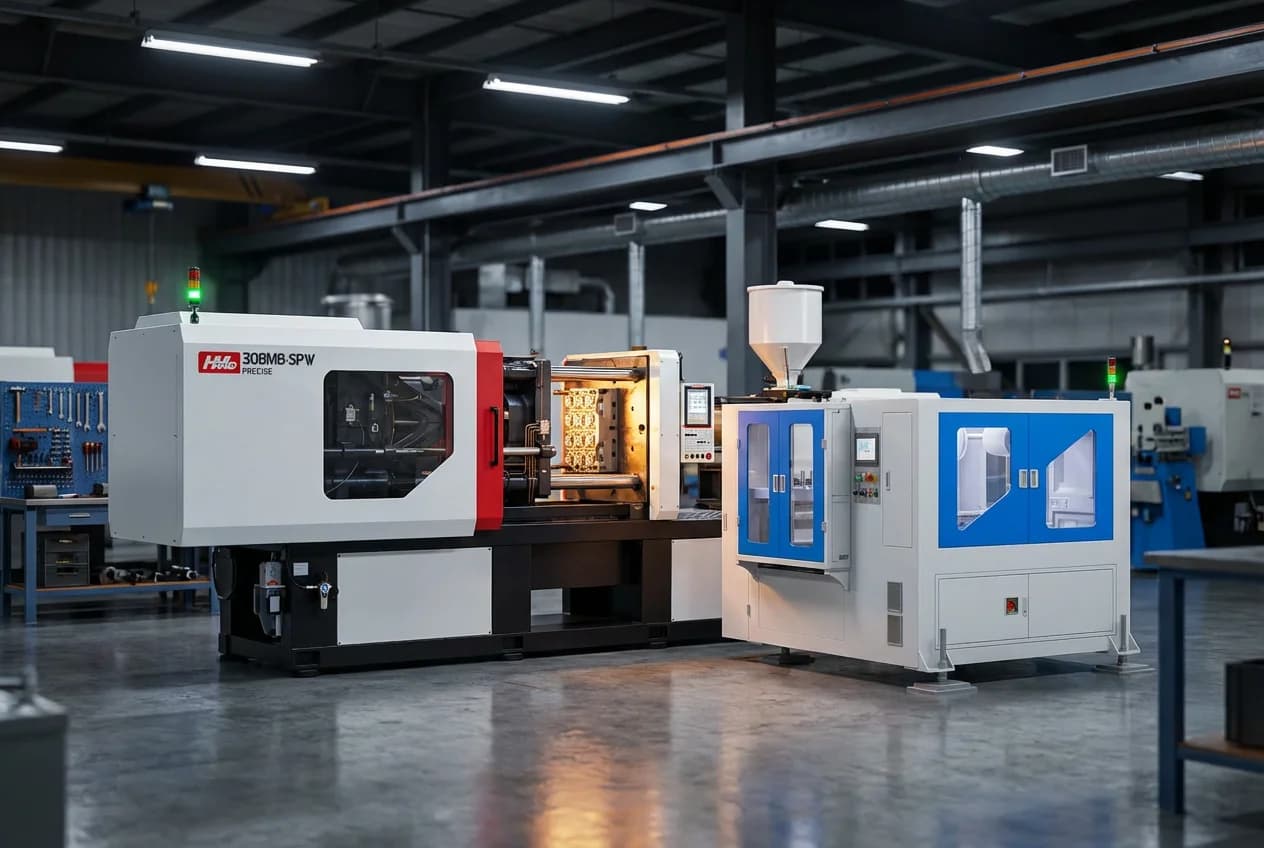
Medium Container Market Requirements
Medium containers span a diverse range of products with varying technical requirements. A 500 ml rectangular takeout container measures 120 x 170 x 40 mm with wall thickness of 0.40-0.55 mm and part weight of 15-20 grams. A 750 ml round deli container measures 130 mm diameter by 65 mm height at 0.45-0.60 mm wall and 18-25 grams. A 1,000 ml rectangular meal prep container reaches 150 x 200 x 55 mm at 0.50-0.65 mm wall and 25-35 grams. These containers require PP homopolymer or impact copolymer with MFI of 35-55 g/10min for the balance of stiffness, impact resistance, and microwave compatibility. The rectangular geometries common in this segment demand larger platen areas per cavity than round cups of similar volume. IML decoration is common for branded food packaging, adding label placement requirements during the mold-open phase. Typical cavity counts are 2-4 for 500-750 ml and 1-2 for 1,000 ml, with the total projected area and shot weight determining machine selection. Container lids are produced separately, often on smaller SPV5 machines.
Key Specs
- •A 500 ml rectangular takeout container measures 120 x 170 x 40 mm with wall thickness of 0.40-0.55 mm and part weight of 15-20 grams.
- •A 750 ml round deli container measures 130 mm diameter by 65 mm height at 0.45-0.60 mm wall and 18-25 grams.
- •A 1,000 ml rectangular meal prep container reaches 150 x 200 x 55 mm at 0.50-0.65 mm wall and 25-35 grams.
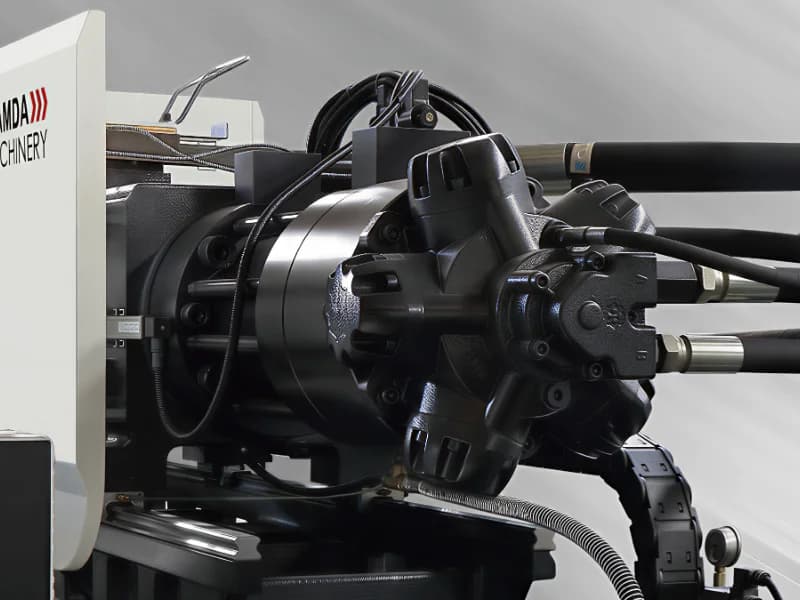
High-speed injection unit with linear guides
HMD 380M8-SPV: Strengths for Medium Containers
The HMD 380M8-SPV (HMD 368M8-SPV platform) at 3,680 kN serves medium container production with specific advantages. The injection pressure of 182 MPa is the highest available with the 55 mm screw configuration, providing superior capability for filling thin-wall sections of 0.40-0.45 mm in the container base and sidewall transition zones where flow resistance peaks. Platen size of 1,030 x 1,000 mm accommodates 2-cavity molds for 500-750 ml containers and single-cavity 1,000 ml containers. Tie bar distance of 670 x 640 mm fits the mold footprint for these configurations. The 400 mm/s injection speed fills medium container walls adequately, with fill times of 0.3-0.5 seconds for typical flow paths of 80-120 mm. The compact machine dimensions of 7.3 x 2.0 x 2.4 m make it suitable for facilities with limited floor space. Injection capacity of 432-465g handles shot weights of 20-40g for single cavity and 40-80g for 2-cavity with comfortable margin. The 45+45 kW dual pump system supports charging-on-fly for cycle times of 6-10 seconds. The 380 excels as a dedicated medium container machine running 1-2 cavity molds with focus on thin-wall precision.
HMD 450M8-SPV: Advantages for Higher Throughput
The HMD 450M8-SPV (HMD 428M8-SPV platform) at 4,280 kN delivers higher throughput through faster injection speed and larger mold accommodation. The 517 mm/s injection speed is 29% faster than the 380, reducing fill time from 0.4 seconds to 0.3 seconds for typical medium container geometries. This speed advantage directly shortens cycle time by 0.1-0.3 seconds for thin-wall sections. Platen size of 1,120 x 1,060 mm fits 4-cavity molds for 500 ml containers and 2-cavity molds for 750-1,000 ml containers with room for IML robot access. Tie bar distance of 720 x 660 mm provides 50 mm more width and 20 mm more height than the 380, critical for rectangular container molds where the long dimension of the container determines minimum tie bar spacing. Maximum daylight of 1,350 mm versus 1,310 mm on the 380 provides marginally more robot clearance. The 4,280 kN clamping force provides 16% more force than the 380 at 3,680 kN, enabling 4-cavity 500 ml container production where total projected area reaches approximately 800 cm2 at specific clamping of 5.3 tonnes per cm2. The 55+55 kW pump system delivers more hydraulic power for faster clamp movements with heavy molds.
Key Specs
- •The HMD 450M8-SPV (HMD 428M8-SPV platform) at 4,280 kN delivers higher throughput through faster injection speed and larger mold accommodation.
- •The 517 mm/s injection speed is 29% faster than the 380, reducing fill time from 0.4 seconds to 0.3 seconds for typical medium container geometries.
- •Platen size of 1,120 x 1,060 mm fits 4-cavity molds for 500 ml containers and 2-cavity molds for 750-1,000 ml containers with room for IML robot access.
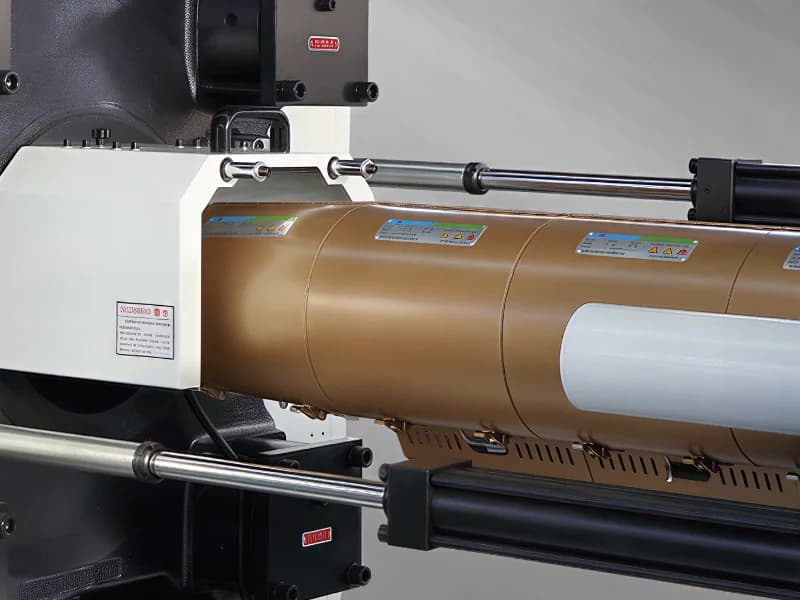
Servo-hydraulic drive system with energy recovery
Need Expert Advice?
Talk to our engineers about your specific production requirements. Free consultation.
Head-to-Head: 500 ml Container Production
For the most common medium container at 500 ml, here is a direct comparison. The HMD 380M8-SPV runs a 2-cavity 500 ml container mold at cycle time of 6.5-7.5 seconds. With 2 parts per cycle at 6.5 seconds, output is 1,108 containers per hour. Monthly output at 85% OEE is 675,000 containers. The mold uses the full 670 x 640 mm tie bar window, leaving minimal clearance for a 2-cavity layout of rectangular containers at 170 mm length. IML robot access is adequate but tight with 1,310 mm daylight. The HMD 450M8-SPV runs a 4-cavity 500 ml container mold at cycle time of 6.0-7.0 seconds. With 4 parts per cycle at 6.0 seconds, output is 2,400 containers per hour. Monthly output at 85% OEE is 1.46 million containers. The wider 720 x 660 mm tie bar distance comfortably fits the 4-cavity layout with proper spacing. The 1,350 mm daylight provides comfortable IML robot access. The 450 delivers 116% more output per hour in this configuration. Even comparing equal 2-cavity molds, the 450 achieves approximately 0.3-0.5 second shorter cycle time due to faster injection speed and clamp movements, producing 10-15% more output than the 380 with the same mold.
IML Considerations for Medium Containers
IML decoration is a key differentiator for branded medium containers, and the machine choice affects IML capability. The HMD 380M8-SPV with 1,310 mm daylight and 640 mm mold opening stroke provides sufficient clearance for SWITEK side-entry IML robots serving 1-2 cavity molds. Label placement on container base panels is straightforward, but sidewall IML for rectangular containers requires the robot to insert labels into multiple positions per cavity, adding 0.5-1.0 seconds to cycle time. The tighter daylight limits the robot arm travel range and speed. The HMD 450M8-SPV with 1,350 mm daylight and 650 mm stroke provides better IML robot access, especially for 4-cavity molds where the robot must serve twice as many cavities. The wider tie bar distance of 720 x 660 mm allows side-entry robot approach from a larger angle, reducing potential interference with tie bars during multi-cavity IML placement. For containers requiring 5-sided IML (base plus 4 sidewalls), the 450's additional clearance can reduce IML cycle time by 0.3-0.5 seconds compared to the 380, directly improving total cycle time. The economic impact: at 0.010-0.015 USD label cost per container, the IML adds approximately 10-20% to variable cost, making cycle time optimization through better machine clearance financially significant.
Key Specs
- •The HMD 380M8-SPV with 1,310 mm daylight and 640 mm mold opening stroke provides sufficient clearance for SWITEK side-entry IML robots serving 1-2 cavity molds.
- •The HMD 450M8-SPV with 1,350 mm daylight and 650 mm stroke provides better IML robot access, especially for 4-cavity molds where the robot must serve twice as many cavities.
- •The wider tie bar distance of 720 x 660 mm allows side-entry robot approach from a larger angle, reducing potential interference with tie bars during multi-cavity IML placement.
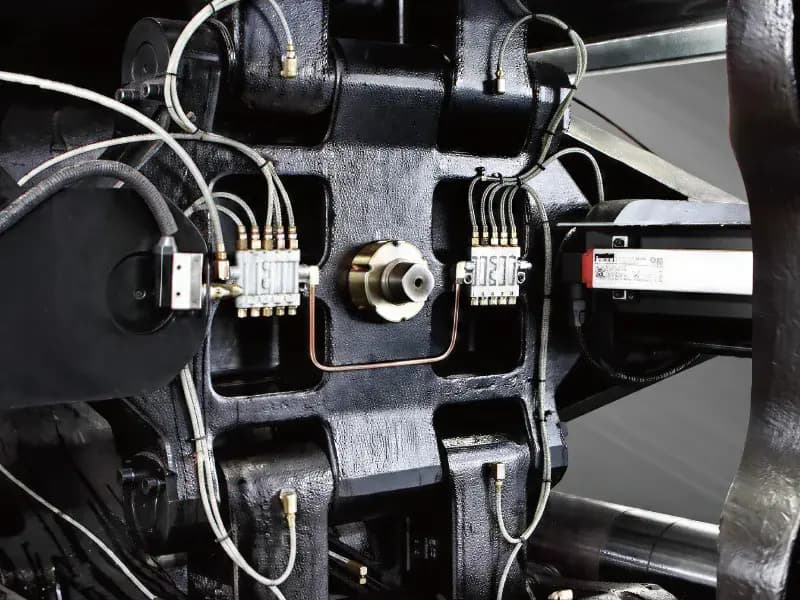
Toggle clamping unit — high rigidity for thin-wall molding
Investment and ROI Comparison
Total investment comparison for medium container production lines. Scenario A: HMD 380M8-SPV with 2-cavity 500 ml container mold with IML. Machine investment approximately 230,000-280,000 USD plus mold at 55,000-75,000 USD plus SWITEK IML robot system at 40,000-60,000 USD equals total 325,000-415,000 USD. Monthly output of 675,000 containers at gross margin of 0.02-0.03 USD per container yields monthly gross profit of 13,500-20,250 USD. Simple payback: 16-31 months. Scenario B: HMD 450M8-SPV with 4-cavity 500 ml container mold with IML. Machine investment approximately 270,000-330,000 USD plus mold at 70,000-100,000 USD plus SWITEK IML robot system at 50,000-70,000 USD equals total 390,000-500,000 USD. Monthly output of 1.46 million containers at the same per-unit margin yields monthly gross profit of 29,200-43,800 USD. Simple payback: 11-17 months. The 450 scenario requires 20-25% higher total investment but achieves 30-45% faster payback due to doubled output. For facilities with confirmed demand exceeding 8 million containers per year, the HMD 450M8-SPV is the clear choice. For lower volumes or market-entry production, the HMD 380M8-SPV provides a lower-risk entry point.
Frequently Asked Questions
For 1,000 ml containers in 2-cavity configuration, the HMD 450M8-SPV is preferred. The larger projected area of approximately 600 cm2 for 2 rectangular containers requires 3,000-3,600 kN clamping, which approaches the 380's limit of 3,680 kN with minimal margin. The 450 at 4,280 kN provides 15-20% safety margin. The 450's wider tie bar distance of 720 x 660 mm also better accommodates the 200 mm length of 1,000 ml container molds.
Related Guides
Ready to Start Your Project?
Get a free consultation and quotation for your thin-wall packaging production line.
Join 500+ manufacturers in 60+ countries who trust HWAMDA.
Get Free Quote