Pre-Shipment Inspection and Testing
Every HWAMDA machine undergoes comprehensive pre-shipment inspection and testing at the factory before packing for international shipment. The testing protocol includes mechanical checks of all moving components, hydraulic system pressure testing at rated and peak pressures, electrical system verification of all circuits and safety interlocks, and a complete dry-cycle test confirming clamping speed, injection speed, and ejection function meet published specifications. For SPV5 thin-wall machines, dry cycle time is verified against the specification sheet, typically 1.5-2.5 seconds depending on tonnage. If the customer's mold is available, a full production trial is conducted using the customer's specific mold and material. This trial validates that the machine-mold combination achieves the target cycle time, part quality, and output rate before the equipment ships. HWAMDA invites customers to attend pre-shipment inspection in person at the factory in Ningbo, China, providing an opportunity to verify machine performance and complete formal acceptance. For customers unable to travel, HWAMDA provides detailed inspection reports with photographs and video recordings of the machine running.
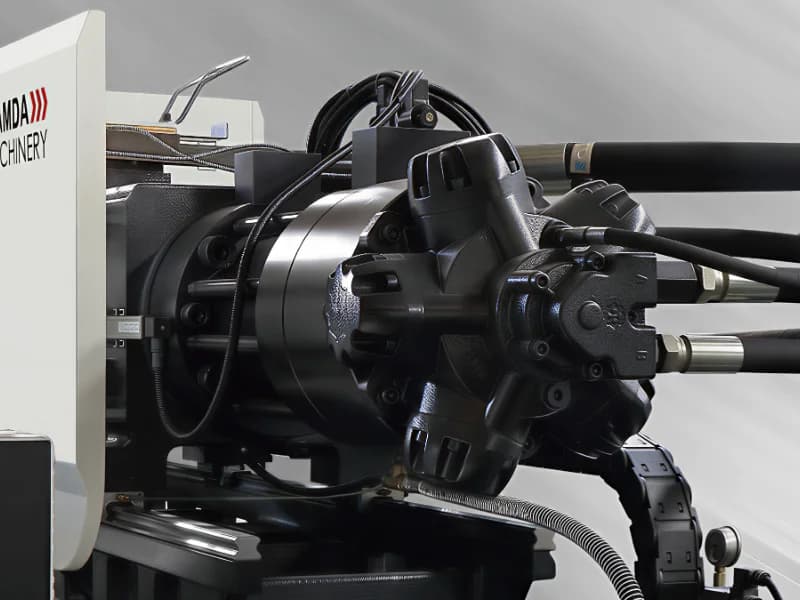
High-speed injection unit with linear guides
Packing and Sea Freight Logistics
HWAMDA machines are packed in heavy-duty wooden crates reinforced for ocean freight, with all surfaces coated in anti-corrosion VCI film to protect against salt air during transit. Machines up to 380 tons typically ship in standard 40-foot high-cube containers, while larger machines of 480-600 tons may require flat-rack containers or breakbulk shipping. The injection unit and clamping unit ship as separate assemblies when combined dimensions exceed container limits. Shipping transit times from Ningbo port to major destinations vary: 15-25 days to Middle Eastern ports (Jeddah, Dubai, Istanbul), 25-35 days to African ports (Lagos, Durban, Alexandria), 20-30 days to Southeast Asian ports, and 30-40 days to South American and European ports. HWAMDA manages freight forwarding and provides all export documentation including commercial invoice, packing list, bill of lading, certificate of origin, and fumigation certificate. The customer handles import duties, customs clearance, and inland transport. HWAMDA provides HS codes and CIF values to facilitate customs documentation.
Port Handling and Customs Clearance
Upon arrival at the destination port, the machine crate must be handled with appropriate equipment: a forklift with minimum 10-ton capacity for machines up to 380 tons, or a mobile crane for larger machines. HWAMDA provides detailed weight and center-of-gravity information for each crate, essential for safe handling. Customers should engage a licensed customs broker in advance to prepare import documentation and coordinate clearance timelines. Import duties for injection molding machines vary by country, typically ranging from 0-15% depending on local tariff schedules and trade agreements. Some countries offer duty exemptions or reductions for capital equipment imports, particularly in free trade zones or designated industrial areas. HWAMDA provides HS code 8477.10 classification documentation and certificates of origin that may qualify for preferential tariff treatment under bilateral agreements. Inland transportation from port to factory requires a flatbed truck suitable for heavy machinery, with the route surveyed for weight restrictions, bridge clearances, and turning radius limitations.
Key Specs
- •Upon arrival at the destination port, the machine crate must be handled with appropriate equipment: a forklift with minimum 10-ton capacity for machines up to 380 tons, or a mobile crane for larger machines.
- •Import duties for injection molding machines vary by country, typically ranging from 0-15% depending on local tariff schedules and trade agreements.
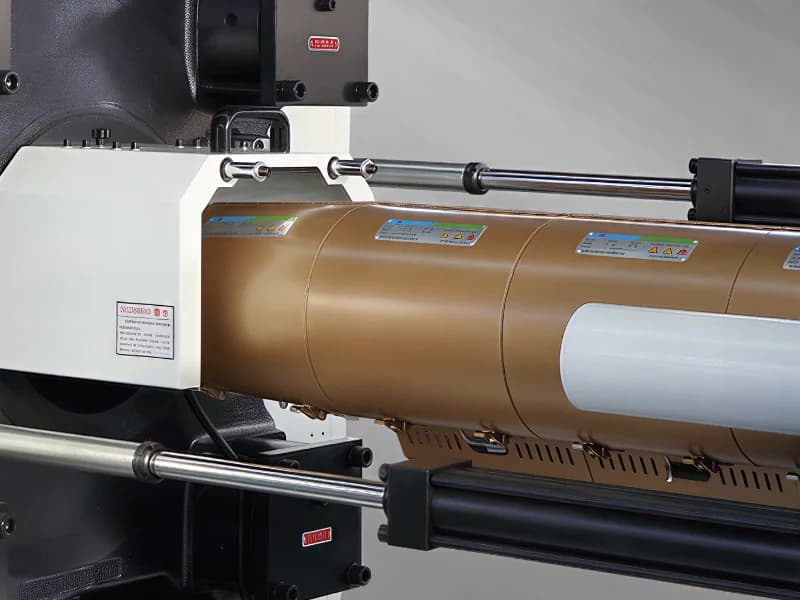
Servo-hydraulic drive system with energy recovery
Need Expert Advice?
Talk to our engineers about your specific production requirements. Free consultation.
Foundation and Utility Preparation
Foundation preparation must be completed before the machine arrives to avoid costly delays. HWAMDA provides detailed foundation drawings for each model, specifying concrete pad dimensions, thickness, reinforcement requirements, and anchor bolt positions. A typical SPV5-380 foundation requires a reinforced concrete pad of approximately 3.0 x 1.5 meters with 300 mm minimum thickness and 25 MPa concrete strength. The foundation must cure for at least 14 days before machine installation. Utility connections should be prepared per HWAMDA's specification sheets: electrical power supply with appropriate voltage (380V/50Hz or 415V/50Hz depending on region), circuit breaker sized for the machine's connected load, cooling water supply and return lines with isolation valves, and compressed air at 6-8 bar with moisture separation. The electrical connection requires a qualified electrician familiar with industrial three-phase installations. HWAMDA provides detailed wiring diagrams and terminal identification. All utility connections should be tested and verified functional before the installation team arrives.
Installation and Commissioning
HWAMDA sends experienced installation engineers to the customer's facility, typically a 7-14 day process depending on the number of machines and production line complexity. The installation sequence begins with positioning the machine on its foundation using a crane or hydraulic jacking system, followed by leveling to within 0.1 mm per meter using precision instruments. After positioning, the team connects all utilities, fills and bleeds the hydraulic system, charges the accumulator, and connects cooling circuits. The electrical system is energized and tested phase by phase, verifying motor rotation directions, heater band function, and sensor calibrations. The commissioning phase progresses through dry-cycle testing to verify all machine movements and speeds, then transitions to production trials with the customer's mold and material. During commissioning, the HWAMDA engineer optimizes all process parameters including injection speed and pressure profiles, holding pressure and time, cooling parameters, and robot synchronization. The machine is not handed over until it demonstrates consistent production at the specified cycle time and quality over a minimum of 4 hours continuous operation.
Key Specs
- •The installation sequence begins with positioning the machine on its foundation using a crane or hydraulic jacking system, followed by leveling to within 0.1 mm per meter using precision instruments.
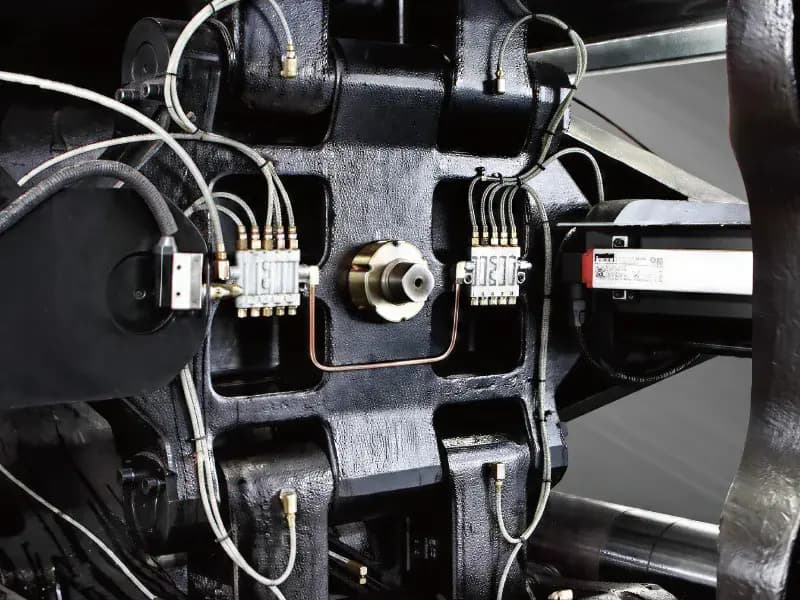
Toggle clamping unit — high rigidity for thin-wall molding
Operator Training Program
HWAMDA provides comprehensive operator training concurrent with machine installation and commissioning at the customer's facility. The standard training program spans 5-7 days and covers four key modules: machine operation fundamentals, process parameter setup and optimization, preventive maintenance procedures, and basic troubleshooting techniques. The machine operation module covers daily startup and shutdown procedures, safety system functions and emergency stops, HMI interface navigation and parameter access, and production monitoring including cycle time, shot weight, and alarm management for consistent quality. Process parameter training teaches operators to understand the relationships between injection speed, pressure, temperature, and resulting part quality. Preventive maintenance training covers the daily, weekly, and monthly maintenance schedule including hydraulic oil level and quality checks, lubrication points and schedules, filter inspection and replacement intervals, and cooling circuit maintenance. HWAMDA provides a detailed maintenance manual in English with all service intervals and procedures documented. For customers operating multiple machines, advanced training is available for designated maintenance technicians.
Frequently Asked Questions
The total timeline from factory departure to production-ready operation is typically 6-12 weeks depending on destination. Sea freight transit takes 15-40 days: approximately 15-25 days to Middle Eastern ports, 25-35 days to African ports, and 30-40 days to South American or European ports. Customs clearance requires 3-14 days depending on the country's procedures and documentation readiness. Installation and commissioning by HWAMDA engineers takes 7-14 days on site. Foundation and utility preparation should be completed during the shipping transit period to avoid delays upon arrival.
Related Guides
Ready to Start Your Project?
Get a free consultation and quotation for your thin-wall packaging production line.
Join 500+ manufacturers in 60+ countries who trust HWAMDA.
Get Free Quote