

Tonnage Calculation Formula
The basic clamping force formula is: Required Tonnage = Projected Area (cm²) × Cavity Pressure (kg/cm²) × Number of Cavities × Safety Factor. For thin-wall packaging, cavity pressure during injection is significantly higher than standard molding, typically 600-1,000 kg/cm² (60-100 MPa) compared to 300-500 kg/cm² for standard parts. For a practical example: a 150ml yogurt cup has a projected area of approximately 50 cm² per cavity. With 8 cavities, total projected area is 400 cm² plus approximately 60 cm² for the runner system, totaling 460 cm². At 800 kg/cm² cavity pressure with a 1.1 safety factor: 460 × 800 × 1.1 = 404,800 kg = approximately 405 tons. This confirms the HWAMDA SPV5 400T as the correct machine selection. The safety factor of 1.05-1.15 accounts for process variations and ensures flash-free production across all cavities. Using the correct thin-wall pressure values (600-1,000 kg/cm²) rather than standard injection molding values is the single most important calculation step for proper machine selection.
Key Specs
- •For thin-wall packaging, cavity pressure during injection is significantly higher than standard molding, typically 600-1,000 kg/cm² (60-100 MPa) compared to 300-500 kg/cm² for standard parts.
- •With 8 cavities, total projected area is 400 cm² plus approximately 60 cm² for the runner system, totaling 460 cm².
- •At 800 kg/cm² cavity pressure with a 1.1 safety factor: 460 × 800 × 1.1 = 404,800 kg = approximately 405 tons.
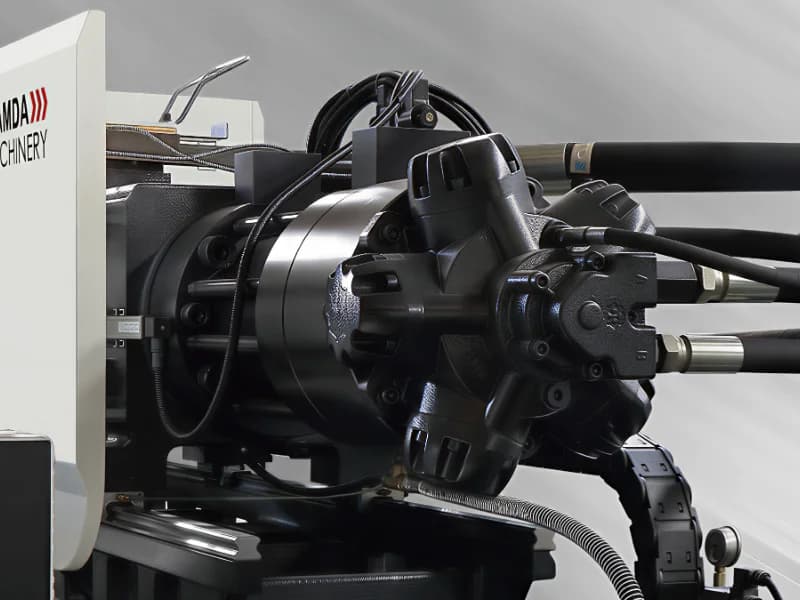
High-speed injection unit with linear guides
Tonnage Requirements by Product Type
Yogurt cups (150ml, 8/12/16 cavity): HWAMDA SPV5 380-400T. The 380T handles 8-cavity molds comfortably, while 12-16 cavity configurations require 400T for adequate clamping margin. Food containers (500ml-1000ml, 4/6/8 cavity): HWAMDA SPV5 480-530T. Larger projected area per cavity demands higher tonnage; 8-cavity food container molds approach 530T requirements. Sauce cups (30ml-120ml, 16/24/32 cavity): HWAMDA SPV5 270-280T. Small individual projected area allows high cavity counts on smaller machines. Milk tea cups (500ml, 8/12 cavity): HWAMDA SPV5 450T. Tall, large-diameter cups need moderate tonnage per cavity. Yogurt pails (1L-2L, 2/4 cavity): HWAMDA SPV5 600T. Large projected area per cavity plus thick walls require maximum clamping force. Tableware (plates/bowls, 16/24/32/48 cavity): HWAMDA SPV5 270-280T. Flat geometry with moderate wall thickness fits well on smaller machines. HWAMDA engineering provides free tonnage calculations and machine model recommendations for any thin-wall packaging application based on customer product specifications and volume targets. All SPV5 models share the same control platform, ensuring consistent operator experience across the range, which simplifies training when factories operate multiple machine sizes.
Common Mistakes in Tonnage Selection
The most common mistake is using standard injection molding pressure values instead of thin-wall values. Standard parts require 300-500 kg/cm² cavity pressure, but thin-wall packaging requires 600-1,000 kg/cm² because the narrow flow channels generate much higher pressure drops. Using standard values results in 30-50% under-estimation, leading to flash problems during production. A second common mistake is ignoring the runner system projected area, which can add 10-15% to the required tonnage. Third, some buyers select machine tonnage based on the mold manufacturer's minimum recommendation without considering future cavity count expansion. If you plan to upgrade from 8 to 12 cavities, choose a machine with sufficient tonnage for the larger mold. Fourth, selecting a machine from a different manufacturer than the mold builder without verifying platen dimensions, tie bar spacing, and mold height compatibility can result in a correctly sized tonnage that physically cannot accept the mold. HWAMDA engineering provides free tonnage verification for any product specification, helping customers avoid both undersizing and costly oversizing mistakes during machine selection.
Key Specs
- •Using standard values results in 30-50% under-estimation, leading to flash problems during production.
- •A second common mistake is ignoring the runner system projected area, which can add 10-15% to the required tonnage.
- •If you plan to upgrade from 8 to 12 cavities, choose a machine with sufficient tonnage for the larger mold.
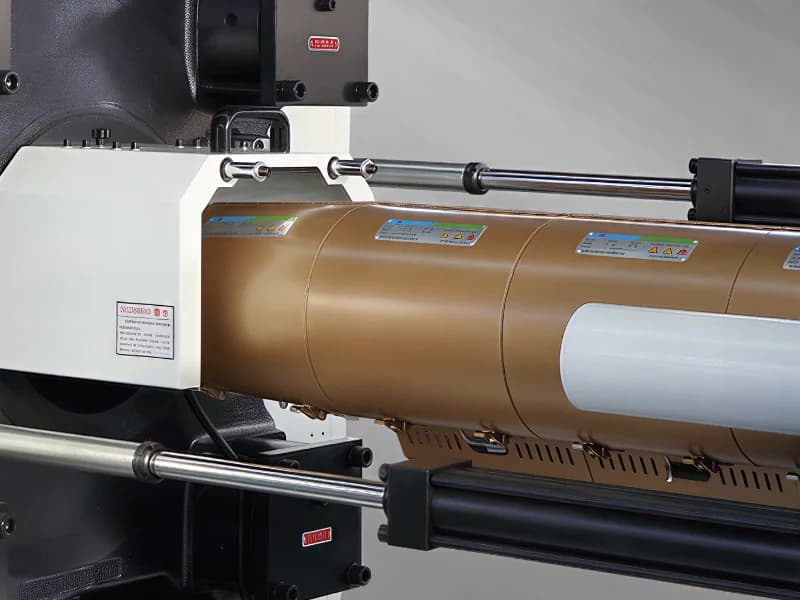
Servo-hydraulic drive system with energy recovery
Need Expert Advice?
Talk to our engineers about your specific production requirements. Free consultation.
Oversizing vs Right-Sizing
Oversizing by one machine frame size (selecting a 450T when 400T is sufficient) adds $10,000-20,000 to the machine cost, increases energy consumption by 15-25%, and provides no production benefit for current tooling. The larger machine also occupies more floor space and requires a heavier foundation. Oversizing is only justified when firm plans exist to scale cavity count within 12 months. Right-sizing delivers the optimal cost-per-unit by matching machine capability to mold requirements within a 10-15% safety margin. The HWAMDA SPV5 series is available in closely spaced tonnage increments (270T, 280T, 380T, 400T, 450T, 480T, 530T, 600T) specifically to enable right-sizing for thin-wall packaging applications. Each model is optimized for specific product categories rather than being a general-purpose machine adapted for packaging. HWAMDA engineering provides free tonnage calculations and machine recommendations based on your product specifications. The closely spaced SPV5 tonnage increments from 270T to 600T enable precise right-sizing rather than forcing customers to over-invest in larger machines than their applications require.
HWAMDA SPV5 Tonnage Range (270T-600T)
The HWAMDA SPV5 270T is optimized for small parts in high cavity counts: sauce cups (16-32 cavity, 3-4s cycle), tableware (16-48 cavity, 4-6s cycle), and small food containers. The SPV5 380T-400T is the most popular model for yogurt cups (8-16 cavity, 3.5-4.5s cycle) and IML margarine containers (4-8 cavity, 5-7s cycle). This tonnage range covers the highest-volume food packaging products. The SPV5 450T serves milk tea cups and medium beverage containers (8-12 cavity, 5-7s cycle). The SPV5 480T-530T handles food containers and larger storage containers (4-8 cavity, 5-7s cycle). The SPV5 600T addresses the heaviest applications including yogurt pails and large dairy containers (2-4 cavity, 10-14s cycle). All SPV5 models share the same control platform, servo-hydraulic power system, and accumulator-assisted injection architecture, ensuring consistent operator experience across the range. The SPV5 range covers the complete spectrum of thin-wall food packaging products from small sauce cups to large dairy pails, with each model specifically optimized for its target application.
Key Specs
- •The HWAMDA SPV5 270T is optimized for small parts in high cavity counts: sauce cups (16-32 cavity, 3-4s cycle), tableware (16-48 cavity, 4-6s cycle), and small food containers.
- •The SPV5 380T-400T is the most popular model for yogurt cups (8-16 cavity, 3.5-4.5s cycle) and IML margarine containers (4-8 cavity, 5-7s cycle).
- •The SPV5 450T serves milk tea cups and medium beverage containers (8-12 cavity, 5-7s cycle).
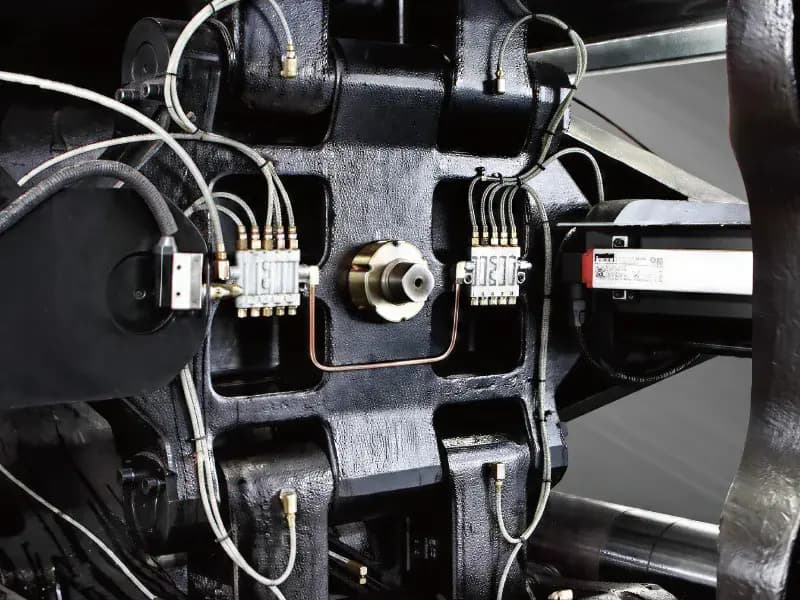
Toggle clamping unit — high rigidity for thin-wall molding
Matching Machine to Mold
Beyond tonnage, verify these compatibility parameters: platen dimensions must accommodate the mold base footprint with minimum 30mm clearance on all sides, tie bar spacing must allow mold insertion without interference, mold height (minimum and maximum) must fall within the machine's daylight range, ejection stroke must match the product depth plus 10-20mm clearance, and shot weight capacity must exceed the total shot weight by at least 20%. HWAMDA provides a comprehensive machine-mold compatibility verification as part of every quotation. When ordering machine and mold together from HWAMDA, compatibility is guaranteed—the mold is designed for the specific machine model and tested on an identical SPV5 machine in HWAMDA's factory before shipment. This eliminates the compatibility risks that arise when sourcing machine and mold from different suppliers. The factory acceptance test includes full production runs at target cycle times with the customer's specified material. This compatibility guarantee eliminates the costly process of resolving machine-mold mismatches that frequently occur when equipment comes from different suppliers without integrated design.
Frequently Asked Questions
An 8-cavity yogurt cup mold (150ml, 0.5mm wall, PP) requires approximately 380-400 tons of clamping force. The HWAMDA SPV5 380T or 400T is the recommended machine. The calculation: 8 cavities × 50 cm² projected area per cavity = 400 cm² plus 60 cm² runner = 460 cm² total × 800 kg/cm² thin-wall pressure × 1.1 safety factor = approximately 405 tons. The SPV5 400T provides adequate margin for consistent flash-free production at 3.5-4.5 second cycle times. The 400T accommodates both current 8-cavity and future 12-cavity upgrade tooling without requiring a machine change.
Related Guides
Ready to Start Your Project?
Get a free consultation and quotation for your thin-wall packaging production line.
Join 500+ manufacturers in 60+ countries who trust HWAMDA.
Get Free Quote