

Types of Robots for Thin-Wall Packaging
Three categories of robots serve thin-wall packaging production. Take-out robots are the simplest, extracting molded parts from the mold and placing them onto a conveyor or stacking station. They use servo-driven side-entry or top-entry configurations with cycle times of 0.8 to 1.5 seconds for part extraction. IML robots are the most complex, combining label placement, part extraction, and often quality verification in a single system. They require 5 or more servo axes and cycle times under 3 seconds. Downstream packaging robots handle stacking, counting, and case packing of finished parts. For thin-wall food packaging, the choice between take-out and IML robots depends on whether the product requires in-mold decoration. Undecorated products like disposable tableware and plain food containers use take-out robots, while branded yogurt cups, margarine tubs, and milk tea cups use IML robots. HWAMDA specifies the appropriate automation level for each turnkey line configuration. The automation level is specified during the turnkey line engineering phase to match the customer's production requirements.
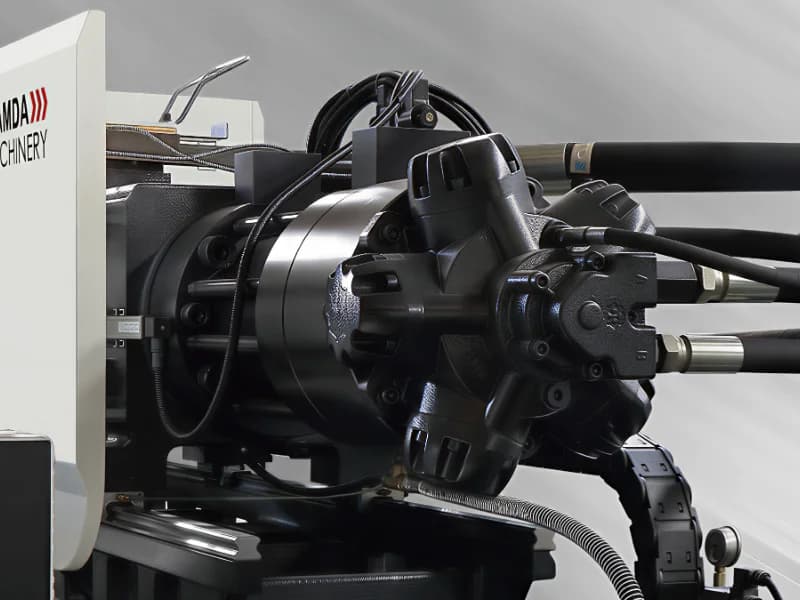
High-speed injection unit with linear guides
Take-Out Robots and Part Handling
Take-out robots for thin-wall packaging use servo-driven arms that enter the mold space during the open phase, grip parts using vacuum or mechanical fingers, retract, and deposit parts onto a conveyor or stacking fixture. For multi-cavity molds producing 8 to 48 parts per cycle, the end-of-arm tooling (EOAT) must simultaneously grip and release all parts in precise alignment. Cycle time for the take-out operation is typically 0.8 to 1.5 seconds, which must fit within the mold-open dwell time to avoid extending the overall cycle. Side-entry robots enter from the operator side of the machine, accessing the mold space without interference from the tie bars. Top-entry robots descend from above and are used when side access is restricted. Both configurations interface with the machine controller for synchronized timing. Take-out robots cost approximately 8,000 to 25,000 dollars depending on payload capacity and axis count, representing a small fraction of the total line investment.
IML Robot Integration (SWITEK SW8/SW67)
HWAMDA partners with SWITEK to provide fully integrated IML automation. The SWITEK SW833 serves machines from 150 to 450 tons with a crosswise stroke of 190 plus 190 mm, vertical stroke of 420 mm, and traverse stroke of 2,100 mm. It achieves take-out times of 1.2 to 1.5 seconds with an 8 kg payload capacity and weighs 1,280 kg. The 5-axis servo motor system provides the speed and precision needed for label placement at plus or minus 0.1 mm accuracy. The complete cycle includes label pickup from the magazine via vacuum suction, electrostatic charging of the label for cavity adherence, label placement into the open mold cavity, mold closing verification, injection cycle wait, part extraction from the core side, and part deposit onto the stacking conveyor. The flexible cassette magazine design allows rapid changeover between label SKUs, supporting multi-product production scheduling. The SW850 model handles larger format containers on machines up to 600 tons.
Key Specs
- •The SWITEK SW833 serves machines from 150 to 450 tons with a crosswise stroke of 190 plus 190 mm, vertical stroke of 420 mm, and traverse stroke of 2,100 mm.
- •The 5-axis servo motor system provides the speed and precision needed for label placement at plus or minus 0.1 mm accuracy.
- •The SW850 model handles larger format containers on machines up to 600 tons.
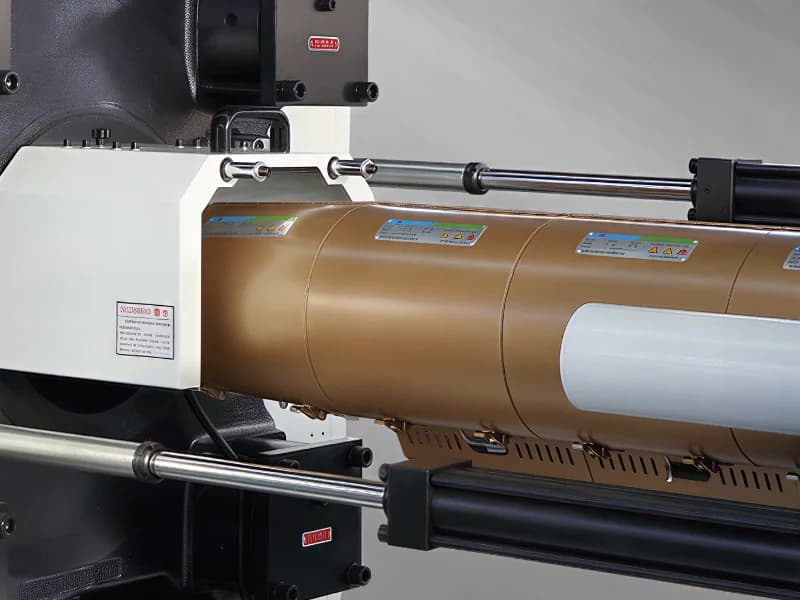
Servo-hydraulic drive system with energy recovery
Need Expert Advice?
Talk to our engineers about your specific production requirements. Free consultation.
Stacking and Packaging Automation
After parts are extracted from the mold, downstream automation handles stacking, counting, and packaging. For nested products like cups and containers, servo-driven stacking systems arrange parts in precise stacks of 25, 50, or 100 units. The stacking mechanism must accommodate the slight taper of thin-wall containers while preventing damage to the thin walls or any IML decoration. Automatic counting sensors verify stack quantity before routing to the bagging station. Bag-in-box or shrink-wrap packaging machines seal the counted stacks into shipping units. For cutlery and flat tableware, counting and bundling machines create sets of 100 or 250 pieces. The entire downstream line typically operates at 10 to 20 percent higher throughput than the injection molding cycle to prevent bottlenecks. HWAMDA provides downstream automation as part of the turnkey package, ensuring compatibility with the injection molding and robot systems. The complete downstream system is sized for 10 to 20 percent higher throughput than the injection cycle to prevent any bottleneck in the packaging process.
Vision Inspection Systems
Vision inspection systems use high-speed cameras and image processing algorithms to inspect 100 percent of produced parts in real time. Key inspection capabilities include label placement verification measuring label position accuracy to plus or minus 0.5 mm, print quality assessment detecting color shifts, smearing, or missing elements, dimensional measurement verifying overall height, diameter, and wall thickness, and defect detection identifying short shots, flash, burn marks, and surface contamination. Camera systems are typically mounted at the part extraction point or on the stacking conveyor, capturing images at speeds synchronized to the production cycle. Parts failing inspection are automatically diverted to a reject bin. In thin-wall production at 3 to 6 second cycle times with multi-cavity molds, vision systems must process 4,000 to 20,000 individual part inspections per hour. Modern AI-powered inspection systems from suppliers like Beck Automation and INTRAVIS achieve detection rates above 99.5 percent. Integration of vision inspection is recommended for premium IML products where label quality is a critical brand requirement.
Key Specs
- •Key inspection capabilities include label placement verification measuring label position accuracy to plus or minus 0.5 mm, print quality assessment detecting color shifts, smearing, or missing elements, dimensional measurement verifying overall height, diameter, and wall thickness, and defect detection identifying short shots, flash, burn marks, and surface contamination.
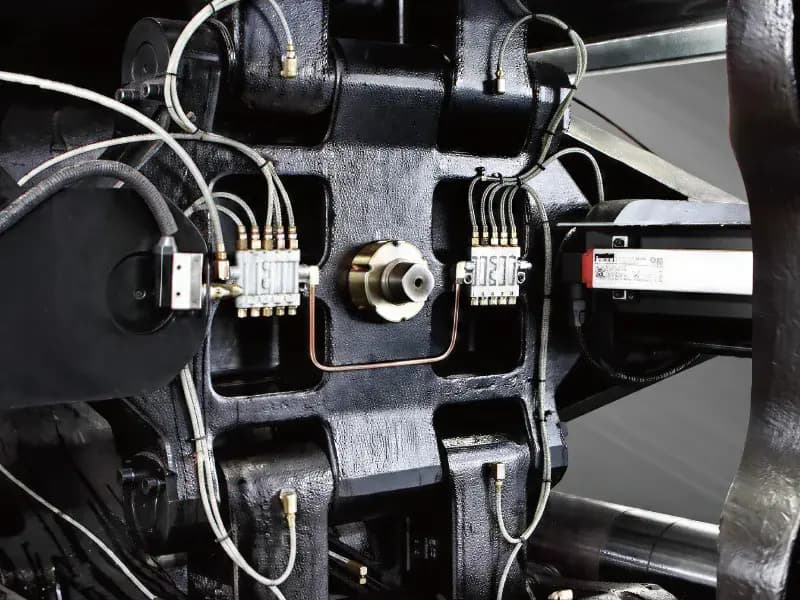
Toggle clamping unit — high rigidity for thin-wall molding
Automation ROI and Labor Savings
The ROI calculation for automation in thin-wall packaging compares the automation investment against labor savings, quality improvements, and throughput increases. A SWITEK IML robot system at 40,000 to 80,000 dollars eliminates 1 to 2 manual labeling operators per shift, saving 2 to 6 full-time positions in a 3-shift operation. In China, where injection molding operator wages average 600 to 800 dollars per month, annual labor savings from eliminating 4 positions total approximately 28,800 to 38,400 dollars. In higher-wage countries like Turkey at 700 to 900 dollars per month or Germany at 3,200 to 3,800 dollars per month, automation payback is proportionally faster. Beyond direct labor savings, automation improves quality consistency by eliminating human variability, enables 24-hour unattended operation, and reduces scrap rates from typical manual handling losses of 1 to 3 percent to below 0.2 percent. Total automation payback is typically 6 to 18 months depending on local labor costs.
Frequently Asked Questions
A fully automated HWAMDA thin-wall production line with IML robot and downstream stacking automation requires approximately 1.8 full-time equivalent workers per line in a single shift: one machine operator who monitors the injection molding process and handles material supply, 0.5 FTE for quality control sampling, and 0.3 FTE for maintenance coverage. Adding IML capability adds approximately 1 FTE for label magazine loading. In a 3-shift operation, this translates to 5.4 to 8.4 total FTEs per line across all shifts. Automation reduces the physical labor requirement while improving output consistency.
Related Guides
Ready to Start Your Project?
Get a free consultation and quotation for your thin-wall packaging production line.
Join 500+ manufacturers in 60+ countries who trust HWAMDA.
Get Free Quote