

Investment Breakdown by Product Type
Yogurt cup production line (SPV5 400T + 8-cavity mold + auxiliaries): Machine $95,000-115,000, mold $40,000-60,000, auxiliary equipment $15,000-25,000, factory preparation $20,000-35,000. Total: $170,000-235,000. With IML automation add $40,000-70,000 for SWITEK system, total: $210,000-305,000. Food container production line (SPV5 530T + 6-cavity mold + auxiliaries): Machine $110,000-135,000, mold $40,000-60,000, auxiliaries $18,000-28,000, factory preparation $22,000-38,000. Total: $190,000-261,000. Sauce cup production line (SPV5 270T + 24-cavity mold + auxiliaries): Machine $70,000-90,000, mold $40,000-55,000, auxiliaries $12,000-20,000, factory preparation $15,000-25,000. Total: $137,000-190,000. Sauce cups offer the lowest entry investment with high unit output. These investment figures include machine, mold, auxiliary equipment, and factory preparation but exclude working capital and raw material inventory which require additional budgeting of $30,000-60,000 per production line for adequate cash reserves. These investment figures represent equipment-only costs and should be supplemented with working capital budgeting of $30,000-60,000 per line to ensure adequate cash reserves during production ramp-up. HWAMDA provides customized investment analysis for each customer's product mix.
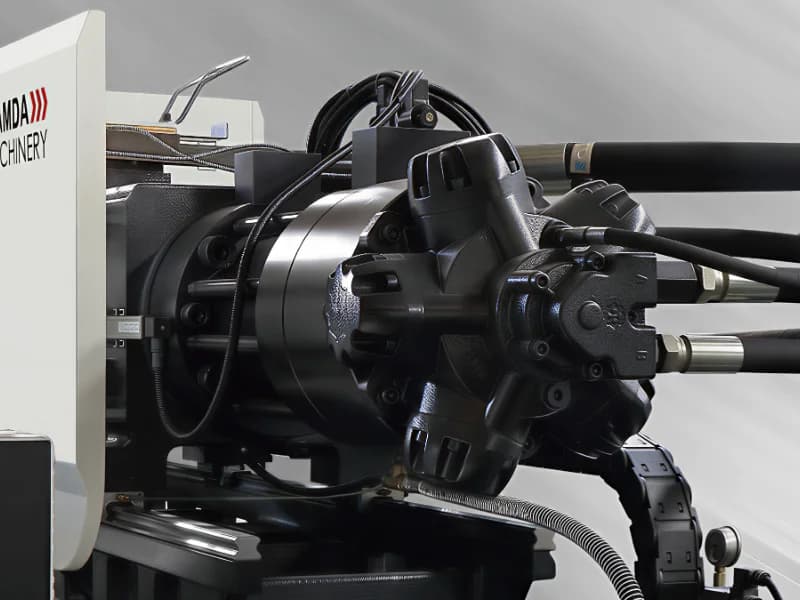
High-speed injection unit with linear guides
Monthly Revenue Projections
Yogurt cup line (8-cavity, 4s cycle, 85% utilization, 24/7): Monthly output approximately 4.3 million cups. Selling price $0.035-0.050 per cup. Monthly revenue: $150,000-215,000. IML-decorated cups command 15-30% premium. Food container line (6-cavity, 6s cycle, 85% utilization): Monthly output approximately 2.2 million containers. Selling price $0.06-0.10 per container. Monthly revenue: $132,000-220,000. Sauce cup line (24-cavity, 3.5s cycle, 85% utilization): Monthly output approximately 15.8 million cups. Selling price $0.008-0.015 per cup. Monthly revenue: $126,000-237,000. Tableware line (32-cavity, 5s cycle, 85% utilization): Monthly output approximately 14.0 million pieces. Selling price $0.005-0.012 per piece. Monthly revenue: $70,000-168,000. Revenue figures represent gross sales at factory-gate prices and vary significantly by regional market conditions. Revenue projections assume steady 85% utilization achieved after 3-6 months of production ramp-up, with initial months generating lower revenue during the customer acquisition and quality validation phase of the operation. The initial months typically generate lower revenue during customer acquisition and quality validation, so financial projections should include a 3-6 month ramp-up period at reduced utilization.
Operating Cost Structure
Raw material (PP resin) is the largest operating cost at 45-55% of selling price. At $1,200/ton average PP price, material cost per 150ml yogurt cup is approximately $0.010-0.014. Energy costs (electricity) run $0.001-0.003 per cup depending on local power rates and machine efficiency. HWAMDA SPV5 servo-driven pumps minimize energy consumption at 12-22 kWh per hour across the range. Labor costs vary dramatically by region: $0.001-0.002 per cup in Southeast Asia, $0.002-0.004 in the Middle East, $0.003-0.005 in Eastern Europe. Mold depreciation (over 5 million cycles) adds $0.002-0.005 per cup. Machine depreciation (over 10 years) adds $0.001-0.003 per cup. Overhead (rent, management, quality, packaging) adds $0.002-0.005 per cup. Total production cost per yogurt cup: $0.020-0.035, with selling price of $0.035-0.050, leaving gross margin of $0.010-0.020 per cup. Maintaining detailed cost tracking from the first day of production is essential for identifying optimization opportunities and making data-driven decisions about pricing, purchasing, and capacity expansion.
Key Specs
- •Raw material (PP resin) is the largest operating cost at 45-55% of selling price.
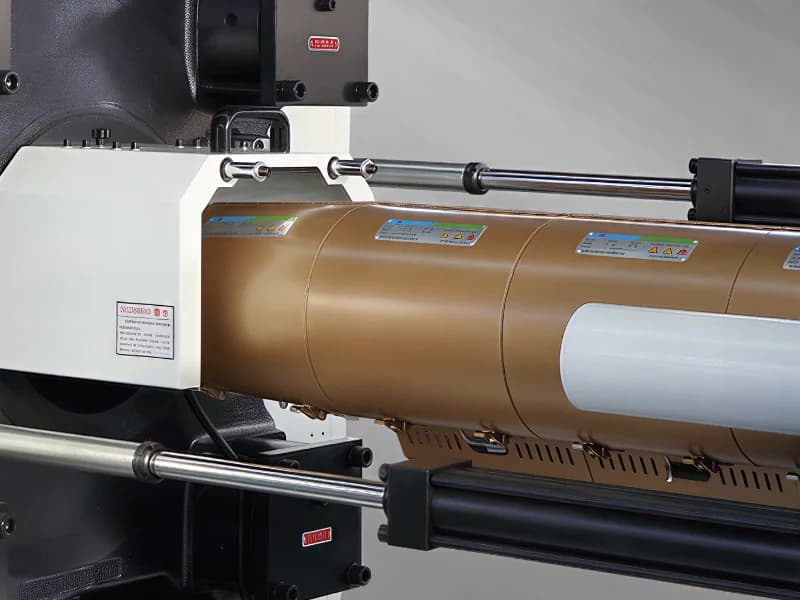
Servo-hydraulic drive system with energy recovery
Need Expert Advice?
Talk to our engineers about your specific production requirements. Free consultation.
Payback Period: 12-24 Months
For a yogurt cup production line with $200,000 total investment: Monthly gross profit at 30% margin on $180,000 revenue = $54,000. After operating expenses, net monthly cash flow approximately $15,000-25,000. Payback period: 8-13 months. For a food container line with $230,000 investment: Monthly gross profit at 28% margin on $175,000 revenue = $49,000. Net monthly cash flow approximately $12,000-22,000. Payback period: 10-19 months. Conservative scenario (70% utilization, lower selling price): Payback extends to 18-30 months. Aggressive scenario (90% utilization, premium IML products): Payback shortens to 8-14 months. The critical factor is capacity utilization—the difference between 70% and 90% utilization represents a 30% revenue increase with only marginal cost increase, dramatically improving ROI. HWAMDA recommends securing initial customer commitments for at least 50% of production capacity before investment to de-risk the payback timeline. HWAMDA recommends securing initial customer commitments for at least 50% of production capacity before investment, ensuring that the payback timeline is based on confirmed demand rather than speculative projections.
Factors That Affect ROI
Capacity utilization is the dominant ROI driver. Every hour of downtime—from machine issues, mold problems, material shortages, or lack of orders—directly reduces revenue while fixed costs continue. Targeting 85% utilization (allowing for maintenance, mold changes, and holidays) is realistic for well-managed operations. Product mix affects margin: IML-decorated containers yield 30-50% higher margins than plain containers. Raw material pricing fluctuations of ±10-15% annually affect margins significantly since material is 45-55% of selling price. Forward purchasing and supplier diversification mitigate this risk. Energy efficiency of the HWAMDA SPV5 servo system provides 15-25% energy savings compared to competitors, improving per-unit margins. Regional market pricing determines the ceiling—markets with limited local competition support higher prices and faster payback, while price-competitive markets require higher volumes and efficiency. Product mix management is an often-overlooked ROI factor—prioritizing high-margin products during production scheduling and reserving low-margin commodity work for periods when premium orders are insufficient to fill capacity.
Key Specs
- •Targeting 85% utilization (allowing for maintenance, mold changes, and holidays) is realistic for well-managed operations.
- •Product mix affects margin: IML-decorated containers yield 30-50% higher margins than plain containers.
- •Raw material pricing fluctuations of ±10-15% annually affect margins significantly since material is 45-55% of selling price.
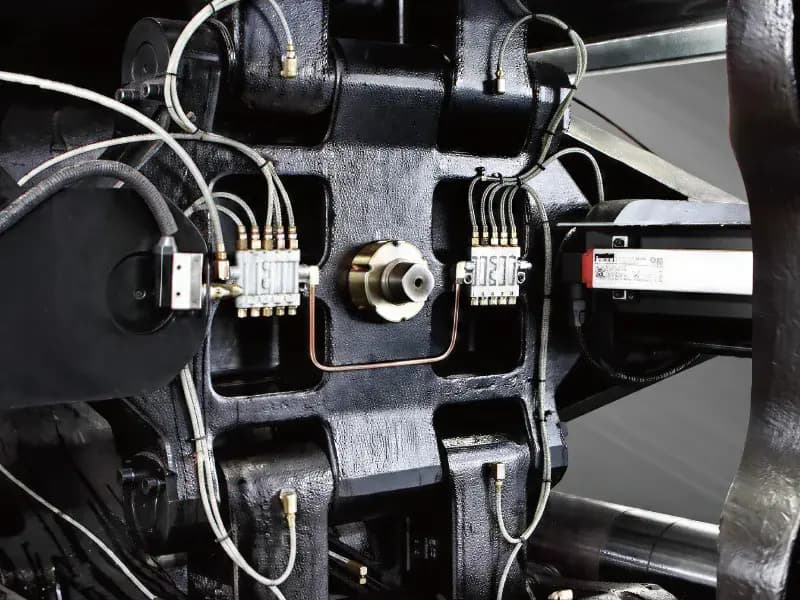
Toggle clamping unit — high rigidity for thin-wall molding
Real Customer ROI Examples
A Southeast Asian yogurt cup manufacturer invested $220,000 in an HWAMDA SPV5 400T line with 8-cavity mold and SWITEK IML automation. Production reached 85% utilization within 4 months of commissioning. IML-decorated cups sold at $0.048 per cup with production cost of $0.028. Monthly net profit reached $25,000 by month 6, achieving full payback in 9 months. A Middle Eastern food container manufacturer invested $250,000 in an SPV5 530T line with 6-cavity mold producing 750ml containers. The local market had limited competition, supporting a selling price of $0.085 per container. Full payback was achieved in 14 months. A Central Asian tableware manufacturer invested $160,000 in an SPV5 280T with 32-cavity plate mold, achieving payback in 16 months through high-volume supply to food service distributors. These examples demonstrate that thin-wall packaging investment delivers strong returns across diverse markets. These real-world examples demonstrate that thin-wall packaging delivers strong returns across diverse markets and product types when production is planned carefully and equipment is properly matched to the application.
Frequently Asked Questions
Typical ROI for a thin-wall packaging production line is 12-24 months payback on total investment. Well-managed operations in markets with strong demand achieve payback as fast as 8-12 months. Key success factors are capacity utilization above 80%, secured customer relationships before investment, and competitive production cost through efficient equipment. HWAMDA SPV5 machines with optimized molds provide the production efficiency needed to achieve these returns consistently. Key success factors are capacity utilization above 80%, secured customer relationships, and competitive production cost through efficient equipment like HWAMDA SPV5 machines. Well-managed operations achieving 85%+ utilization and competitive production costs consistently deliver returns within this range.
Related Guides
Ready to Start Your Project?
Get a free consultation and quotation for your thin-wall packaging production line.
Join 500+ manufacturers in 60+ countries who trust HWAMDA.
Get Free Quote