Market Research and Product Selection
Begin by identifying the highest-demand packaging products in your target market. Visit local supermarkets, dairy plants, food service distributors, and restaurant supply chains to understand what containers are currently used, who supplies them, and at what prices. Look for products currently imported from distant suppliers—local production offers delivery speed and cost advantages that imported products cannot match. The best entry products for new manufacturers are yogurt cups (150ml-500ml)—high volume, stable demand from dairy industry; food containers (500ml-1000ml)—broad application across food service and retail; sauce cups (30ml-120ml)—extremely high volume for fast food and restaurants; and disposable tableware—growing demand with food delivery expansion. Start with 2-3 products that share similar machine and mold requirements to maximize equipment utilization. HWAMDA's sales engineering team can help evaluate product-market fit based on your regional market data. Focus on 2-3 products that share similar machine requirements to maximize equipment utilization across your initial product range, keeping the operation simple during the learning phase.
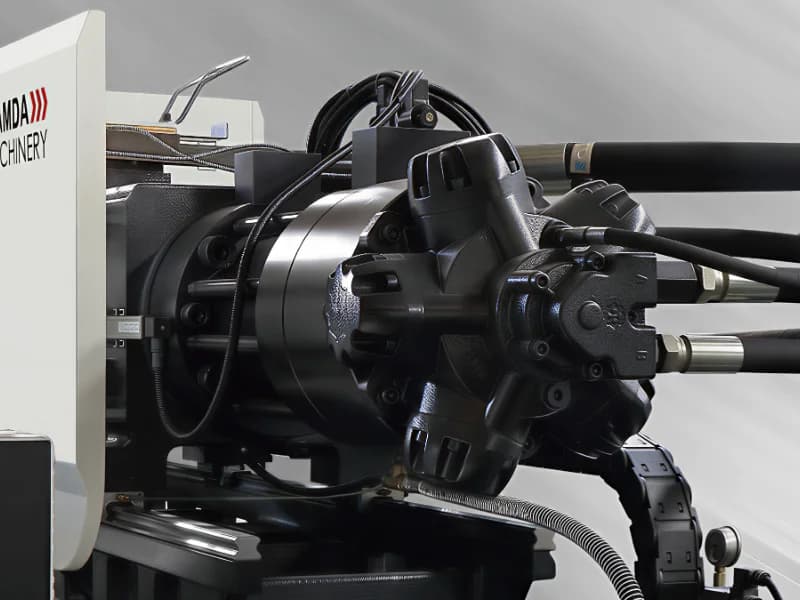
High-speed injection unit with linear guides
Total Investment Required
A viable 2-machine startup requires $250,000-400,000 in total capital. Equipment breakdown: 2 HWAMDA SPV5 machines ($80,000-120,000 each, matched to your product range), 2-4 production molds ($30,000-65,000 each), auxiliary equipment including chillers, dryers, conveyors, and compressors ($20,000-40,000), and optional IML automation ($40,000-80,000 per line). Factory preparation costs $30,000-80,000 for electrical installation (200-400 kVA capacity), compressed air system, cooling water infrastructure, flooring, and basic building modifications. Working capital of $30,000-60,000 covers initial raw material inventory (2-3 months supply of PP resin), first 3 months of operating expenses, and quality testing and certification costs. For a more ambitious 4-machine startup, budget $500,000-800,000 total. HWAMDA offers project consulting to help plan investment and equipment selection based on your specific budget and market targets. HWAMDA offers project consulting to help plan investment allocation based on specific budgets and market targets, ensuring capital is deployed where it generates the fastest return. Including a contingency reserve of 10-15% above budgeted costs provides insurance against unexpected expenses during the startup phase when revenue has not yet fully stabilized.
Equipment List and Procurement
Core equipment: HWAMDA SPV5 injection molding machines (model selected by tonnage calculation for your products), thin-wall production molds (designed and manufactured by HWAMDA based on your product drawings), and hot runner systems (integrated in HWAMDA molds). Auxiliary equipment: process chiller (10-20 HP per machine), hopper dryer or dehumidifier (for moisture-sensitive materials), granulator for regrind processing, conveyor and stacking systems, and compressed air system (1.5-2.0 m³/min per machine). Optional equipment: SWITEK IML robotic system (for branded containers), printing or labeling equipment, quality testing instruments (digital scale, thickness gauge, compression tester), and packaging and sealing machines. HWAMDA provides complete equipment lists with specifications for each product type. Sourcing machine and molds from HWAMDA as a package ensures compatibility and simplifies commissioning. Auxiliary equipment can be sourced locally or through HWAMDA's partner network. Sourcing machine and molds from HWAMDA as a package ensures compatibility and simplifies commissioning, reducing the risk of integration problems between equipment from different suppliers.
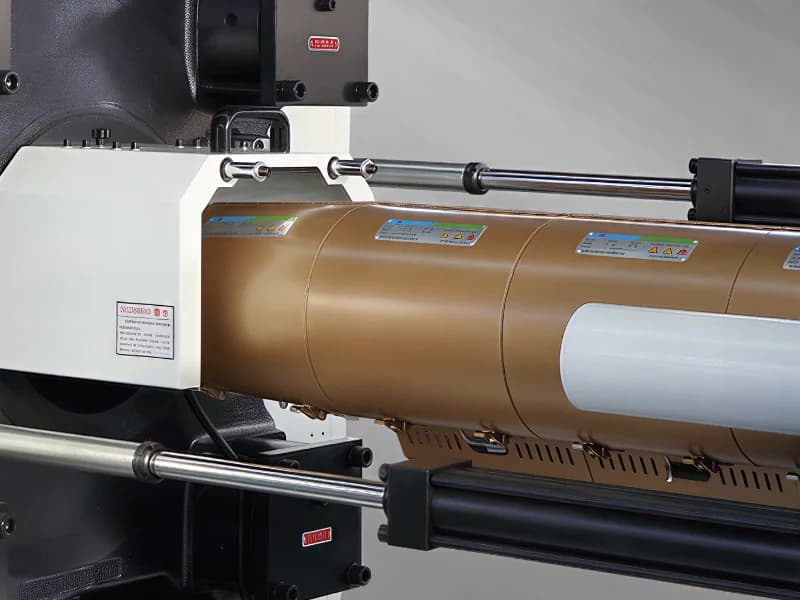
Servo-hydraulic drive system with energy recovery
Need Expert Advice?
Talk to our engineers about your specific production requirements. Free consultation.
Factory Setup Timeline
Month 1-2: Market research, product design finalization, and equipment ordering. Submit product drawings to HWAMDA for DFM review and quotation. Secure factory space (minimum 300 m² for 2 machines). Month 2-3: Factory preparation begins—electrical installation, compressed air, cooling water, and flooring. Mold design approval and manufacturing starts at HWAMDA (8-14 week lead time). Month 3-5: Machine manufacturing at HWAMDA. Factory preparation continues with auxiliary equipment installation. Recruit and begin training operators. Apply for food safety certifications. Month 5-6: Machine delivery and installation. Mold delivery and fitting. Commissioning and mold trials on production material. HWAMDA engineers conduct on-site training (5-7 days). Month 6-7: Trial production, quality validation, and sample submission to target customers. Month 7+: Commercial production begins. Total timeline from decision to first commercial production is approximately 5-7 months. Total timeline from decision to first commercial production is approximately 5-7 months, depending on factory preparation complexity and whether express manufacturing is selected.
Revenue Projections
A 2-machine operation running yogurt cups and food containers at 85% utilization generates the following monthly output: Machine 1 (SPV5 400T, 8-cavity yogurt cup mold, 4s cycle): approximately 4.3 million cups per month. Machine 2 (SPV5 480T, 6-cavity food container mold, 6s cycle): approximately 1.8 million containers per month. At typical selling prices of $0.035-0.050 per yogurt cup and $0.06-0.10 per food container, monthly revenue ranges $250,000-430,000 (local currency equivalent). With material cost representing 45-55% of selling price and operating costs (labor, energy, overhead) at 20-30%, gross margins of 25-35% yield monthly gross profit of $60,000-150,000 (at scale). Net profit after depreciation, interest, and taxes typically runs 15-25% of revenue. Payback period for the initial $250,000-400,000 investment is 18-30 months under conservative assumptions. Actual results depend heavily on local market pricing, capacity utilization, and operational efficiency. Actual results depend heavily on local market pricing, capacity utilization, and operational efficiency, so conservative projections with sensitivity analysis are recommended for financial planning.
Key Specs
- •A 2-machine operation running yogurt cups and food containers at 85% utilization generates the following monthly output: Machine 1 (SPV5 400T, 8-cavity yogurt cup mold, 4s cycle): approximately 4.3 million cups per month.
- •With material cost representing 45-55% of selling price and operating costs (labor, energy, overhead) at 20-30%, gross margins of 25-35% yield monthly gross profit of $60,000-150,000 (at scale).
- •Net profit after depreciation, interest, and taxes typically runs 15-25% of revenue.
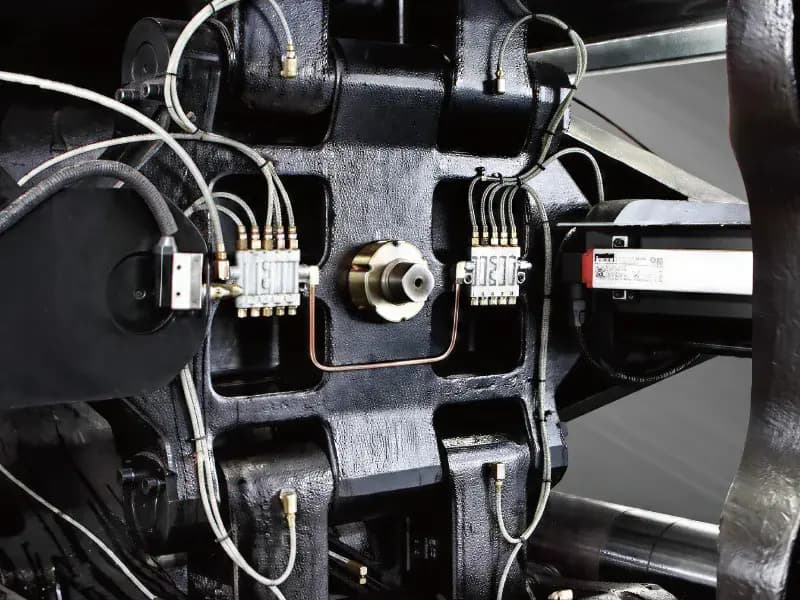
Toggle clamping unit — high rigidity for thin-wall molding
Common Mistakes to Avoid
Underestimating working capital is the most common startup failure. Budget at least 3 months of operating expenses beyond equipment costs. Many new factories run out of cash for raw material purchases before revenue from initial sales arrives. Second, avoid buying the cheapest equipment—low-cost machines and molds from unqualified suppliers result in quality problems, downtime, and customer loss that far exceed the initial savings. Third, do not skip food safety certification. Selling uncertified packaging to food companies exposes your business to legal liability and excludes you from the most valuable customers. Fourth, start with proven products that have established demand rather than innovative designs that require market education. Fifth, do not commit to large customer contracts before validating production quality and capacity. HWAMDA supports new factory operators with technical guidance during startup, remote troubleshooting, and connections to experienced packaging industry professionals. Start with proven, high-demand products and proven equipment from experienced suppliers to minimize the compound risk of simultaneously introducing new products and new production technology.
Frequently Asked Questions
A viable thin-wall food packaging factory requires $250,000-400,000 minimum for a 2-machine startup. This covers 2 HWAMDA SPV5 injection molding machines, 2-4 production molds, auxiliary equipment, factory preparation, and 3 months of working capital. For a single-machine operation, the minimum is approximately $150,000-200,000, though HWAMDA recommends 2 machines for production continuity. A more comprehensive 4-machine setup with IML capability requires $500,000-800,000. HWAMDA offers flexible payment terms including milestone-based payments that spread the financial commitment across the project timeline for better cash flow management. HWAMDA offers milestone-based payment terms that align cash outflows with manufacturing progress for better cash flow management.
Related Guides
Ready to Start Your Project?
Get a free consultation and quotation for your thin-wall packaging production line.
Join 500+ manufacturers in 60+ countries who trust HWAMDA.
Get Free Quote