

Material Properties Comparison
PP offers a melting point of 160-170°C, making it suitable for hot-fill applications and microwave reheating. Its flexural modulus of 1,300-1,800 MPa provides the hinge strength needed for flip-top containers. PP exhibits excellent chemical resistance to acids, bases, and fats, which is critical for dairy and sauce packaging. Shrinkage rate runs 1.0-2.5%, requiring precise mold compensation. PS (both GPPS and HIPS) provides superior optical clarity in its general-purpose form, with light transmittance exceeding 88%. GPPS has a flexural modulus of 2,800-3,400 MPa, making it significantly more rigid than PP at equivalent wall thickness. However, PS is brittle and has a lower heat deflection temperature of only 80-95°C. HIPS adds rubber modification for improved impact resistance but sacrifices transparency. PS shrinkage is lower at 0.4-0.7%, enabling tighter dimensional control in multi-cavity molds. For thin-wall packaging specifically, PP's superior impact resistance means containers survive transportation and handling better than brittle GPPS, reducing customer complaints and returns.
Key Specs
- •PP offers a melting point of 160-170°C, making it suitable for hot-fill applications and microwave reheating.
- •Its flexural modulus of 1,300-1,800 MPa provides the hinge strength needed for flip-top containers.
- •Shrinkage rate runs 1.0-2.5%, requiring precise mold compensation.
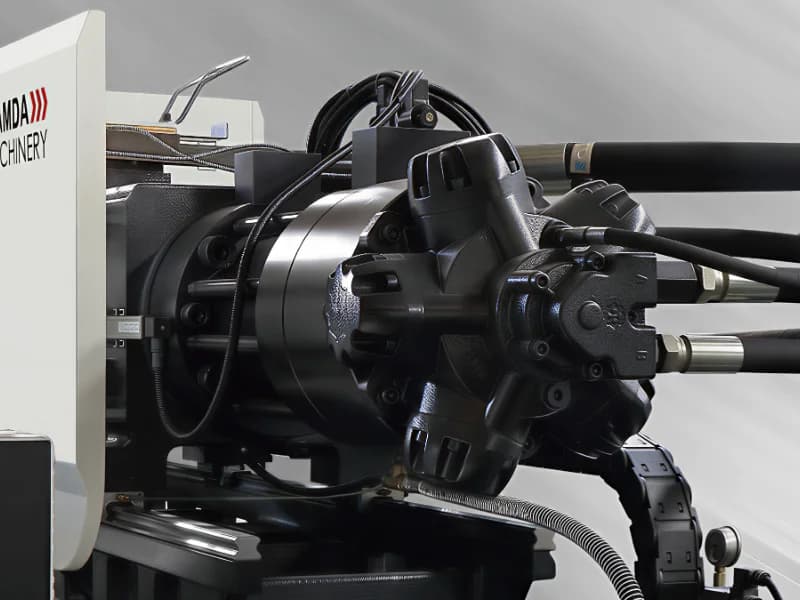
High-speed injection unit with linear guides
Processing Requirements
PP thin-wall molding requires melt temperatures of 220-280°C with injection speeds of 200-400 mm/s to fill thin cavities before the material freezes. Mold temperatures for PP typically run 20-50°C, and cycle times for yogurt cups reach 3.5-4.5 seconds on HWAMDA SPV5 machines with 8-16 cavity molds. PP's higher melt viscosity demands greater injection pressure, typically 150-200 MPa, and accumulator-equipped machines. PS processes at lower melt temperatures of 180-280°C with mold temperatures of 20-70°C. Its MFI of 10-30+ g/10 min (200°C/5 kg) enables excellent flow into thin sections. PS cycle times are generally 10-15% shorter than PP for equivalent products due to faster crystallization and lower cooling requirements. For disposable tableware production on HWAMDA SPV5 270-280T machines, PS molds with 16-48 cavities achieve cycle times of 4-6 seconds. PS also generates less wear on screws and barrels than PP. HWAMDA SPV5 machines handle both PP and PS with parameter adjustments, allowing manufacturers to switch materials based on product requirements.
Food Safety and Compliance
PP complies with FDA 21 CFR §177.1520 for olefin polymers, covering both homopolymer and copolymer grades. It is approved for all food contact conditions including hot-fill up to 100°C and microwave use. PP demonstrates minimal extractables and is free from BPA and styrene monomer concerns. EU compliance follows Regulation (EU) No. 10/2011 with overall migration limits of 10 mg/dm². PS is regulated under FDA 21 CFR §177.1640 for PS and §177.1050 for HIPS. The primary concern with PS is residual styrene monomer, which must remain below 0.5% by weight per FDA requirements. PS is not recommended for microwave applications or contact with hot fatty foods above 70°C. Many markets are implementing PS bans for single-use food service items, creating regulatory risk for new investments. Both materials require food-grade certification from resin suppliers and should be processed in dedicated clean-room environments. These regulatory differences make PP the safer long-term choice for food packaging investments, particularly as global food safety standards continue to tighten and harmonize across markets.
Key Specs
- •It is approved for all food contact conditions including hot-fill up to 100°C and microwave use.
- •The primary concern with PS is residual styrene monomer, which must remain below 0.5% by weight per FDA requirements.
- •PS is not recommended for microwave applications or contact with hot fatty foods above 70°C.
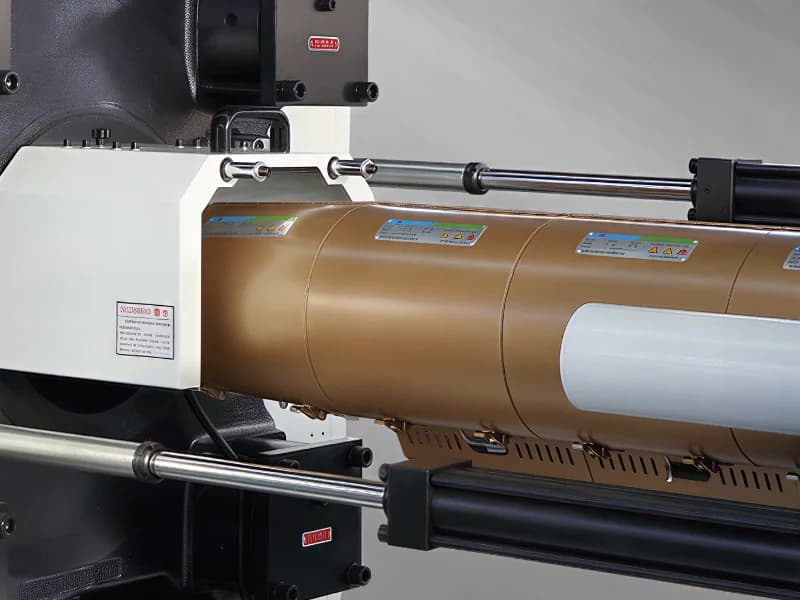
Servo-hydraulic drive system with energy recovery
Need Expert Advice?
Talk to our engineers about your specific production requirements. Free consultation.
Cost and Availability
PP resin prices typically range $1,100-1,400/ton depending on grade and region, with high-flow thin-wall grades commanding a 5-10% premium over standard injection grades. PP is the world's second most produced polymer, ensuring stable global supply from multiple producers. Material cost per yogurt cup (150ml, 0.45mm wall) runs approximately $0.008-0.012. PS (GPPS/HIPS) resin generally costs $1,000-1,300/ton, making it 5-15% cheaper than equivalent PP grades. However, PS thin-wall molds can be simpler and less expensive due to lower processing pressures and PS's better flow characteristics. For disposable tableware and deli containers, PS often delivers the lowest total cost per unit. The cost advantage narrows when considering the regulatory trend toward PP as many regions restrict PS for food service. Mold tooling costs are comparable, though PS molds may achieve longer service life due to lower abrasion. Transportation per-unit costs differ since PP's lower density means more containers per shipping pallet, reducing freight by 10-15% compared to PS.
Environmental and Recyclability Impact
PP is classified as resin code #5 and has strong recyclability credentials. Mechanical recycling of PP food containers is commercially viable and growing rapidly, with recycled PP (rPP) finding applications in non-food packaging, automotive parts, and textiles. PP's lighter density (0.90 g/cm³) compared to PS (1.04-1.06 g/cm³) means less material per container and lower transportation emissions. Many brand owners are transitioning from PS to PP specifically for sustainability marketing. PS recycling infrastructure is less developed, with resin code #6 often excluded from curbside collection programs. However, chemical recycling technologies for PS are advancing, with pyrolysis processes converting waste PS back to styrene monomer. The environmental debate has driven legislative action—the EU Single-Use Plastics Directive and numerous national regulations now restrict PS food service items. For new factory investments, PP offers significantly lower regulatory risk and stronger market acceptance for sustainability-conscious brand owners. The recyclability advantage of PP is increasingly reflected in brand owner procurement requirements, with major food companies specifying PP-only packaging to meet sustainability commitments.
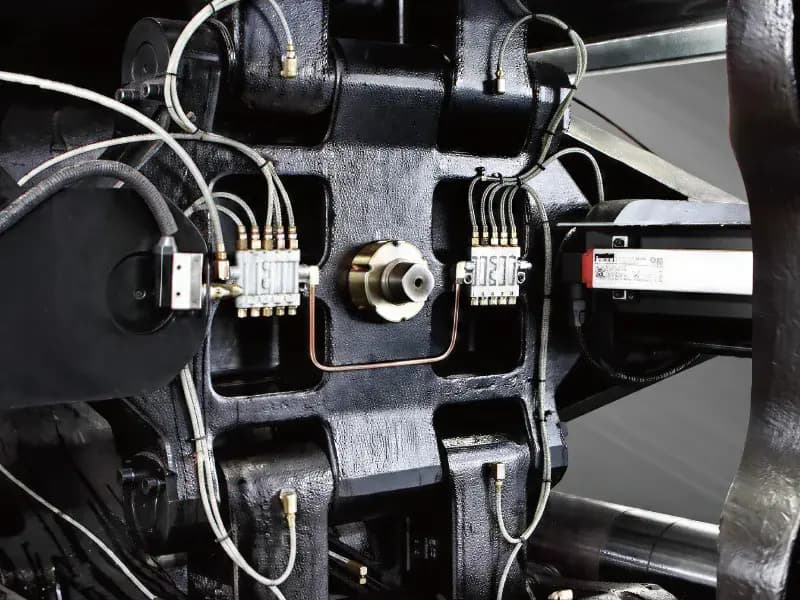
Toggle clamping unit — high rigidity for thin-wall molding
Recommendation by Application
For yogurt cups and dairy containers, PP is the clear choice. It handles hot-fill processes, resists dairy fats, supports IML decoration with HWAMDA SPV5 380-400T machines and 8-16 cavity molds at 3.5-4.5 second cycles. PP's microwave compatibility adds consumer value and is increasingly required by dairy brands. HWAMDA provides complete PP yogurt cup production lines with SWITEK IML automation. For rigid transparent deli containers and disposable clear lids, GPPS remains competitive where regulations permit. Its clarity and rigidity at thin wall thicknesses are difficult to match with PP. For disposable tableware including plates, bowls, and cutlery, PS offers the lowest production cost on HWAMDA SPV5 270-280T machines with 16-48 cavity molds at 4-6 second cycles. However, new packaging factories should strongly consider PP for long-term viability given the global regulatory trend against single-use PS. HWAMDA engineers provide material evaluation support during the project planning phase, analyzing specific product requirements and target markets to recommend the optimal configuration.
Frequently Asked Questions
PP can replace PS in most food packaging applications but with trade-offs. PP lacks the optical clarity of GPPS, making it less suitable for transparent deli containers where product visibility drives sales. PP is also less rigid than PS at equal wall thickness, requiring slight design modifications. However, PP offers superior heat resistance, microwave compatibility, and better recyclability. For yogurt cups, sauce containers, and food service items, PP is the preferred replacement. HWAMDA SPV5 machines process both PP and PS with adjustable parameters.
Related Guides
Ready to Start Your Project?
Get a free consultation and quotation for your thin-wall packaging production line.
Join 500+ manufacturers in 60+ countries who trust HWAMDA.
Get Free Quote