Defining Automation Levels for Thin-Wall Production
Thin-wall injection molding automation spans four distinct levels, each with specific equipment configurations and labor requirements on HWAMDA SPV5 machines. Level 1 -- Manual: machine operates in semi-automatic cycle mode, operator manually removes parts from the mold area. Cycle time limited to 6-8s due to manual part removal delay. Requires 2 operators per machine (one for part removal, one for quality/packing). Suitable only for prototype or very low-volume production. Level 2 -- Basic Automation: SWITEK swing-arm robot removes parts and drops onto conveyor. Cycle time 4.0-5.0s achievable. Requires 1 operator per machine for quality monitoring and packaging. Level 3 -- Advanced Automation: SWITEK side-entry robot with IML capability, automated stacking, counting, and bagging. Cycle time 3.5-4.5s. Requires 0.5-1 operator per machine (shared monitoring). Level 4 -- Full Line Integration: all Level 3 features plus automated box packing, palletizing, quality vision inspection, and MES integration via INOVA OPC-UA. Cycle time 3.5-4.5s with zero manual handling from mold to pallet. Requires 0.3-0.5 operators per machine for supervision and material replenishment.
Key Specs
- •Cycle time limited to 6-8s due to manual part removal delay.
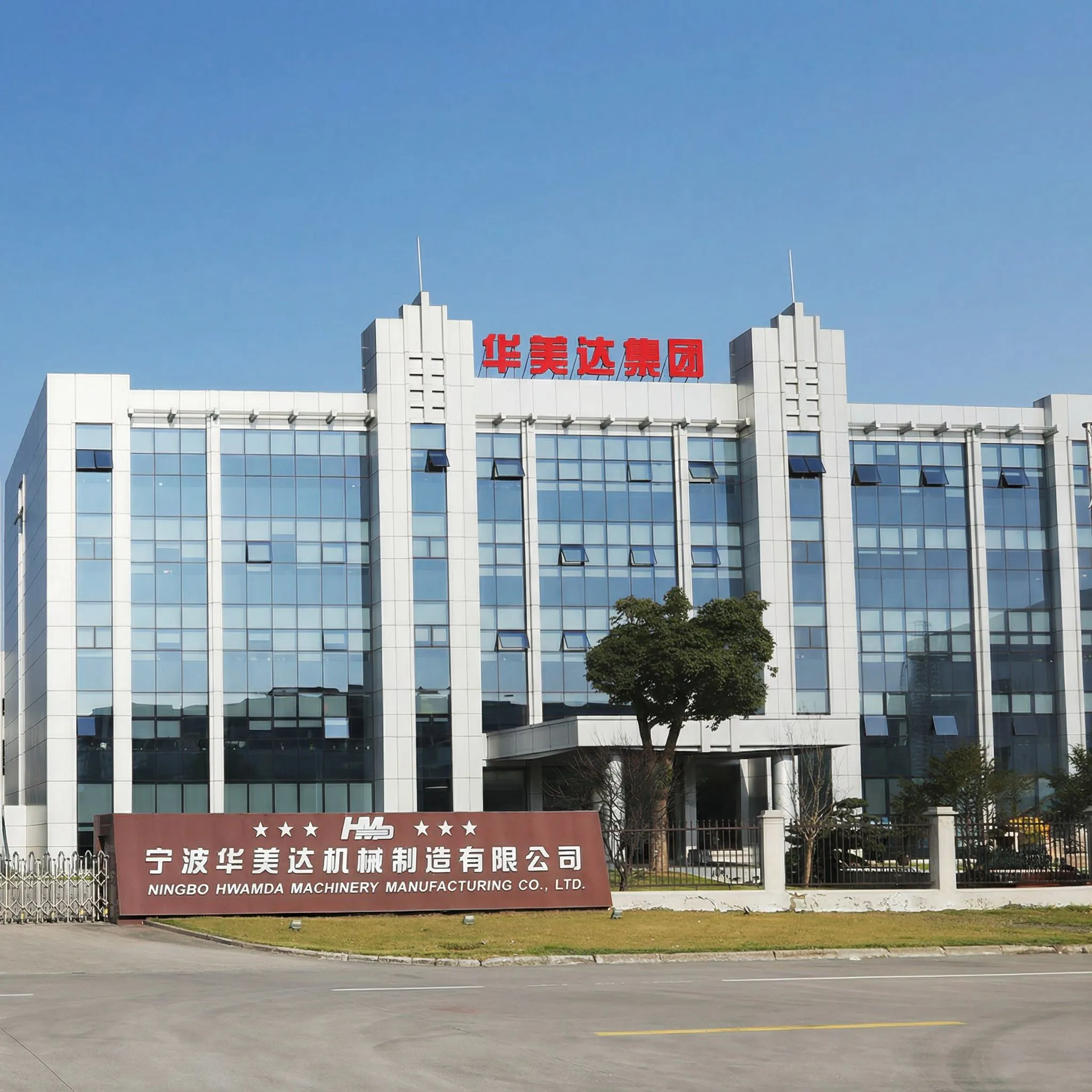
HWAMDA factory — quality manufacturing since 2003
Semi-Automatic Production Line Configuration and Costs
A semi-automatic HWAMDA SPV5 production line (Level 2) consists of: the injection molding machine (HMD 380M8-SPV at USD 85,000-95,000), a SWITEK swing-arm or top-entry robot (USD 15,000-25,000), a 3-5m belt conveyor (USD 2,000-4,000), and a mold temperature controller and chiller (USD 5,000-10,000). Total investment: USD 107,000-134,000. This configuration produces 8-cavity yogurt cups at 4.0-4.5s cycle time (7,200-8,000 cups/hour), with 1 operator per machine handling quality inspection, counting, stacking into sleeves, and packaging into cartons. The operator workload limits the practical maximum to approximately 7,000 parts/hour before quality of manual operations degrades. Semi-auto lines are appropriate for: annual production volumes below 15 million parts, markets with labor costs below USD 300/month per operator, frequent product changeovers (more than 2 per week) where automation equipment changeover adds complexity, and startup operations that plan to upgrade to full automation as volume grows. On HWAMDA SPV5 machines, the semi-auto configuration is the most common for export to Southeast Asia, Africa, and parts of the Middle East.
Fully Automatic Production Line Configuration and Costs
A fully automatic HWAMDA SPV5 IML production line (Level 3-4) integrates: injection molding machine (HMD 380M8-SPV at USD 85,000-95,000), SWITEK side-entry IML robot with label magazine, vacuum label feeder, and multi-station gripper (USD 45,000-70,000), IML label magazine and static charging system (USD 5,000-10,000), automated stacking unit with part counter (USD 8,000-15,000), automated bagging/sleeving machine (USD 10,000-20,000), vision inspection system for defect detection and label alignment verification (USD 15,000-30,000), and conveyor system with automated box packing (USD 10,000-20,000). Total investment: USD 178,000-260,000 for a standard IML line, up to USD 350,000-450,000 with palletizing robot and full MES integration. This configuration produces 8-cavity IML yogurt cups at 3.5-4.2s cycle time (6,857-8,228 cups/hour) with zero manual part handling. One operator supervises 2-3 machines, performing only material replenishment (PP resin, labels, packaging material) and responding to alarms. Annual output per line: 50-65 million cups running 24/7 at 85 percent OEE.
Key Specs
- •This configuration produces 8-cavity IML yogurt cups at 3.5-4.2s cycle time (6,857-8,228 cups/hour) with zero manual part handling.
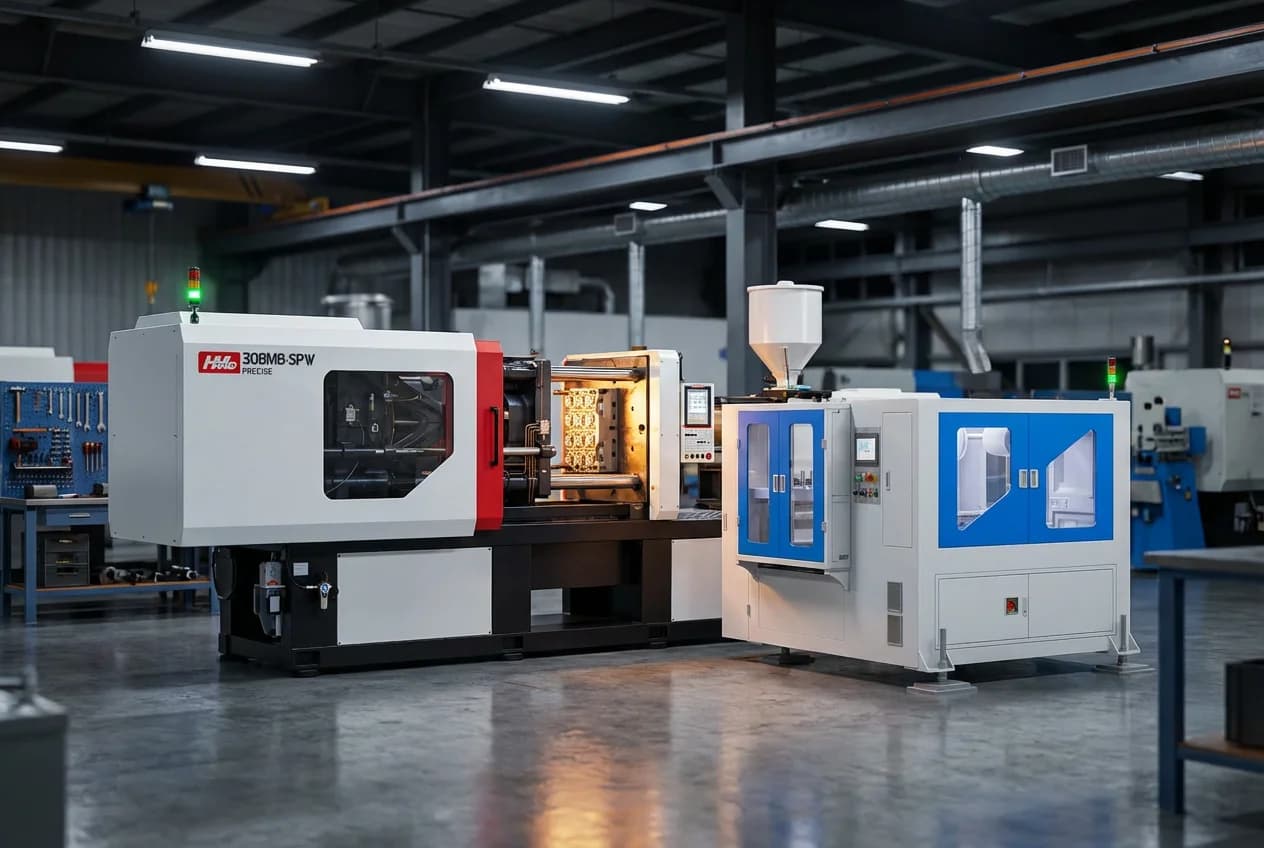
SPV5 machines on the production floor
Need Expert Advice?
Talk to our engineers about your specific production requirements. Free consultation.
Labor Cost Analysis and Automation ROI Calculation
The automation investment payback depends primarily on local labor cost and production volume. ROI framework for upgrading from semi-auto (Level 2) to full auto (Level 3): Additional equipment investment: USD 80,000-150,000. Labor savings: semi-auto requires 1 operator per machine across 3 shifts = 3.3 FTE per machine (accounting for weekends and leave). Full auto requires 0.5 operator per machine across 3 shifts = 1.65 FTE per machine. Net saving: 1.65 FTE per machine. At USD 800/month fully loaded labor cost (Middle East): annual saving = 1.65 x USD 800 x 12 = USD 15,840 per machine. Simple payback: USD 80,000 / USD 15,840 = 5.1 years. At USD 2,000/month (Turkey, Russia): annual saving = USD 39,600. Payback: 2.0 years. Additional automation benefits not captured in labor savings: consistent stacking quality (reduced packaging line jams), lower scrap from vision inspection (0.5-1.0 percent quality improvement), and 5-8 percent cycle time reduction from optimized robot movements versus manual handling. Including these productivity benefits reduces effective payback by 20-30 percent. The breakeven labor rate is approximately USD 400/month -- below this level, semi-auto is more economical regardless of production volume.
Robot Selection and Integration with HWAMDA SPV5 Machines
SWITEK robots are the standard automation partner for HWAMDA SPV5 thin-wall lines, available in configurations matched to specific production requirements. SWITEK SW Series swing-arm robots (USD 15,000-20,000): 0.8-1.2s pick-and-place cycle, suitable for Level 2 semi-auto with non-IML production. Payload 3-8 kg, adequate for 8-cavity thin-wall parts. SWITEK SP Series side-entry robots (USD 35,000-55,000): 0.5-0.8s in-mold time for label placement plus part removal, the standard choice for IML production. Label accuracy of plus or minus 0.3mm at placement speeds of 600-800mm travel time. Payload 5-12 kg, supporting up to 16-cavity IML configurations. SWITEK SH Series high-speed robots (USD 55,000-70,000): 0.4-0.6s in-mold time, for the fastest cycle applications below 3.5s. All SWITEK robots interface with the HWAMDA INOVA controller via Euromap 67 standard protocol, providing: mold-open signal, ejection signal, robot-in-mold permission, and robot-clear-of-mold confirmation. The INOVA controller's robot interface setup screen configures all timing parameters: robot entry delay after mold open (typically 0.05-0.1s), ejection trigger timing, and mold close authorization after robot clear signal. Integration commissioning typically requires 1-2 days with a SWITEK technician on-site.
Key Specs
- •Label accuracy of plus or minus 0.3mm at placement speeds of 600-800mm travel time.
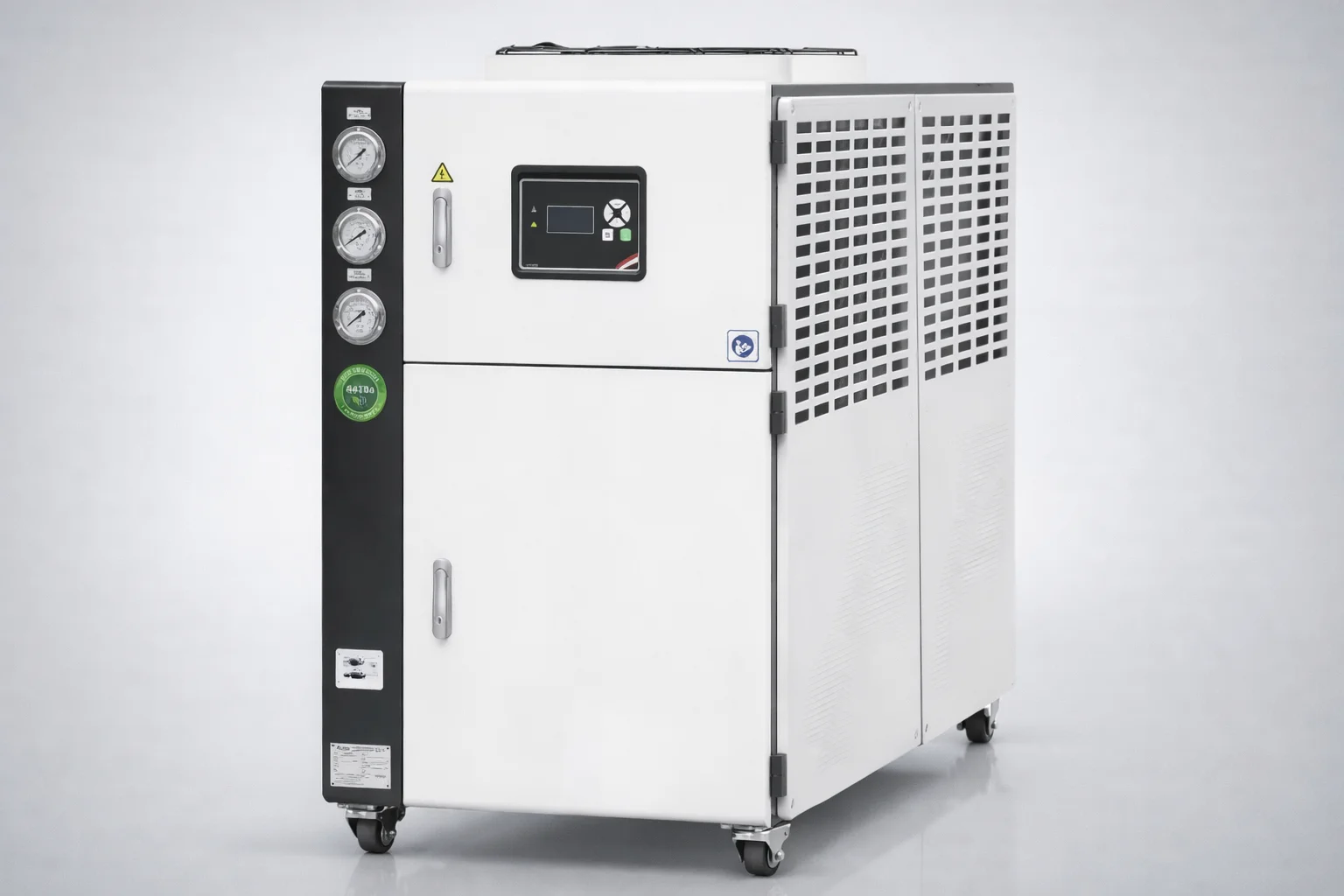
Industrial cooling system for injection molding
Scaling Automation: Phased Investment Strategy
HWAMDA recommends a phased automation strategy that matches investment to production growth, avoiding over-capitalization in the startup phase. Phase 1 (Year 1, USD 120,000-140,000): Install HMD 380M8-SPV with SWITEK swing-arm robot and basic conveyor. Run non-IML production at 4.0-4.5s cycle with 1 operator per machine. Establish market presence and customer base. Phase 2 (Year 2-3, additional USD 60,000-100,000): Upgrade to SWITEK side-entry IML robot, add label magazine system, and install automated stacking. Introduce IML products at premium pricing. Reduce operators to 0.5 per machine. Phase 3 (Year 3-5, additional USD 40,000-80,000): Add vision inspection, automated packaging, and MES integration. Achieve Level 4 full automation. Optimize for maximum OEE and minimum labor. The HWAMDA SPV5 machine platform supports this phased approach because the INOVA controller and machine interfaces are pre-configured for all automation levels -- the robot interface (Euromap 67), auxiliary output signals, and MES communication (OPC-UA) are standard on every SPV5 machine. This eliminates the need for controller upgrades between phases and ensures that the initial machine investment is protected through the full automation journey. Each phase should be justified by demonstrated demand: Phase 2 is triggered when annual volume exceeds 20 million parts, and Phase 3 when volume exceeds 40 million parts per line.
Frequently Asked Questions
Full automation (Level 3-4) pays back in 1.5-3 years when operator wages exceed USD 800/month and annual production exceeds 20 million parts. The additional investment of USD 80,000-150,000 over a semi-auto line saves 1.65 FTE per machine. Below USD 400/month labor cost, semi-auto is more economical. Include productivity benefits (5-8 percent cycle time improvement, 0.5-1.0 percent quality improvement) to reduce effective payback by 20-30 percent.
Related Guides
Ready to Start Your Project?
Get a free consultation and quotation for your thin-wall packaging production line.
Join 500+ manufacturers in 60+ countries who trust HWAMDA.
Get Free Quote