

OEE Calculation Framework for Thin-Wall Production
OEE = Availability x Performance x Quality, where each factor is expressed as a percentage. For HWAMDA SPV5 thin-wall production, the calculation for an 8-cavity yogurt cup line running 24/7: Availability = (Planned Production Time - Downtime) / Planned Production Time. Planned production time is 24 hours x 30 days = 720 hours/month. Downtime includes: mold changes (2-4 hours per change, 4-8 changes per month = 8-32 hours), material changes (0.5-1 hour each, 8-12 per month = 4-12 hours), unplanned stops (machine faults, mold repairs = 5-20 hours), and startup/shutdown waste time (0.5-1 hour per start = 4-8 hours). Typical availability: 92-97 percent (well-managed) versus 80-90 percent (poorly managed). Performance = (Ideal Cycle Time x Total Parts) / Running Time. Ideal cycle time for 8-cavity yogurt cups: 4.0s. If actual average cycle time is 4.3s due to minor stops and speed losses: Performance = 4.0/4.3 = 93 percent. Quality = Good Parts / Total Parts. Thin-wall quality rates: 98-99.5 percent (well-optimized) versus 95-97 percent (startup or unstable process). Combined OEE: optimized line = 0.95 x 0.93 x 0.99 = 87.4 percent; unoptimized = 0.85 x 0.88 x 0.96 = 71.8 percent.
Key Specs
- •Downtime includes: mold changes (2-4 hours per change, 4-8 changes per month = 8-32 hours), material changes (0.5-1 hour each, 8-12 per month = 4-12 hours), unplanned stops (machine faults, mold repairs = 5-20 hours), and startup/shutdown waste time (0.5-1 hour per start = 4-8 hours).
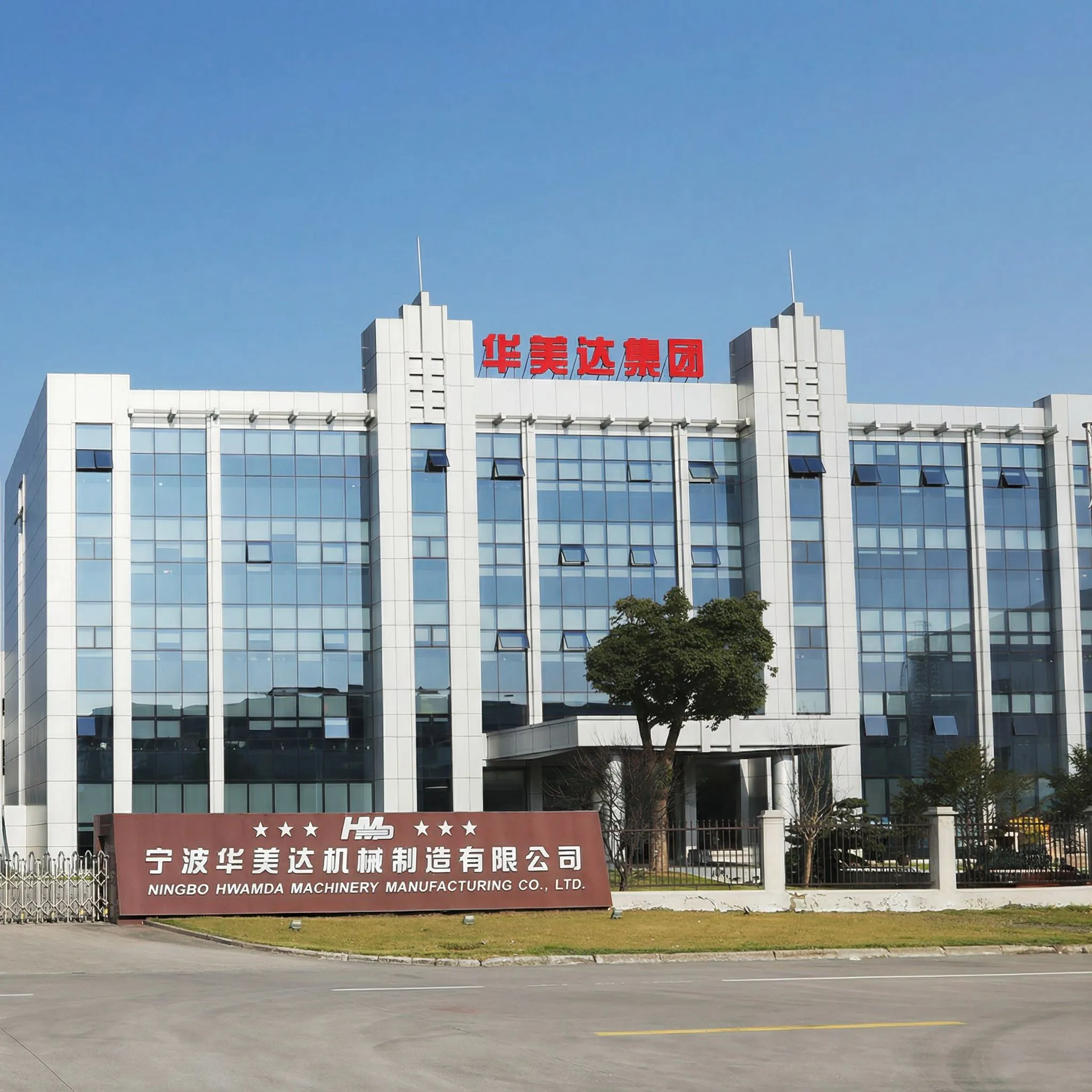
HWAMDA factory — quality manufacturing since 2003
Production Scheduling Strategies for Multi-Product Lines
Most HWAMDA SPV5 thin-wall production facilities run multiple products on shared machines, requiring scheduling strategies that balance changeover costs against inventory carrying costs. The Economic Lot Size (ELS) calculation determines the optimal production run length for each product: ELS = square root of (2 x Annual Demand x Changeover Cost / Annual Holding Cost per Unit). For a yogurt cup with annual demand of 50 million units, changeover cost of USD 800 (2 hours downtime at USD 400/hour lost margin), and holding cost of USD 0.001 per cup per year: ELS = square root of (2 x 50,000,000 x 800 / 0.001) = approximately 283,000 cups per batch, equivalent to 33 hours of production at 8,571 cups/hour on the HWAMDA HMD 380M8-SPV. Scheduling sequence optimization minimizes total changeover time: group similar products (same material, similar colors) in succession. Light-to-dark color sequencing reduces purging requirements: white to yellow to green to blue to red to black. Material changes (PP homo to PP random copolymer) should be batched separately, as resin changeover requires 15-20 minutes of purging (10-13 kg material waste). Use the INOVA controller's recipe system to store qualified parameters for each product, reducing process setup time from 30-45 minutes (manual) to 5-10 minutes (recipe recall).
Reducing Unplanned Downtime Through Preventive Maintenance
Unplanned downtime is the largest OEE loss on thin-wall production lines, accounting for 5-15 percent of available time on poorly maintained HWAMDA SPV5 machines versus less than 2 percent on well-maintained lines. The top 5 unplanned downtime causes and prevention strategies: 1. Hot runner heater failure (2-8 hours downtime): prevent by replacing heaters at 2 million shots and monitoring duty cycle trending on the INOVA controller. 2. Check ring wear causing weight variation (1-4 hours for diagnosis and replacement): prevent by replacing at 2 million shot intervals based on cushion SPC data. 3. Mold cooling blockage (1-2 hours for cleaning): prevent with quarterly descaling and monthly flow rate verification. 4. Hydraulic leak (2-6 hours for seal replacement): prevent by inspecting high-pressure connections weekly and replacing seals at annual overhaul. 5. Robot fault/cycle stop (0.5-2 hours): prevent by cleaning robot gripper mechanisms weekly and verifying sensor alignment monthly. Total preventive maintenance time budget: 4-6 hours per week scheduled during planned downtime (shift change, weekends) to prevent 10-20 hours per month of unplanned stops. ROI of preventive maintenance: USD 1,000-2,000 per month in parts and labor prevents USD 5,000-15,000 per month in lost production.
Key Specs
- •Hot runner heater failure (2-8 hours downtime): prevent by replacing heaters at 2 million shots and monitoring duty cycle trending on the INOVA controller.
- •Check ring wear causing weight variation (1-4 hours for diagnosis and replacement): prevent by replacing at 2 million shot intervals based on cushion SPC data.
- •Mold cooling blockage (1-2 hours for cleaning): prevent with quarterly descaling and monthly flow rate verification.
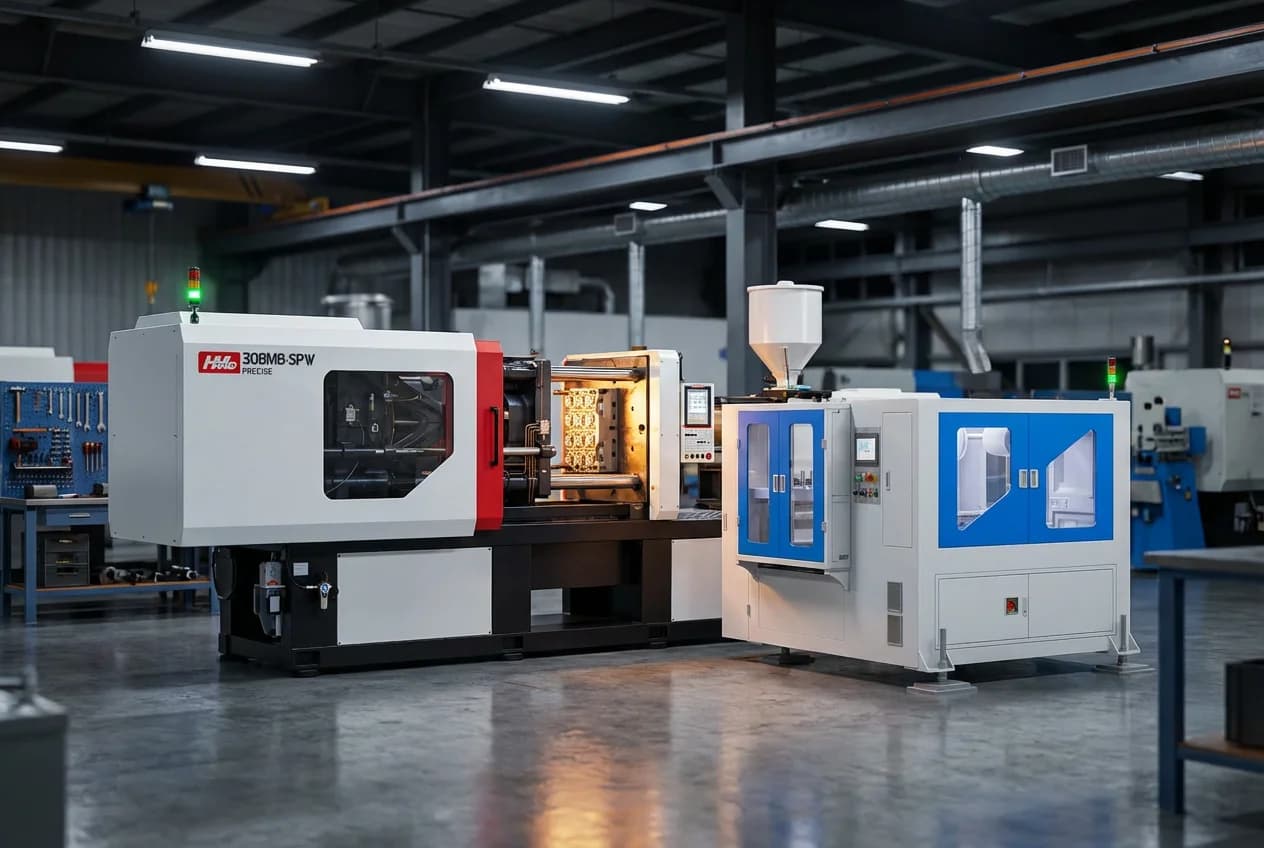
SPV5 machines on the production floor
Need Expert Advice?
Talk to our engineers about your specific production requirements. Free consultation.
Cycle Time Optimization Techniques
Cycle time directly impacts OEE performance rate and is the most controllable variable on HWAMDA SPV5 machines. A thin-wall cycle consists of: injection fill (0.15-0.25s), pack/hold (0.5-1.5s), cooling (1.5-3.0s), mold open (0.3-0.5s), ejection and robot handling (0.3-0.8s), and mold close (0.3-0.5s). Optimization priorities by impact: Cooling time reduction (largest component at 40-65 percent of cycle): optimize coolant temperature (reduce from 25 to 15 degrees C for PP saves 0.3-0.5s), improve cooling channel efficiency (conformal cooling saves 0.5-0.8s), use BeCu core inserts (saves 0.2-0.4s). Parallel movements via INOVA controller (saves 0.3-0.5s total): charging on fly (screw recovery during mold opening), ejection during mold opening, robot entry during ejection. Mold movement speed optimization: increase clamp speed to 1200 mm/s with proper deceleration profile to prevent impact (saves 0.1-0.2s). Hold time optimization through gate seal study: holding beyond gate freeze wastes time -- determine exact gate seal time and set hold 0.1s beyond that point. Cumulative cycle time reduction on an initial 4.5s cycle: 4.5 - 0.4 (cooling) - 0.4 (parallel movements) - 0.1 (mold speed) - 0.2 (hold time) = 3.4s, a 24 percent improvement yielding 32 percent more output per hour.
Quick Mold Change Systems and Changeover Reduction
Mold changeover time on HWAMDA SPV5 machines ranges from 45 minutes (manual clamping, manual connections) to 10-15 minutes (with quick mold change systems). SMED (Single Minute Exchange of Dies) methodology separates internal activities (requiring machine stopped) from external activities (performed while machine runs). External activities performed before machine stops: preheat the next mold to operating temperature (40-60 degrees C) using an external preheater, stage the mold on a mold change cart at the machine, load the new recipe on the INOVA controller, and pre-stage the correct material and masterbatch. Internal activities with quick mold change equipment: hydraulic clamp plates (Staubli or equivalent) reduce clamping from 15-20 minutes (24 bolts) to 1-2 minutes. Multi-coupling plates for water and air connections reduce hook-up from 10-15 minutes (12 individual connections) to 30 seconds (single plate engagement). Standard machine interface dimensions on HWAMDA SPV5: 560 x 560mm platen bolt pattern on HMD 380M8-SPV, maximum mold weight 3,500 kg. Investment for quick mold change system: USD 8,000-15,000 per machine for hydraulic clamping plus USD 3,000-6,000 for multi-coupling plates. Payback: if monthly changeovers total 20 hours reduced to 5 hours, the 15 hours recovered at USD 400/hour margin = USD 6,000/month, payback in 2-4 months.
Key Specs
- •Standard machine interface dimensions on HWAMDA SPV5: 560 x 560mm platen bolt pattern on HMD 380M8-SPV, maximum mold weight 3,500 kg.
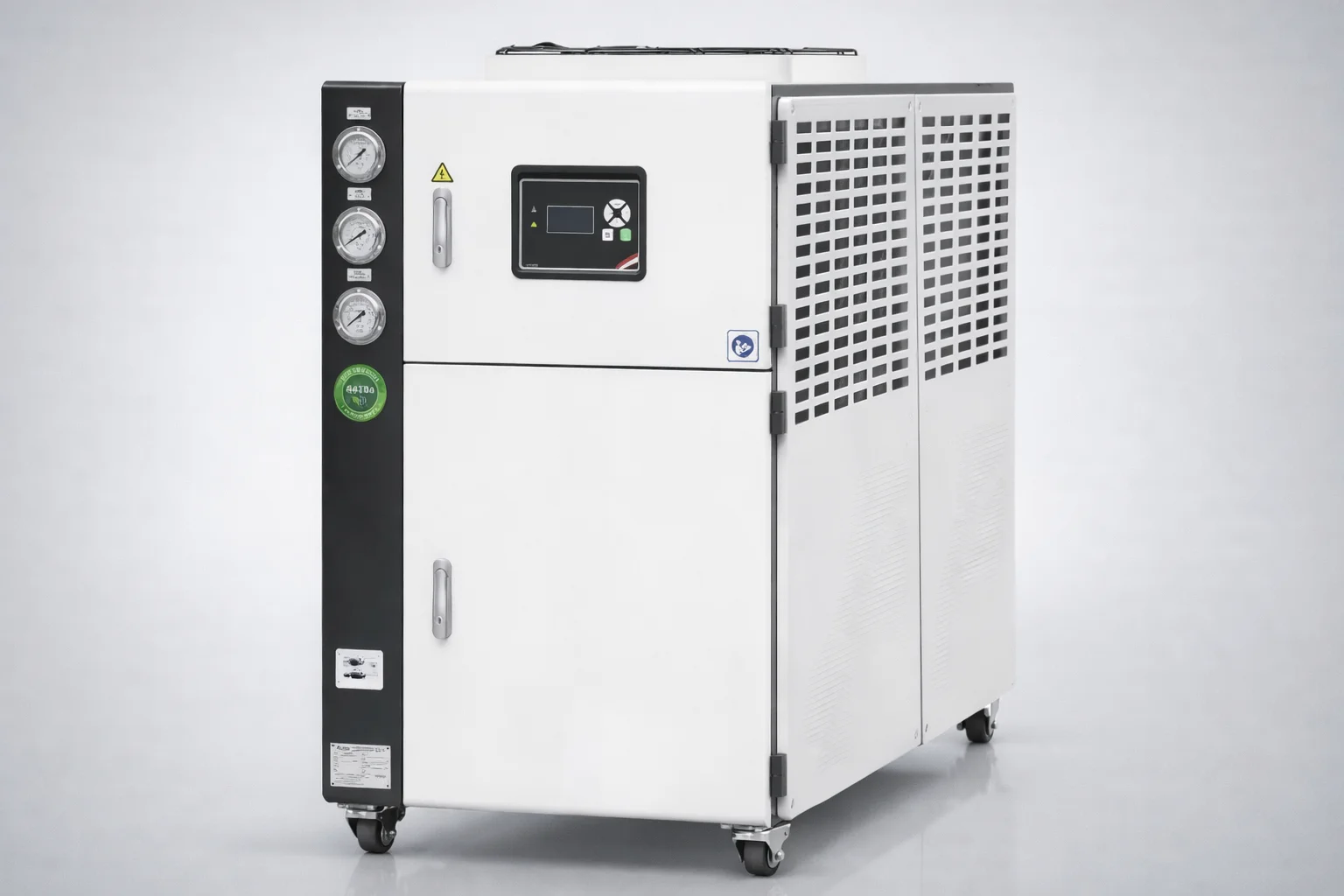
Industrial cooling system for injection molding
Data-Driven OEE Improvement Using INOVA Controller Analytics
The HWAMDA INOVA controller generates data that enables systematic OEE improvement when analyzed properly. Real-time data available: cycle time per shot (resolution 0.01s), machine state (running, stopped, fault, mold change), reject count (from automated sorting), and energy consumption per cycle. Export data via OPC-UA to an MES (Manufacturing Execution System) for automated OEE calculation and reporting. Minimum viable OEE tracking: log machine state changes (start, stop, fault) with timestamps and reason codes. Pareto analysis of downtime reasons identifies the top 3 causes responsible for 60-80 percent of losses. Weekly OEE review meetings should compare: actual versus target cycle time (identify performance losses), downtime breakdown by cause (identify availability losses), and scrap rate by defect type (identify quality losses). Target setting: establish a baseline OEE over 4 weeks of normal production, then set improvement targets of 2-3 percentage points per quarter. For a 4-machine facility, increasing OEE from 78 to 85 percent (7 points over 3 quarters) generates approximately 9 percent more output from existing capacity -- equivalent to the production of half an additional machine without capital investment. Annual value of this improvement: USD 50,000-120,000 per machine depending on product value and volume.
Frequently Asked Questions
Target 85 percent OEE as a realistic goal for HWAMDA SPV5 thin-wall production lines, comprising 95 percent availability, 93 percent performance, and 99 percent quality. World-class operations achieve 90-92 percent. Newly installed lines typically start at 65-75 percent and improve over 6-12 months through systematic optimization. Below 75 percent indicates significant losses in one or more OEE components requiring focused improvement.
Related Guides
Ready to Start Your Project?
Get a free consultation and quotation for your thin-wall packaging production line.
Join 500+ manufacturers in 60+ countries who trust HWAMDA.
Get Free Quote