

Chiller Sizing for High-Speed Thin-Wall Molds
Thin-wall molds running PP at 220-240°C melt temperature with 15-25°C mold surface temperature require aggressive cooling. The heat load formula is Q = m x Cp x delta-T, where m is the throughput in kg/hr. An 8-cavity yogurt cup mold producing 6g cups at 4.5s cycles generates roughly 38.4 kg/hr of PP, requiring approximately 18-22 kW of cooling capacity. For an HWAMDA HMD 400M8-SPV running food containers at 3,500-4,000 kN clamping force, specify a process chiller delivering 25-30 kW at 10°C supply water temperature with a flow rate of 80-120 L/min. Water-cooled chillers from brands like Piovan, Matsui, or Chinese suppliers such as Kaifeng offer COP values of 3.5-4.2, translating to energy costs of $0.8-1.2 per hour. Always install a secondary mold temperature controller (MTC) capable of maintaining +/-0.5°C stability, as temperature fluctuations beyond 1°C cause dimensional variation exceeding 0.02mm on 0.4mm wall cups.
Key Specs
- •Thin-wall molds running PP at 220-240°C melt temperature with 15-25°C mold surface temperature require aggressive cooling.
- •For an HWAMDA HMD 400M8-SPV running food containers at 3,500-4,000 kN clamping force, specify a process chiller delivering 25-30 kW at 10°C supply water temperature with a flow rate of 80-120 L/min.
- •Always install a secondary mold temperature controller (MTC) capable of maintaining +/-0.5°C stability, as temperature fluctuations beyond 1°C cause dimensional variation exceeding 0.02mm on 0.4mm wall cups.
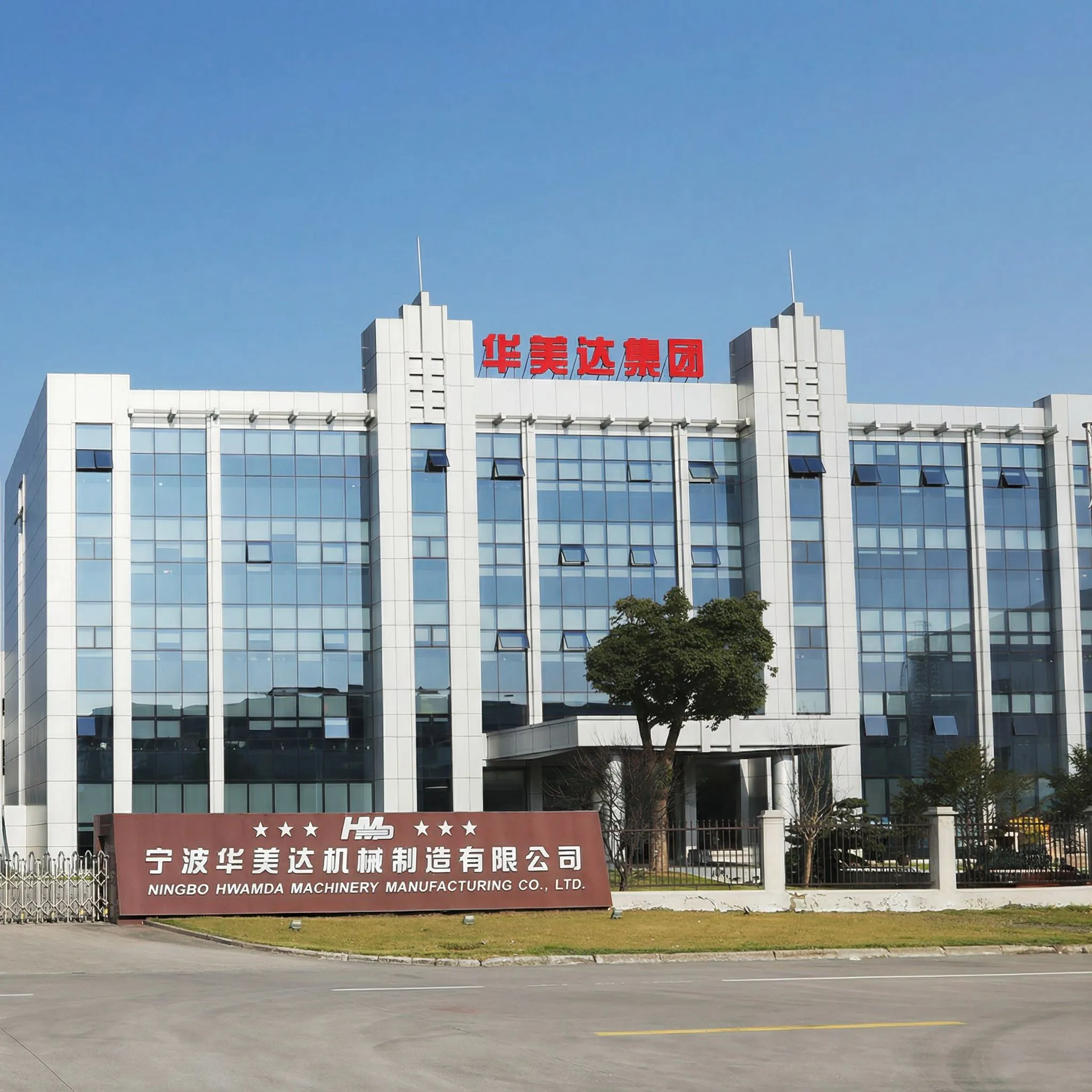
HWAMDA factory — quality manufacturing since 2003
Dehumidifying Dryers and Material Handling Systems
Standard PP grades for thin-wall packaging (MFI 50-80 g/10min) are not hygroscopic, but moisture on pellet surfaces from warehouse storage can still cause splay marks and reduced mechanical properties. A desiccant dryer with a throughput capacity of 50-80 kg/hr suits most SPV5 production cells. Set drying temperature at 80-90°C for PP with a residence time of 2-3 hours. For higher-MFI grades like SABIC FLOWPACT FPC70 or Borealis BorPure RJ766MO, reduce temperature to 75°C to prevent pellet bridging. Budget $3,000-6,000 for a standalone hopper dryer or $8,000-15,000 for a central drying system serving 2-4 machines. Vacuum loaders should deliver 300-500 kg/hr transfer rates with stainless steel contact surfaces for food-grade compliance. Gravimetric blenders from Maguire or Motan-Colortronic enable masterbatch dosing at +/-0.1% accuracy, critical when adding 1-3% white masterbatch for yogurt cup production or 0.5-1.0% nucleating agents for improved stiffness.
Conveyor and Stacking Systems for Finished Parts
Parts exiting a thin-wall mold at cycle times of 3.5-5.0 seconds require conveyor systems that prevent stacking damage and enable efficient downstream handling. For cup and container production on the HWAMDA SPV5 series, a SWITEK side-entry robot with 0.6-0.8 second take-out time feeds parts onto a flat belt conveyor running at 15-25 m/min. Conveyor width should match or exceed the mold pitch spacing, typically 800-1,200mm for 4-8 cavity molds. Automatic stacking and counting systems from SWITEK or Campetella integrate directly with the IML robot, stacking cups in nested columns of 25-50 units for cartoning. For food-grade applications, specify FDA/EU 10/2011-compliant belt materials in white polyurethane or silicone. Budget $5,000-12,000 for a basic belt conveyor with counting, or $25,000-45,000 for an integrated stacking-packaging system. Consider adding a vision inspection station between the robot and stacker to reject defective parts at speeds up to 800 parts/min.
Key Specs
- •Conveyor width should match or exceed the mold pitch spacing, typically 800-1,200mm for 4-8 cavity molds.
- •Automatic stacking and counting systems from SWITEK or Campetella integrate directly with the IML robot, stacking cups in nested columns of 25-50 units for cartoning.
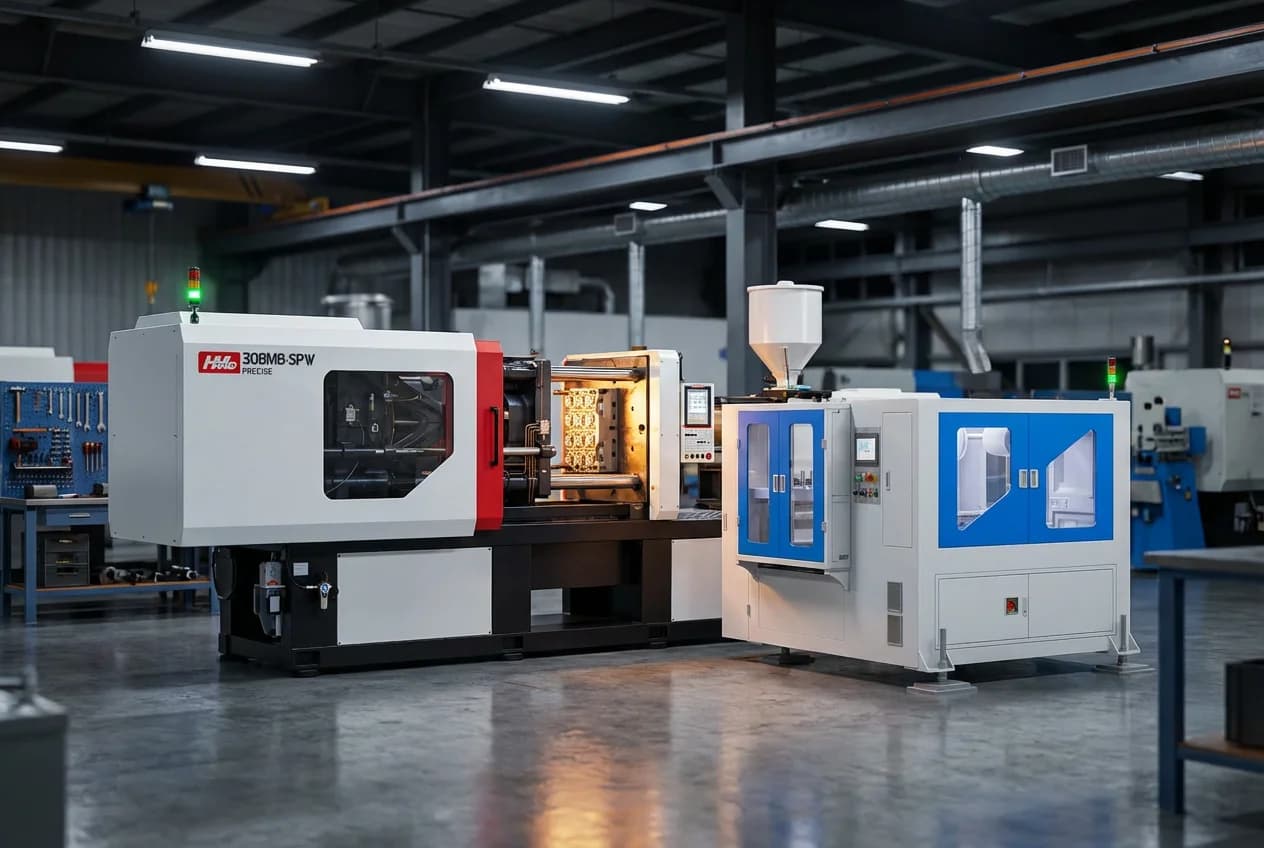
SPV5 machines on the production floor
Need Expert Advice?
Talk to our engineers about your specific production requirements. Free consultation.
Mold Temperature Controllers and Cooling Water Management
Precise mold temperature control is the single largest factor affecting thin-wall part quality after injection speed. For PP yogurt cups with 0.35-0.45mm walls, maintain cavity-side temperature at 18-25°C and core-side at 15-22°C using separate MTC circuits. Water flow through conformal cooling channels requires 3-5 bar pressure with turbulent flow (Reynolds number above 10,000) to achieve optimal heat transfer coefficients of 3,000-5,000 W/m2K. Specify pressurized water MTCs with 9-12 kW heating capacity and 24-36 kW cooling capacity from manufacturers like GWK, Tool-Temp, or Regloplas. Chinese alternatives from Aocheng or Ounensi offer comparable performance at 40-60% lower cost, priced at $2,000-4,500 per unit. Install flow meters on each cooling circuit to monitor water flow rates of 8-15 L/min per circuit. Cooling water treatment with corrosion inhibitors and biocides extends mold life and maintains heat transfer efficiency, preventing the 15-30% degradation in cooling performance that occurs with untreated water over 6-12 months.
Granulators and Scrap Recycling Equipment
Even with hot runner molds eliminating runner waste, thin-wall production generates 1-3% scrap from start-up purging, short shots during optimization, and rejected parts. A beside-the-press granulator with throughput capacity of 30-60 kg/hr handles scrap from a single SPV5 cell. Select screen sizes of 5-8mm for PP regrind that feeds directly back into the hopper via a vacuum loader. For food-grade applications where regrind cannot contact virgin material (as required by many food brand specifications), use a separate collection bin and sell scrap to recyclers at $0.3-0.5/kg for PP. Slow-speed granulators from Wanner, Rapid, or Zerma produce less dust and fines than high-speed models, yielding cleaner regrind with bulk density of 0.35-0.45 g/cm3. Budget $2,500-5,000 for a quality beside-the-press granulator. When food safety regulations permit up to 15-20% regrind incorporation (common for non-direct-food-contact lids and caps), the material cost savings reach $1,500-3,000 per month on a production line consuming 800-1,200 kg/day of PP at $1.2-1.5/kg.
Key Specs
- •Even with hot runner molds eliminating runner waste, thin-wall production generates 1-3% scrap from start-up purging, short shots during optimization, and rejected parts.
- •Select screen sizes of 5-8mm for PP regrind that feeds directly back into the hopper via a vacuum loader.
- •When food safety regulations permit up to 15-20% regrind incorporation (common for non-direct-food-contact lids and caps), the material cost savings reach $1,500-3,000 per month on a production line consuming 800-1,200 kg/day of PP at $1.2-1.5/kg.
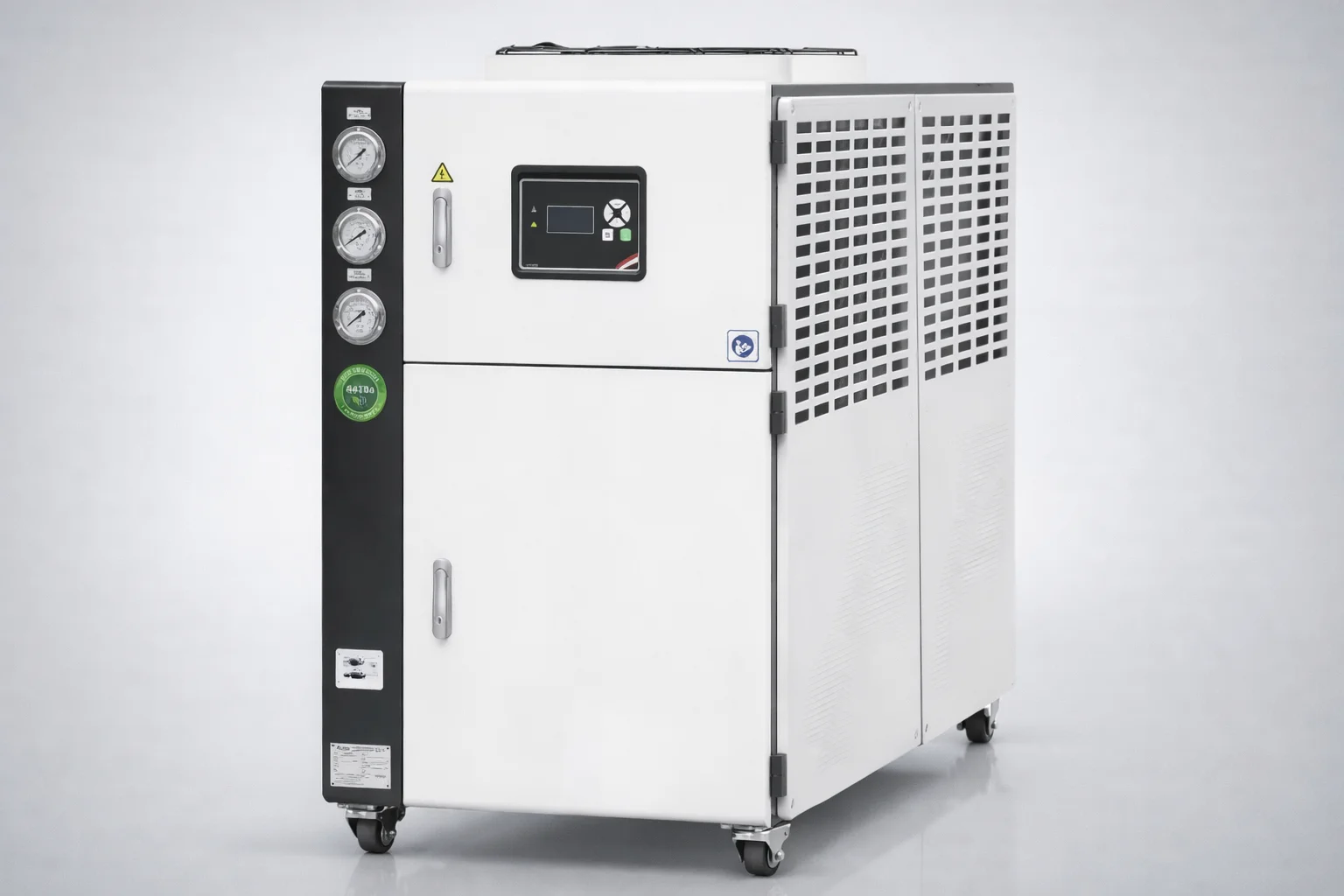
Industrial cooling system for injection molding
Complete Auxiliary Equipment Budget and Integration Planning
A fully equipped HWAMDA SPV5 thin-wall production cell requires $35,000-85,000 in auxiliary equipment, depending on automation level and brand selection. The breakdown for a typical 400-ton cell producing IML yogurt cups includes: process chiller $8,000-15,000, mold temperature controllers (2 units) $4,000-9,000, dehumidifying dryer $3,000-6,000, vacuum loaders $2,000-4,000, gravimetric blender $5,000-12,000, conveyor system $5,000-12,000, granulator $2,500-5,000, and central control integration $3,000-8,000. European auxiliary brands (Piovan, Motan, GWK) command 50-100% price premiums over Chinese equivalents but offer faster global service response. When purchasing a turnkey line from HWAMDA, request auxiliary equipment bundling for 10-15% package discounts. Ensure all auxiliaries operate on the same communication protocol (typically Euromap 77 or OPC-UA) for centralized monitoring through the INOVA controller. Plan factory utilities for 3-phase 380-440V power supply, compressed air at 6-8 bar, and cooling water infrastructure with 30-40% overcapacity for future expansion.
Frequently Asked Questions
For an HWAMDA HMD 400M8-SPV running 8-cavity PP food container molds, specify a process chiller with 25-30 kW cooling capacity at 10°C supply temperature and 80-120 L/min flow rate. This handles the approximately 20-25 kW heat load generated by processing 35-45 kg/hr of PP at 230°C melt temperature. Add a separate 12 kW mold temperature controller for each mold half. Total cooling infrastructure budget: $12,000-24,000.
Related Guides
Ready to Start Your Project?
Get a free consultation and quotation for your thin-wall packaging production line.
Join 500+ manufacturers in 60+ countries who trust HWAMDA.
Get Free Quote