

Stack Mold Working Principle
A stack mold contains two or more mold faces separated by additional parting lines, with all faces filling simultaneously from a central hot runner manifold. In a 2-level stack mold, cavities exist on both the fixed-side and moving-side parting faces, with a center section that opens in both directions during ejection. The injection unit feeds molten PP through a central sprue bushing into a manifold that distributes material equally to both levels. When the mold opens, both parting lines separate simultaneously, and parts are ejected from both faces. The center section is driven by a mechanical linkage or hydraulic cylinder that ensures equal and synchronized opening on both sides. The key mechanical advantage is that the projected area of the two mold faces acts on the clamping system separately because they are oriented in the same direction, so the required clamping force is only marginally higher than for a single-face mold, not doubled.
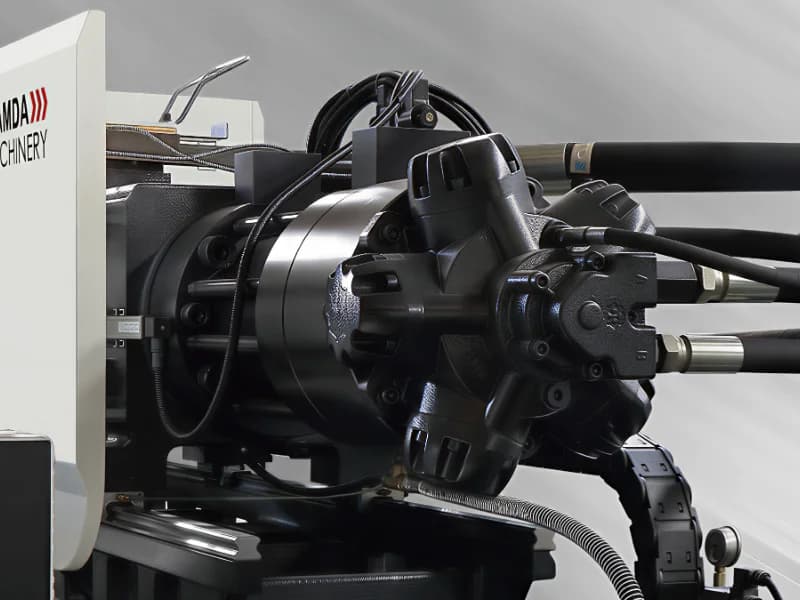
High-speed injection unit with linear guides
Advantages Over Single-Face Molds
The primary advantage of stack molds is doubling output without requiring a second machine. A 2-level stack mold with 16 cavities per face produces 32 parts per cycle compared to 16 parts from a single-face mold on the same machine. This doubles hourly output while using the same floor space, same operator, same material handling system, and same energy for clamping. The required clamping force increases by only 20 to 30 percent because the two mold faces share the clamping load rather than adding their projected areas. Injection volume requirements double, requiring a machine with sufficient plasticizing capacity and shot volume. The cycle time increase is typically 0.5 to 1.5 seconds due to longer mold opening stroke, but per-part cycle time is approximately halved. For a facility limited by floor space or machine count, stack molds provide the most cost-effective path to increased output. These advantages make stack molds the preferred configuration for operations where machine count is the primary constraint on output growth.
Hot Runner Design for Stack Molds
The hot runner system in a stack mold must route molten PP from a single injection nozzle through the fixed platen, through the center section, and into cavities on both mold faces while maintaining balanced flow. This requires a specialized manifold design with a central sprue bushing, a T-junction or multi-level distribution within the center section, and equal-length flow paths to all cavities. The valve gate system must actuate simultaneously on both faces to ensure balanced filling. Pressure drop through the extended hot runner path is higher than in single-face molds, typically 80 to 200 bar additional loss through the center-section routing. This must be accounted for in machine injection pressure specification. Temperature control of the center section is critical because it is surrounded by cooling mold steel on both sides. Independent heater zones and thermocouples in the center section maintain melt temperature within plus or minus 2 degrees Celsius across all flow paths.
Key Specs
- •Pressure drop through the extended hot runner path is higher than in single-face molds, typically 80 to 200 bar additional loss through the center-section routing.
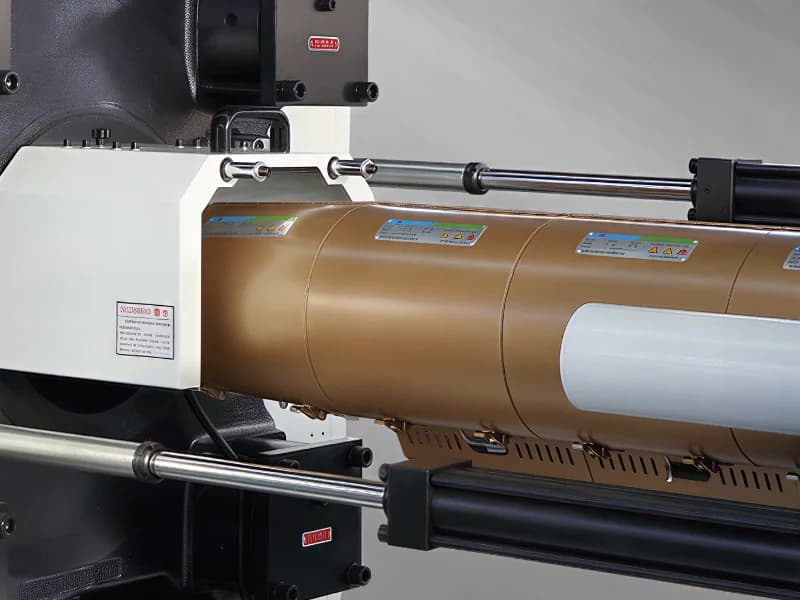
Servo-hydraulic drive system with energy recovery
Need Expert Advice?
Talk to our engineers about your specific production requirements. Free consultation.
Machine Requirements for Stack Molding
Stack molds place specific demands on the injection molding machine beyond standard thin-wall requirements. The daylight (maximum mold opening distance) must accommodate the stack mold height plus sufficient opening stroke for parts to eject from both faces. A 2-level stack mold for yogurt cups may require 1,200 to 1,600 mm of daylight, while a single-face mold needs only 800 to 1,000 mm. HWAMDA SPV5 machines provide maximum daylight of 1,160 to 1,390 mm depending on the model, suitable for stack molds on smaller containers. The injection volume must be sufficient for the combined shot weight of both mold faces. For a 32-cavity yogurt cup stack mold at 6 grams per cup, the total shot weight is approximately 192 grams plus runner volume, requiring injection volume of at least 250 cm3. Plasticizing capacity must match the higher throughput demand. The HMD 400M8-SPV with injection volumes up to 1,078 cm3 and plasticizing capacity exceeding 20 grams per second supports most stack mold configurations.
Application Examples in Food Packaging
Stack molds are most commonly used for small to medium-sized thin-wall packaging products where the individual cavity footprint is compact enough to fit multiple cavities per face within the available platen area. Yogurt cup molds with 16 cavities per face in a 2-level stack produce 32 cups per cycle on a 400 to 450 ton machine. Cup lid molds with 16 to 32 cavities per face are ideally suited for stack mold configurations due to the flat geometry of lids. Sauce cup molds with 24 to 32 cavities per face produce 48 to 64 cup-and-lid sets per cycle. Small round food containers up to 250 mL work well in stack configurations. Products less suited for stack molds include large containers above 500 mL, deep-draw products like yogurt pails, and IML containers where the IML robot must access the cavity from the side. HWAMDA evaluates each application to determine whether a stack or single-face configuration provides the best output-per-investment ratio.
Key Specs
- •Yogurt cup molds with 16 cavities per face in a 2-level stack produce 32 cups per cycle on a 400 to 450 ton machine.
- •Cup lid molds with 16 to 32 cavities per face are ideally suited for stack mold configurations due to the flat geometry of lids.
- •Sauce cup molds with 24 to 32 cavities per face produce 48 to 64 cup-and-lid sets per cycle.
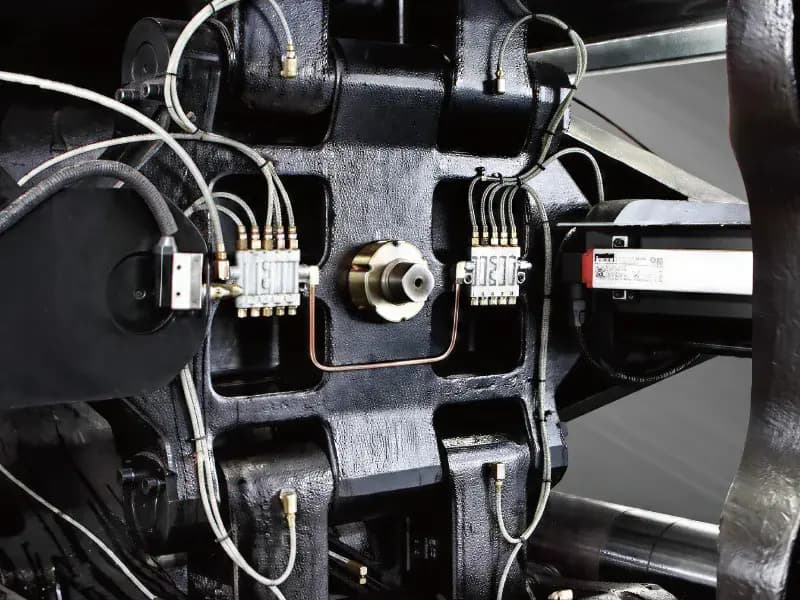
Toggle clamping unit — high rigidity for thin-wall molding
Cost-Benefit Analysis
A 2-level stack mold costs approximately 60 to 80 percent more than an equivalent single-face mold due to the additional mold face, center section mechanism, and extended hot runner system. However, the stack mold eliminates the need for a second machine, second set of auxiliaries, and additional operator, which would collectively cost 100,000 to 200,000 dollars or more. For a 16-cavity yogurt cup single-face mold priced at 80,000 to 150,000 dollars, the 2-level stack version producing 32 cups per cycle costs approximately 130,000 to 250,000 dollars. The incremental investment of 50,000 to 100,000 dollars doubles output while saving the full cost of a second machine line. At 3 million cups per month, the incremental revenue from the doubled output is approximately 75,000 to 90,000 dollars monthly, recovering the stack mold premium within 1 to 2 months. Stack molds are most economically justified for production volumes exceeding 5 million units per month.
Frequently Asked Questions
A 2-level stack mold doubles the number of cavities compared to a single-face mold on the same machine. With a slight increase in cycle time of 0.5 to 1.5 seconds for the additional opening stroke, the net output increase is approximately 80 to 95 percent. For example, a 16-cavity single-face yogurt cup mold producing 12,800 cups per hour at 4.5-second cycle would be replaced by a 32-cavity stack mold producing approximately 22,000 cups per hour at 5.2-second cycle, an increase of 72 percent.
Related Guides
Ready to Start Your Project?
Get a free consultation and quotation for your thin-wall packaging production line.
Join 500+ manufacturers in 60+ countries who trust HWAMDA.
Get Free Quote