

Root Causes of Warping
Non-uniform cooling is the primary cause of warping in thin-wall containers. When one side of the container cools faster than the other, differential shrinkage creates internal stresses that distort the part after ejection. In a yogurt cup, if the core (inside) cools 10°C hotter than the cavity (outside), the inside surface shrinks more after ejection, pulling the cup wall inward and creating an oval top rim. Molecular orientation from high-speed injection creates anisotropic shrinkage—the material shrinks more in the flow direction than perpendicular to it. In thin-wall parts with flow-length ratios above 100:1, this orientation effect is severe. Unbalanced gate placement causes pressure and temperature gradients across the part, leading to differential packing density. Premature ejection before sufficient cooling locks in residual stresses that release as warpage after the part leaves the mold. In multi-cavity molds, cavity-to-cavity variation in cooling creates differential warpage where some cavities produce perfectly round cups while others are consistently oval—this is a mold issue.
Key Specs
- •In a yogurt cup, if the core (inside) cools 10°C hotter than the cavity (outside), the inside surface shrinks more after ejection, pulling the cup wall inward and creating an oval top rim.
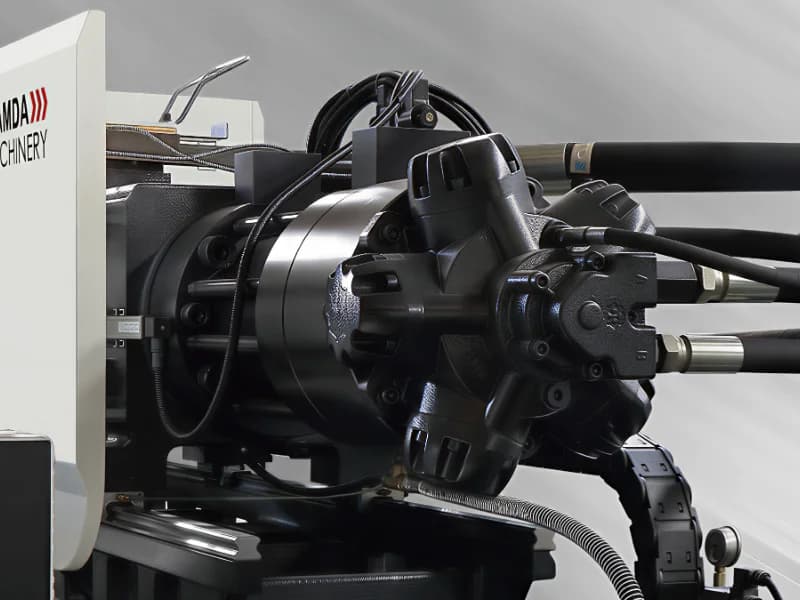
High-speed injection unit with linear guides
Cooling Uniformity Solutions
Ensure core and cavity cooling circuits maintain equal temperatures within ±2°C. Use separate temperature control units for core and cavity circuits to adjust independently. For yogurt cups and tall containers, the core cooling is typically the bottleneck—the small core diameter limits cooling channel size. Beryllium copper cores with thermal conductivity 4 times higher than steel dramatically improve core-side heat extraction. Conformal cooling channels machined to follow the part contour at uniform distance from the cavity surface eliminate hot spots that conventional straight-drilled channels cannot avoid. Baffle and bubbler inserts in core pins ensure turbulent flow in tight spaces. Maintain cooling water temperature at 15-25°C with flow rates achieving turbulent flow (Reynolds number above 10,000) in all circuits. Regular descaling and water treatment prevent channel blockage that causes gradual cooling deterioration. HWAMDA mold designs include optimized cooling layouts verified by thermal simulation. Monitoring cooling water quality with pH testing and conductivity measurement prevents channel degradation that causes increasing warpage and longer cycle times over months of continuous production.
Gate Design and Location
Center-bottom gating provides the most symmetrical fill pattern for round containers, promoting uniform molecular orientation and equal flow length in all directions. This is the standard gate location for yogurt cups, food containers, and beverage cups on HWAMDA molds. Gate diameter must be large enough for complete fill without excessive shear that degrades material properties. For rectangular containers and lids, multiple gate points may be needed to ensure uniform fill. Hot runner valve gates enable sequential filling that controls weld line position and minimizes orientation-induced warpage. Gate land length affects holding pressure transmission—too long a gate land causes the gate to freeze prematurely, resulting in insufficient packing in far-from-gate regions that warp toward the gate. HWAMDA uses Moldflow simulation to verify fill balance and predict warpage tendency during the mold design phase, making gate modifications before steel cutting. HWAMDA uses Moldflow simulation to verify fill balance and predict warpage tendency during mold design, identifying and correcting gate-related warpage issues before any steel is cut.
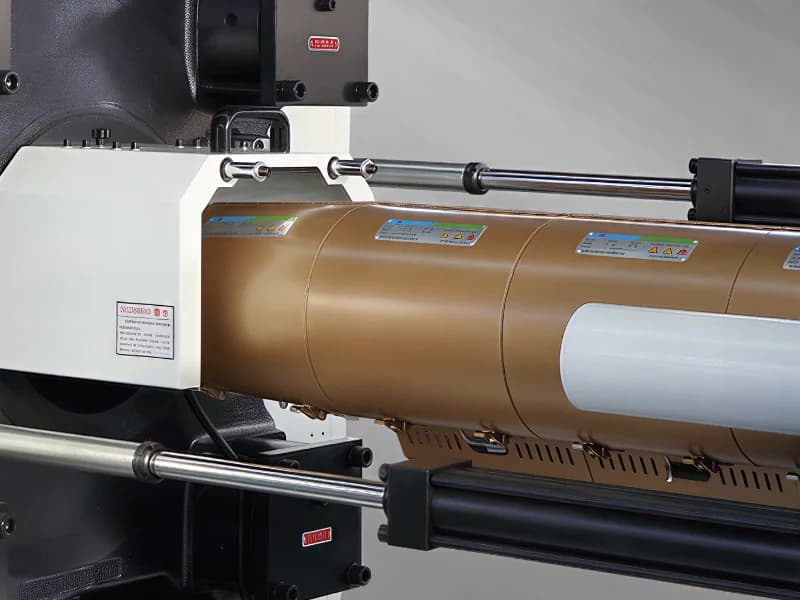
Servo-hydraulic drive system with energy recovery
Need Expert Advice?
Talk to our engineers about your specific production requirements. Free consultation.
Process Parameter Adjustments
Holding (packing) pressure and time have the strongest influence on warpage among process parameters. Insufficient holding pressure causes sink marks and inward warpage, while excessive holding overpacks near-gate regions causing outward warpage. Optimize holding pressure by incrementally increasing from a low value until part weight stabilizes—this is the minimum effective holding pressure. Cooling time is often set too short to achieve target cycle times, resulting in parts that are too hot at ejection (above 80-90°C) and warp during post-mold cooling. The optimal approach is to reduce cooling time only after implementing mold cooling improvements (BeCu inserts, conformal cooling) rather than compromising part quality. Mold temperature affects crystallization—higher mold temperatures (40-50°C vs 20-30°C) promote more uniform crystallization and reduce orientation-induced warpage at the cost of slightly longer cycle time. HWAMDA recommends systematic DOE (Design of Experiment) trials to find the optimal balance. Finding the optimal balance between cycle time and part quality requires systematic experimentation, evaluating each parameter change against both productivity and quality metrics simultaneously.
Material Grade Selection
PP grades with balanced shrinkage characteristics minimize warpage tendency. Random copolymer PP has lower and more isotropic shrinkage than homopolymer PP, making it preferred for containers where dimensional stability is critical. Nucleated PP grades crystallize more uniformly, reducing the differential crystallization that causes warpage in thick-thin transitions. High-flow PP grades (MFI 40-80) fill at lower pressures, reducing molecular orientation and orientation-induced warpage compared to lower-flow grades that require extreme injection speeds. Material suppliers offer warpage-optimized grades specifically for thin-wall packaging—consult with your resin supplier about grades formulated for minimum warpage. Avoid mixing PP grades or using regrind above 10-15% of total shot weight, as inconsistent material properties amplify warpage variability from shot to shot. Material suppliers offer warpage-optimized thin-wall grades with balanced flow and shrinkage properties—consult your resin supplier specifically about grades formulated for minimum warpage in injection molding. These recommendations should be validated against your specific product requirements through systematic material trials, as performance can vary with container geometry and processing conditions.
Key Specs
- •Avoid mixing PP grades or using regrind above 10-15% of total shot weight, as inconsistent material properties amplify warpage variability from shot to shot.
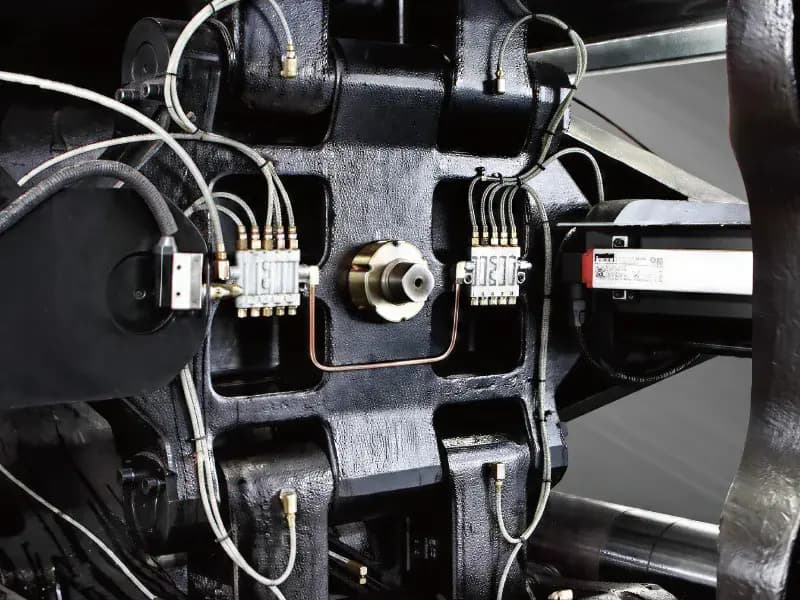
Toggle clamping unit — high rigidity for thin-wall molding
Mold Design Modifications
If warpage persists after process optimization, mold modifications may be necessary. Adding cooling channels to hot areas identified by thermal camera inspection of parts immediately after ejection targets the root cause directly. Increasing core diameter or adding BeCu core inserts improves core-side cooling for tall containers like yogurt cups and milk tea cups. Mold venting affects fill uniformity—inadequate venting causes trapped air that creates localized pressure differences and uneven packing. Ensure vent depths of 0.02-0.03mm for PP at all parting line locations, especially at the last-fill areas. Ejection system modifications can reduce ejection-induced warpage: use stripper plate ejection instead of pin ejection for flat containers, increase the number of ejector pins to distribute ejection force evenly, and add air-assist ejection to reduce mechanical stress during part removal. HWAMDA provides warpage analysis and mold modification recommendations as part of after-sales technical support. HWAMDA provides warpage analysis and mold modification recommendations as part of after-sales support, leveraging experience from hundreds of similar mold optimization projects worldwide.
Frequently Asked Questions
Oval yogurt cups are caused by non-uniform cooling between the core and cavity sides, combined with molecular orientation from the injection fill pattern. The most common fix is improving core cooling—install BeCu core inserts, increase cooling water flow rate, and lower cooling water temperature. Verify that core and cavity temperatures are within ±2°C by measuring with a surface pyrometer. Also check that holding pressure is sufficient to pack the part uniformly. HWAMDA mold designs include optimized cooling for roundness control. HWAMDA mold designs include optimized cooling verified by thermal simulation to prevent oval distortion, which is the most common warranty claim for yogurt cup molds. Also check holding pressure levels, as insufficient packing contributes to post-mold shrinkage pulling cup walls out of round.
Related Guides
Ready to Start Your Project?
Get a free consultation and quotation for your thin-wall packaging production line.
Join 500+ manufacturers in 60+ countries who trust HWAMDA.
Get Free Quote