

Injection Speed and Pressure Requirements
Wall thickness is the primary determinant of required injection speed. For walls of 0.3 to 0.5 mm, injection speeds of 500 to over 1,000 mm/s are necessary to fill the cavity before the melt front freezes. For 0.5 to 0.8 mm walls, speeds of 300 to 700 mm/s are typical. Walls of 0.8 to 1.2 mm require 200 to 500 mm/s. HWAMDA SPV5 machines achieve these speeds through servo-hydraulic accumulator systems that store pressurized hydraulic fluid and release it in a burst during injection. The HMD 270M8-SPV delivers 368 mm/s injection speed at 177 MPa pressure, while larger models like the HMD 400M8-SPV reach 442 mm/s at 164 MPa with a 60 mm screw diameter. Injection pressure requirements range from 1,500 to 2,400 bar depending on wall thickness, flow path length, and the number of cavities. The injection unit's double rod cylinder design and linear guide system minimize friction, maximizing the effective speed and pressure delivered to the melt front.
Key Specs
- •For walls of 0.3 to 0.5 mm, injection speeds of 500 to over 1,000 mm/s are necessary to fill the cavity before the melt front freezes.
- •For 0.5 to 0.8 mm walls, speeds of 300 to 700 mm/s are typical.
- •Walls of 0.8 to 1.2 mm require 200 to 500 mm/s.
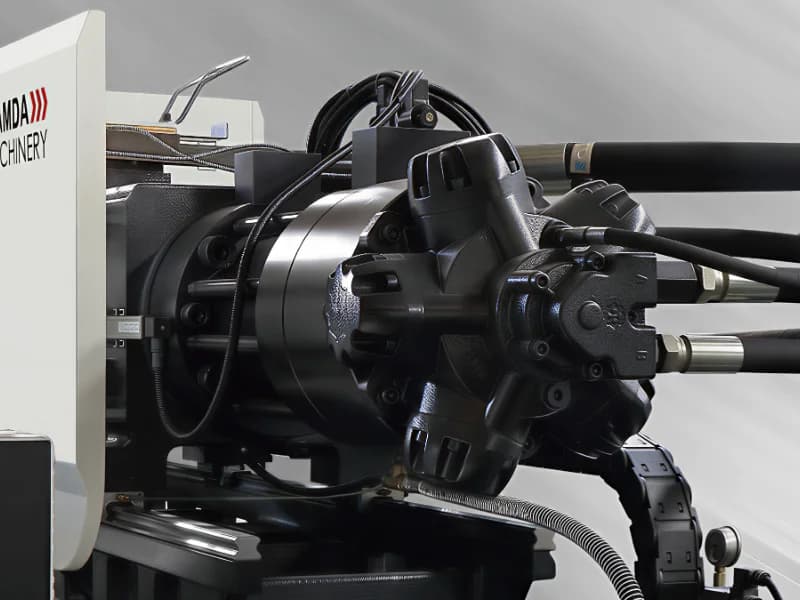
High-speed injection unit with linear guides
Melt Temperature and Barrel Profiling
Food-grade PP for thin-wall packaging is processed at melt temperatures of 220 to 260 degrees Celsius, with barrel zone profiling that gradually increases temperature from the feed zone to the nozzle. A typical profile for PP thin-wall molding uses 200 to 210 degrees Celsius at the feed zone, 220 to 240 degrees at the compression zone, 240 to 260 degrees at the metering zone, and 240 to 250 degrees at the nozzle. Higher melt temperatures reduce viscosity and improve flow but increase cooling time and risk thermal degradation. HWAMDA SPV5 machines provide 6 temperature control zones with infrared heating bands that improve plasticizing capacity and temperature uniformity. The screw L/D ratios of 23:1 to 25:1 across the SPV5 range ensure thorough melting and mixing of the PP granules. Screw speeds of up to 300 to 350 rpm with high-speed hydraulic motors provide plasticizing capacity sufficient for the rapid shot-to-shot demands of thin-wall production.
Cooling Time Optimization Strategies
Cooling time is the dominant component of the injection molding cycle, typically accounting for 60 to 80 percent of total cycle time. In thin-wall molding, cooling time is proportional to the square of the wall thickness, meaning a 50 percent reduction in wall thickness reduces cooling time by 75 percent. This fundamental relationship is why thin-wall parts can be produced with cycle times of 3 to 6 seconds versus 15 to 30 seconds for standard-wall parts. Optimization strategies include maximizing coolant flow rate through mold circuits to maintain turbulent flow conditions with Reynolds numbers above 10,000, minimizing coolant temperature to 8 to 15 degrees Celsius while avoiding condensation, and using BeCu inserts in thermally critical zones to increase local heat transfer rates. The mold design should minimize the distance between the cooling channel and the cavity surface, ideally 8 to 15 mm, while maintaining structural integrity. HWAMDA's mold engineering team uses thermal simulation to optimize cooling channel layout for each specific container geometry.
Key Specs
- •The mold design should minimize the distance between the cooling channel and the cavity surface, ideally 8 to 15 mm, while maintaining structural integrity.
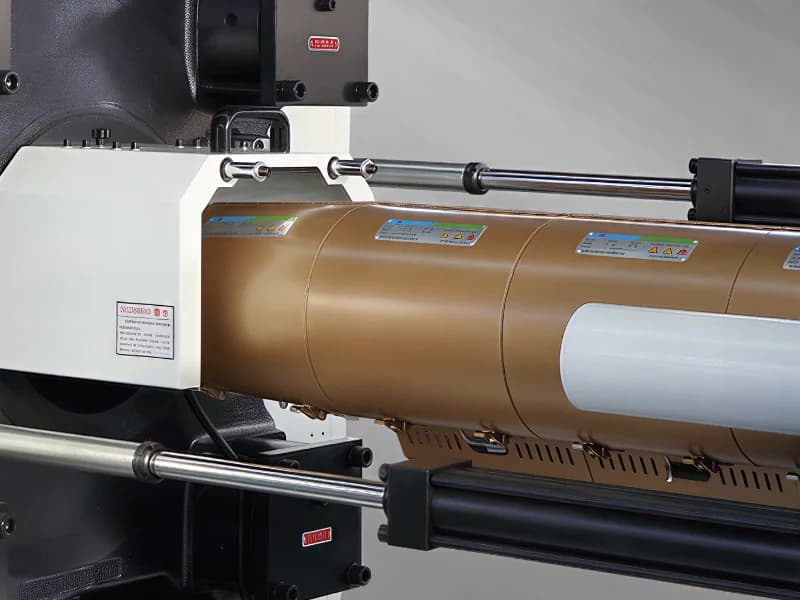
Servo-hydraulic drive system with energy recovery
Need Expert Advice?
Talk to our engineers about your specific production requirements. Free consultation.
Process Window for Thin-Wall Parts
The process window for thin-wall injection molding is inherently narrow compared to standard-wall molding, requiring tighter machine control and more frequent monitoring. Small variations in melt temperature, injection speed, or cooling time can produce visible defects on finished containers. A typical process window for PP yogurt cup production spans approximately plus or minus 5 degrees Celsius in melt temperature, plus or minus 10 percent in injection speed, and plus or minus 0.3 seconds in cooling time before defects appear. Operating consistently within this window requires the machine controller to maintain shot-to-shot repeatability better than plus or minus 0.5 percent in part weight and plus or minus 0.1 seconds in total cycle time. The HWAMDA INOVA controller provides the closed-loop precision needed for stable production within these tight tolerances, continuously adjusting injection velocity, switchover pressure, and packing profile to compensate for minor material and thermal variations. Process window mapping during mold trials (T1, T2, T3) establishes the documented safe operating envelope for each mold and material combination.
Common Defects and Corrective Actions
Short shots (incomplete filling) are the most common defect in thin-wall molding, caused by insufficient injection speed, low melt temperature, or inadequate venting. The corrective action is to increase injection speed, raise melt temperature by 5 to 10 degrees, or clean/deepen vent channels. Flash occurs when the melt enters the parting line gap, typically caused by excessive injection pressure, insufficient clamping force, or worn mold surfaces. Reducing packing pressure or inspecting mold alignment resolves this issue. Warpage results from uneven cooling, typically when one side of the container cools faster than the other. Balancing core and cavity temperature or adjusting cooling circuit flow rates corrects warpage. Burn marks appear at the end of flow paths where trapped air compresses and ignites, requiring improved venting or reduced injection speed in the final filling phase. Sink marks are rare in true thin-wall parts but can appear at thicker sections like ribs or gate areas.
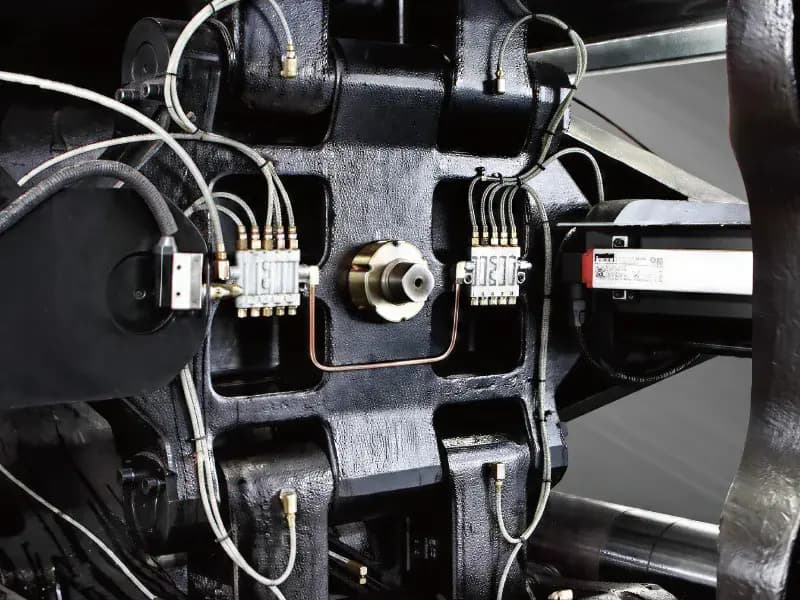
Toggle clamping unit — high rigidity for thin-wall molding
Process Monitoring and Quality Control
Production-level quality control for thin-wall packaging relies on monitoring key process parameters and product characteristics in real time throughout every production shift. The HWAMDA INOVA controller logs injection speed profile, peak injection pressure, switchover position, cushion value, cycle time, and all barrel zone temperatures for every shot, creating a complete process record. Deviations from the established process window trigger visual and audible alarms or automatic part diversion to reject bins. Statistical Process Control software tracks cavity-to-cavity weight variation over time, targeting Cpk values above 1.33 for all critical dimensions to ensure statistically capable production. In-line weight monitoring using precision digital scales samples parts at defined intervals to verify weight consistency across all cavities. Vision inspection systems can be integrated to detect visual defects including short shots, flash, discoloration, burn marks, and IML label misalignment at rates of 100 percent part inspection for applications requiring the highest quality assurance levels. These monitoring systems form the foundation for ISO 9001 and FSSC 22000 food safety management documentation.
Frequently Asked Questions
The required injection speed depends directly on wall thickness. For walls of 0.3 to 0.5 mm typical of yogurt cups and sauce cups, injection speeds of 500 to over 1,000 mm/s are required. For 0.5 to 0.8 mm walls used in milk tea cups and food containers, 300 to 700 mm/s is typical. HWAMDA SPV5 machines deliver injection speeds of 368 to 517 mm/s depending on the model, with accumulator systems providing the instantaneous high-flow burst needed to fill thin cavities before freeze-off.
Related Guides
Ready to Start Your Project?
Get a free consultation and quotation for your thin-wall packaging production line.
Join 500+ manufacturers in 60+ countries who trust HWAMDA.
Get Free Quote