

Key Process Parameters for SPC Monitoring in Thin-Wall Molding
Selecting the right parameters for SPC monitoring is critical -- monitoring too few misses process shifts, while monitoring too many creates alarm fatigue. For thin-wall food packaging on HWAMDA SPV5 machines, the recommended primary parameters are: peak injection pressure (most sensitive indicator of material viscosity change and check ring condition, normal variation plus or minus 2-3 percent), fill time (direct indicator of flow behavior, normal variation plus or minus 0.01-0.02s), cushion position at transfer (indicates shot volume consistency, normal variation plus or minus 0.3-0.5mm), plasticizing time (indicates screw/barrel wear and material feeding consistency, normal variation plus or minus 0.05-0.10s), and cycle time (indicates overall process stability, normal variation plus or minus 0.03-0.05s). Secondary parameters monitored for trend analysis include: melt temperature at nozzle (plus or minus 2 degrees C), barrel heating zone power draw (plus or minus 5 percentage points duty cycle), and hydraulic oil temperature (40-50 degrees C range). The INOVA controller captures all parameters at 1ms resolution and calculates running statistics (mean, range, standard deviation) over configurable sample groups of 5-25 consecutive shots.
Key Specs
- •For thin-wall food packaging on HWAMDA SPV5 machines, the recommended primary parameters are: peak injection pressure (most sensitive indicator of material viscosity change and check ring condition, normal variation plus or minus 2-3 percent), fill time (direct indicator of flow behavior, normal variation plus or minus 0.01-0.02s), cushion position at transfer (indicates shot volume consistency, normal variation plus or minus 0.3-0.5mm), plasticizing time (indicates screw/barrel wear and material feeding consistency, normal variation plus or minus 0.05-0.10s), and cycle time (indicates overall process stability, normal variation plus or minus 0.03-0.05s).
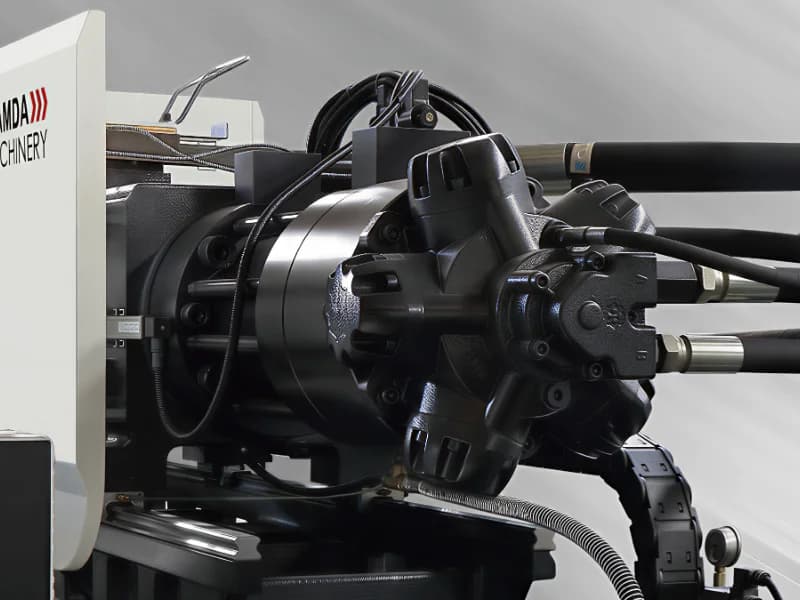
High-speed injection unit with linear guides
Control Chart Setup and Interpretation
X-bar and R charts (or X-bar and S charts for subgroup sizes above 10) are the primary SPC tools for injection molding. On HWAMDA SPV5 machines, the INOVA controller generates these charts automatically. Setup procedure: run a 50-shot capability study under stable conditions, calculate the process mean (X-bar-bar) and average range (R-bar) across 10 subgroups of 5 shots each. Control limits are calculated: UCL = X-bar-bar + A2 x R-bar, LCL = X-bar-bar - A2 x R-bar, where A2 = 0.577 for n=5. For a yogurt cup mold with mean peak injection pressure of 142 MPa and average range of 3.2 MPa: UCL = 142 + 0.577 x 3.2 = 143.85 MPa, LCL = 142 - 1.85 = 140.15 MPa. Western Electric rules detect non-random patterns: 1 point beyond 3-sigma (immediate investigation), 2 of 3 consecutive points beyond 2-sigma (warning), 4 of 5 consecutive points beyond 1-sigma (trending), and 8 consecutive points on one side of the centerline (shift). The INOVA controller applies these rules automatically and triggers color-coded alerts: yellow for warning, red for stop conditions.
Process Capability Analysis (Cp and Cpk)
Process capability indices quantify how well the process fits within specification limits. For thin-wall food packaging on HWAMDA SPV5 machines, the critical specification is typically part weight: a 6g yogurt cup with a customer specification of 5.7-6.3g (plus or minus 5 percent). Calculate Cp = (USL - LSL) / (6 x sigma). If the process standard deviation is 0.08g: Cp = 0.6 / 0.48 = 1.25. Cpk accounts for centering: if the process mean is 6.05g, Cpk = min[(6.3 - 6.05)/(3 x 0.08), (6.05 - 5.7)/(3 x 0.08)] = min[1.04, 1.46] = 1.04. Target Cpk values: 1.33 minimum for standard food packaging (99.994 percent within spec, 63 ppm defect rate), 1.67 for premium/export markets (0.6 ppm defect rate). Achieving Cpk above 1.33 on HWAMDA SPV5 machines requires: check ring in good condition (cushion variation below 0.5mm), material from a single lot (MFI variation below plus or minus 2 g/10min), stable mold temperature (plus or minus 1 degree C), and consistent melt temperature (plus or minus 2 degrees C). Process capability studies should be repeated whenever a significant change occurs: new material lot, mold maintenance, machine service, or parameter adjustment.
Key Specs
- •Achieving Cpk above 1.33 on HWAMDA SPV5 machines requires: check ring in good condition (cushion variation below 0.5mm), material from a single lot (MFI variation below plus or minus 2 g/10min), stable mold temperature (plus or minus 1 degree C), and consistent melt temperature (plus or minus 2 degrees C).
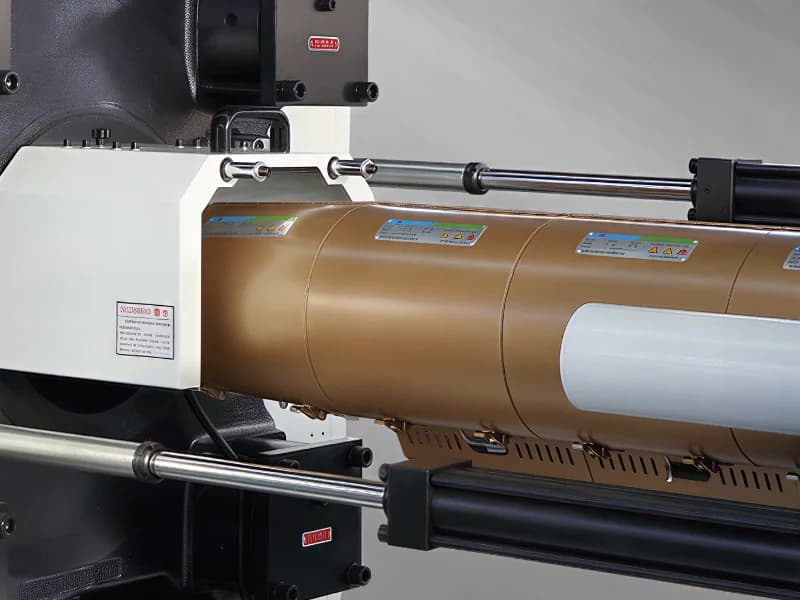
Servo-hydraulic drive system with energy recovery
Need Expert Advice?
Talk to our engineers about your specific production requirements. Free consultation.
Automated Quality Sorting Based on SPC Data
The INOVA controller on HWAMDA SPV5 machines can automatically segregate suspect parts based on real-time process parameter monitoring. When any monitored parameter exceeds its specification limit (not just the control limit), the controller sends a digital output signal to the SWITEK robot, which diverts that shot's parts to a separate reject container. This parameter-based sorting catches defects that visual inspection misses: a yogurt cup that is 0.2g underweight due to a momentary check ring leak looks normal but fails the stacking strength requirement. Configuration: set specification limits for each monitored parameter (tighter than control limits, representing the boundary between acceptable and rejectable product). Typical reject trigger conditions for yogurt cups: peak injection pressure deviating more than 5 percent from setpoint, fill time exceeding plus or minus 0.05s from target, cushion deviating more than 1.0mm from target, or cycle time exceeding the target by more than 0.3s. False reject rate with properly calibrated limits is 0.5-2.0 percent -- these parts are quarantined for manual inspection and can be released if they pass dimensional and weight checks. The reject signal can also trigger automatic sample retention for quality lab analysis.
Long-Term SPC Data Analysis for Preventive Maintenance
SPC data accumulated over weeks and months reveals gradual machine and mold wear patterns that justify preventive maintenance before failures occur. On HWAMDA SPV5 machines, export SPC data from the INOVA controller monthly and analyze trends in: plasticizing time -- a progressive increase of 0.1-0.2s over 6 months indicates screw or barrel wear requiring measurement and potential replacement. Cushion drift -- a gradual shift of 0.5-1.0mm over 3-6 months signals check ring wear, confirmed by measuring cushion variation (standard deviation increase from 0.3mm to 0.8mm). Peak injection pressure increase -- a 5-10 percent rise over 3 months may indicate hot runner nozzle restriction from carbon buildup, especially if correlated with specific cavity weight reduction. Heating zone duty cycle increase -- a zone running at 90-100 percent duty versus 50-60 percent baseline indicates heater element degradation or thermocouple drift, preventable through replacement before failure. Correlate SPC trends with mold shot count to establish wear intervals: if check ring data consistently degrades at 2 million shots, schedule replacement at 1.8 million shots to avoid unplanned downtime. This data-driven maintenance approach reduces unplanned stops by 60-80 percent on typical thin-wall production lines.
Key Specs
- •Cushion drift -- a gradual shift of 0.5-1.0mm over 3-6 months signals check ring wear, confirmed by measuring cushion variation (standard deviation increase from 0.3mm to 0.8mm).
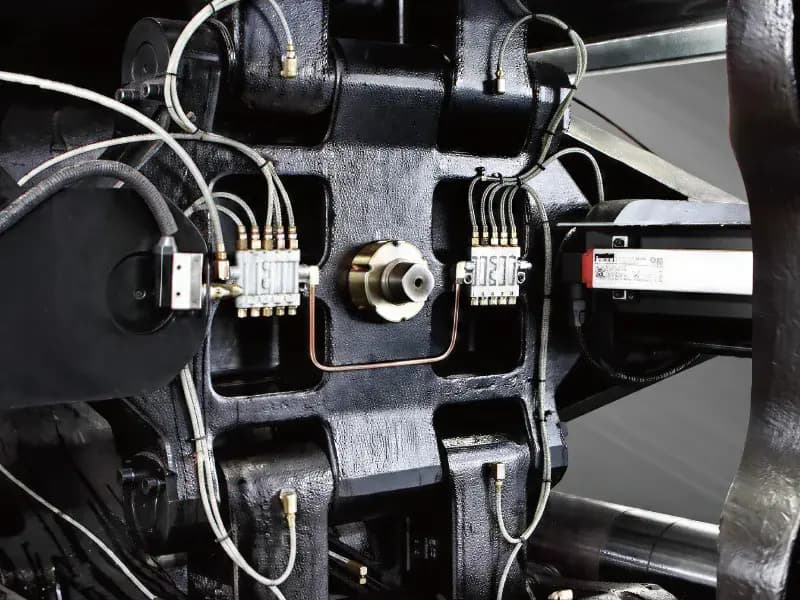
Toggle clamping unit — high rigidity for thin-wall molding
Implementing SPC Across a Multi-Machine Production Floor
Scaling SPC from a single HWAMDA SPV5 machine to an entire production floor of 8-16 machines requires centralized data collection and standardized procedures. The INOVA controller's OPC-UA (Euromap 77) interface enables real-time data streaming to a central SPC software system (InfinityQS, Wonderware, or equivalent). Each machine reports its key parameters every cycle, with the central system generating cross-machine comparisons, shift reports, and exception alerts. Standardize the SPC program by creating a parameter specification sheet for each mold/machine combination: document the qualified mean, control limits, and specification limits for all monitored parameters. Train operators on control chart interpretation: what a trend looks like, when to call a supervisor versus making a minor adjustment, and the documentation required for any parameter change. Weekly SPC review meetings between production, quality, and maintenance teams analyze the previous week's data, identify developing trends, and schedule preventive actions. For BRCGS and FSSC 22000 certification, SPC records must demonstrate ongoing process control and continuous improvement -- auditors expect to see control charts, capability studies, and corrective action logs.
Frequently Asked Questions
On HWAMDA SPV5 machines, monitor 5 primary parameters: peak injection pressure (plus or minus 3 percent), fill time (plus or minus 0.02s), cushion position (plus or minus 0.5mm), plasticizing time (plus or minus 0.1s), and cycle time (plus or minus 0.05s). These capture 90 percent of process variation sources. The INOVA controller calculates running statistics automatically. Add part weight measurement (from an inline scale) as the ultimate quality confirmation.
Related Guides
Ready to Start Your Project?
Get a free consultation and quotation for your thin-wall packaging production line.
Join 500+ manufacturers in 60+ countries who trust HWAMDA.
Get Free Quote