

Space Requirements per Production Line
A complete thin-wall injection molding production line requires more floor space than the machine footprint alone suggests. The HWAMDA SPV5-380, used for yogurt cups and margarine tubs, has a machine footprint of approximately 6.5 x 1.8 meters, but the complete production cell including robot, conveyor, stacking system, and operator access requires approximately 8 x 6 meters (48 square meters). Adding the mold temperature controller, material dryer, and chiller increases the cell footprint to approximately 10 x 8 meters (80 square meters). For larger machines, the SPV5-530 for food containers requires approximately 12 x 9 meters (108 square meters) per production cell, while the SPV5-600 for yogurt pails needs approximately 14 x 10 meters (140 square meters). These dimensions include standard maintenance access space of 1.5 meters on three sides of the machine and 3 meters at the operator side. IML-equipped lines require additional space for label magazine storage and robot work envelope, adding approximately 2 x 3 meters to the cell footprint. A six-line facility handling mixed product types typically requires 1,200-1,800 square meters of production floor space.
Key Specs
- •The HWAMDA SPV5-380, used for yogurt cups and margarine tubs, has a machine footprint of approximately 6.5 x 1.8 meters, but the complete production cell including robot, conveyor, stacking system, and operator access requires approximately 8 x 6 meters (48 square meters).
- •For larger machines, the SPV5-530 for food containers requires approximately 12 x 9 meters (108 square meters) per production cell, while the SPV5-600 for yogurt pails needs approximately 14 x 10 meters (140 square meters).
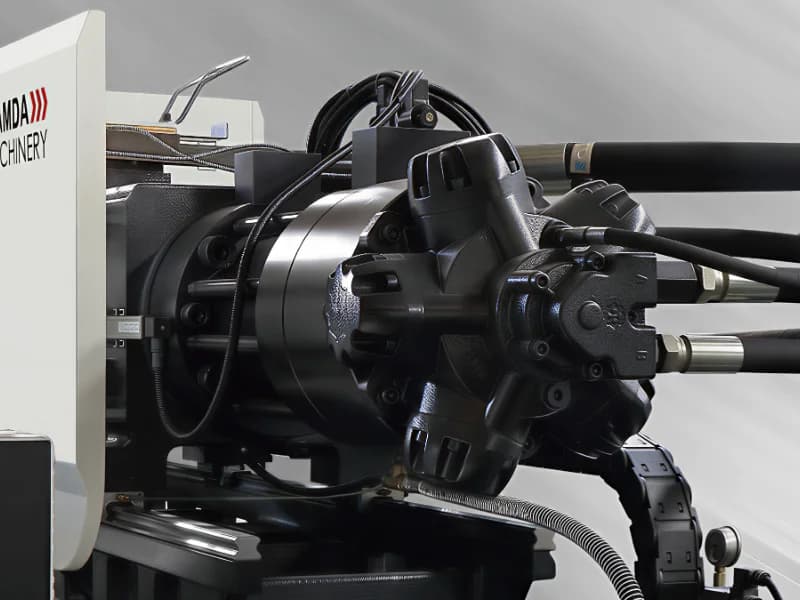
High-speed injection unit with linear guides
Machine Placement and Material Flow
Machine placement should follow the principle of linear material flow from raw material input to finished goods output, minimizing crossing paths and backtracking. The optimal layout arranges production lines in parallel rows with a central aisle of 4-5 meters width for material delivery and forklift access. Raw material enters from one end of the facility, flows through drying and feeding systems to the machines, and finished products exit from the opposite end toward packaging and warehouse. For thin-wall production, the material flow sequence includes: raw material storage, material drying and blending, central feeding system distribution, injection molding machine, robot take-out and stacking, quality inspection station, carton packing, and palletizing. HWAMDA recommends centralized material handling for facilities with three or more production lines. A central drying and feeding system with vacuum conveying distributes pre-dried PP resin to all machines through dedicated pipelines, eliminating individual hopper dryers and reducing floor clutter. The conveying distance should not exceed 30 meters to maintain consistent material temperature and moisture levels.
Utility Requirements: Power, Water, Compressed Air
Utility infrastructure must be sized for peak demand across all production lines operating simultaneously. Electrical power requirements for HWAMDA SPV5 machines range from 45-80 kW connected load per machine depending on tonnage, with actual average consumption of 18-35 kW during production. A six-line facility requires approximately 300-500 kW total connected load including auxiliaries. Plan for a main transformer capacity of 500-630 kVA with 20% reserve. Cooling water supply requires a central chiller system maintaining 8-15 degrees C water temperature with total flow capacity of 300-600 liters per minute for a six-line facility. The chiller capacity should be sized at 30-50 kW cooling per production line depending on the product and cycle time. Compressed air at 6-8 bar pressure is required for pneumatic components on machines, robots, and auxiliaries. A six-line facility typically requires 3-5 cubic meters per minute of compressed air with an appropriately sized compressor and dryer system. HWAMDA provides detailed utility specification sheets for each machine model to support facility planning.
Key Specs
- •Plan for a main transformer capacity of 500-630 kVA with 20% reserve.
- •Compressed air at 6-8 bar pressure is required for pneumatic components on machines, robots, and auxiliaries.
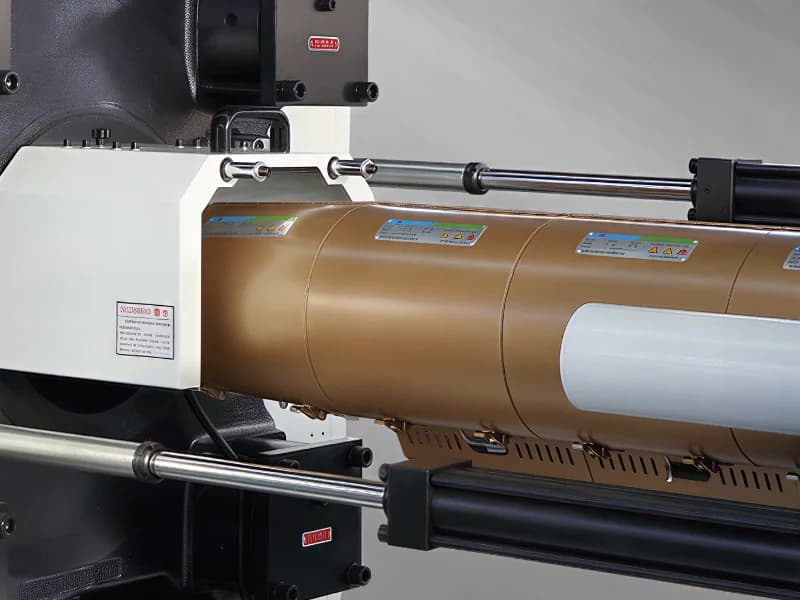
Servo-hydraulic drive system with energy recovery
Need Expert Advice?
Talk to our engineers about your specific production requirements. Free consultation.
Material Storage and Handling
Raw material storage and handling systems must maintain material quality while supporting continuous production. PP resin for thin-wall packaging is typically supplied in 25 kg bags or 1,000 kg bulk bags, with storage requirements dependent on production volume and supply chain logistics. A general guideline is maintaining 2-4 weeks of inventory, which for a six-line facility producing 30-50 million containers per month amounts to 60-120 tonnes of PP resin requiring approximately 100-200 square meters of dry, covered storage. Material drying is essential for PP processing, as moisture content above 0.05% causes surface defects including splay marks. Central drying systems with desiccant dryers achieve consistent moisture below 0.02% with drying temperatures of 80-90 degrees C and residence times of 2-4 hours. HWAMDA recommends dehumidifying dryers for humid climate installations where ambient moisture exceeds 60% relative humidity. Colorant and additive handling requires separate storage with clear identification. Gravimetric blending systems at each machine ensure precise color and additive ratios within plus or minus 0.1% by weight.
Quality Control Area Setup
A dedicated quality control area should be located adjacent to the production floor for convenient sample collection while maintaining controlled measurement conditions. The QC lab requires climate control at 23 plus or minus 2 degrees C and 50 plus or minus 10% relative humidity for consistent measurements. Essential QC equipment includes digital calipers and micrometers, an ultrasonic wall thickness gauge, a precision scale with 0.01 gram resolution, a top-load compression tester for stacking strength, and visual inspection stations with standardized lighting. For IML production, additional equipment includes label adhesion testing apparatus and a vision system for position verification. The QC area should store reference samples from each product, approved limit samples, and retained production samples per customer requirements. HWAMDA recommends implementing statistical process control that collects weight and dimensional data every 30-60 minutes, enabling trend detection before quality deviations become critical. The QC area typically requires 30-50 square meters for a facility with 4-6 production lines.
Key Specs
- •The QC lab requires climate control at 23 plus or minus 2 degrees C and 50 plus or minus 10% relative humidity for consistent measurements.
- •The QC area typically requires 30-50 square meters for a facility with 4-6 production lines.
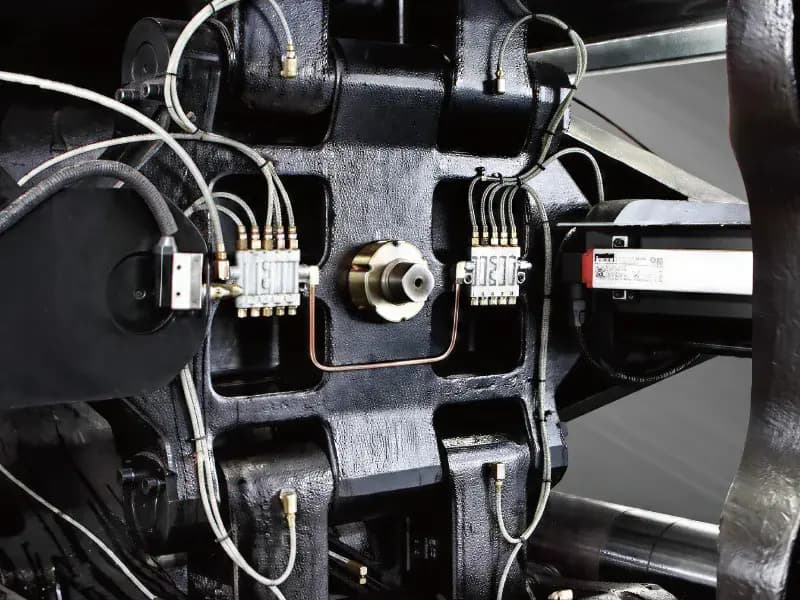
Toggle clamping unit — high rigidity for thin-wall molding
Expansion Planning
Factory layout should accommodate future expansion without disrupting existing production. The most effective approach reserves space for additional lines at initial design, even if not installed for years. HWAMDA recommends designing the initial facility with utility infrastructure sized for the ultimate planned capacity, including electrical bus bars, cooling water headers, and compressed air manifolds with stub connections for future machines. This adds 10-15% to initial utility costs but avoids the much higher expense and production disruption of retrofitting later. Building design should facilitate expansion through modular construction, clear-span structural systems without interior columns in the production area, and appropriately located loading dock access. A typical expansion starts with 2-3 production lines, adding 1-2 lines per year as market demand grows. The factory layout should accommodate this growth without reorganization of existing lines. HWAMDA's turnkey project planning includes facility layout consulting that considers both immediate requirements and long-term expansion scenarios for clients establishing new thin-wall packaging operations.
Frequently Asked Questions
A complete HWAMDA thin-wall production line including machine, robot, conveyor, stacker, and auxiliary equipment requires 80-140 square meters depending on machine tonnage. The SPV5-380 for yogurt cups needs approximately 80 square meters per production cell. The SPV5-530 for food containers requires approximately 108 square meters. The SPV5-600 for yogurt pails needs approximately 140 square meters including maintenance access space. IML-equipped lines add roughly 6 square meters for label magazine and robot work envelope. A six-line facility handling mixed product types requires 1,200-1,800 square meters total production floor area.
Related Guides
Ready to Start Your Project?
Get a free consultation and quotation for your thin-wall packaging production line.
Join 500+ manufacturers in 60+ countries who trust HWAMDA.
Get Free Quote