

Working Principle Comparison
Conventional hydraulic machines use a continuously running pump that pressurizes hydraulic oil to drive all machine movements: clamping, injection, plasticizing, and ejection. The pump runs at constant speed regardless of demand, with excess flow diverted through relief valves, generating heat and wasting energy during idle periods. All-electric machines replace hydraulic systems with individual servo motors directly driving each axis through ball screws or toggle mechanisms. Each motor operates only when its axis is in motion, eliminating idle-state energy consumption. Servo-hydraulic machines, the technology used in HWAMDA SPV5 systems, combine a variable-speed servo motor with a fixed-displacement hydraulic pump. The servo motor adjusts speed to match actual demand, reducing to near-zero during holding and cooling phases. This approach delivers 40-60% energy savings compared to conventional hydraulic machines while maintaining the high clamping forces that hydraulic architecture provides. The hydraulic circuit also enables simultaneous multi-axis movement, such as plasticizing during cooling, which contributes to shorter cycle times in thin-wall applications.
Key Specs
- •This approach delivers 40-60% energy savings compared to conventional hydraulic machines while maintaining the high clamping forces that hydraulic architecture provides.
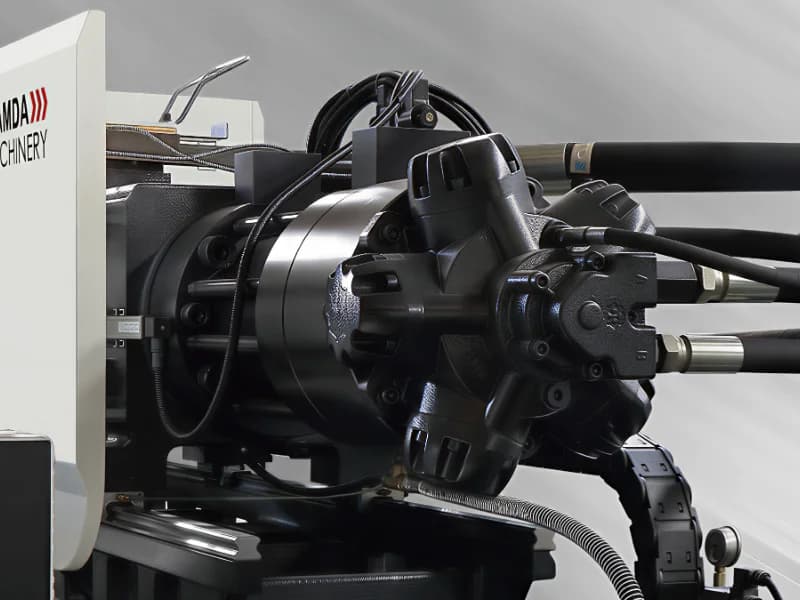
High-speed injection unit with linear guides
Speed and Precision Differences
All-electric machines offer the highest precision due to direct servo motor drive with closed-loop position control, achieving positional repeatability of plus or minus 0.01 mm. This translates to exceptional shot weight repeatability of plus or minus 0.1-0.2 grams for thin-wall packaging. However, achieving the high clamping forces required for large multi-cavity thin-wall molds demands very large and expensive servo motors, which significantly increases machine cost above 300 tons. Servo-hydraulic machines like the HWAMDA SPV5 series achieve injection speeds of 300-500 mm/s with positional repeatability of plus or minus 0.05 mm. Shot weight consistency reaches plus or minus 0.3 grams, meeting requirements for all standard thin-wall food packaging applications. The speed capability of servo-hydraulic systems matches or exceeds all-electric machines in the injection phase because hydraulic accumulators deliver very high instantaneous flow rates. For the critical injection phase in thin-wall molding, where the cavity must fill in 0.15-0.30 seconds, the HWAMDA SPV5 injection system provides sufficient speed and response for consistent filling of 0.4-0.7 mm wall sections.
Energy Consumption and Operating Costs
Energy consumption varies significantly between the three technologies and represents a major operating cost factor. Conventional hydraulic machines consume 4-8 kWh per kilogram of processed material, as the pump runs continuously regardless of demand phase. All-electric machines achieve 2-4 kWh per kilogram through direct drive efficiency and zero idle-state power draw. HWAMDA SPV5 servo-hydraulic machines consume 3-5 kWh per kilogram, approaching all-electric efficiency. For a practical comparison, consider a 380-ton machine running yogurt cup production at 4-second cycles for 6,000 hours per year. A conventional hydraulic machine at 30 kW average consumption uses approximately 180,000 kWh annually. The HWAMDA SPV5-380 at 18-22 kW average consumption uses approximately 108,000-132,000 kWh. An all-electric equivalent at 15-18 kW uses approximately 90,000-108,000 kWh. At USD 0.10 per kWh, annual energy savings of the SPV5 versus conventional hydraulic range from USD 4,800-7,200. The all-electric machine saves an additional USD 1,800-2,400 annually versus the SPV5, a modest advantage relative to the much higher purchase price.
Key Specs
- •The HWAMDA SPV5-380 at 18-22 kW average consumption uses approximately 108,000-132,000 kWh.
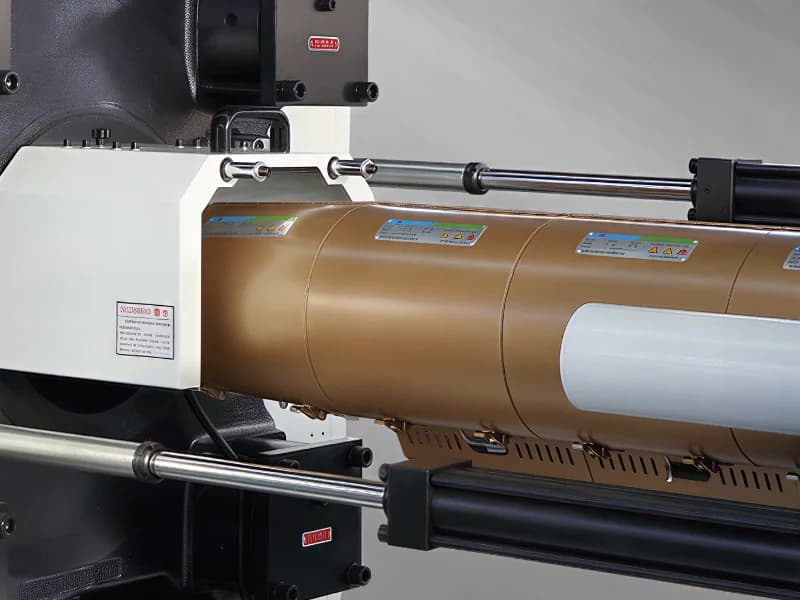
Servo-hydraulic drive system with energy recovery
Need Expert Advice?
Talk to our engineers about your specific production requirements. Free consultation.
Price and ROI Analysis
The purchase price differential between machine technologies is the most decisive factor for many buyers. In the 380-ton class suitable for yogurt cups and margarine tubs, an HWAMDA SPV5 servo-hydraulic machine costs USD 50,000-80,000. A comparable all-electric machine costs USD 250,000-450,000, representing a 4-6 times premium. This premium purchases incremental precision and energy improvements that may or may not justify the investment. ROI analysis using a 10-year machine life demonstrates the economics clearly. The additional capital cost of USD 200,000-370,000, financed at typical rates, generates annual carrying costs of USD 25,000-50,000. The annual energy savings of the all-electric machine versus the HWAMDA SPV5 amount to only USD 1,800-2,400. Even including potentially lower maintenance costs of USD 3,000-5,000 per year, the total annual savings of USD 5,000-7,400 do not approach the annual cost of the price premium. The payback period for the all-electric premium exceeds the machine's useful life in nearly all standard food packaging scenarios.
Suitability for Thin-Wall Packaging
Thin-wall food packaging production places specific demands on machine technology that favor different drive solutions depending on application requirements. The critical requirements include high injection speed for cavity filling before freeze-off, high clamping force to resist the opening forces from multi-cavity molds operating under extreme injection pressures, and sufficient precision for consistent part quality across millions of production cycles. For clamping forces above 300 tons, which covers virtually all thin-wall food packaging applications from sauce cups at 270T to yogurt pails at 600T, servo-hydraulic technology provides the best balance of capability and cost. All-electric machines in this tonnage range are disproportionately expensive because the large servo motors and toggle mechanisms required for high clamping forces represent the most expensive components in the machine. The HWAMDA SPV5 range from 270T to 600T covers all standard thin-wall food packaging applications with servo-hydraulic drive technology optimized specifically for thin-wall processing parameters and cycle time requirements.
Key Specs
- •For clamping forces above 300 tons, which covers virtually all thin-wall food packaging applications from sauce cups at 270T to yogurt pails at 600T, servo-hydraulic technology provides the best balance of capability and cost.
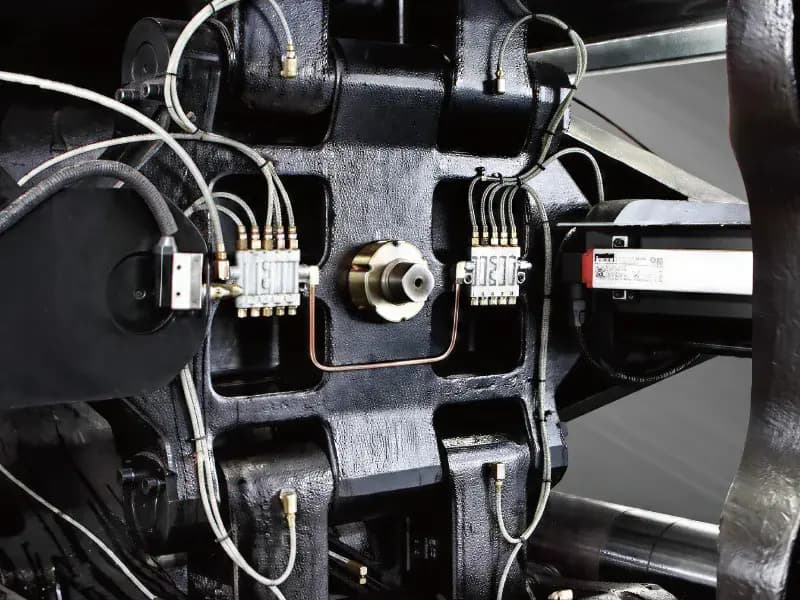
Toggle clamping unit — high rigidity for thin-wall molding
HWAMDA Servo-Hydraulic Advantage
HWAMDA's SPV5 servo-hydraulic platform is purpose-engineered for thin-wall food packaging production, incorporating specific design features that address the unique demands of this application segment. The injection unit uses an accumulator-assisted servo-hydraulic circuit that delivers peak injection speeds of 300-500 mm/s with response times under 20 milliseconds, ensuring consistent cavity filling across all production cycles. The servo-hydraulic drive system uses premium components including Rexroth hydraulic valves, Siemens servo motors, and precision-ground ball screws that deliver repeatable performance over millions of cycles. Energy recovery during deceleration phases feeds energy back into the system, further improving efficiency beyond standard servo-hydraulic designs. The controller platform provides 10-stage injection profiles with 1 ms resolution, real-time cavity pressure monitoring capability, and comprehensive data logging for statistical process control. For buyers evaluating machine technology for thin-wall packaging lines, the HWAMDA SPV5 delivers the full processing capability needed for yogurt cups, food containers, sauce cups, tableware, and IML applications at a price point enabling profitable production.
Frequently Asked Questions
For thin-wall food packaging requiring 270-600 tons of clamping force, servo-hydraulic machines like the HWAMDA SPV5 offer the best overall value proposition. All-electric machines in this tonnage range cost 4-6 times more while providing only incremental precision and energy improvements that rarely justify the premium. The HWAMDA SPV5 achieves 40-60% energy savings versus conventional hydraulic machines and delivers injection speeds of 300-500 mm/s, which is sufficient for all standard thin-wall packaging applications including yogurt cups, food containers, sauce cups, and IML-decorated products.
Related Guides
Ready to Start Your Project?
Get a free consultation and quotation for your thin-wall packaging production line.
Join 500+ manufacturers in 60+ countries who trust HWAMDA.
Get Free Quote