

Cooling Load Calculation for Thin-Wall Molds
Calculate the cooling load by determining the heat that must be removed from each shot of molten PP to solidify and cool the parts to ejection temperature. For PP thin-wall molding: heat to remove per shot equals shot weight multiplied by specific heat capacity multiplied by temperature difference from melt to ejection temperature. For a 16-cavity yogurt cup mold producing 10g cups with a 160g total shot weight: Q = 0.160 kg x 1.8 kJ/kg-°C x (240°C melt - 60°C ejection) = 51.8 kJ per shot. At 4.0-second cycle time (900 shots per hour), the continuous cooling load is 51.8 x 900 / 3600 = 12.95 kW. Add 30% for heat gained from the hydraulic system, barrel radiation, and ambient conditions, giving a total cooling requirement of approximately 16.8 kW. The actual cooling demand varies by product: sauce cups (2-4g, 48-cavity) require 8-12 kW, yogurt cups (4-8g, 8-16 cavity) require 12-20 kW, and food containers (15-25g, 4-8 cavity) require 20-35 kW. Always size temperature control units at 1.3-1.5 times the calculated load to ensure adequate capacity during summer peak ambient temperatures and to maintain temperature stability during process disturbances.
Key Specs
- •For a 16-cavity yogurt cup mold producing 10g cups with a 160g total shot weight: Q = 0.160 kg x 1.8 kJ/kg-°C x (240°C melt - 60°C ejection) = 51.8 kJ per shot.
- •Add 30% for heat gained from the hydraulic system, barrel radiation, and ambient conditions, giving a total cooling requirement of approximately 16.8 kW.
- •The actual cooling demand varies by product: sauce cups (2-4g, 48-cavity) require 8-12 kW, yogurt cups (4-8g, 8-16 cavity) require 12-20 kW, and food containers (15-25g, 4-8 cavity) require 20-35 kW.
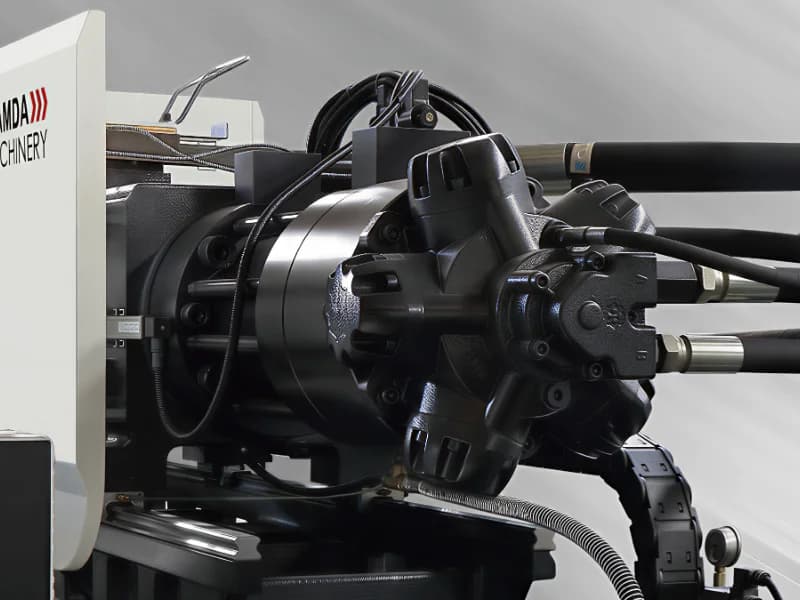
High-speed injection unit with linear guides
Water Temperature Controller vs. Chiller Selection
For thin-wall PP molding, mold temperatures typically range from 15-50°C, requiring either a process chiller (for temperatures below ambient) or a water temperature controller (for temperatures at or above ambient). Process chillers using R-410A or R-134a refrigerant provide cooling water at 7-15°C for applications requiring the fastest possible cycle times. A 20kW air-cooled chiller suitable for an SPV5 380T machine costs $4,000-8,000 and provides water flow of 60-100 liters per minute at 10°C supply temperature. For mold temperatures of 25-50°C (common in IML applications where higher mold temperatures improve label adhesion), pressurized water temperature controllers are more energy-efficient. These units heat and cool water using a combination of electric heaters (6-12 kW) and tower water cooling, maintaining setpoint within plus or minus 0.5°C. Pressurized water units operating up to 120°C and 3.5 bar cost $2,500-5,000 and are suitable for applications beyond standard thin-wall PP. Oil temperature controllers are not typically used for thin-wall PP molding but may be required for mold temperatures above 90°C in engineering resin applications.
Flow Rate and Pressure Requirements
Cooling water flow rate through the mold determines heat transfer efficiency and temperature uniformity across cavities. Turbulent flow is essential for effective cooling—maintain a Reynolds number above 10,000 in the cooling channels. For typical thin-wall mold cooling channels of 8-12mm diameter, this requires flow velocities of 1.5-3.0 m/s, corresponding to flow rates of 4-12 liters per minute per channel. A 16-cavity mold typically has 8-16 independent cooling circuits (some shared between cavity pairs), requiring total flow rates of 40-120 liters per minute. Measure the pressure drop across the mold using the temperature control unit's built-in pressure gauges: typical mold circuit pressure drop is 1.5-3.0 bar at the required flow rates. The temperature control unit pump must deliver adequate flow at a pressure sufficient to overcome the mold circuit resistance plus piping losses (typically 1-2 bar additional). Total pump pressure requirement is 3-5 bar for most thin-wall mold configurations. Use flow meters on each circuit to verify flow balance between cavity pairs—flow variation exceeding 10% between circuits causes non-uniform cooling and dimensional variation. Install quick-connect couplings (DN12 or DN16) on all mold cooling connections for fast changeover.
Key Specs
- •For typical thin-wall mold cooling channels of 8-12mm diameter, this requires flow velocities of 1.5-3.0 m/s, corresponding to flow rates of 4-12 liters per minute per channel.
- •Measure the pressure drop across the mold using the temperature control unit's built-in pressure gauges: typical mold circuit pressure drop is 1.5-3.0 bar at the required flow rates.
- •The temperature control unit pump must deliver adequate flow at a pressure sufficient to overcome the mold circuit resistance plus piping losses (typically 1-2 bar additional).
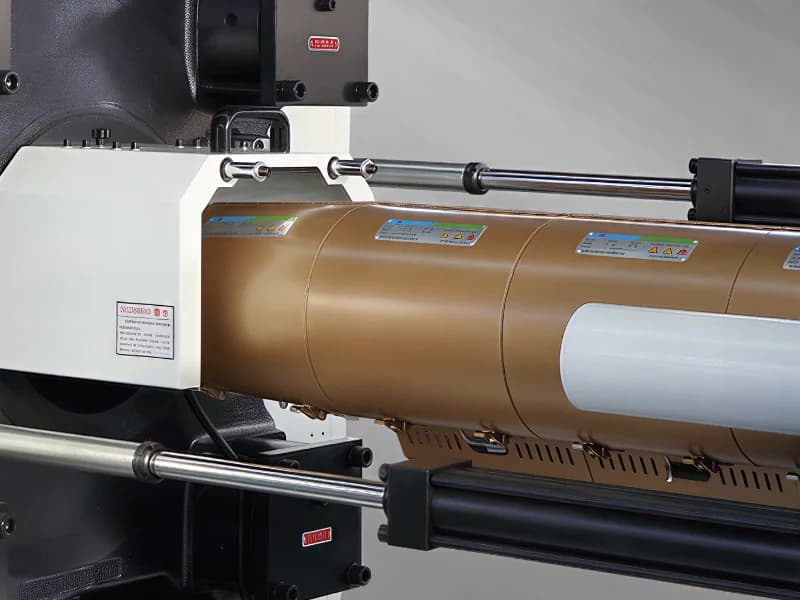
Servo-hydraulic drive system with energy recovery
Need Expert Advice?
Talk to our engineers about your specific production requirements. Free consultation.
Multi-Zone Temperature Management
Thin-wall molds often require different temperatures on the cavity side, core side, and hot runner manifold, necessitating 2-4 independent temperature zones. The cavity side (container exterior) typically runs 2-5°C warmer than the core side to promote shrinkage onto the core for clean ejection. For IML applications, the cavity temperature is set 5-10°C higher (30-40°C vs 20-25°C on the core) to improve label adhesion and prevent label wrinkling during filling. Connect each zone to a dedicated temperature control unit or use a multi-zone unit with independent circuits. The HWAMDA INOVA controller monitors mold temperature through thermocouples embedded in the mold and can display real-time temperature data alongside machine parameters. Configure high and low temperature alarms on the INOVA at plus or minus 3°C from setpoint—temperature deviations beyond this range correlate with dimensional variation exceeding part specifications for thin-wall containers. For hot runner manifolds using YUDO or Synventive systems, the hot runner controller manages zone temperatures independently at 200-260°C. Ensure the manifold cooling circuits do not share temperature control units with the mold cavity cooling circuits, as the vastly different temperature requirements would compromise control accuracy.
Water Quality and Scale Prevention
Cooling water quality directly affects heat transfer efficiency and mold cooling channel longevity. Use treated water with hardness below 100 ppm CaCO3, pH 7.0-8.5, and total dissolved solids below 500 ppm. Hard water with calcium content above 200 ppm deposits scale inside the 8-12mm cooling channels at a rate of 0.1-0.3mm per year, reducing heat transfer by 10-25% and eventually blocking channels completely. Install a water treatment system including softening (ion exchange) and biocide dosing (chlorine or non-oxidizing biocide) to maintain water quality. For closed-loop systems, add corrosion inhibitors (nitrite-based or molybdate-based) to protect the carbon steel mold base and stainless steel channels. Test water quality monthly using a portable test kit measuring pH, hardness, conductivity, and biocide concentration. Flush and descale mold cooling channels every 3-6 months using a mild acid solution (5% phosphoric acid) circulated for 2-4 hours followed by neutralization and rinsing. Install Y-strainers (100 mesh) at the temperature control unit inlet to catch particulate debris before it enters the mold. Replace strainer screens during each mold change.
Key Specs
- •Hard water with calcium content above 200 ppm deposits scale inside the 8-12mm cooling channels at a rate of 0.1-0.3mm per year, reducing heat transfer by 10-25% and eventually blocking channels completely.
- •Flush and descale mold cooling channels every 3-6 months using a mild acid solution (5% phosphoric acid) circulated for 2-4 hours followed by neutralization and rinsing.
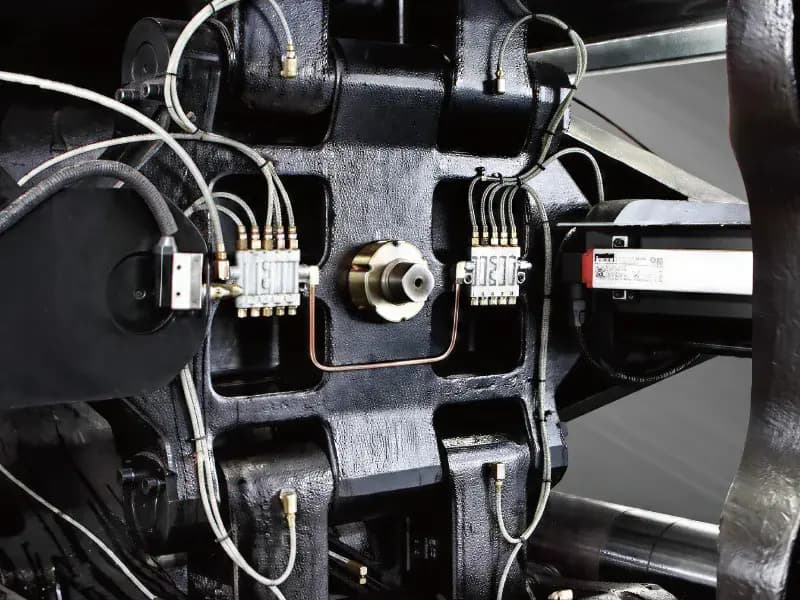
Toggle clamping unit — high rigidity for thin-wall molding
Energy Optimization and Seasonal Adjustments
Temperature control units and chillers represent 15-25% of total production line energy consumption. Implement free cooling during winter months when ambient temperatures drop below the required mold temperature—a dry cooler or cooling tower can replace chiller operation entirely when outdoor temperatures are below 15°C, saving $3,000-8,000 annually in electricity per machine. Install variable frequency drives on chiller compressors and cooling tower fans to modulate capacity with actual demand rather than running at full speed continuously. Use insulated cooling water lines (minimum 13mm wall closed-cell foam insulation) to prevent heat gain from ambient air, which is particularly important in tropical factories where ambient temperatures reach 35-40°C. Set the chiller supply temperature to the highest value that still achieves the target cycle time—raising supply water from 10°C to 15°C reduces chiller energy consumption by approximately 15% while increasing cycle time by only 0.1-0.3 seconds in most thin-wall applications. Monitor the temperature difference between supply and return water: a Delta-T of 3-5°C indicates proper flow rates, while Delta-T below 2°C suggests excessive flow (wasted pump energy) and Delta-T above 8°C indicates insufficient flow or blocked channels.
Frequently Asked Questions
For an HWAMDA SPV5 HMD 380M8-SPV running a 16-cavity yogurt cup mold at 4.0-second cycles, the calculated cooling load is approximately 17-20kW. With a 1.5x safety factor, select a chiller rated at 25-30kW cooling capacity. An air-cooled process chiller providing 10°C water at 80-100 liters per minute flow rate costs $5,000-8,000. For tropical environments where ambient temperatures exceed 35°C, upsize to 35-40kW to compensate for reduced condenser efficiency.
Related Guides
Ready to Start Your Project?
Get a free consultation and quotation for your thin-wall packaging production line.
Join 500+ manufacturers in 60+ countries who trust HWAMDA.
Get Free Quote