

System Architecture and Component Selection
A central feeding system consists of five main components: bulk storage silos (20-60 ton capacity), vacuum conveying lines (50-75mm diameter stainless steel), a central drying station (if required for hygroscopic materials), gravimetric or volumetric blending units at each machine, and a PLC control system managing material flow to all machines. For PP thin-wall production, the primary resin silo should hold 3-5 days of production supply. A facility with 6 HWAMDA SPV5 machines averaging 400 kg/hour PP consumption each requires 2,400 kg/hour total throughput and 100-200 ton silo capacity. Use 304 stainless steel piping throughout the system to prevent contamination of food-grade PP. Vacuum pumps generate 200-400 mbar negative pressure to convey PP pellets at velocities of 15-25 m/s through the distribution piping. Size the vacuum pump at 1.5-2.0 times the peak demand to ensure reliable delivery during simultaneous filling of multiple machine hoppers. Each machine receives material through a dedicated receiver mounted on the feed throat, with a capacity of 5-15 kg per fill cycle and an automatic refill trigger when the level drops below 30%.
Key Specs
- •A central feeding system consists of five main components: bulk storage silos (20-60 ton capacity), vacuum conveying lines (50-75mm diameter stainless steel), a central drying station (if required for hygroscopic materials), gravimetric or volumetric blending units at each machine, and a PLC control system managing material flow to all machines.
- •A facility with 6 HWAMDA SPV5 machines averaging 400 kg/hour PP consumption each requires 2,400 kg/hour total throughput and 100-200 ton silo capacity.
- •Each machine receives material through a dedicated receiver mounted on the feed throat, with a capacity of 5-15 kg per fill cycle and an automatic refill trigger when the level drops below 30%.
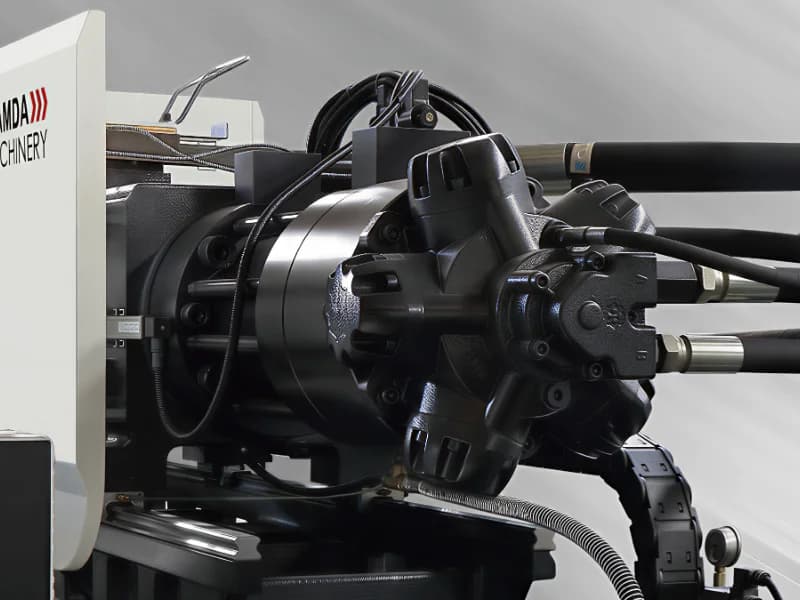
High-speed injection unit with linear guides
Material Drying and Conditioning Requirements
Standard PP homopolymer and copolymer grades used in thin-wall packaging are non-hygroscopic and do not require drying under normal storage conditions. However, if material has been exposed to rain during transport or stored in humid conditions exceeding 80% relative humidity, drying at 80-90°C for 2-4 hours reduces moisture content below 0.05% to prevent splay marks on container surfaces. For facilities also processing PET (sauce cups, beverage containers), a centralized desiccant dryer is essential: PET requires drying to below 50 ppm moisture at 160-170°C for 4-6 hours in a dehumidifying hopper dryer with dewpoint controlled to minus 40°C or below. Size the drying hopper based on the material throughput rate multiplied by the required residence time. A PET line consuming 300 kg/hour requires a 1,200-1,800 kg capacity dryer for 4-6 hour residence time. Central drying stations serving multiple machines achieve 15-25% energy savings compared to individual machine-mounted dryers through better heat recovery and consistent dewpoint control. Install inline moisture analyzers after the dryer to verify moisture content before material reaches the machine.
Gravimetric Blending for Regrind and Additives
Mount a gravimetric blender on each SPV5 machine's feed throat to precisely meter virgin PP, regrind (recycled runners and rejected parts), color masterbatch, and UV stabilizer additives. Gravimetric blenders weigh each component in a loss-in-weight hopper and adjust feed rates in real-time to maintain the target recipe within plus or minus 0.1% accuracy. For thin-wall production, typical blend recipes include 80-95% virgin PP (MFI 30-70 g/10min), 5-15% regrind from the inline granulator, and 1-3% color or additive masterbatch. Maximum regrind content depends on the product application: food-contact containers meeting FDA 21 CFR or EU 10/2011 regulations may limit regrind to material generated from the same production run to maintain traceability. Blender throughput must exceed the machine's plasticizing rate: the HMD 380M8-SPV with a 60mm screw at 300 r/min plasticizes approximately 120-150 g/s of PP, requiring a blender throughput of at least 500 kg/hour. Install a metal separator between the blender output and the machine feed throat to catch any ferrous contaminants from the regrind process. Each gravimetric blender costs $8,000-15,000 and logs blend ratios for quality traceability.
Key Specs
- •Gravimetric blenders weigh each component in a loss-in-weight hopper and adjust feed rates in real-time to maintain the target recipe within plus or minus 0.1% accuracy.
- •For thin-wall production, typical blend recipes include 80-95% virgin PP (MFI 30-70 g/10min), 5-15% regrind from the inline granulator, and 1-3% color or additive masterbatch.
- •Blender throughput must exceed the machine's plasticizing rate: the HMD 380M8-SPV with a 60mm screw at 300 r/min plasticizes approximately 120-150 g/s of PP, requiring a blender throughput of at least 500 kg/hour.
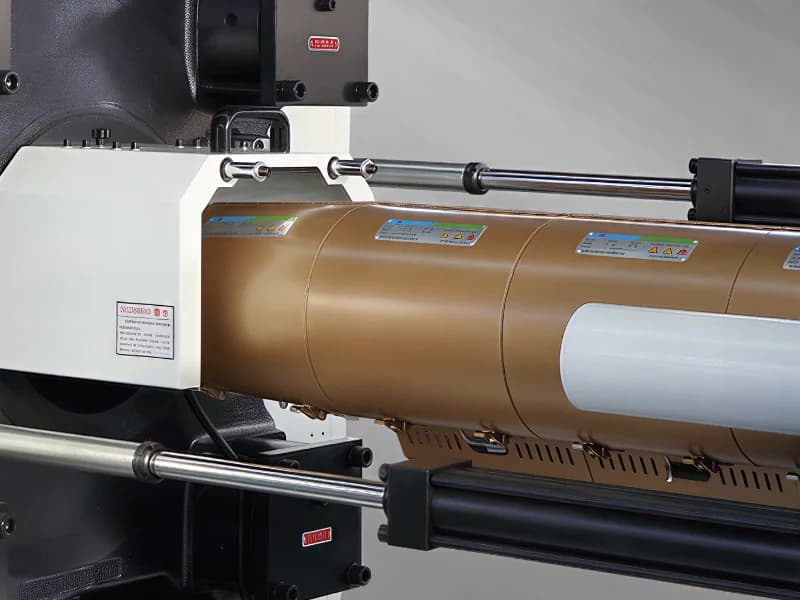
Servo-hydraulic drive system with energy recovery
Need Expert Advice?
Talk to our engineers about your specific production requirements. Free consultation.
Piping Design and Layout Optimization
Design the central feeding piping layout to minimize conveying distance and the number of bends, which create friction losses and potential material degradation. PP pellets conveyed through excessive bends generate angel hair (fine polymer strands) that block filters and contaminate the hopper. Limit the total piping run to 60 meters maximum with no more than 4 ninety-degree bends per line. Use long-radius bends (minimum 10x pipe diameter radius) rather than sharp elbows to reduce impact velocity and angel hair generation. Pipe diameter selection depends on throughput: 50mm pipes handle up to 300 kg/hour, 63mm pipes handle 300-600 kg/hour, and 75mm pipes handle 600-1,000 kg/hour per line. Install sight glasses at each receiver and at two points along the main trunk line to verify material flow and detect blockages. Use flex connections at machine feed points to accommodate the slight movements of the SPV5 injection unit during operation. Route pipes with a minimum 1-2% downward slope toward the receivers to prevent material accumulation at low points. Install purge valves at each branch point to enable material changes and line cleaning. Use quick-connect couplings for flexible routing changes when adding or relocating machines.
Control System and Integration
The central feeding control system uses a dedicated PLC (Allen-Bradley, Siemens S7, or Mitsubishi) with a touchscreen HMI that displays real-time status of all vacuum receivers, blenders, and silo levels. Program the PLC with priority-based sequencing: when multiple machine receivers request material simultaneously, the controller activates them in a programmed priority sequence to prevent vacuum pressure drops that cause incomplete fills. Each vacuum receiver includes a high-level and low-level capacitive sensor. The controller triggers a refill when the material drops to the low-level sensor and stops filling when the high-level sensor activates—typical fill cycle time is 15-30 seconds for a 10 kg receiver batch. Integrate silo level monitoring using load cells (plus or minus 0.5% accuracy) or radar level sensors to provide real-time inventory data and trigger automatic reorder alerts when silo levels drop below the 3-day supply threshold. Connect the central feeding PLC to the plant's manufacturing execution system (MES) via Ethernet/IP or Profinet to log material consumption per machine for production cost tracking. Install alarm outputs for critical faults including vacuum pump failure, blocked lines, empty silos, and blender recipe deviations.
Key Specs
- •The controller triggers a refill when the material drops to the low-level sensor and stops filling when the high-level sensor activates—typical fill cycle time is 15-30 seconds for a 10 kg receiver batch.
- •Integrate silo level monitoring using load cells (plus or minus 0.5% accuracy) or radar level sensors to provide real-time inventory data and trigger automatic reorder alerts when silo levels drop below the 3-day supply threshold.
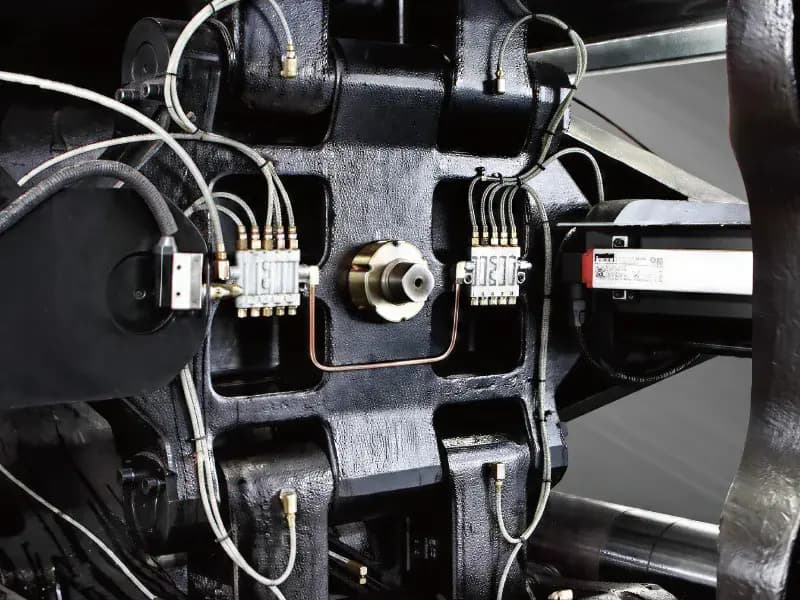
Toggle clamping unit — high rigidity for thin-wall molding
Installation Cost and Maintenance Schedule
A complete central feeding system for a 6-machine SPV5 production facility costs $80,000-180,000 depending on automation level and piping complexity. Major cost components include bulk storage silos ($15,000-40,000 for 40-100 ton capacity), vacuum conveying system with pump, piping, and receivers ($30,000-60,000), gravimetric blenders at $8,000-15,000 each ($48,000-90,000 for 6 machines), and the PLC control system ($10,000-25,000). Installation labor adds 20-30% to equipment cost. Maintenance requirements include weekly inspection of vacuum pump oil level and filter condition, monthly cleaning of receiver filters and sight glasses, quarterly inspection of piping joints and flex connections for wear, and annual replacement of vacuum pump vanes and receiver gaskets. The vacuum pump filter element (typically a cartridge or bag type rated at 1-5 microns) requires replacement every 1,000-2,000 operating hours. Calibrate gravimetric blender load cells every 6 months using certified test weights. The annual maintenance cost runs $3,000-6,000 for the complete system. ROI from labor savings alone (eliminating 2-3 material handling operators across 3 shifts) typically achieves payback in 12-18 months.
Frequently Asked Questions
Yes, design the system with dedicated piping circuits for each resin type to prevent cross-contamination. A typical thin-wall facility runs PP on most machines and PET on 1-2 machines. Install separate silos, separate vacuum lines, and separate receivers for each material. Use color-coded piping (blue for PP, green for PET) and lockout quick-connects to prevent accidental cross-connection. The PLC control system tracks material assignments and prevents incorrect material delivery.
Related Guides
Ready to Start Your Project?
Get a free consultation and quotation for your thin-wall packaging production line.
Join 500+ manufacturers in 60+ countries who trust HWAMDA.
Get Free Quote