

Price Comparison by Mold Complexity
Chinese mold pricing for thin-wall food packaging (FOB China): 4-cavity yogurt cup mold with valve gate hot runner $18,000-30,000, 8-cavity yogurt cup mold with YUDO hot runner $35,000-55,000, 2-cavity food container mold $12,000-22,000, 4-cavity food container IML mold $28,000-45,000, 8-16 cavity sauce cup mold $25,000-40,000. Local/European mold pricing for equivalent specifications: 4-cavity yogurt cup $40,000-65,000, 8-cavity yogurt cup $70,000-120,000, 2-cavity food container $30,000-50,000, 4-cavity food container IML $60,000-95,000, 8-16 cavity sauce cup $50,000-85,000. The price gap stems from: lower Chinese labor costs ($15-25/hr for skilled mold makers vs $50-100/hr in Europe), vertically integrated supply chains with steel and components sourced locally, and lower overhead costs. Top-tier Chinese mold makers like LKM, Jingdiao, and specialized thin-wall mold shops in Ningbo and Taizhou deliver quality comparable to mid-range European molds at 40-50% of the price, though the top-end European precision mold makers still hold an edge in tolerance consistency over millions of cycles.
Key Specs
- •Chinese mold pricing for thin-wall food packaging (FOB China): 4-cavity yogurt cup mold with valve gate hot runner $18,000-30,000, 8-cavity yogurt cup mold with YUDO hot runner $35,000-55,000, 2-cavity food container mold $12,000-22,000, 4-cavity food container IML mold $28,000-45,000, 8-16 cavity sauce cup mold $25,000-40,000.
- •Local/European mold pricing for equivalent specifications: 4-cavity yogurt cup $40,000-65,000, 8-cavity yogurt cup $70,000-120,000, 2-cavity food container $30,000-50,000, 4-cavity food container IML $60,000-95,000, 8-16 cavity sauce cup $50,000-85,000.
- •Top-tier Chinese mold makers like LKM, Jingdiao, and specialized thin-wall mold shops in Ningbo and Taizhou deliver quality comparable to mid-range European molds at 40-50% of the price, though the top-end European precision mold makers still hold an edge in tolerance consistency over millions of cycles.
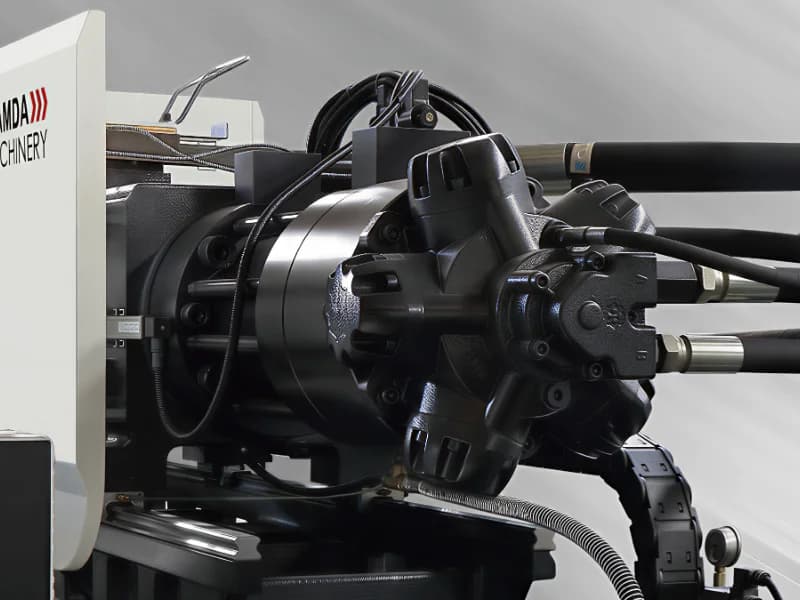
High-speed injection unit with linear guides
Steel Quality and Mold Life Expectations
Mold steel selection determines longevity for thin-wall molds subjected to 120-177 MPa injection pressure and 2,700-6,000 kN clamping force on HWAMDA SPV5 machines. Chinese molds typically offer: P20 pre-hardened steel (30-36 HRC) for cavities running under 500,000 cycles ($8-12/kg), 718H (pre-hardened to 33-36 HRC) for mid-volume up to 1 million cycles ($12-18/kg), or H13/2344 (heat-treated to 48-52 HRC) for high-volume thin-wall molds exceeding 1 million cycles ($20-30/kg). European mold makers default to S136 (stainless, 48-52 HRC) for food contact molds at $35-50/kg or Bohler M340 ISOPLAST for premium corrosion resistance. For an 8-cavity yogurt cup mold running 24/7 at 4.5s cycles, annual production exceeds 7 million cycles. Only H13/2344 or S136 steel provides the required 3-5 million cycle life between refurbishment. Insist on H13 or better when ordering thin-wall molds from Chinese suppliers, as some quote P20 by default to lower pricing. Verify steel certificates (mill test reports) showing actual hardness after heat treatment of 48-52 HRC minimum.
Dimensional Precision and Cavity Consistency
Thin-wall molds require exceptional dimensional precision because a 0.02mm variation on a 0.40mm wall represents 5% thickness change. Chinese mold makers achieve cavity dimensional accuracy of +/-0.01-0.02mm using CNC machining centers (Makino, Sodick, or domestic equivalents) and wire EDM with +/-0.005mm capability. European premium mold makers achieve +/-0.005-0.01mm consistently. The critical quality metric for multi-cavity molds is cavity-to-cavity consistency: the variation between the same dimension across all 8 cavities. Chinese molds typically deliver +/-0.015-0.025mm cavity-to-cavity variation, while European molds achieve +/-0.005-0.015mm. For practical impact, on an 8-cavity yogurt cup mold running on the HWAMDA HMD 400M8-SPV, +/-0.025mm cavity variation produces part weight variation of +/-0.15-0.20g on a 6g cup (2.5-3.3%). European-level +/-0.01mm variation yields +/-0.06-0.08g (1.0-1.3%). Most food packaging specifications accept +/-0.3g (5%), so Chinese mold precision is adequate for the vast majority of applications.
Key Specs
- •Thin-wall molds require exceptional dimensional precision because a 0.02mm variation on a 0.40mm wall represents 5% thickness change.
- •Chinese mold makers achieve cavity dimensional accuracy of +/-0.01-0.02mm using CNC machining centers (Makino, Sodick, or domestic equivalents) and wire EDM with +/-0.005mm capability.
- •European premium mold makers achieve +/-0.005-0.01mm consistently.
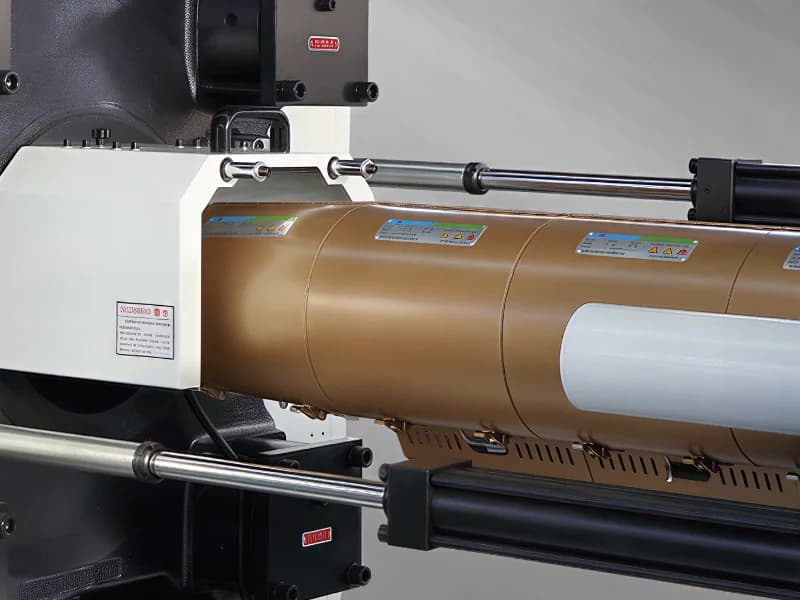
Servo-hydraulic drive system with energy recovery
Need Expert Advice?
Talk to our engineers about your specific production requirements. Free consultation.
Cooling Channel Quality and Cycle Time Impact
Cooling channel design and execution quality differ more between Chinese and European molds than cavity precision. European mold makers routinely use mold flow simulation (Moldflow, Moldex3D) to optimize cooling channel placement, costing $2,000-5,000 per mold in engineering time. Chinese mold makers may skip simulation on standard geometries, relying on experience-based designs. The result: European molds often achieve 10-15% shorter cooling times due to optimized channel placement. Cooling channel drilling quality matters for turbulent flow. Channel surface roughness of Ra 3.2 or below (European standard) promotes turbulent flow at lower Reynolds numbers compared to Ra 6.3-12.5 (common in Chinese molds). Smoother channels also resist scale buildup longer. Cross-drilled channel intersections should be plugged with press-fit hardened steel plugs (European standard) rather than copper plugs (common Chinese practice) to prevent corrosion and leakage over millions of cycles. When ordering Chinese molds for HWAMDA SPV5 machines, specify: cooling channel surface finish Ra 3.2 maximum, hardened steel plugs at all intersections, individual flow testing of each circuit at 5 bar before delivery, and provide your own Moldflow cooling analysis to the mold maker.
Communication, Design Review, and Quality Control
The largest risk factor with Chinese molds is communication during the design and manufacturing process. Successful mold procurement requires: detailed mold specifications documented in English with dimensional drawings (not just part drawings), regular DFM (Design for Manufacture) review at weeks 1-2 with the mold maker's engineering team, weekly progress photos and dimensional reports during the 6-10 week manufacturing period, and a formal trial report with sample parts from the T1 (first trial) molding. Language barriers cause specification misunderstandings on 15-25% of first-time orders. Mitigation strategies: work with Chinese mold makers who have English-speaking project engineers, use HWAMDA as an intermediary (they routinely coordinate mold procurement for turnkey line customers), and insist on detailed DFM reports before cutting steel. Trial molding (T1) at the mold maker's facility or at HWAMDA's factory allows correction before shipping. Budget 1-3 trial iterations at $500-1,500 each. Mold delivery from China to final destination adds 3-6 weeks by sea freight. Air freight for urgent molds costs $3-6/kg (an 8-cavity mold at 2,000kg costs $6,000-12,000 air freight versus $500-1,000 sea freight).
Key Specs
- •Language barriers cause specification misunderstandings on 15-25% of first-time orders.
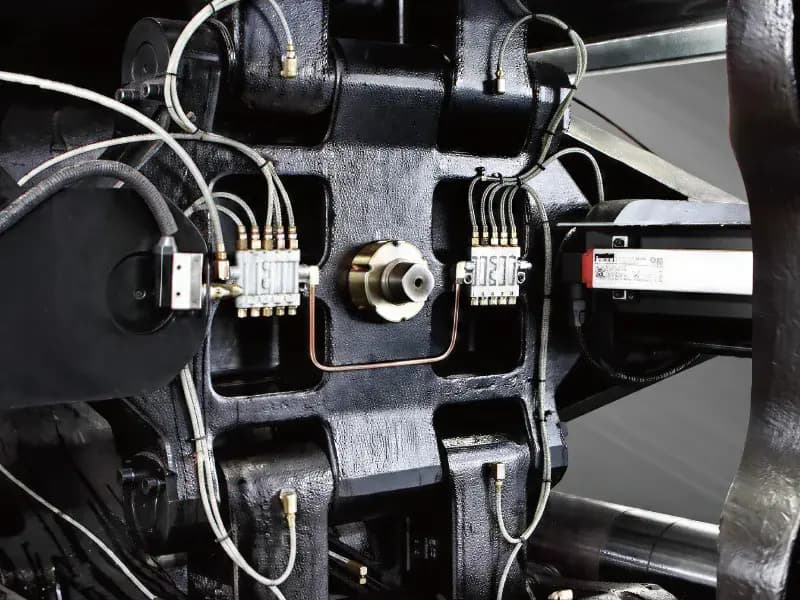
Toggle clamping unit — high rigidity for thin-wall molding
Recommendation: When to Source Chinese vs Local Molds
Source from Chinese mold makers when: production volume justifies the 6-10 week lead time plus 3-6 weeks shipping, the mold design is a proven geometry (yogurt cups, food containers, sauce cups) where Chinese mold makers have extensive experience, HWAMDA is coordinating the mold purchase as part of a turnkey line package (ensuring machine-mold compatibility), and total mold budget must stay under $55,000 for 8-cavity configurations. Source locally or from European mold makers when: first-to-market speed requires mold delivery within 4-6 weeks, complex geometries or tight tolerances below +/-0.01mm are required, ongoing design modifications during production are expected (local proximity enables faster iteration), or regulatory requirements mandate traceable European-origin tooling (rare but exists in some pharmaceutical packaging). The hybrid approach works well: source the first mold locally for rapid development and validation, then replicate in China at 40-60% cost for production scaling. Many HWAMDA customers order a first set of molds from Chinese specialists in Ningbo (near HWAMDA's factory) for $35,000-55,000 and achieve quality sufficient for 95% of food packaging applications.
Frequently Asked Questions
Essential specifications: cavity steel H13/2344 heat treated to 48-52 HRC (not P20), hot runner brand (YUDO or Synventive), cooling channel diameter and layout with Ra 3.2 surface finish, hardened steel channel plugs, individual cavity dimensional report, T1 trial molding report with 100-shot sample parts and weight data, and mold life guarantee of minimum 3 million cycles. Provide 3D part model, 2D drawings with GD&T tolerances, and material data sheet for the specific PP grade.
Related Guides
Ready to Start Your Project?
Get a free consultation and quotation for your thin-wall packaging production line.
Join 500+ manufacturers in 60+ countries who trust HWAMDA.
Get Free Quote