

Capital Investment Comparison
Greenfield thin-wall factory investment breakdown for a 4-line operation: land and building (1,500-2,500 m2) $200,000-500,000 depending on region, 4x HWAMDA SPV5 machines (HMD 400M8-SPV) $340,000-400,000, 4x 8-cavity molds with hot runners $140,000-220,000, 4x IML robots (SWITEK) $100,000-160,000, auxiliary equipment (chillers, dryers, conveyors) $140,000-280,000, utilities infrastructure (power, water, compressed air) $50,000-120,000, cleanroom or food-grade environment modifications $30,000-80,000, and commissioning/training $20,000-40,000. Total: $1,020,000-1,800,000. Upgrading an existing facility: 2x HWAMDA SPV5 machines to start $170,000-200,000, 2x molds $70,000-110,000, 2x IML robots $50,000-80,000, auxiliary modifications $40,000-80,000, floor reinforcement and utility upgrades $20,000-50,000, and layout modifications $10,000-30,000. Total: $360,000-550,000. The upgrade path requires 55-70% less capital but delivers only 50% of the production capacity, making cost-per-unit-capacity roughly equivalent.
Key Specs
- •The upgrade path requires 55-70% less capital but delivers only 50% of the production capacity, making cost-per-unit-capacity roughly equivalent.
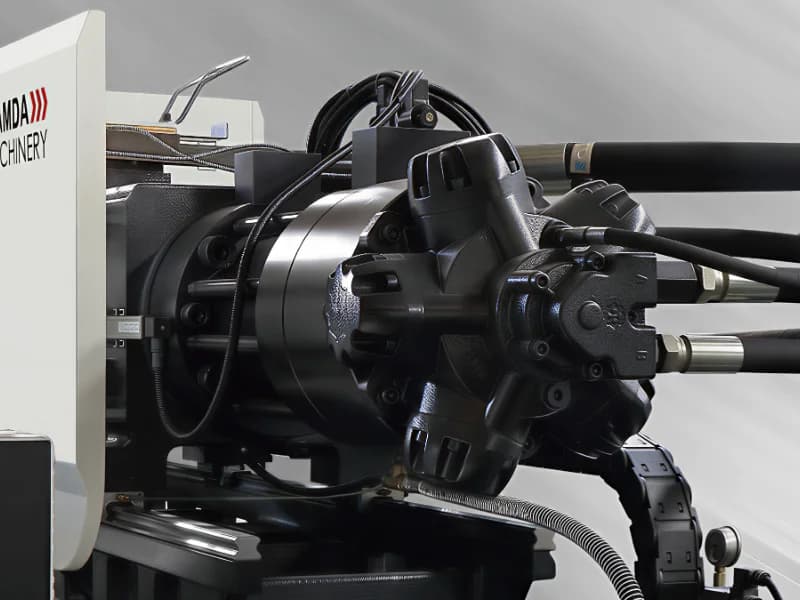
High-speed injection unit with linear guides
Production Layout and Material Flow Optimization
A purpose-built thin-wall packaging factory can optimize material flow from raw PP pellet storage through molding to finished goods shipping. Ideal layout for an HWAMDA SPV5 production cell requires 80-120 m2 per machine including robot, auxiliaries, and operator access (machine footprint alone is approximately 6.2x1.7m for the HMD 400M8-SPV). Ceiling height should be minimum 5 meters for overhead crane access (mold changes require lifting 1,500-2,500 kg molds). A 4-line factory needs 400-600 m2 of production space plus 200-400 m2 for material storage, 100-200 m2 for finished goods, and 50-100 m2 for quality lab and office. The total 750-1,300 m2 should be configured in a U-flow or linear layout with raw materials entering one end and finished goods exiting the other. Upgrading an existing factory typically forces compromise: machines may be positioned around existing columns, utility routing follows sub-optimal paths, and ceiling height may limit crane installation. These compromises can add 15-30% to material handling time and reduce OEE by 5-10% compared to optimized layouts.
Utility Infrastructure Requirements
Thin-wall molding has specific utility demands that often exceed existing general-purpose molding facilities. Electrical: each HWAMDA SPV5 cell (machine + robot + auxiliaries) requires 120-180 kVA at 380-440V 3-phase. A 4-line factory needs 480-720 kVA total transformer capacity, plus 20% reserve for future expansion. Existing factories with 200-300 kVA service require $20,000-50,000 in electrical upgrades. Cooling water: 4 production cells need 320-600 L/min total cooling water flow at 10-15°C and 3-5 bar pressure. A central chiller system (80-120 kW) with cooling tower costs $25,000-50,000 for greenfield versus $15,000-30,000 to supplement an existing system. Compressed air: IML robots and mold functions require 400-600 L/min of dry, oil-free air at 6-8 bar per cell. A 4-cell factory needs a 75-110 kW screw compressor with refrigerated dryer ($15,000-30,000). Floor loading: HWAMDA SPV5 machines weigh 12-25 tons. Floor must support 5-10 tons/m2 point loading. Many existing facilities require floor reinforcement ($30-80/m2) costing $5,000-15,000 for the production area.
Key Specs
- •A 4-line factory needs 480-720 kVA total transformer capacity, plus 20% reserve for future expansion.
- •Cooling water: 4 production cells need 320-600 L/min total cooling water flow at 10-15°C and 3-5 bar pressure.
- •Compressed air: IML robots and mold functions require 400-600 L/min of dry, oil-free air at 6-8 bar per cell.
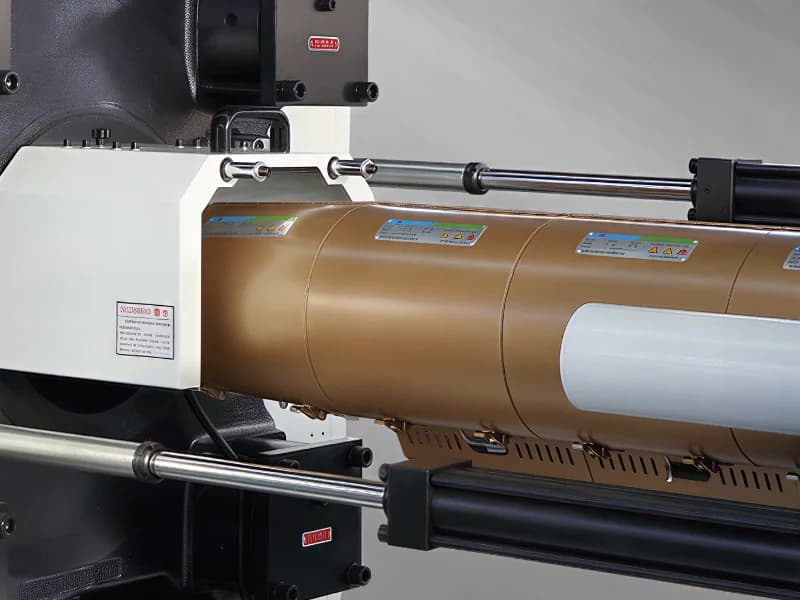
Servo-hydraulic drive system with energy recovery
Need Expert Advice?
Talk to our engineers about your specific production requirements. Free consultation.
Food Safety and Regulatory Compliance
Food packaging production demands environmental controls that general-purpose molding shops rarely have. ISO 22000 certification (required by many food brand customers) mandates documented pest control, air quality management, personnel hygiene protocols, and material traceability. New factories can integrate these from design: sealed production area with positive air pressure, HEPA-filtered air supply delivering ISO Class 8 (100,000 particles/m3) environment, epoxy-coated floors and walls for cleanability, separate material receiving and finished goods areas preventing cross-contamination, and handwashing stations with interlocked door access. Cost premium for food-grade new construction: $20-40/m2 ($30,000-80,000 for a 1,500 m2 facility). Upgrading existing facilities to food-grade standards is possible but challenging: sealing gaps and openings ($5,000-15,000), installing HVAC filtration ($10,000-25,000), epoxy floor coating ($15-25/m2), and documentation/certification ($5,000-15,000 for ISO 22000). BRCGS Packaging certification, recognized by global food brands, costs $5,000-15,000 and requires 6-12 months to achieve.
Timeline and Phased Implementation Strategy
Greenfield factory timeline: site selection and permits (2-4 months), construction (4-8 months), equipment installation (1-2 months), commissioning and trial production (1-2 months), certification (3-6 months concurrent). Total: 8-14 months to certified production. Upgrade timeline: equipment selection and ordering (1-2 months), facility modifications (1-3 months concurrent with equipment lead time), equipment installation (1-2 weeks per line), commissioning (1-2 weeks per line), certification (3-6 months). Total: 3-6 months to production, 6-12 months to certification. A phased approach combines both strategies: Phase 1 (months 1-6) upgrade existing facility with 2 HWAMDA SPV5 lines to generate revenue and validate market demand. Phase 2 (months 6-18) design and build purpose-built factory based on Phase 1 learnings. Phase 3 (months 18-24) relocate Phase 1 equipment to new factory, add 2-4 additional lines. This approach reduces risk by validating the business case with $360,000-550,000 initial investment before committing to the full $1-1.8 million greenfield project.
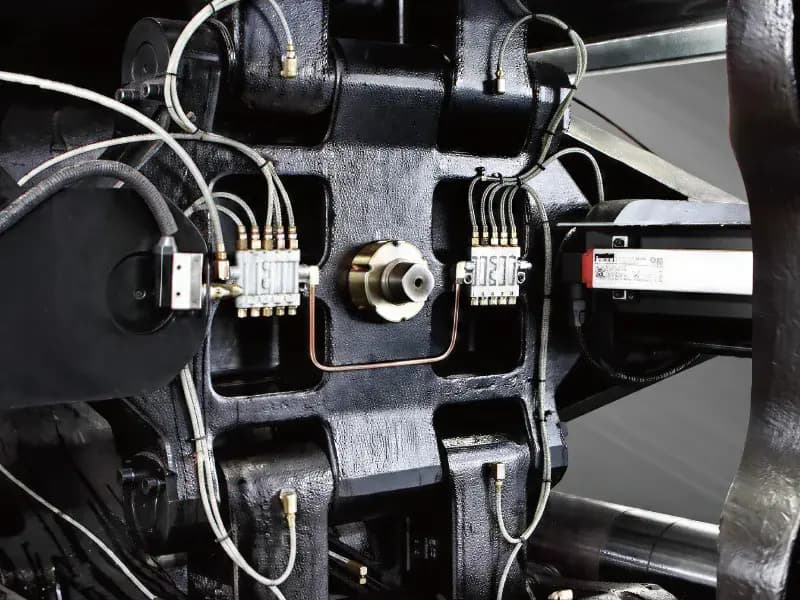
Toggle clamping unit — high rigidity for thin-wall molding
ROI Analysis and Payback Period Comparison
Greenfield 4-line factory producing 8-cavity yogurt cups at 4.5s cycles generates 25,600 cups/hr across 4 machines, or approximately 184 million cups/year at 85% OEE. At $0.02-0.03 margin per cup, annual gross profit is $3.7-5.5 million. With $1.0-1.8 million investment, payback period is 3-6 months. Upgraded 2-line operation produces 92 million cups/year, generating $1.8-2.8 million annual margin on $360,000-550,000 investment, with payback in 2-4 months. The upgrade path shows faster ROI due to lower capital requirement but limits scalability. Key financial risks: greenfield projects tie up capital for 8-14 months before generating revenue, while upgrades generate cash flow within 3-6 months. Market risk is also lower with the upgrade approach since commitment can be scaled back if demand projections prove optimistic. For markets with established demand (Middle East dairy, Southeast Asian food service), greenfield investment is justified. For new market entry or unproven products, the phased upgrade approach offers lower risk with comparable per-unit economics. HWAMDA supports both approaches with turnkey line packages and can stagger equipment delivery to match phased installation schedules.
Frequently Asked Questions
Budget 80-120 m2 per complete production cell including the SPV5 machine (6.2x1.7m footprint for HMD 400M8-SPV), IML robot (2.0x1.5m), auxiliary equipment (3x2m), operator access and safety zones, and material staging area. Ceiling height must be 5m minimum for overhead crane. Add 50% for aisles and common areas, bringing total facility requirement to approximately 200 m2 per line.
Related Guides
Ready to Start Your Project?
Get a free consultation and quotation for your thin-wall packaging production line.
Join 500+ manufacturers in 60+ countries who trust HWAMDA.
Get Free Quote