

Heat Transfer Physics: Water vs Air Cooling
The fundamental difference is thermal conductivity and heat transfer coefficient. Water has a thermal conductivity of 0.6 W/mK versus 0.026 W/mK for air, a 23x advantage. More importantly, the convective heat transfer coefficient for turbulent water flow in cooling channels reaches 3,000-5,000 W/m2K, compared to 10-50 W/m2K for forced air and only 5-25 W/m2K for natural air convection. For a thin-wall PP yogurt cup with 0.40mm walls injected at 230°C melt temperature into a mold at 20°C, the required heat removal is approximately 250-350 kJ/kg of PP processed. At 40 kg/hr throughput on an 8-cavity HWAMDA HMD 400M8-SPV line, total heat removal rate is 2.8-3.9 kW from the mold cavity surfaces alone. Water cooling channels running at 15°C supply temperature with 8-15 L/min flow per circuit remove this heat within 1.5-2.5 seconds. Air cooling the same cavity surface would require 30-120 seconds, making it entirely incompatible with thin-wall cycle time targets. The cooling time formula t = (h2/pi2*alpha) * ln(C*(Tmelt-Tmold)/(Teject-Tmold)) shows cooling time is proportional to wall thickness squared, making efficient cooling even more critical for slightly thicker walls.
Key Specs
- •For a thin-wall PP yogurt cup with 0.40mm walls injected at 230°C melt temperature into a mold at 20°C, the required heat removal is approximately 250-350 kJ/kg of PP processed.
- •Water cooling channels running at 15°C supply temperature with 8-15 L/min flow per circuit remove this heat within 1.5-2.5 seconds.
- •Air cooling the same cavity surface would require 30-120 seconds, making it entirely incompatible with thin-wall cycle time targets.
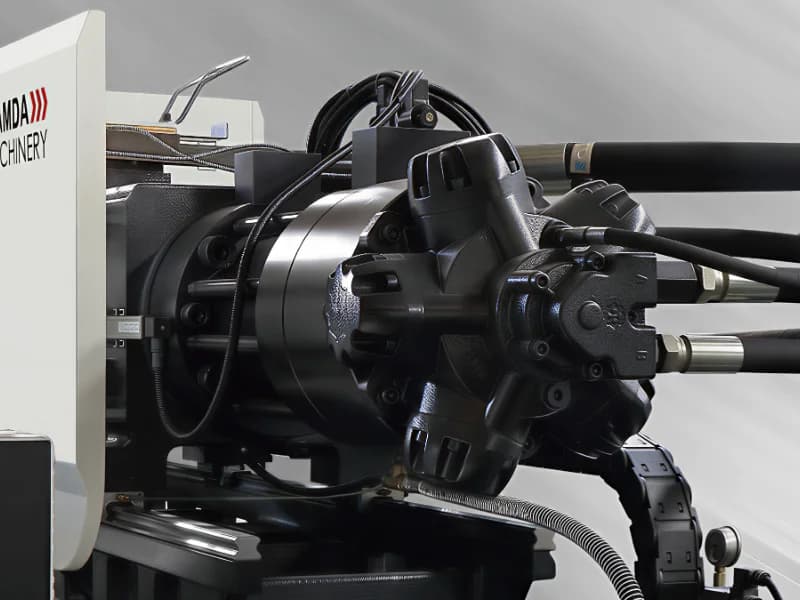
High-speed injection unit with linear guides
Water Cooling Channel Design for Thin-Wall Molds
Proper water cooling channel design is the foundation of achieving short cycle times on HWAMDA SPV5 machines. Standard cooling channels are 8-12mm diameter drilled holes positioned 1.5-2.0x diameter from the cavity surface, with channel-to-channel spacing of 3-5x diameter. For a thin-wall yogurt cup mold cavity in H13 steel, typical specifications are: channel diameter 8mm, distance from cavity surface 12-16mm, channel spacing 24-40mm, and water temperature 15-25°C with flow rate of 10-15 L/min per circuit (turbulent flow with Reynolds number above 10,000). Conformal cooling channels, produced by DMLS (direct metal laser sintering) or 3D printing in maraging steel, follow the cavity contour at a uniform 8-10mm distance from the surface. This approach reduces cooling time by 20-40% compared to conventional straight channels by eliminating hot spots, particularly in deep-draw cup geometries where conventional drilling cannot reach. Conformal cooling adds $5,000-15,000 per cavity to mold cost but reduces cycle time from 4.5s to 3.5-3.8s on the same HWAMDA SPV5 machine, paying back in 2-4 months on high-volume production.
Where Air Cooling Applies in Thin-Wall Mold Systems
Despite water cooling's dominance, air cooling serves specific auxiliary functions in thin-wall mold systems. Air cooling is used for: ejector plate cooling where water channels risk leaks near moving components (5-10 L/min compressed air at 3-5 bar), external mold surface cooling to prevent condensation in humid environments (ambient air fans preventing dew point issues on cold mold surfaces), thin core pin cooling where pin diameter is too small for water channels (pins below 3mm diameter may use air bubblers delivering 2-5 L/min through a 1.5mm central hole), and stack mold center section cooling where water routing complexity is prohibitive. Beryllium copper (BeCu) inserts with thermal conductivity of 100-130 W/mK (versus 25-35 W/mK for H13 steel) can partially substitute for water cooling in tight areas, conducting heat to adjacent water-cooled zones. Air-assist ejection using a 3-5 bar air blast through the mold core also aids part release on thin-wall cups where vacuum suction holds parts to the core after mold open. This 0.05-0.10 second air blast is integral to the ejection phase on HWAMDA SPV5 molds.
Key Specs
- •Air cooling is used for: ejector plate cooling where water channels risk leaks near moving components (5-10 L/min compressed air at 3-5 bar), external mold surface cooling to prevent condensation in humid environments (ambient air fans preventing dew point issues on cold mold surfaces), thin core pin cooling where pin diameter is too small for water channels (pins below 3mm diameter may use air bubblers delivering 2-5 L/min through a 1.5mm central hole), and stack mold center section cooling where water routing complexity is prohibitive.
- •Air-assist ejection using a 3-5 bar air blast through the mold core also aids part release on thin-wall cups where vacuum suction holds parts to the core after mold open.
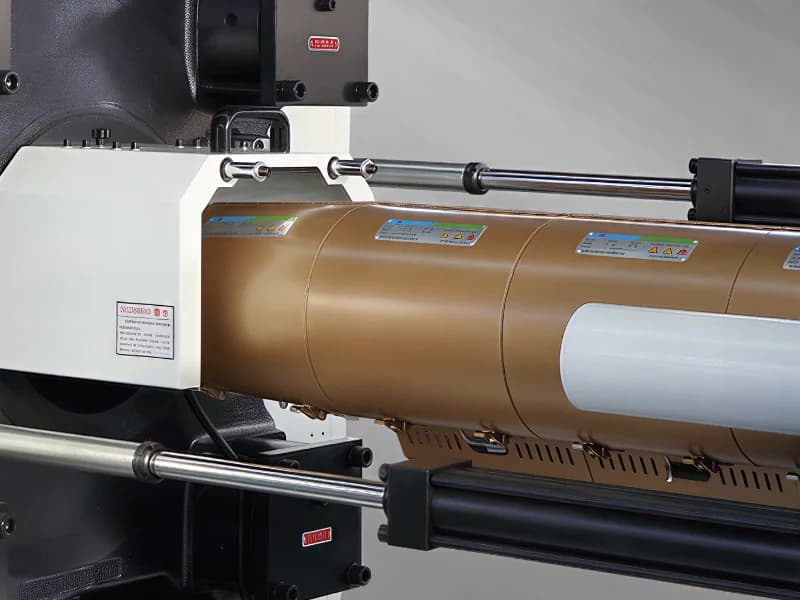
Servo-hydraulic drive system with energy recovery
Need Expert Advice?
Talk to our engineers about your specific production requirements. Free consultation.
Cooling System Requirements for HWAMDA SPV5 Machines
The HWAMDA SPV5 machine-side cooling infrastructure must support the mold's water cooling demands. The machine provides hydraulic oil cooling (requiring 15-25 kW cooling capacity with oil temperature target of 42-48°C) and barrel cooling (typically air-cooled fans on the feed throat zone). Mold cooling is supplied externally through a process chiller delivering 10-15°C water at 3-5 bar pressure with total flow capacity of 80-150 L/min for an 8-cavity mold. The HMD 400M8-SPV platen provides water connection ports on both stationary and moving platens with standard KJC or DME quick-connect fittings. Typical mold cooling circuit count: 8-cavity yogurt cup mold requires 8-16 circuits (1-2 per cavity for core and cavity), each needing independent temperature and flow control. Use a manifold distribution system with individual flow regulators and temperature monitoring on each circuit. Water quality must be maintained with conductivity below 300 microS/cm, pH 7.0-8.5, and hardness below 100 ppm CaCO3 to prevent scale buildup in cooling channels that degrades heat transfer by 15-30% within 6-12 months.
Impact on Part Quality and Dimensional Control
Cooling uniformity directly determines dimensional accuracy, warpage, and surface quality of thin-wall parts. Non-uniform cooling causes differential shrinkage, resulting in warpage of 0.5-2.0mm on yogurt cups where the specification is typically under 0.3mm. Water cooling achieves temperature uniformity of +/-2-3°C across the cavity surface with properly designed channels, while air cooling varies by +/-10-20°C. For a 0.40mm wall PP cup, a 5°C temperature difference between two cavity zones creates 0.01-0.02mm thickness variation and 0.1-0.2mm warpage, potentially exceeding tolerance. On multi-cavity molds, cavity-to-cavity cooling balance is equally critical. Use flow meters (turbine or ultrasonic type, $50-100 per circuit) on each cooling circuit to maintain +/-10% flow balance across all cavities. Temperature differential between inlet and outlet water should be 2-4°C per circuit; differences exceeding 5°C indicate insufficient flow or channel blockage. The INOVA controller on HWAMDA SPV5 machines can monitor mold temperature inputs from cavity thermocouples, alarming when temperature deviates beyond +/-2°C from setpoint.
Key Specs
- •Non-uniform cooling causes differential shrinkage, resulting in warpage of 0.5-2.0mm on yogurt cups where the specification is typically under 0.3mm.
- •Water cooling achieves temperature uniformity of +/-2-3°C across the cavity surface with properly designed channels, while air cooling varies by +/-10-20°C.
- •For a 0.40mm wall PP cup, a 5°C temperature difference between two cavity zones creates 0.01-0.02mm thickness variation and 0.1-0.2mm warpage, potentially exceeding tolerance.
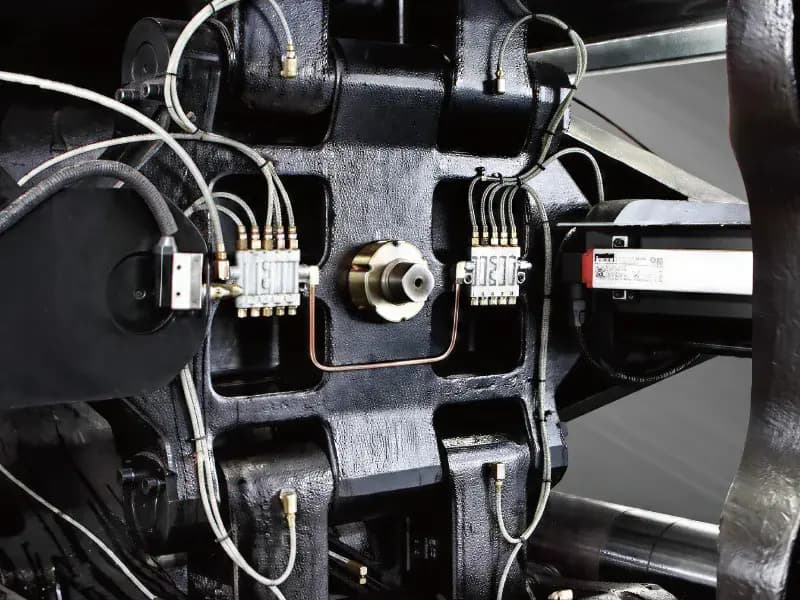
Toggle clamping unit — high rigidity for thin-wall molding
Cost Comparison and System Design Recommendations
Water cooling infrastructure for an HWAMDA SPV5 production cell requires: process chiller ($8,000-15,000 for 25-30 kW capacity), mold temperature controllers ($2,000-4,500 each, 2 units recommended), water treatment system ($500-1,500), manifolds and flow regulators ($800-2,000 for 8-16 circuits), and installation piping ($1,000-3,000). Total water cooling investment: $14,300-36,000. Air cooling for equivalent heat removal would require industrial fans and ducting ($2,000-5,000) but simply cannot achieve the required cooling rates for thin-wall production. The only practical comparison is between standard drilled water channels versus conformal cooling: standard channels cost $0 extra in mold build (included in standard mold price of $35,000-55,000 for 8-cavity), while conformal cooling adds $5,000-15,000 per cavity set but reduces cycle time by 20-40%. For production volumes above 15 million parts per year, conformal cooling pays back within 2-6 months through increased output. Recommendation: always specify water cooling for all cavity and core surfaces, add conformal cooling for cycle-time-critical applications, and reserve air cooling only for auxiliary functions like ejector plates and external condensation prevention.
Frequently Asked Questions
For PP thin-wall containers with 0.35-0.50mm walls on HWAMDA SPV5 machines, use 15-25°C cooling water. Lower temperatures (10-15°C) achieve faster cooling but risk condensation on the mold surface in humid environments (above 60% RH) and can cause skin-layer stress marks on the part surface. Higher temperatures (25-35°C) improve surface gloss and reduce internal stress but extend cycle time by 0.5-1.0 second. Optimal temperature depends on wall thickness and ambient conditions.
Related Guides
Ready to Start Your Project?
Get a free consultation and quotation for your thin-wall packaging production line.
Join 500+ manufacturers in 60+ countries who trust HWAMDA.
Get Free Quote