

How Toggle Clamping Works in the SPV5 Series
The HWAMDA SPV5 toggle clamping unit uses a five-point double-toggle linkage mechanism driven by a hydraulic cylinder through a crosshead. As the crosshead advances, the toggle links extend from a folded position to a nearly straight-line lock-up, mechanically amplifying the hydraulic cylinder force by a factor of 20-50x depending on the toggle geometry and angle. At full extension (lock-up), the toggle links are within 0.1-0.3 degrees of straight, generating the rated clamping force of 2,700-6,000 kN with minimal hydraulic pressure. The SPV5's toggle links are nitrided for surface hardness of 58-62 HRC and wear resistance exceeding 10 million cycles. Alloy metallic tie bars with enhanced strength connect the stationary and moving platens, maintaining parallelism within 0.03-0.05mm across the platen face. The strengthened platen design uses high-rigidity structures with FEA-optimized rib patterns to achieve platen deflection under 0.05mm at full tonnage, critical for uniform clamp pressure distribution across 4-16 cavity thin-wall molds.
Key Specs
- •At full extension (lock-up), the toggle links are within 0.1-0.3 degrees of straight, generating the rated clamping force of 2,700-6,000 kN with minimal hydraulic pressure.
- •The SPV5's toggle links are nitrided for surface hardness of 58-62 HRC and wear resistance exceeding 10 million cycles.
- •Alloy metallic tie bars with enhanced strength connect the stationary and moving platens, maintaining parallelism within 0.03-0.05mm across the platen face.
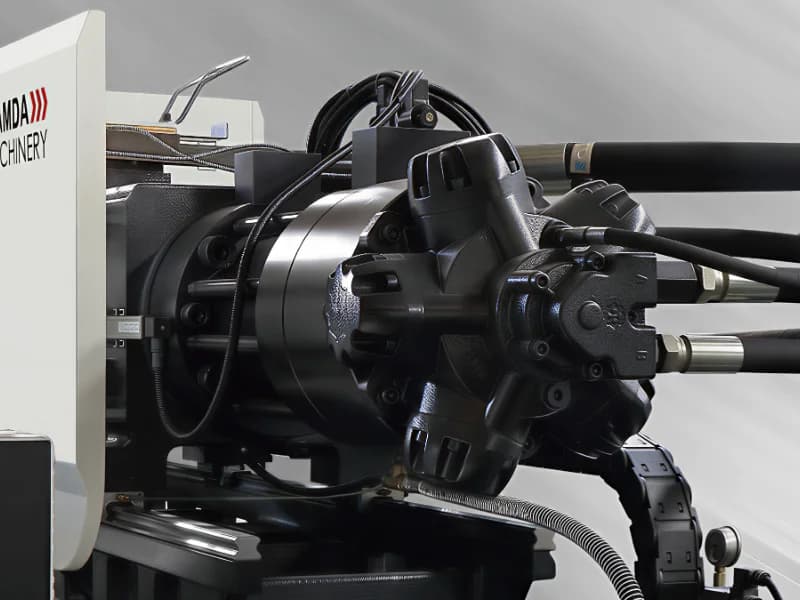
High-speed injection unit with linear guides
How Direct Hydraulic Clamping Works
Direct hydraulic clamping (also called ram clamping or direct-lock) uses a large-diameter hydraulic cylinder directly behind the moving platen to generate clamping force. The clamp force is directly proportional to cylinder area multiplied by hydraulic pressure, with no mechanical amplification. A typical 400-ton direct-clamp machine uses a cylinder bore diameter of 500-600mm operating at 14-17 MPa system pressure. The advantages of direct clamping include infinite adjustability of clamping force from 0-100% without mold height adjustment, simpler mechanical construction with fewer moving parts, uniform force distribution across the platen face, and compact machine footprint with 15-20% shorter overall length. Direct clamp machines from manufacturers like Engel (duo series) and Haitian (Zhafir Zeres) are popular for large parts and thick-wall applications where precise force control matters more than cycle speed. However, for thin-wall packaging where the mold opens and closes 800-1,200 times per hour, the speed limitations of direct clamping become significant.
Speed and Cycle Time Performance Comparison
Toggle clamping delivers substantially faster open/close times than direct hydraulic systems, a critical advantage for thin-wall production. The HWAMDA SPV5 toggle system achieves mold close times of 0.3-0.5 seconds and mold open times of 0.3-0.5 seconds on 560-700mm strokes, with maximum platen velocity exceeding 1,000 mm/s during rapid traverse. Toggle systems accelerate rapidly because the hydraulic cylinder drives the lightweight crosshead rather than the heavy moving platen, with the toggle linkage providing mechanical advantage for the final locking motion. Direct hydraulic clamping achieves mold close/open times of 0.8-1.5 seconds on equivalent strokes because the full-bore cylinder must move the entire platen mass through the complete stroke at hydraulic flow-limited speeds. On a 400-ton machine running 8-cavity yogurt cups, the toggle advantage of 0.5-1.0 seconds per cycle (combined open and close) reduces total cycle time from 5.0-5.5s (direct clamp) to 4.0-4.5s (toggle). This 15-20% cycle time improvement translates directly to 15-20% higher output.
Key Specs
- •The HWAMDA SPV5 toggle system achieves mold close times of 0.3-0.5 seconds and mold open times of 0.3-0.5 seconds on 560-700mm strokes, with maximum platen velocity exceeding 1,000 mm/s during rapid traverse.
- •This 15-20% cycle time improvement translates directly to 15-20% higher output.
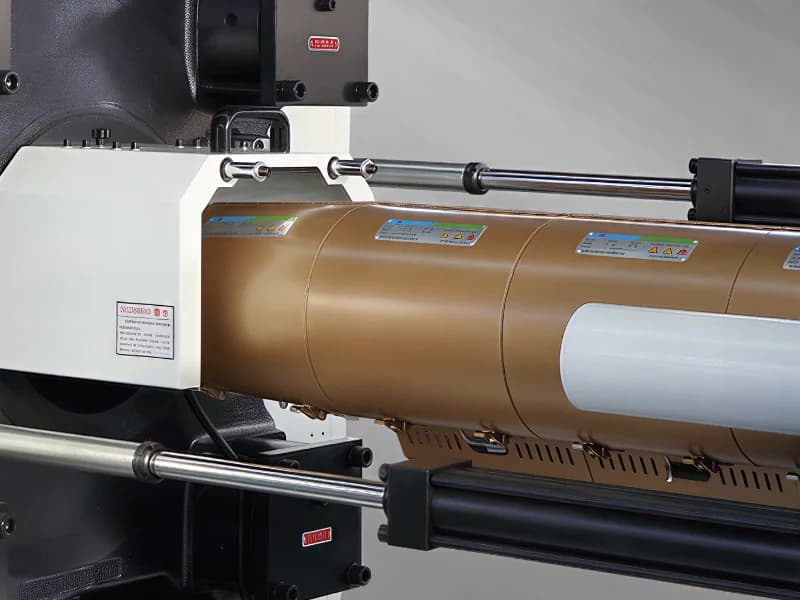
Servo-hydraulic drive system with energy recovery
Need Expert Advice?
Talk to our engineers about your specific production requirements. Free consultation.
Energy Consumption and Efficiency Analysis
Toggle clamping consumes 40-60% less energy for the clamping function compared to direct hydraulic systems. At full lock-up, the toggle mechanism holds clamping force through mechanical self-locking with nearly zero hydraulic energy input. Only the small pre-load cylinder maintains the crosshead position, consuming 1-3 kW. Direct clamping must maintain full hydraulic pressure throughout the holding and cooling phases, consuming 15-25 kW continuously on a 400-ton machine. For a typical thin-wall cycle with 2-3 seconds of clamp-closed time, the energy difference is: toggle consumes 0.002-0.009 kWh per cycle for clamping, while direct clamp consumes 0.008-0.021 kWh per cycle. At 800 cycles/hour over 7,200 annual hours, the difference is 3,456-6,912 kWh annually ($276-553 at $0.08/kWh). Combined with the SPV5's servo pump system that powers the toggle cylinder, total machine energy consumption is 0.95-1.1 kWh/kg versus 1.2-1.4 kWh/kg for a comparable direct-clamp servo-hydraulic machine. The SPV5's dual-pump system further optimizes energy use by running the clamp pump at minimal speed during the self-locking hold phase while the injection pump handles plasticizing.
Platen Deflection and Mold Protection
Uniform platen deflection is critical for thin-wall molds where parting line gaps exceeding 0.02-0.03mm cause flash defects. Toggle systems generate clamping force through four tie bars at the platen corners, creating a bending pattern where the center of the platen deflects slightly outward. The HWAMDA SPV5's strengthened platen design limits this center deflection to under 0.05mm at full tonnage through optimized rib structures and increased platen thickness. Direct hydraulic clamping applies force through a central ram, creating the opposite deflection pattern: the center is compressed while the edges bow outward. This central loading pattern can be advantageous for single-cavity molds positioned at platen center but disadvantageous for multi-cavity molds spread across the platen face. For 8-cavity thin-wall molds with cavity spacing of 100-150mm across a 930x900mm platen (HMD 308M8-SPV specification), the toggle system's edge-loaded pattern with the reinforced platen provides more uniform clamp pressure across all cavities. Mold protection features on the SPV5 include low-pressure mold close with sensitivity to 0.1mm position deviation, protecting fragile thin-wall core pins worth $500-1,500 each.
Key Specs
- •Uniform platen deflection is critical for thin-wall molds where parting line gaps exceeding 0.02-0.03mm cause flash defects.
- •The HWAMDA SPV5's strengthened platen design limits this center deflection to under 0.05mm at full tonnage through optimized rib structures and increased platen thickness.
- •For 8-cavity thin-wall molds with cavity spacing of 100-150mm across a 930x900mm platen (HMD 308M8-SPV specification), the toggle system's edge-loaded pattern with the reinforced platen provides more uniform clamp pressure across all cavities.
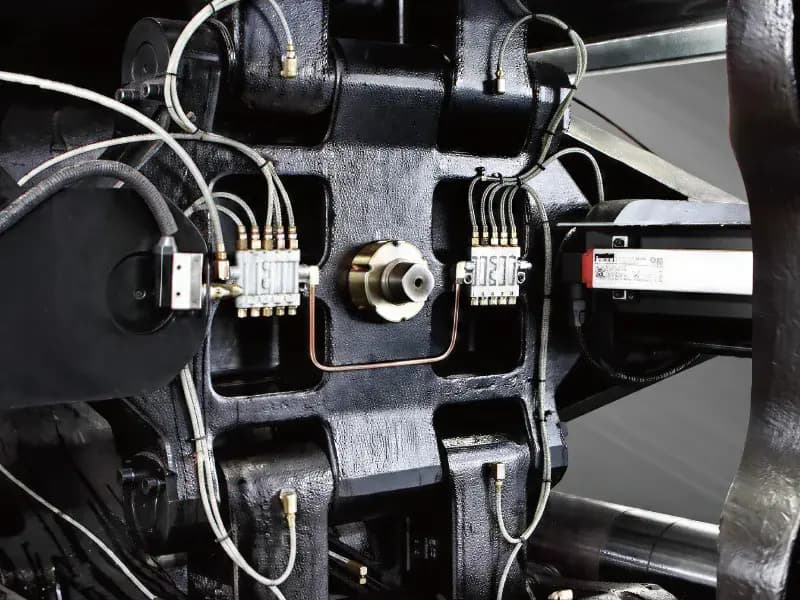
Toggle clamping unit — high rigidity for thin-wall molding
Recommendation for Thin-Wall Packaging Applications
Toggle clamping is the clear choice for thin-wall food packaging production, and the HWAMDA SPV5's five-point toggle design is specifically optimized for this application. Choose toggle clamping (HWAMDA SPV5) when: cycle time targets are below 5.0 seconds, multi-cavity molds with 4-16 cavities are used, production volume exceeds 10 million parts annually, energy cost is a concern (saves $200-550/year on clamping alone), and rapid mold open is needed for IML robot access within 0.5-second windows. Consider direct clamping only when: producing very large, single-cavity parts where central force application is preferred, infinite force adjustability is needed for process development, extremely long cooling times (above 10 seconds) make cycle speed irrelevant, or machine footprint constraints prohibit the longer toggle machine length. For HWAMDA's target applications of yogurt cups (4-8 cavity, HMD 350-400M8-SPV), food containers (2-4 cavity, HMD 400-480M8-SPV), sauce cups (8-16 cavity, HMD 270-350M8-SPV), and IML margarine tubs (2-4 cavity, HMD 400-530M8-SPV), the SPV5 toggle system delivers optimal performance.
Frequently Asked Questions
The SPV5's nitrided toggle links with optimized structure are rated for over 10 million cycles, equivalent to 3-5 years of continuous thin-wall production at 4-second cycles. Automatic centralized lubrication reduces wear by maintaining a consistent grease film on all pin/bushing interfaces. Toggle pin bushings are the primary wear component, replaceable at $200-400 per set during scheduled maintenance at 3-5 million cycle intervals.
Related Guides
Ready to Start Your Project?
Get a free consultation and quotation for your thin-wall packaging production line.
Join 500+ manufacturers in 60+ countries who trust HWAMDA.
Get Free Quote