

Hydraulic System Architecture Explained
A single-pump hydraulic system uses one variable-displacement piston pump driven by a servo motor to power all machine movements sequentially. When the injection unit is filling the mold, the clamping unit cannot move. A dual-pump system employs two independent servo pump units, each with its own motor, pump, and pressure control, allowing simultaneous operation of two machine functions. The HWAMDA SPV5 takes this further with high-speed accumulator circuits that store hydraulic energy during low-demand phases and release it for peak injection speed. For example, the HMD 400M8-SPV's dual 55+55 kW pump system delivers combined flow rates exceeding 200 L/min during parallel operations, compared to 100-120 L/min maximum from a single-pump equivalent. This additional flow capacity enables the 442 mm/s injection speed on the 60mm screw while simultaneously maintaining clamping pressure at 4,000 kN. The accumulator pre-charge pressure of 80-100 bar supplements the pump output during the 0.2-0.5 second injection phase.
Key Specs
- •This additional flow capacity enables the 442 mm/s injection speed on the 60mm screw while simultaneously maintaining clamping pressure at 4,000 kN.
- •The accumulator pre-charge pressure of 80-100 bar supplements the pump output during the 0.2-0.5 second injection phase.
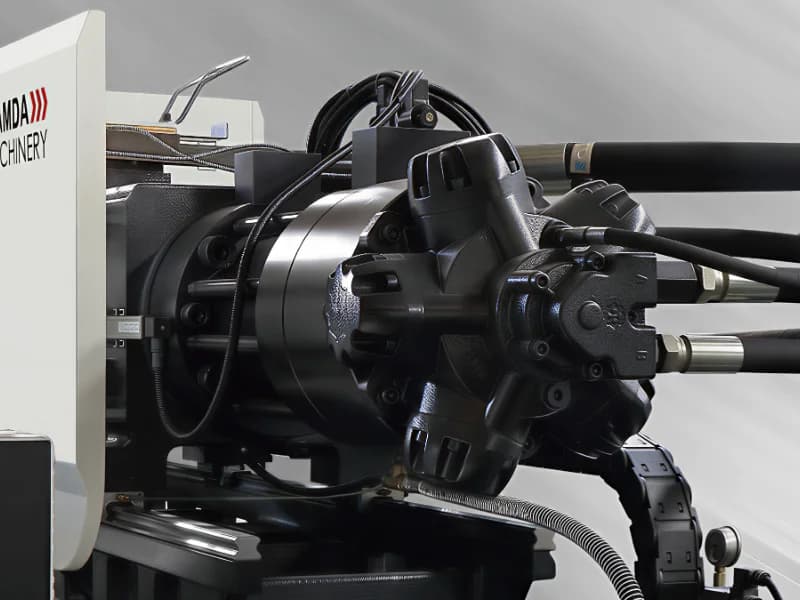
High-speed injection unit with linear guides
Cycle Time Impact of Parallel Movements
The primary advantage of dual-pump systems is enabling parallel (simultaneous) machine movements that shrink cycle time. In a single-pump machine, the cycle executes sequentially: mold close (0.5s) then injection (0.3s) then hold (1.0s) then cooling (2.0s) then mold open (0.5s) then ejection (0.3s), totaling 4.6 seconds with no overlap. The HWAMDA SPV5 dual-pump system enables: plasticizing during cooling (saves 0.8-1.2s), mold break during ejection (saves 0.1-0.2s), and core pull during mold open (saves 0.1-0.3s). This parallel operation, called charging on the fly in HWAMDA's specifications, reduces the effective cycle from 4.6s to approximately 3.5-3.8s for the same part. On an 8-cavity yogurt cup mold, this 20-25% cycle time reduction increases daily output from approximately 135,000 to 170,000 cups, adding $700-1,400 in daily production value at $0.02 margin per cup. Over a year of 7,200 operating hours, the dual-pump advantage generates $180,000-360,000 in additional revenue per machine.
Energy Efficiency Comparison
Counter-intuitively, dual-pump servo systems can match or beat single-pump energy consumption despite having twice the motor capacity. The key is variable-speed operation: each servo motor runs only at the speed required for its current task and drops to near-zero consumption during idle phases. The HWAMDA SPV5's dual 55+55 kW system on the HMD 400M8-SPV consumes 0.95-1.1 kWh/kg during typical thin-wall production, compared to 1.2-1.5 kWh/kg for a single-pump servo machine producing the same parts at longer cycle times. The energy savings come from two sources. First, the shorter cycle time means less total machine-on time per part. Second, servo motors operating at partial load (40-60% of rated capacity during most phases) achieve higher efficiency than a single larger motor at 80-90% load. Annual energy cost for the HMD 400M8-SPV: approximately $25,344 at $0.08/kWh versus $31,104-38,880 for a comparable single-pump machine. The $5,760-13,536 annual energy savings partially offsets the $8,000-15,000 price premium of the dual-pump configuration.
Key Specs
- •Second, servo motors operating at partial load (40-60% of rated capacity during most phases) achieve higher efficiency than a single larger motor at 80-90% load.
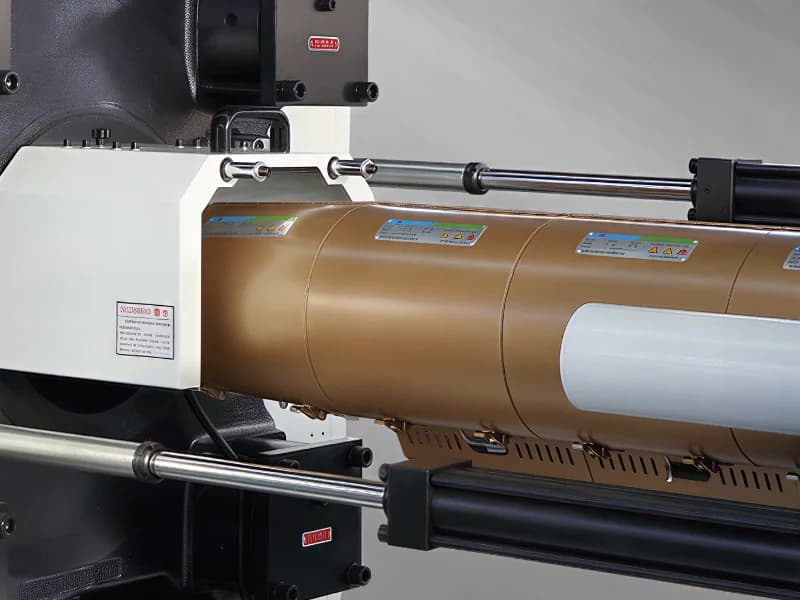
Servo-hydraulic drive system with energy recovery
Need Expert Advice?
Talk to our engineers about your specific production requirements. Free consultation.
Reliability and Maintenance Considerations
Dual-pump systems have more components but distribute wear across two units, potentially extending individual component life. Each pump in the HWAMDA SPV5 system operates at 50-60% of its rated capacity during normal production versus 80-90% for a single pump doing all the work. This reduced loading extends pump life from typical 15,000-20,000 hours (single pump) to 20,000-30,000 hours per pump in the dual system. Maintenance schedules for the SPV5 dual-pump system: hydraulic oil change every 4,000-5,000 hours ($400-600), filter replacement every 2,000 hours ($200-400), pump seal inspection every 8,000 hours ($300-500 per pump), and servo motor inspection every 10,000 hours ($200-300 per motor). Annual maintenance cost for dual pumps: $2,000-3,500 versus $1,500-2,500 for single pump. The $500-1,000 additional annual maintenance is far outweighed by productivity gains. If one pump fails, the SPV5 can operate in degraded single-pump mode at reduced speed, maintaining production at 60-70% output while awaiting repair rather than complete shutdown.
Noise and Environmental Comparison
Noise levels matter in production environments subject to occupational health regulations limiting exposure to 85 dBA over 8 hours. Single-pump machines with a large servo motor running at high speed generate 72-78 dBA at 1 meter during injection phase. The HWAMDA SPV5 dual-pump system distributes the hydraulic load across two smaller motors, each operating at lower speeds, resulting in 68-74 dBA at 1 meter. The noise reduction of 4-6 dBA represents a perceived loudness decrease of approximately 30-40%, improving operator comfort on 12-hour shifts. Hydraulic oil temperature is another environmental factor. Single-pump systems running at 80-90% capacity generate more heat, requiring oil coolers to maintain temperature below 55°C. The SPV5 dual-pump system at 50-60% loading maintains oil temperature at 42-48°C with standard cooling, reducing thermal degradation of hydraulic oil and extending change intervals. Lower oil temperature also improves servo motor efficiency by 2-3% and reduces the cooling water demand for the hydraulic oil circuit by approximately 5-8 kW.
Key Specs
- •The noise reduction of 4-6 dBA represents a perceived loudness decrease of approximately 30-40%, improving operator comfort on 12-hour shifts.
- •Single-pump systems running at 80-90% capacity generate more heat, requiring oil coolers to maintain temperature below 55°C.
- •The SPV5 dual-pump system at 50-60% loading maintains oil temperature at 42-48°C with standard cooling, reducing thermal degradation of hydraulic oil and extending change intervals.
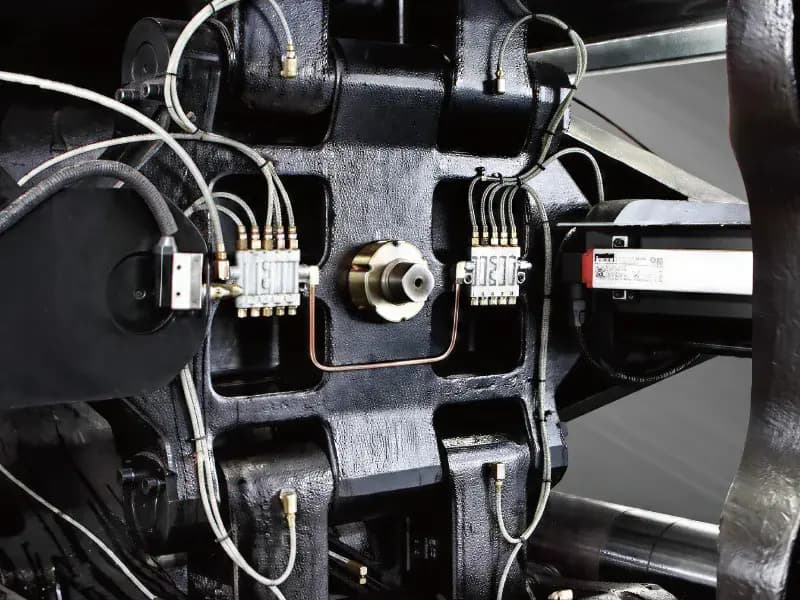
Toggle clamping unit — high rigidity for thin-wall molding
Investment Analysis and Break-Even Calculation
The dual-pump configuration adds $8,000-15,000 to machine cost compared to a single-pump equivalent of the same tonnage. For the HWAMDA SPV5 series, this premium is built into the standard configuration as all SPV5 models ship with dual-pump systems. Competitive Chinese machines offering single-pump options at $8,000-15,000 less sacrifice 20-25% cycle time performance. Break-even analysis for the dual-pump premium: at 4.0s versus 5.0s cycle time on an 8-cavity yogurt cup mold, the dual-pump machine produces 7,200 cups/hr versus 5,760 cups/hr, an additional 1,440 cups/hr worth $28.80/hr at $0.02 margin. The $8,000-15,000 premium pays back in 278-521 operating hours, or 1.5-3 months of single-shift production. For 24/7 operations, payback occurs in 12-22 days. There is no practical scenario in thin-wall packaging where a single-pump system provides better economics than the HWAMDA SPV5's dual-pump design, making it the correct choice for any production volume exceeding 5 million parts per year.
Frequently Asked Questions
The HWAMDA SPV5 can operate in degraded single-pump mode if one pump unit fails. Cycle time increases by 30-40% (e.g., from 4.0s to 5.2-5.6s) as parallel movements are no longer possible, but production continues at 60-70% output. This failover capability prevents complete production shutdown while the failed pump is repaired or replaced, typically within 2-5 days with HWAMDA support.
Related Guides
Ready to Start Your Project?
Get a free consultation and quotation for your thin-wall packaging production line.
Join 500+ manufacturers in 60+ countries who trust HWAMDA.
Get Free Quote