

Margarine Container Dimensions and Material Selection
Margarine containers come in standardized sizes tailored to retail markets. A 250g tub measures approximately 120 x 90 x 60 mm for rectangular or 110 mm diameter by 55 mm height for round, with wall thickness of 0.38-0.45 mm and part weight of 10-14 grams. A 500g tub reaches 150 x 110 x 80 mm or 130 mm diameter by 70 mm height at 0.42-0.50 mm wall and 16-20 grams. The thin wall combined with the flat, wide base creates a part with excellent stiffness-to-weight ratio when IML labels on the base and sidewalls contribute structural reinforcement. PP homopolymer with MFI of 45-70 g/10min is the standard material, providing the combination of stiffness at 1,400-1,700 MPa flexural modulus, grease resistance, and FDA/EU food contact compliance required for spreadable fat packaging. The PP must withstand contact with margarine containing up to 80% fat content without stress cracking or migration exceeding EU 10/2011 limits of 10 mg/dm2 overall migration. For markets requiring extended shelf life, PP with enhanced oxygen barrier or multi-layer co-injection options are available but add complexity. The container rim is designed for heat-seal closure with aluminum foil lids, requiring a flat, flash-free rim surface with plus or minus 0.05 mm flatness tolerance.
Key Specs
- •A 250g tub measures approximately 120 x 90 x 60 mm for rectangular or 110 mm diameter by 55 mm height for round, with wall thickness of 0.38-0.45 mm and part weight of 10-14 grams.
- •A 500g tub reaches 150 x 110 x 80 mm or 130 mm diameter by 70 mm height at 0.42-0.50 mm wall and 16-20 grams.
- •PP homopolymer with MFI of 45-70 g/10min is the standard material, providing the combination of stiffness at 1,400-1,700 MPa flexural modulus, grease resistance, and FDA/EU food contact compliance required for spreadable fat packaging.
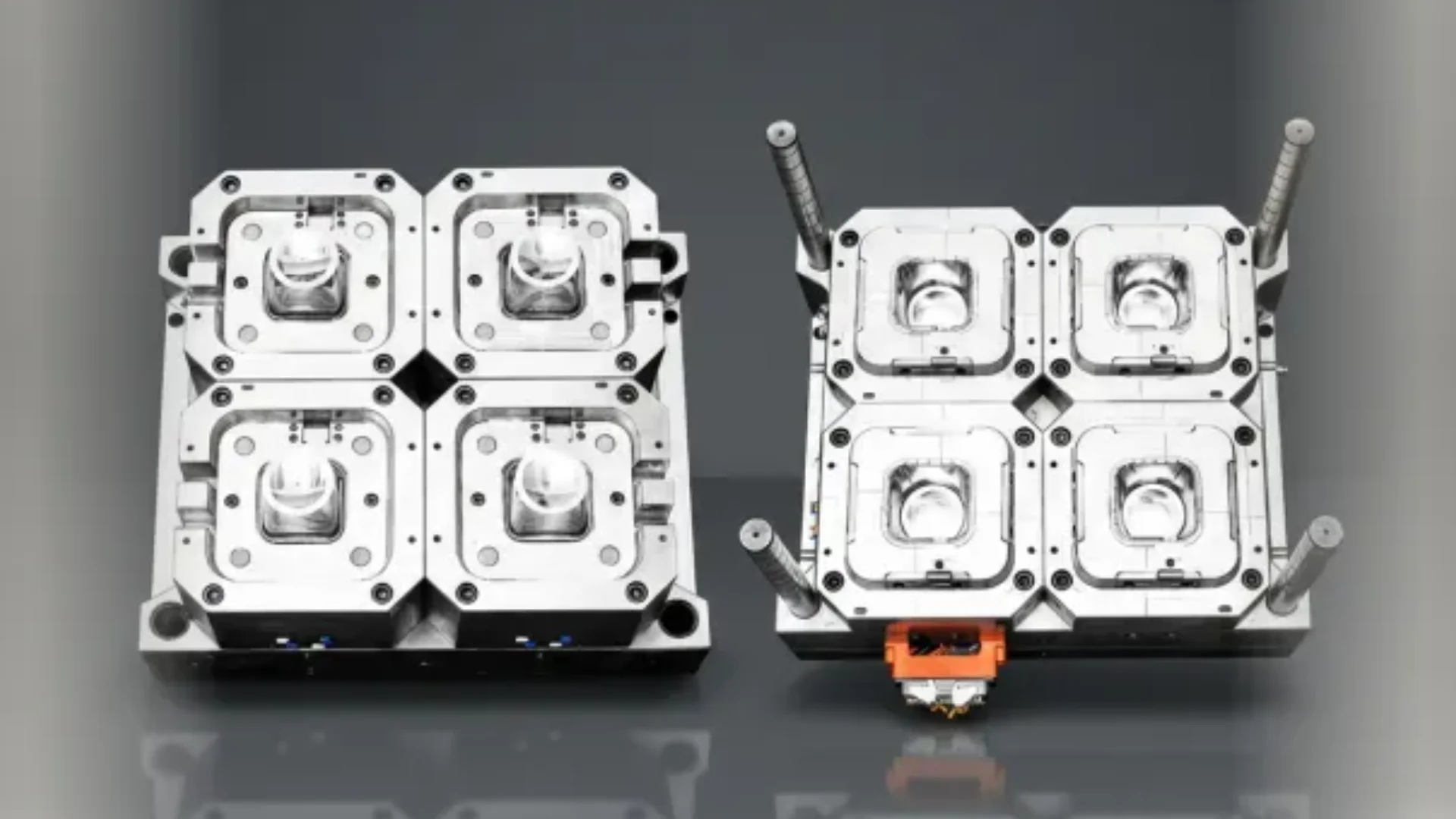
IML mold system for margarine container production
Stack Mold Technology for Doubled Output
Margarine container production frequently employs stack molds to double output without proportionally increasing machine clamping force. A 4+4 stack mold configuration produces 8 containers per cycle using only the clamping force needed for 4 cavities plus the additional force to hold the center section. On an HMD 418M8-SPV with 4,180 kN clamping force, a 4+4 stack mold for 250g margarine tubs requires approximately 3,800-4,000 kN, as the stack configuration distributes injection pressure across two parting planes. The mold includes a center hot runner distribution plate that splits the melt from a single machine nozzle to both mold faces, requiring 8 valve gate nozzles at 1.5-2.0 mm gate diameter. Stack mold weight reaches 3,000-5,000 kg, within the capacity of the HMD 418M8-SPV with its platen size of 1,070 x 1,050 mm. The maximum daylight of 1,315 mm must accommodate the doubled mold stack height. IML systems for stack molds require dual-sided label placement, with the SWITEK robot placing labels in both the front and rear mold faces during the mold-open phase. Stack molds increase capital investment by 40-60% over single-face molds but reduce per-unit machine cost by approximately 45% through doubled output.
ICM Technology for Ultra-Thin Margarine Tubs
Injection Compression Molding is an advanced technique used for the thinnest margarine containers at 0.38-0.42 mm wall. ICM operates by partially closing the mold before injection, creating a slightly larger cavity gap. The SPV5 machine injects the PP melt at lower pressure into this enlarged gap, then applies the final clamping force to compress the melt to the final wall thickness. This reduces injection pressure requirements by 25-40%, enabling wall thicknesses that would otherwise require impractically high pressures. On the HMD 350M8-SPV, standard injection at 0.38 mm wall would require pressures exceeding 180 MPa, whereas ICM achieves the same wall at 120-140 MPa by using the clamping force of 3,500 kN for the compression phase. ICM also improves part quality: the compression phase eliminates sink marks, reduces residual stress, and produces more uniform wall thickness with variation below plus or minus 0.03 mm. The INOVA controller manages the ICM sequence through precise clamp position control, transitioning from injection to compression within 0.05 seconds. ICM reduces material consumption by 5-10% for the same container volume, as the more uniform filling allows thinner nominal walls. The technique is particularly valuable for margarine tubs where wall thickness directly impacts both material cost and container rigidity.
Key Specs
- •Injection Compression Molding is an advanced technique used for the thinnest margarine containers at 0.38-0.42 mm wall.
- •This reduces injection pressure requirements by 25-40%, enabling wall thicknesses that would otherwise require impractically high pressures.
- •On the HMD 350M8-SPV, standard injection at 0.38 mm wall would require pressures exceeding 180 MPa, whereas ICM achieves the same wall at 120-140 MPa by using the clamping force of 3,500 kN for the compression phase.
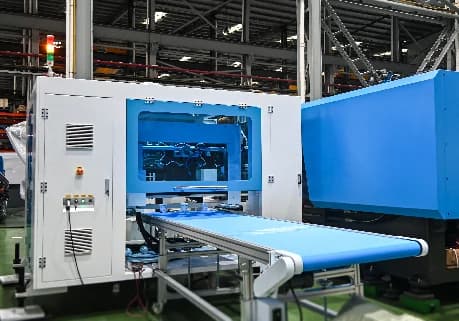
Label magazine feeding system for consistent IML decoration
Need Expert Advice?
Talk to our engineers about your specific production requirements. Free consultation.
IML System Design for Margarine Packaging
IML on margarine containers involves label placement on the base panel and typically 2-4 sidewall panels, requiring sophisticated label handling and placement systems. Base labels are flat rectangles or ovals matching the container bottom shape, while sidewall labels are pre-formed to the container taper angle of 3-5 degrees. Labels use 50-70 micrometer PP film with reverse-printed food-safe inks and a heat-seal compatible inner layer. The SWITEK IML robot system for margarine tubs includes multiple vacuum end-effectors that pick labels from 4-8 separate magazine stacks and place them sequentially or simultaneously into the mold cavities. Label placement accuracy must be within plus or minus 0.3 mm for base labels and plus or minus 0.5 mm for sidewall labels to maintain brand quality standards. The electrostatic charging system applies 25-30 kV to ensure labels remain positioned during mold closing. During injection at 230-245 degrees Celsius melt temperature, the PP melt fuses with the label creating a bond strength exceeding 3 N/25mm. For full-wrap IML covering 100% of visible surfaces, the label placement cycle adds 0.5-1.0 seconds, bringing total cycle to 4.3-5.5 seconds. Vision system inspection downstream verifies label position, print quality, and absence of wrinkles at production speed.
Process Parameters for Margarine IML Production
Margarine container molding on SPV5 machines combines the demands of thin-wall filling with the precision requirements of IML positioning. Injection speed of 450-517 mm/s fills the 0.38-0.50 mm wall sections in 0.15-0.25 seconds, with a velocity-to-pressure transfer at 96-98% fill to prevent label displacement from excessive packing pressure. Melt temperature of 230-245 degrees Celsius provides optimal flow and IML fusion. Hold pressure at 40-55% of injection pressure for 0.5-0.8 seconds packs the part while maintaining label position. The thinner the wall, the shorter the hold time as gates freeze faster. Cooling time of 1.0-2.0 seconds at mold temperature of 15-20 degrees Celsius solidifies the thin PP wall rapidly. For stack molds, cooling must be balanced between front and rear faces, with independent temperature control units for each mold half. Total cycle time for 4-cavity single-face mold is 3.8-4.2 seconds and for 4+4 stack mold is 4.0-4.5 seconds, the slight increase due to extended mold movement for the stack configuration. With charging-on-fly on the dual 55+55 kW pump system, screw recovery completes within the mold movement phase. The INOVA controller monitors IML-specific parameters including label vacuum pressure, electrostatic charge status, and robot-mold interlock timing.
Key Specs
- •Injection speed of 450-517 mm/s fills the 0.38-0.50 mm wall sections in 0.15-0.25 seconds, with a velocity-to-pressure transfer at 96-98% fill to prevent label displacement from excessive packing pressure.
- •Hold pressure at 40-55% of injection pressure for 0.5-0.8 seconds packs the part while maintaining label position.
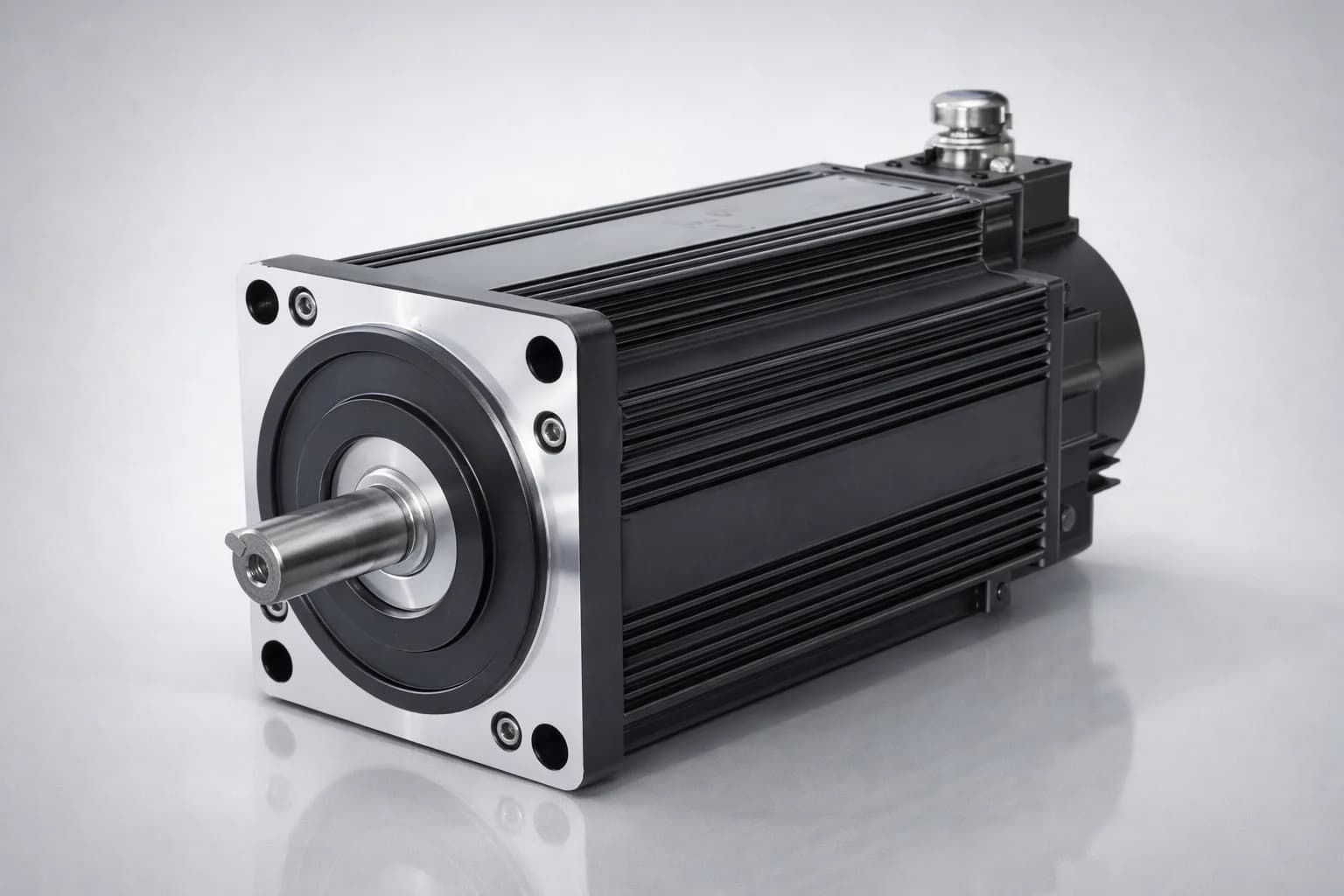
Servo motor driven IML system for precision label placement
Quality Standards and Market Requirements
Margarine containers face the strictest quality requirements of any thin-wall packaging application due to retail shelf visibility and food contact regulations. Dimensional tolerances include wall thickness variation of plus or minus 0.04 mm, rim flatness within 0.05 mm for foil seal integrity, and overall height within plus or minus 0.15 mm for filling line compatibility. IML quality criteria include wrinkle-free labels on all surfaces, registration accuracy within plus or minus 0.3 mm, color consistency with delta E below 2.0 versus the approved standard, and no air bubbles between label and container wall. Food safety testing per EU Regulation 10/2011 is mandatory for European markets, with migration testing using vegetable oil simulant at 40 degrees Celsius for 10 days representing the long-term fat contact condition. Some retailers require BRC Grade A certification for their margarine container suppliers. Production lines on HWAMDA SPV5 machines achieve these standards through the combination of precise injection control within plus or minus 1% pressure repeatability, consistent mold temperature within plus or minus 1 degree Celsius, and automated IML placement with 0.1 mm robot repeatability. Monthly output from a 4+4 stack mold at 4.5-second cycle reaches 2.72 million containers at 85% OEE.
Frequently Asked Questions
Stack molds double output per cycle from 4 to 8 containers without proportionally increasing machine size or clamping force. A 4+4 stack mold on the HMD 418M8-SPV produces 6,400 containers per hour at 4.5-second cycle, versus 3,200 per hour from a 4-cavity single-face mold. The 40-60% higher mold investment pays back within 6-12 months through doubled output. Stack molds require machines with adequate daylight of 1,300+ mm and dual-sided IML robot capability.
Related Guides
Ready to Start Your Project?
Get a free consultation and quotation for your thin-wall packaging production line.
Join 500+ manufacturers in 60+ countries who trust HWAMDA.
Get Free Quote