

Tableware Product Range and Specifications
Disposable tableware spans a wide range of geometries and sizes. Bowls at 250 ml capacity measure 110-120 mm diameter by 45-55 mm height with 0.40-0.55 mm wall and 8-12 grams weight. Larger 500 ml bowls reach 150-180 mm diameter by 50-60 mm height at 0.45-0.60 mm wall and 15-20 grams. Round plates of 180-230 mm diameter are shallow at 15-25 mm depth with 0.38-0.50 mm wall and 10-18 grams. Spoons and forks range from 130-180 mm length at 3-8 grams. The shallow geometry of plates allows very high cavity counts, with specialized flat-part machines achieving up to 52 cavities for small plates. For conventional injection molding on SPV5 machines, 4-8 cavities is standard for bowls and 8-12 for plates. PP is the dominant material for microwaveable tableware at MFI of 35-60 g/10min, while general-purpose PS at MFI of 10-20 g/10min is used for rigid, non-microwaveable items. Emerging biodegradable options include PLA at MFI of 15-40 g/10min, CPLA for heat-resistant applications processed at 175-190 degrees Celsius, and PP-grain powder blends offering partial biodegradability.
Key Specs
- •Bowls at 250 ml capacity measure 110-120 mm diameter by 45-55 mm height with 0.40-0.55 mm wall and 8-12 grams weight.
- •Larger 500 ml bowls reach 150-180 mm diameter by 50-60 mm height at 0.45-0.60 mm wall and 15-20 grams.
- •Round plates of 180-230 mm diameter are shallow at 15-25 mm depth with 0.38-0.50 mm wall and 10-18 grams.
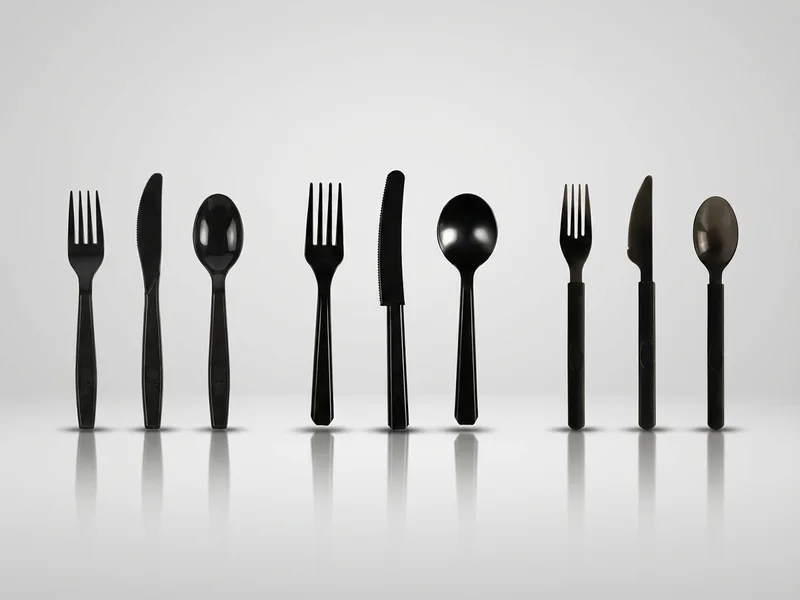
Disposable tableware production line — forks, spoons, knives
Machine Selection by Tableware Type
Different tableware items require different SPV5 configurations based on projected area and part geometry. For 8-cavity 250 ml bowls with total projected area of approximately 800 cm2, the HMD 368M8-SPV at 3,680 kN provides adequate clamping. The injection unit with 55 mm screw at 400 mm/s injection speed handles the 70-100g total shot weight. Platen size of 1,030 x 1,000 mm accommodates the 8-cavity mold layout. For 4-cavity 500 ml bowls or large plates, the HMD 400M8-SPV at 4,000 kN offers the larger platen size of 1,080 x 1,060 mm needed for wider mold footprints. The 60 mm screw with 442 mm/s injection speed fills the 0.45-0.60 mm wall sections efficiently. For cutlery production with 8-12 cavities, the HMD 308M8-SPV at 3,080 kN is sufficient due to the small projected area of spoons and forks, with platen size of 930 x 900 mm. The HMD 418M8-SPV at 4,180 kN with 517 mm/s injection speed is the versatile choice for facilities producing multiple tableware types, as it handles the full range from 4-cavity large bowls to 8-cavity plates with its 1,070 x 1,050 mm platen and 432g injection capacity.
Mold Design for Various Tableware Geometries
Tableware molds vary significantly based on product geometry. Bowl molds use standard 2-plate construction with valve gate hot runners, gate positioned at the bowl base center. The shallow depth of 45-60 mm allows short core pins with minimal deflection risk, simplifying mold design compared to tall cup molds. Cooling channel layout follows the bowl contour with circuits on both core and cavity sides, maintaining 15-22 degrees Celsius surface temperature. Plate molds for round plates of 180-230 mm diameter require large platen area but modest mold height. The flat geometry allows higher cavity counts within the same platen footprint: a 4x2 layout of 8 plates fits on the HMD 400M8-SPV platen. Gate position at the plate center produces uniform radial flow, achieving consistent wall thickness across the plate diameter. Cutlery molds are multi-cavity with 8-16 cavities arranged in parallel rows, using cold runner or hot runner systems with sub-gate designs for clean gate vestiges. The thin cross-sections of spoon bowls at 0.40-0.55 mm and fork tines at 0.60-0.80 mm require injection speeds of 400-517 mm/s for complete fill. All tableware molds use H13 steel for high-volume production with expected mold life of 5-8 million cycles.
Key Specs
- •The shallow depth of 45-60 mm allows short core pins with minimal deflection risk, simplifying mold design compared to tall cup molds.
- •Plate molds for round plates of 180-230 mm diameter require large platen area but modest mold height.
- •Cutlery molds are multi-cavity with 8-16 cavities arranged in parallel rows, using cold runner or hot runner systems with sub-gate designs for clean gate vestiges.
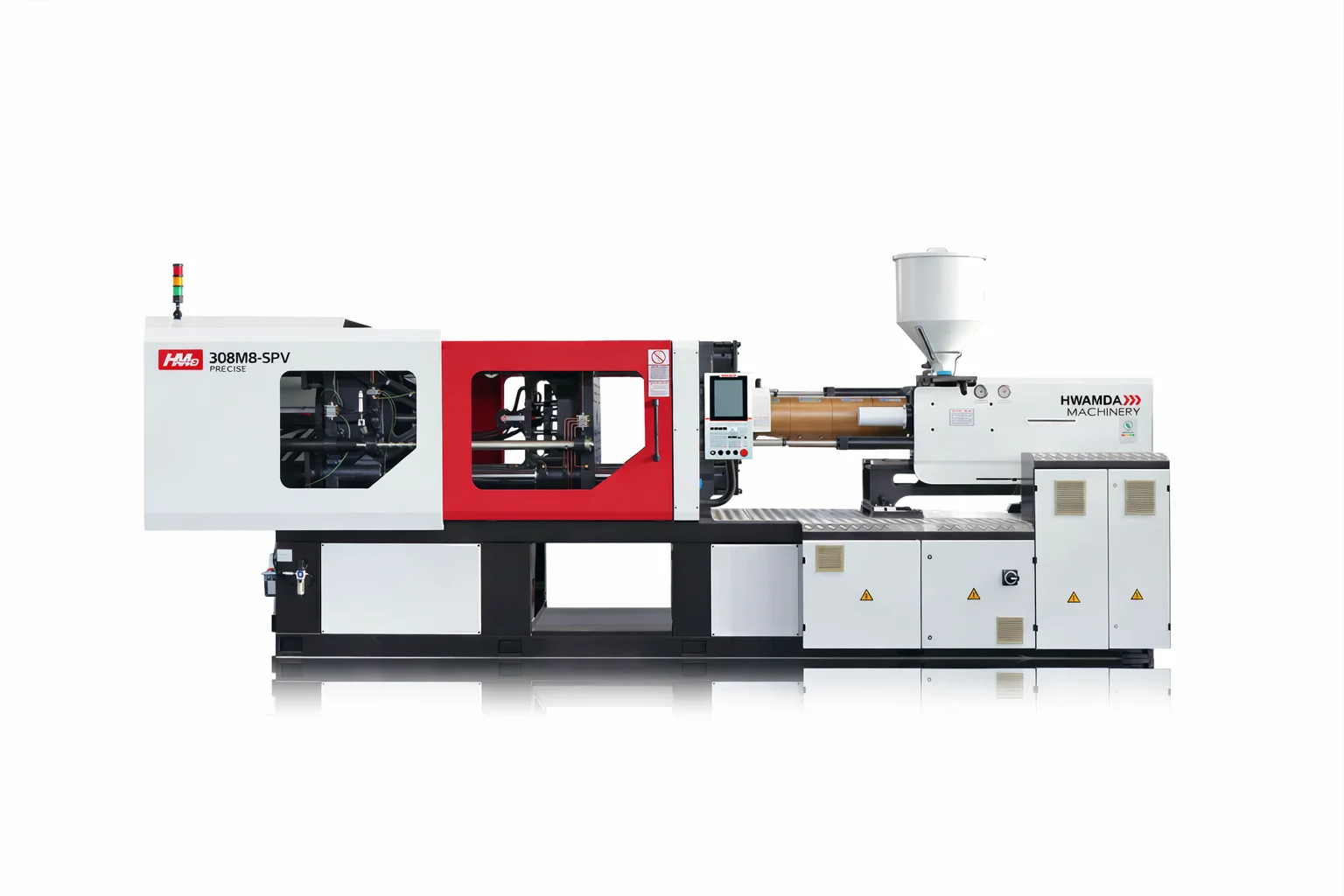
SPV5 series machine for high-cavity tableware molds
Need Expert Advice?
Talk to our engineers about your specific production requirements. Free consultation.
Processing Biodegradable Materials on SPV5 Machines
The transition to sustainable tableware materials is a major market driver. HWAMDA SPV5 machines process several biodegradable alternatives with modified parameters. PLA requires processing at 175-210 degrees Celsius, significantly lower than PP, with mold temperature of 25-35 degrees Celsius for amorphous PLA and 80-100 degrees Celsius for crystallized PLA. The INOVA controller 6-zone barrel temperature system accommodates these different profiles. PLA injection speed should be reduced to 250-350 mm/s to prevent shear degradation that causes molecular weight reduction and brittleness. CPLA for heat-resistant tableware processes at 175-190 degrees Celsius and requires nucleating agents to achieve crystallinity above 30% for heat resistance to 80 degrees Celsius. PP-grain blends containing 20-40% wheat straw, corn starch, or rice hull powder process at 180-220 degrees Celsius with injection speeds of 300-400 mm/s. These filled materials increase screw and barrel wear by 2-3 times compared to neat PP, making the use of bimetallic barrels and hardened screw flights important. The SPV5 screw with chrome-nickel-boron alloy coating provides enhanced wear resistance for filled material processing. Cycle times for biodegradable materials are typically 10-30% longer than equivalent PP parts due to lower melt temperatures and modified cooling requirements.
Production Rates and Output Optimization
Tableware production rates vary by product type and cavity count. For 8-cavity 250 ml PP bowls on the HMD 368M8-SPV at 5.0-second cycle, output is 5,760 bowls per hour. With 85% OEE over 24/7 operation, monthly output reaches 3.51 million bowls. For 4-cavity large plates on the HMD 400M8-SPV at 4.5-second cycle, output is 3,200 plates per hour and 1.95 million monthly. Cutlery production with 12-cavity molds at 3.5-4.0 second cycle achieves 10,800-12,343 pieces per hour and 6.59-7.53 million monthly. Material cost for a 10g PP bowl at 1.20 USD/kg is 0.012 USD. For PLA at approximately 2.50 USD/kg, the same 10g bowl costs 0.025 USD, a 108% material cost premium that biodegradable markets must absorb through higher selling prices. Energy consumption with the SPV5 servo-hydraulic drive is 1.0-1.2 kWh/kg for PP and 0.8-1.0 kWh/kg for PLA due to lower processing temperatures. Tableware has high market price sensitivity, with PP bowls selling at 0.015-0.030 USD and biodegradable versions at 0.035-0.060 USD in bulk. The HWAMDA SPV5 energy efficiency advantage of 25-35% over standard hydraulic machines is critical for maintaining profitability in this price-sensitive segment.
Key Specs
- •With 85% OEE over 24/7 operation, monthly output reaches 3.51 million bowls.
- •For PLA at approximately 2.50 USD/kg, the same 10g bowl costs 0.025 USD, a 108% material cost premium that biodegradable markets must absorb through higher selling prices.
- •The HWAMDA SPV5 energy efficiency advantage of 25-35% over standard hydraulic machines is critical for maintaining profitability in this price-sensitive segment.
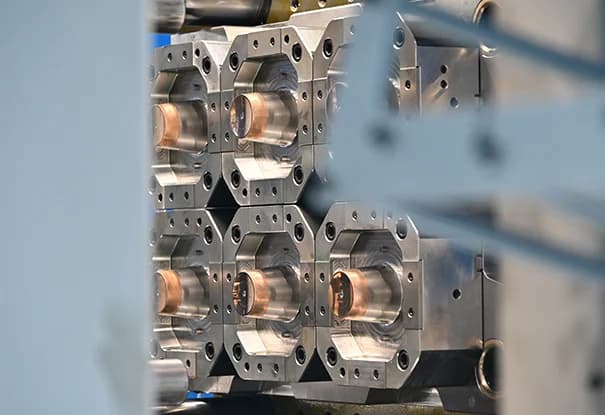
High-cavity mold detail — precision machined cavities
Quality Requirements and Food Contact Compliance
Disposable tableware for food contact must meet regulatory standards while withstanding the thermal and mechanical stresses of food service. Structural requirements include top-load strength for bowls of 15-25 N filled with 250 ml of liquid, flex resistance for spoons of 10 N applied at mid-span without breaking, and temperature resistance to 100 degrees Celsius for PP microwaveable items. Food contact compliance follows the same FDA 21 CFR and EU 10/2011 frameworks as other food packaging, with migration testing performed using appropriate food simulants. For PP tableware, migration testing uses 3% acetic acid for acidic foods and 50% ethanol for fatty foods. For PLA and CPLA items, specific migration limits for residual lactide must be below 5 mg/kg. Quality control on SPV5 production lines includes weight monitoring of plus or minus 5% for tableware versus plus or minus 2.5% for precision cups, visual inspection for short shots and flash, and dimensional checks for stacking compatibility. The lower precision requirements of tableware versus precision dairy cups allow slightly wider process windows, which contributes to the high OEE of 85-90% achievable for tableware production. Finished goods must be packaged in food-safe PE-lined cartons or shrink-wrapped sleeves with production lot traceability.
Frequently Asked Questions
Yes, HWAMDA SPV5 machines process PLA with modified parameters: barrel temperature of 175-210 degrees Celsius across 6 zones, injection speed of 250-350 mm/s, and mold temperature of 25-35 degrees Celsius for amorphous PLA. The INOVA controller accommodates the different temperature profiles. PLA cycle times are 10-30% longer than PP. For heat-resistant CPLA tableware, mold temperature must be raised to 80-100 degrees Celsius for in-mold crystallization, requiring high-temperature mold temperature controllers.
Related Guides
Ready to Start Your Project?
Get a free consultation and quotation for your thin-wall packaging production line.
Join 500+ manufacturers in 60+ countries who trust HWAMDA.
Get Free Quote