

Yogurt Pail Specifications and Design Criteria
Yogurt pails typically feature round or oval cross-sections designed for shelf stability and consumer convenience. A 1-liter round pail measures approximately 120 mm diameter by 110 mm height with wall thickness of 0.50-0.65 mm and part weight of 30-38 grams. A 2-liter pail reaches 150 mm diameter by 140 mm height at 0.60-0.80 mm wall and 40-50 grams. The design includes a reinforced rim section of 1.5-2.5 mm for snap-fit or press-fit lid attachment, typically with an undercut feature that requires slide core or collapsible core in the mold. Bottom wall thickness is 0.70-1.0 mm for structural rigidity when the pail is full. PP impact copolymer with MFI of 25-45 g/10min is preferred over homopolymer for yogurt pails due to its superior impact resistance at refrigerated temperatures of 2-8 degrees Celsius. The lower MFI compared to thin-wall cups is acceptable because the thicker walls of 0.50-0.80 mm provide adequate flow time. For chilled and frozen dairy applications, the PP grade must maintain notched Izod impact strength above 5 kJ/m2 at 0 degrees Celsius. The pail base typically includes a recessed area for date coding and a center injection gate mark that must be flat for stable stacking.
Key Specs
- •A 1-liter round pail measures approximately 120 mm diameter by 110 mm height with wall thickness of 0.50-0.65 mm and part weight of 30-38 grams.
- •A 2-liter pail reaches 150 mm diameter by 140 mm height at 0.60-0.80 mm wall and 40-50 grams.
- •The design includes a reinforced rim section of 1.5-2.5 mm for snap-fit or press-fit lid attachment, typically with an undercut feature that requires slide core or collapsible core in the mold.
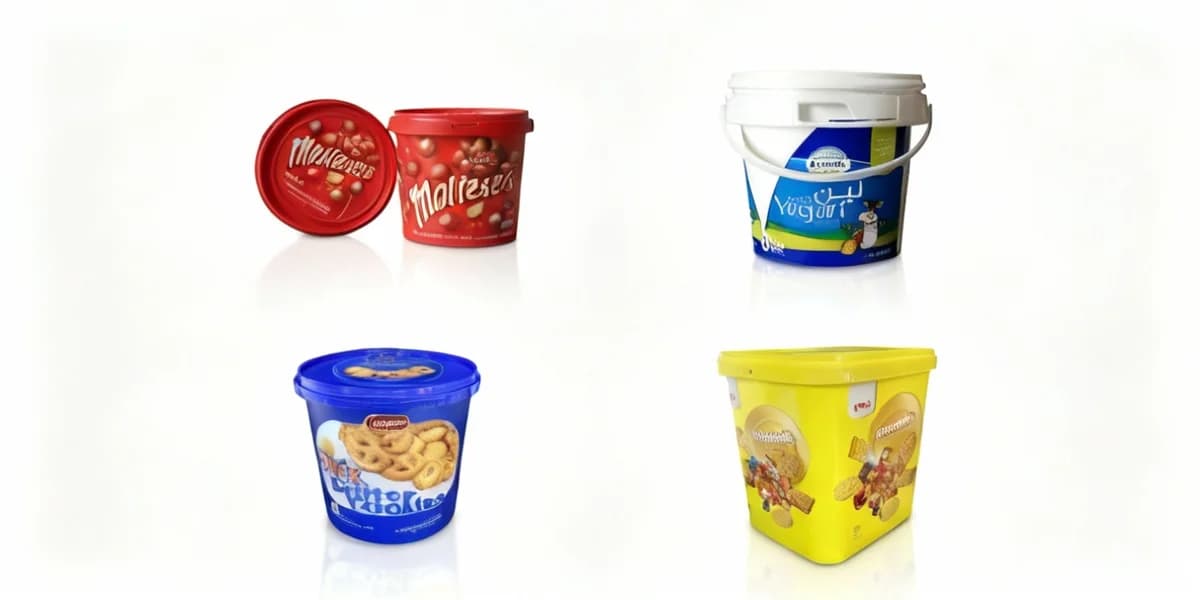
Complete yogurt pail production line with IML
Machine Configuration for Large-Format Pails
Yogurt pails require larger SPV5 machines due to their significant projected area and shot weight. For 4-cavity 1-liter pails with approximately 450 cm2 total projected area, the HMD 480M8-SPV at 4,800 kN provides adequate clamping, with platen size of 1,190 x 1,140 mm and tie bar distance of 760 x 710 mm. The injection unit with 55-57 mm screw delivers 432-465g injection weight, handling the total shot of 130-160g for 4 pails plus runner. For 2-cavity 2-liter pails, the HMD 530M8-SPV at 5,300 kN offers the platen area of 1,250 x 1,200 mm needed for the larger mold, with injection capacity of 845-898g using the 65-67 mm screw. Injection speed of 490-517 mm/s is sufficient for the thicker 0.50-0.80 mm walls. For single-cavity 2-liter pails with IML on multiple sides, the HMD 600M8-SPV at 6,000 kN provides maximum platen area of 1,300 x 1,250 mm and the highest injection speed of 560 mm/s in the SPV5 range. The mold opening stroke of 720-810 mm accommodates the tall pail geometry with clearance for robot entry. Maximum daylight of 1,470-1,710 mm allows for deep-draw pail molds with their extended core lengths.
Mold Technology for Pail Production
Yogurt pail molds incorporate features not typically found in smaller cup molds. The valve gate hot runner system uses 2.0-3.0 mm gate diameters for the larger shot volume, positioned at the base center. For multi-cavity pail molds, manifold design must handle longer flow paths and higher shot volumes while maintaining cavity balance within plus or minus 3% by weight. The mold includes mechanical or hydraulic slide cores for the rim undercut feature, adding complexity and increasing mold cycle time by 0.3-0.5 seconds for slide movement. Cooling circuit design is critical for pails due to their greater thermal mass. The core side uses spiral or baffled cooling with 10-12 mm diameter channels, while the cavity side employs conformal cooling circuits following the pail contour. Water flow rate of 12-15 liters per minute per circuit at supply temperatures of 12-18 degrees Celsius removes the heat from the 30-50g PP part efficiently. Mold weight for a 4-cavity 1-liter pail reaches 3,000-4,500 kg, requiring the crane capacity and platen mounting provisions of the larger SPV5 machines. For IML-decorated pails, the mold accommodates label placement on the sidewall and optionally the base, with the SWITEK robot handling the larger labels of 100-140 mm height.
Key Specs
- •The valve gate hot runner system uses 2.0-3.0 mm gate diameters for the larger shot volume, positioned at the base center.
- •For multi-cavity pail molds, manifold design must handle longer flow paths and higher shot volumes while maintaining cavity balance within plus or minus 3% by weight.
- •The core side uses spiral or baffled cooling with 10-12 mm diameter channels, while the cavity side employs conformal cooling circuits following the pail contour.
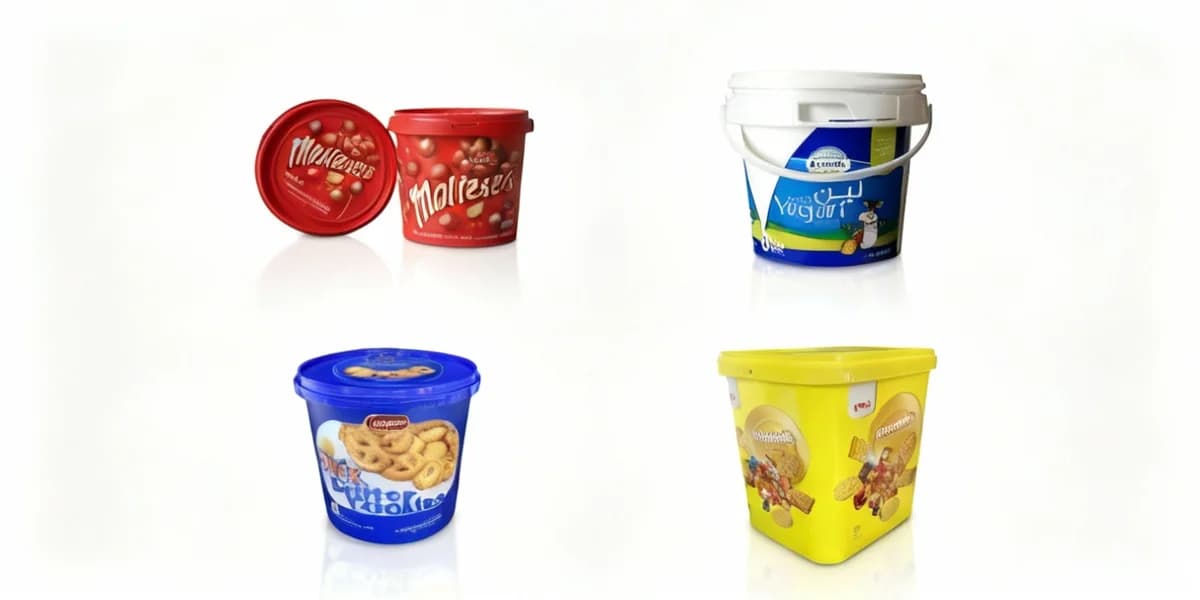
IML decorated pails — premium shelf presentation
Need Expert Advice?
Talk to our engineers about your specific production requirements. Free consultation.
Process Parameters for Thick-Wall Pail Sections
Yogurt pails have thicker walls than standard thin-wall cups, shifting the process focus from ultra-high speed to balanced fill and cooling. On the HMD 530M8-SPV, injection speed of 350-490 mm/s fills the 0.50-0.80 mm wall adequately without requiring the maximum machine capability. Injection pressure of 140-170 MPa is sufficient for the thicker cross-section. The injection profile uses a 3-stage velocity control: medium speed at 70% through the base section of 0.70-1.0 mm thickness, high speed at 90% through the thinner sidewall of 0.50-0.65 mm, and reduced speed at 60% for the rim fill to prevent flash at the parting line. Hold pressure of 50-65% injection pressure for 1.5-2.5 seconds compensates for the greater volumetric shrinkage in the thicker sections. Cooling time ranges from 3.0-6.0 seconds, determined primarily by the thickest section at the rim of 1.5-2.5 mm. The INOVA controller cooling timer optimization function can identify the minimum cooling time by monitoring ejection quality indicators. Total cycle time of 7.0-12.0 seconds includes slide movement for rim undercut release. Charging-on-fly easily completes the 130-200g charge during the extended mold movement window.
IML Decoration for Retail Dairy Packaging
IML on yogurt pails delivers premium graphics that differentiate branded dairy products on retail shelves. The larger surface area of 1-2 liter pails allows for extensive branding with full wrap-around labels or panel labels covering 60-80% of the sidewall. Labels for pails use 60-80 micrometer PP film with food-safe inks, matching the PP substrate for recyclability in mono-material PP packaging streams. Label placement on the curved sidewall of a pail requires careful pre-forming of the flat label into the conical shape matching the pail draft angle. The SWITEK IML robot uses a vacuum cup end-effector shaped to the pail contour, placing the label against the cavity wall and securing it with electrostatic charge. For pails with base labels, a separate label placement step adds 0.3-0.5 seconds to the robot cycle. IML quality on pails is judged by wrinkle-free appearance especially at the label overlap seam, registration accuracy within plus or minus 0.8 mm on the larger surface, color consistency matching the approved Pantone standard, and bond strength exceeding 3 N/25mm peel force. The thicker pail wall of 0.50-0.80 mm provides more heat energy for label fusion compared to thin cups, generally producing stronger IML bonds. Label cost for pail-sized IML ranges from 0.015-0.030 USD per label.
Key Specs
- •The larger surface area of 1-2 liter pails allows for extensive branding with full wrap-around labels or panel labels covering 60-80% of the sidewall.
- •IML quality on pails is judged by wrinkle-free appearance especially at the label overlap seam, registration accuracy within plus or minus 0.8 mm on the larger surface, color consistency matching the approved Pantone standard, and bond strength exceeding 3 N/25mm peel force.
- •The thicker pail wall of 0.50-0.80 mm provides more heat energy for label fusion compared to thin cups, generally producing stronger IML bonds.
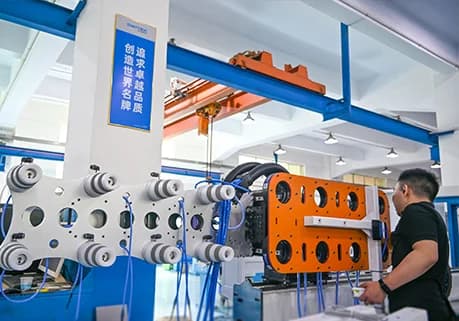
SWITEK IML robot arm with label placement system
Production Economics for Yogurt Pail Lines
Yogurt pail production runs at lower piece counts than smaller cups but generates higher revenue per piece. An HMD 530M8-SPV with 2-cavity 2-liter pail mold at 10-second cycle produces 720 pails per hour. At 85% OEE, monthly output reaches 439,000 pails. Material cost for a 45g PP pail at 1.20 USD/kg is 0.054 USD per pail. IML label cost adds 0.020-0.030 USD. Energy cost at 1.0-1.2 kWh/kg is approximately 0.005 USD per pail. Total variable cost is 0.079-0.089 USD per pail. Wholesale prices of 0.15-0.25 USD per pail provide gross margins of 40-55%. With a 4-cavity 1-liter pail mold at 8-second cycle on the HMD 480M8-SPV, output increases to 1,800 pails per hour and 1.10 million monthly. The smaller 1-liter pail at 35g has lower material cost of 0.042 USD but similar IML cost. Mold investment ranges from 80,000-120,000 USD for 2-cavity 2-liter to 120,000-180,000 USD for 4-cavity 1-liter with IML. Machine payback including mold investment is typically 18-30 months. The growing market for large-format yogurt in family sizes of 1 kg and above drives steady demand for pail production capacity.
Frequently Asked Questions
For 2-liter yogurt pails, the HMD 530M8-SPV at 5,300 kN is recommended for 2-cavity molds, offering platen size of 1,250 x 1,200 mm, injection capacity of 845-898g, and injection speed of 490 mm/s. For single-cavity production with complex IML requiring maximum access, the HMD 600M8-SPV at 6,000 kN provides the largest platen area of 1,300 x 1,250 mm and highest injection speed of 560 mm/s. Both models deliver cycle times of 8-12 seconds for 2-liter pails.
Related Guides
Ready to Start Your Project?
Get a free consultation and quotation for your thin-wall packaging production line.
Join 500+ manufacturers in 60+ countries who trust HWAMDA.
Get Free Quote