

Yogurt Pail Market Demand in Saudi Arabia
Saudi Arabia represents one of the Middle East's largest dairy packaging markets, with per capita yogurt consumption exceeding 25 kg annually. Major producers including Almarai, Nadec, SADAFCO, and Al Safi Danone require hundreds of millions of 1-2 kg yogurt pails yearly. The Kingdom's Vision 2030 localization strategy actively encourages domestic manufacturing of food packaging to reduce import dependency. Currently, a significant portion of rigid PP dairy containers is imported from Turkey, Egypt, and China, creating opportunity for Saudi-based converters. SASO food contact material standards require compliance with GSO 839 and related Gulf Standards, which domestically produced pails can satisfy with full traceability documentation. The Saudi dairy market grows at 5-7% annually, driven by population growth, urbanization, and expanding modern retail channels where branded yogurt pails with IML decoration command premium shelf positioning. Saudi Arabia's retail modernization, with hypermarket chains like Tamimi, Panda, and Danube expanding nationwide, increases demand for shelf-ready IML-decorated pails that enhance brand visibility in refrigerated display cases. The Kingdom's food processing industry has grown at 8-10% annually, creating sustained demand growth for packaging across all dairy categories.
Key Specs
- •The Saudi dairy market grows at 5-7% annually, driven by population growth, urbanization, and expanding modern retail channels where branded yogurt pails with IML decoration command premium shelf positioning.
- •The Kingdom's food processing industry has grown at 8-10% annually, creating sustained demand growth for packaging across all dairy categories.
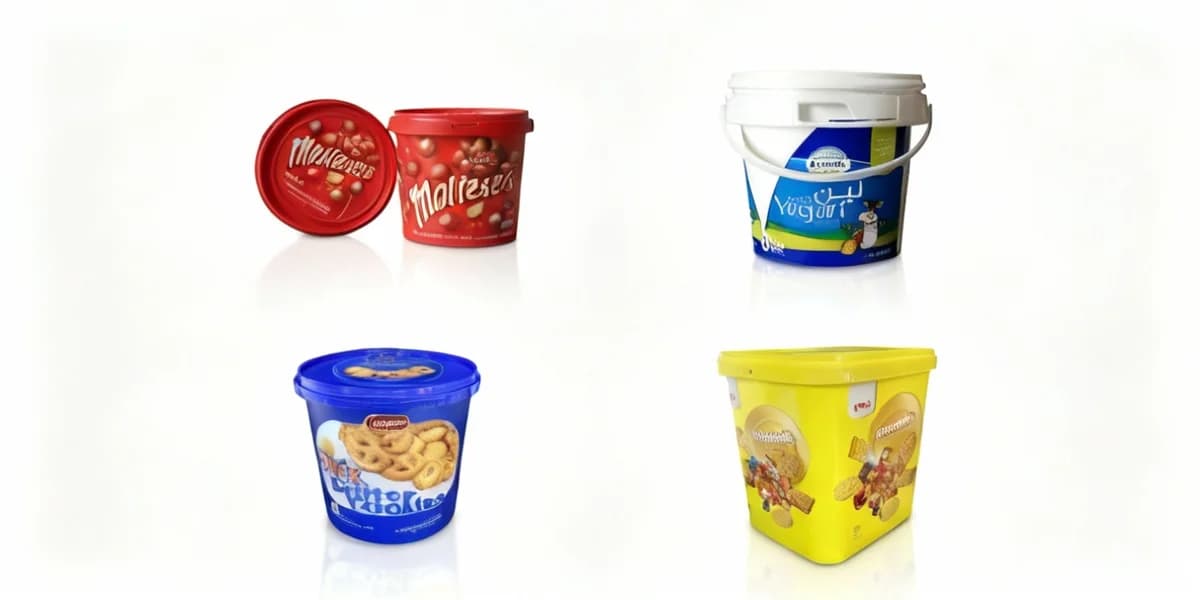
Complete yogurt pail production line with IML
Recommended Machine: HMD 600M8-SPV (600T)
The HWAMDA HMD 600M8-SPV delivers 600 tons of clamping force required for large-format yogurt pails with projected areas exceeding 400 square centimeters. The SPV5 servo-hydraulic system provides injection pressure up to 185 MPa with a 90 mm screw diameter, delivering shot weights up to 1,200g PP to fill thick-base pail geometries. Injection speed reaches 280 mm/s, sufficient for the 0.7-1.0 mm wall sections typical of 1-2 kg yogurt pails. The machine's platen dimensions of 1,050 x 1,050 mm accommodate 2 and 4-cavity mold configurations with adequate clearance for side-entry robot access. Energy consumption of 0.38-0.45 kWh per kg translates to approximately $0.012-0.016 per pail under Saudi electricity rates, which are among the lowest globally at $0.048 per kWh for industrial users. The 600T platform includes proportional hydraulic clamp control preventing flash on pail rims while maintaining short clamp-up times. The machine's robust construction is specifically engineered for the Saudi operating environment, with enhanced hydraulic oil cooling capacity for ambient temperatures exceeding 45 degrees Celsius. Sealed electrical cabinets with filtered air conditioning protect sensitive controller and servo components from dust and humidity. The KEBA controller supports Arabic language interface and provides comprehensive production data logging for quality management system documentation.
Mold Configuration: 4-Cavity for Saudi Arabia
For the Saudi Arabian market, HWAMDA recommends a 4-cavity mold producing 1 kg round yogurt pails with snap-fit lids. The mold utilizes valve-gate hot runner technology with sequential filling to prevent weld lines on the pail body, critical for IML label adhesion quality. Each cavity incorporates conformal cooling channels achieving surface temperatures of 22-28 degrees Celsius, optimized for higher ambient temperatures typical in Saudi factory environments. The mold design includes integrated lid production capability through a separate lid mold running on a secondary machine. Core pull mechanisms accommodate the tamper-evident rim geometry required by Saudi dairy brands. Mold steel uses NAK80 for cavities and S136 for cores, providing corrosion resistance in the moisture-rich PP processing environment. The 4-cavity configuration achieves 10-12 second cycle times for 1 kg pails, producing approximately 1,200-1,440 pails per hour while maintaining wall thickness uniformity within 0.05 mm.For Middle East orders, HWAMDA conducts comprehensive factory acceptance tests including dimensional verification, cycle optimization, and sample part quality approval.Each cavity's sample output is documented and provided to Saudi Arabia clients for approval before the mold leaves the factory.The hot runner controller ships pre-calibrated with the mold to Saudi Arabia, enabling immediate plug-and-play startup at the customer's facility.
Key Specs
- •The 4-cavity configuration achieves 10-12 second cycle times for 1 kg pails, producing approximately 1,200-1,440 pails per hour while maintaining wall thickness uniformity within 0.05 mm.For Middle East orders, HWAMDA conducts comprehensive factory acceptance tests including dimensional verification, cycle optimization, and sample part quality approval.Each cavity's sample output is documented and provided to Saudi Arabia clients for approval before the mold leaves the factory.The hot runner controller ships pre-calibrated with the mold to Saudi Arabia, enabling immediate plug-and-play startup at the customer's facility.
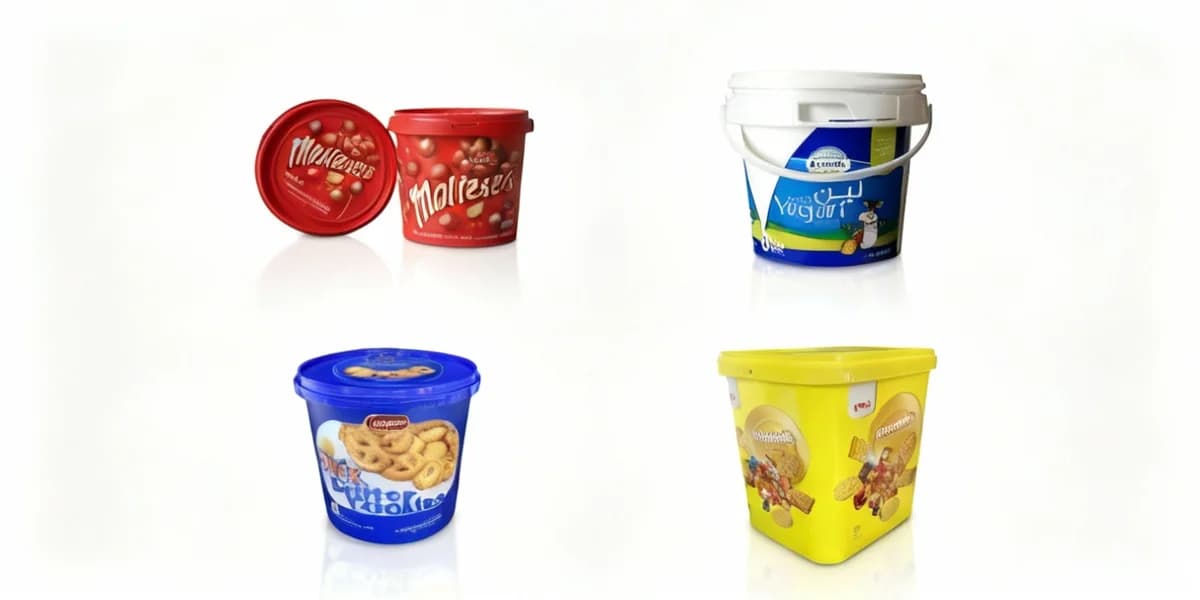
IML decorated pails — premium shelf presentation
Need Expert Advice?
Talk to our engineers about your specific production requirements. Free consultation.
Daily Output & Shift Planning
A 600T machine with 4-cavity mold running at 11 second average cycle produces approximately 1,309 pails per hour. Operating 22 hours per day across 320 production days yields roughly 9.2 million pails annually. Saudi dairy giants like Almarai consume well over 100 million pails per year, meaning multiple HWAMDA lines may be required for tier-one supplier qualification. For mid-sized converters targeting regional dairy brands, one machine provides sufficient output to serve 3-5 customers simultaneously. Material consumption at 35-45 grams per 1 kg pail requires 320-415 tons of food-grade PP annually. Saudi manufacturers benefit from competitive PP resin pricing due to proximity to SABIC and other Gulf petrochemical producers. HWAMDA recommends maintaining dual mold sets for continuous production during scheduled mold maintenance, ensuring zero supply interruption to demanding dairy customers requiring just-in-time delivery. Saudi Arabia's dairy distribution operates on tight schedules with major supermarket chains requiring 48-72 hour order fulfillment. Production reliability is therefore critical, and HWAMDA's system achieves 87-92% OEE in Saudi operating conditions. Mold changeover between 1 kg and 2 kg pail formats takes approximately 2.5 hours, enabling flexible production scheduling aligned with fluctuating order patterns across different dairy brand customers.
Investment Structure & Break-Even Analysis
The complete HWAMDA yogurt pail production system for Saudi Arabia requires investment of $280,000-$350,000, including the 600T machine, 4-cavity pail mold plus lid mold, auxiliary equipment, and installation. Production cost per pail averages $0.035-0.045 including PP material, energy, IML labels, and labor. Wholesale pricing for IML-decorated 1 kg yogurt pails in the Saudi market ranges from $0.08-0.12 per unit, providing gross margins of $0.035-0.075 per pail. At 9.2 million annual output, gross profit ranges from $320,000-$690,000. Saudi labor costs average $500-700 per month for machine operators, with a typical 8-person team costing approximately $60,000-$67,000 annually. Net annual profit typically reaches $200,000-$500,000, supporting payback periods of 8-18 months. Saudi manufacturers qualifying under SIDF industrial development financing can access subsidized loans. Saudi Arabia's competitive operating cost structure, combining low electricity at $0.048/kWh with domestic SABIC PP resin at $1,050-1,200 per ton, creates production economics significantly more favorable than many competing markets. MODON industrial city lease rates for factory space of approximately $4-6 per square meter per month further reduce operating overhead compared to equivalent European or East Asian manufacturing locations.
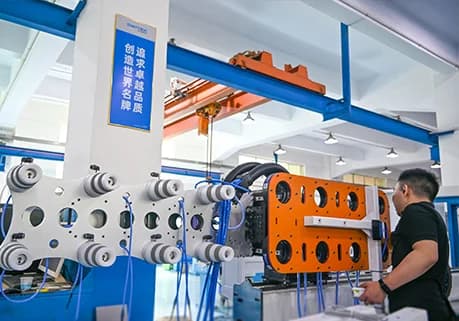
SWITEK IML robot arm with label placement system
Transport Routes & Service Coverage
HWAMDA delivers to Saudi Arabia via sea freight to Jeddah Islamic Port or Dammam King Abdulaziz Port, with transit times of 18-22 days from Guangdong. The 600T machine requires a 40-foot open-top container, while molds and auxiliaries ship in standard containers. Saudi customs clearance for industrial machinery under HS 8477.10 carries a 5% duty rate, with potential exemption for projects approved under MODON industrial city programs. HWAMDA provides Arabic and English documentation meeting SASO labeling requirements. Installation and commissioning takes 14-18 days with HWAMDA engineers on-site, including training for Saudi and expatriate operators. The Kingdom's industrial cities in Riyadh, Jeddah, and Dammam offer ready-built factory shells with utilities that simplify production line setup. HWAMDA has established relationships with Saudi-based industrial equipment agents providing local warranty service and spare parts. HWAMDA maintains 12-month warranty coverage for all machines delivered to Saudi Arabia, with extended warranty options available through local service partners. Remote diagnostic capability enables 24-hour technical support response, while critical spare parts can be dispatched via air freight from Guangdong within 3-5 business days. Factory acceptance testing at HWAMDA's facility is offered to all Saudi customers before shipment.
Frequently Asked Questions
HWAMDA's 600T machine with 2 or 4-cavity molds produces yogurt pails from 500ml to 2 kg capacity. The standard configuration for Saudi Arabia targets 1 kg round pails with snap-fit lids, the most common format for brands like Almarai and Nadec. Mold quick-change capability allows switching between 1 kg and 2 kg formats within 2-3 hours. HWAMDA's quality management system and documentation packages are designed to support customers' regulatory compliance requirements across all major international food packaging standards and certification frameworks.
Related Guides
Ready to Start Your Project?
Get a free consultation and quotation for your thin-wall packaging production line.
Join 500+ manufacturers in 60+ countries who trust HWAMDA.
Get Free Quote