

Yogurt Pail Market Demand in Egypt
Egypt is the Arab world's most populous country with over 104 million people and strong dairy consumption traditions. Annual yogurt consumption exceeds 15 kg per capita, with locally produced zabadi and laban packaged predominantly in rigid PP containers. Major dairy companies including Juhayna, Domty, Labanita, and Obour Land require tens of millions of 500ml to 2 kg pails annually. Egypt's packaging import bill exceeds $400 million yearly, and the government's localization strategy under Egypt Vision 2030 incentivizes domestic packaging production. The Egyptian pound's devaluation has made imported containers increasingly expensive, creating a strong business case for local pail manufacturing. Egypt exports dairy products to Libya, Sudan, and other North African markets, meaning domestically produced packaging supports both local consumption and export-oriented dairy operations. The growing trend toward branded, premium-quality yogurt pails with high-resolution printed decoration drives investment in advanced production technology capable of delivering consistent quality at scale.With HWAMDA's production technology, Egypt-based producers achieve faster market response times than those relying on imports or legacy equipment.This operational agility is especially valuable in North Africa, where brand owners increasingly prefer local suppliers who can meet tight delivery schedules.
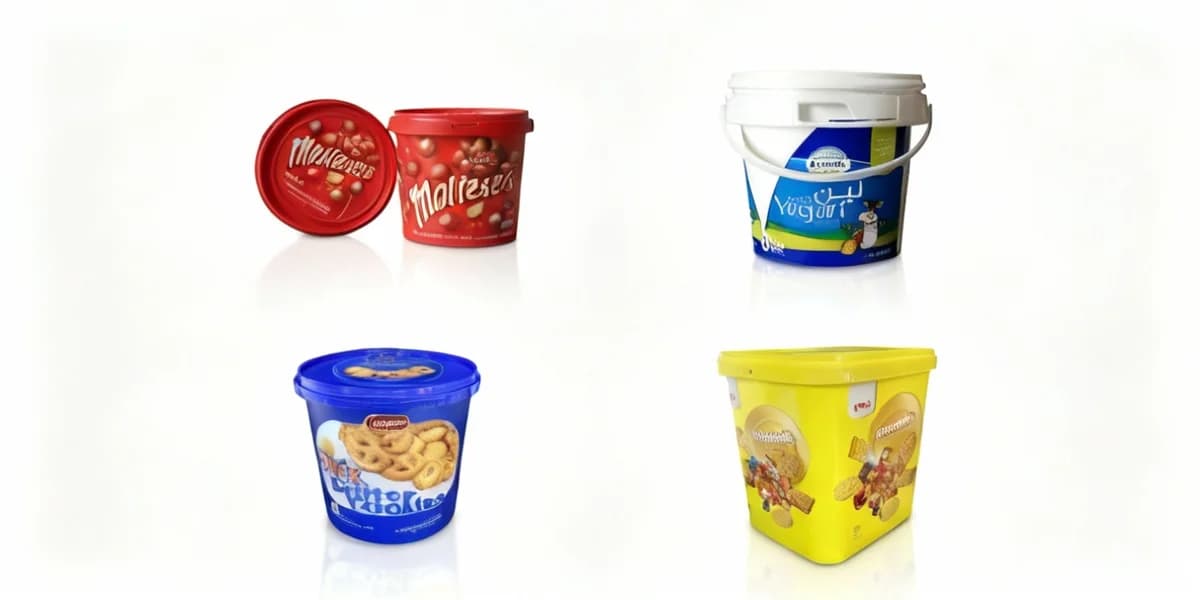
Complete yogurt pail production line with IML
Recommended Machine: HMD 600M8-SPV (600T)
The HMD 600M8-SPV addresses Egypt's need for robust, efficient yogurt pail production. With 600 tons of clamping force and a 90 mm injection screw, the machine processes PP homopolymer at shot weights up to 1,200g, filling 4-cavity pail molds within 2 seconds. The SPV5 servo system is particularly valuable in Egypt where electricity costs of approximately $0.065-0.08 per kWh make energy efficiency a meaningful cost driver. The servo-hydraulic system reduces power consumption by 40-50% compared to conventional hydraulic machines, saving approximately $15,000-$20,000 annually. The machine's robust construction withstands high ambient temperatures and dust conditions common in Egyptian industrial zones. The KEBA controller supports Arabic language interface and provides remote diagnostic capability via cellular connectivity, enabling HWAMDA's engineering team to troubleshoot issues without site visits.The machine platform supports continuous production around the clock, with scheduled maintenance at 2,000-hour intervals that align with Egypt's typical shift rotation patterns.Egypt operators achieve 8,000-10,000 hours of hydraulic oil life through HWAMDA's recommended filtration maintenance schedule.With a 40,000+ hour rating on the servo motor assembly, Egypt plants can project multi-year operation before scheduled drivetrain maintenance.For North Africa installations, HWAMDA's remote support during the 90-day commissioning period ensures rapid ramp-up to target production rates.
Mold Configuration: 4-Cavity for Egypt
HWAMDA's 4-cavity yogurt pail mold for Egypt produces standard 1 kg round containers with tamper-evident snap lids. The mold design prioritizes durability and serviceability, using hardened P20 steel with chrome plating on cavity surfaces for extended life. Valve-gate hot runners minimize material waste by eliminating cold runner scrap, keeping regrind below 2%. Cooling system design accounts for Egypt's high ambient temperatures by specifying enhanced heat exchanger capacity. The mold achieves 10-12 second cycle times at 4-cavity configuration, with each pail weighing 38-45 grams. HWAMDA provides detailed mold maintenance manuals translated into Arabic, with illustrated procedures for preventive maintenance, cooling line descaling, and wear component replacement. The mold's modular construction allows cavity inserts to be replaced individually without removing the complete mold from the machine.HWAMDA's factory acceptance testing for Egypt-bound molds covers dimensional accuracy, cavity balance, cooling performance, and cycle time validation under production conditions.HWAMDA provides cavity-by-cavity sample parts to Egypt buyers for dimensional and visual quality sign-off.HWAMDA delivers the hot runner controller pre-tuned and matched to each mold, so Egypt operators can start production without additional calibration.
Key Specs
- •Valve-gate hot runners minimize material waste by eliminating cold runner scrap, keeping regrind below 2%.
- •The mold achieves 10-12 second cycle times at 4-cavity configuration, with each pail weighing 38-45 grams.
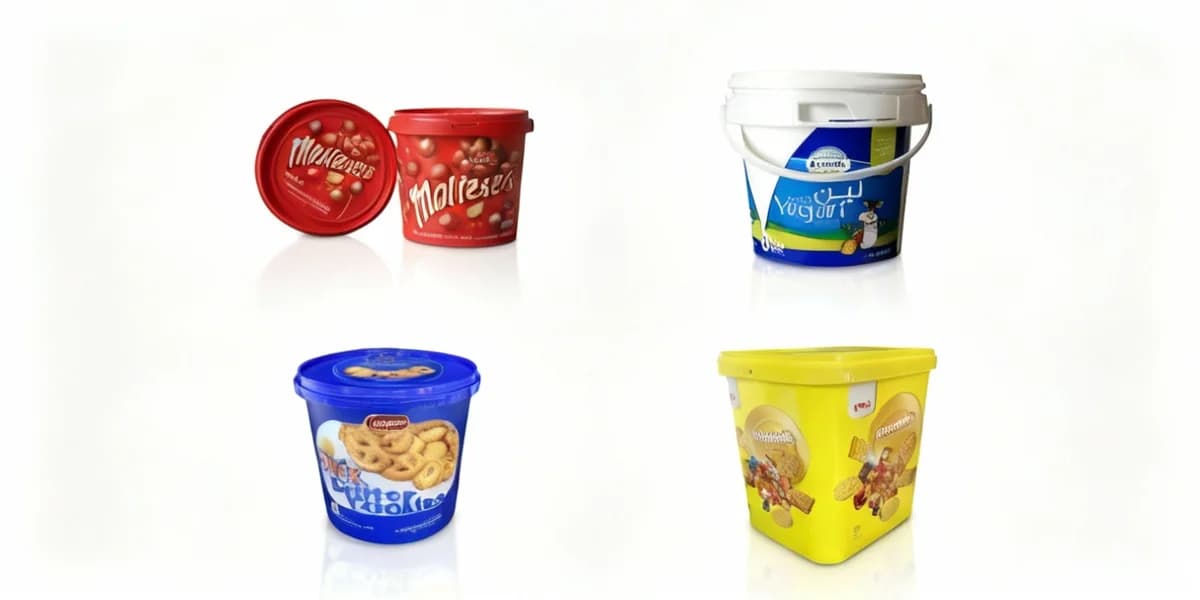
IML decorated pails — premium shelf presentation
Need Expert Advice?
Talk to our engineers about your specific production requirements. Free consultation.
Output Targets & Capacity Configuration
At 4 cavities and 11 second average cycle, the system outputs 1,309 pails per hour or approximately 8.6 million pails annually at 22 hours daily across 300 production days. Egyptian dairy demand is heavily concentrated in Greater Cairo and the Nile Delta, favoring production facilities in 10th of Ramadan City, 6th of October City, or Sadat City industrial zones. Material consumption at 40 grams average per pail requires approximately 344 tons of PP annually. Egyptian converters typically source PP from Egyptian Petrochemicals Company or import from Saudi Arabia and Gulf suppliers. HWAMDA recommends maintaining 45-day raw material inventory given occasional customs delays at Egyptian ports. Production scheduling should account for Ramadan demand increases when dairy consumption spikes 30-40%, requiring pre-season inventory building.Real-time OEE tracking is built into every HWAMDA system delivered to North Africa, enabling data-driven production management and rapid issue response.All production data is archived for traceability and analysis, enabling Egypt operators to demonstrate compliance and drive continuous improvement.The reporting suite delivers shift-level, daily, and monthly analytics that North Africa manufacturers need for lean improvement programs and customer compliance.
Financial Planning & Return Analysis
A complete HWAMDA yogurt pail line for Egypt requires $250,000-$310,000 including the 600T machine, mold, auxiliaries, and commissioning. Egyptian production costs average $0.028-0.038 per pail, benefiting from low labor costs of $250-400 per month per operator and subsidized industrial electricity. Wholesale pail prices in the Egyptian market of $0.055-0.080 provide gross margins of $0.017-0.042 per unit. At 8.6 million annual output, gross profit ranges from $146,000-$361,000. A 12-person operating team costs approximately $42,000-$57,600 annually. Net profit after all expenses typically reaches $80,000-$250,000, yielding payback periods of 12-30 months. Egyptian manufacturers in designated industrial zones qualify for tax holidays of 5-10 years under Investment Law 72/2017.For North Africa projects, HWAMDA builds customized financial models with scenario analysis for raw material pricing, production volumes, and market conditions.For Egypt companies seeking financing, HWAMDA's models provide the professional documentation that lending institutions require for equipment investment approval.Egypt buyers benefit from strong equipment residual values (25-35% after 10 years), supporting both depreciation schedules and eventual trade-in or resale.
Key Specs
- •Egyptian manufacturers in designated industrial zones qualify for tax holidays of 5-10 years under Investment Law 72/2017.For North Africa projects, HWAMDA builds customized financial models with scenario analysis for raw material pricing, production volumes, and market conditions.For Egypt companies seeking financing, HWAMDA's models provide the professional documentation that lending institutions require for equipment investment approval.Egypt buyers benefit from strong equipment residual values (25-35% after 10 years), supporting both depreciation schedules and eventual trade-in or resale.
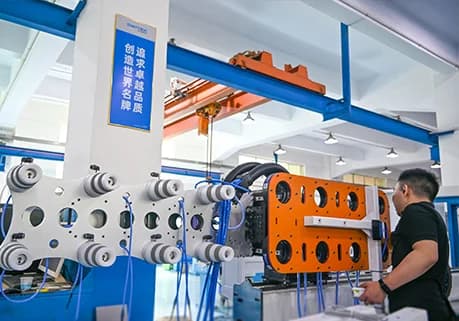
SWITEK IML robot arm with label placement system
Supply Chain & Regional Support
HWAMDA ships to Egypt via sea freight to Alexandria or Port Said with 22-28 day transit from Guangdong. Import duties on injection molding machinery in Egypt average 5-10%, though industrial zone enterprises may qualify for duty exemption. HWAMDA accepts letters of credit through major Egyptian banks including CIB, NBE, and Banque Misr. Installation takes 16-20 days including machine setup, mold trial, and operator training. HWAMDA provides comprehensive training programs adapted to Egyptian operator experience levels, with Arabic-language operation manuals and video tutorials. Egypt's established plastics industry includes qualified mold maintenance technicians and hydraulic specialists available through local service companies. HWAMDA has supplied equipment to multiple Egyptian converters and understands the regulatory environment including Egyptian Organization for Standards approval processes.HWAMDA's warranty for Egypt installations covers the complete machine for 12 months, with servo motor and drive systems eligible for 24-month extended coverage.Egypt clients can travel to HWAMDA's Guangdong factory or designate an inspection agent to oversee acceptance testing before equipment ships to Alexandria.Remote monitoring for Egypt projects extends 60 days beyond commissioning, providing an additional safety net during the critical early production phase.
Frequently Asked Questions
HWAMDA's system produces yogurt pails at $0.028-0.038 per unit in Egypt, including PP material, energy, labor, and factory overhead. Egypt's low labor costs of $250-400 per month and competitive industrial electricity rates contribute to favorable unit economics. This cost structure provides healthy margins against wholesale pail prices of $0.055-0.080 in the Egyptian market. HWAMDA provides detailed project financial models customized for each customer's specific market conditions, helping buyers present compelling investment cases to banks and financing institutions. Equipment package pricing offers 8-12% savings versus purchasing components individually.
Related Guides
Ready to Start Your Project?
Get a free consultation and quotation for your thin-wall packaging production line.
Join 500+ manufacturers in 60+ countries who trust HWAMDA.
Get Free Quote