

Yogurt Cup Specifications and Design Parameters
Standard yogurt cups for the global dairy market range from 125 ml to 200 ml capacity, with dimensions of 75-95 mm diameter and 60-80 mm height. The wall thickness of 0.30-0.40 mm creates a length-to-wall-thickness ratio exceeding 150:1, which is among the most challenging in thin-wall molding. Part weight ranges from 5.4 grams for a 150 ml cup to 7.5 grams for a 200 ml version, both using high-flow PP homopolymer with MFI of 50-80 g/10min at 230 degrees Celsius. The cup design includes a rolled rim section of 1.2-1.5 mm thickness for sealing integrity with aluminum foil lids, a slight draft angle of 3-5 degrees for reliable ejection, and a flat or slightly concave base with 0.5-0.8 mm wall thickness. The IML label pocket is designed as a 0.15-0.20 mm step in the cavity surface that positions the label precisely within plus or minus 0.3 mm. Material selection strongly favors PP homopolymer over random copolymer for its superior stiffness at 1,300-1,700 MPa flexural modulus, which prevents cup deformation during filling and sealing at dairy production line speeds of 20,000-40,000 cups per hour.
Key Specs
- •Standard yogurt cups for the global dairy market range from 125 ml to 200 ml capacity, with dimensions of 75-95 mm diameter and 60-80 mm height.
- •The wall thickness of 0.30-0.40 mm creates a length-to-wall-thickness ratio exceeding 150:1, which is among the most challenging in thin-wall molding.
- •The cup design includes a rolled rim section of 1.2-1.5 mm thickness for sealing integrity with aluminum foil lids, a slight draft angle of 3-5 degrees for reliable ejection, and a flat or slightly concave base with 0.5-0.8 mm wall thickness.
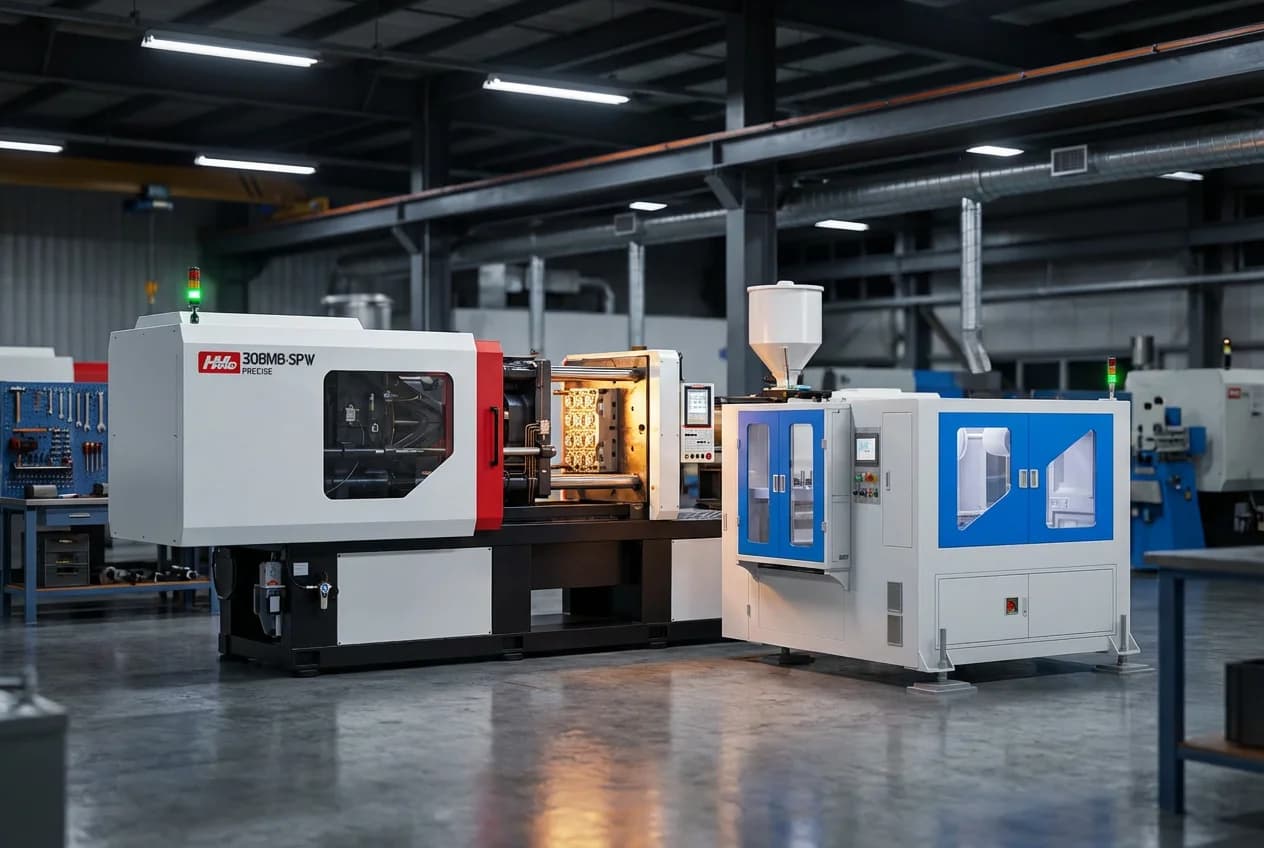
Finished yogurt cups — high-speed thin-wall production
Machine Selection: SPV5 Models for Yogurt Cup Production
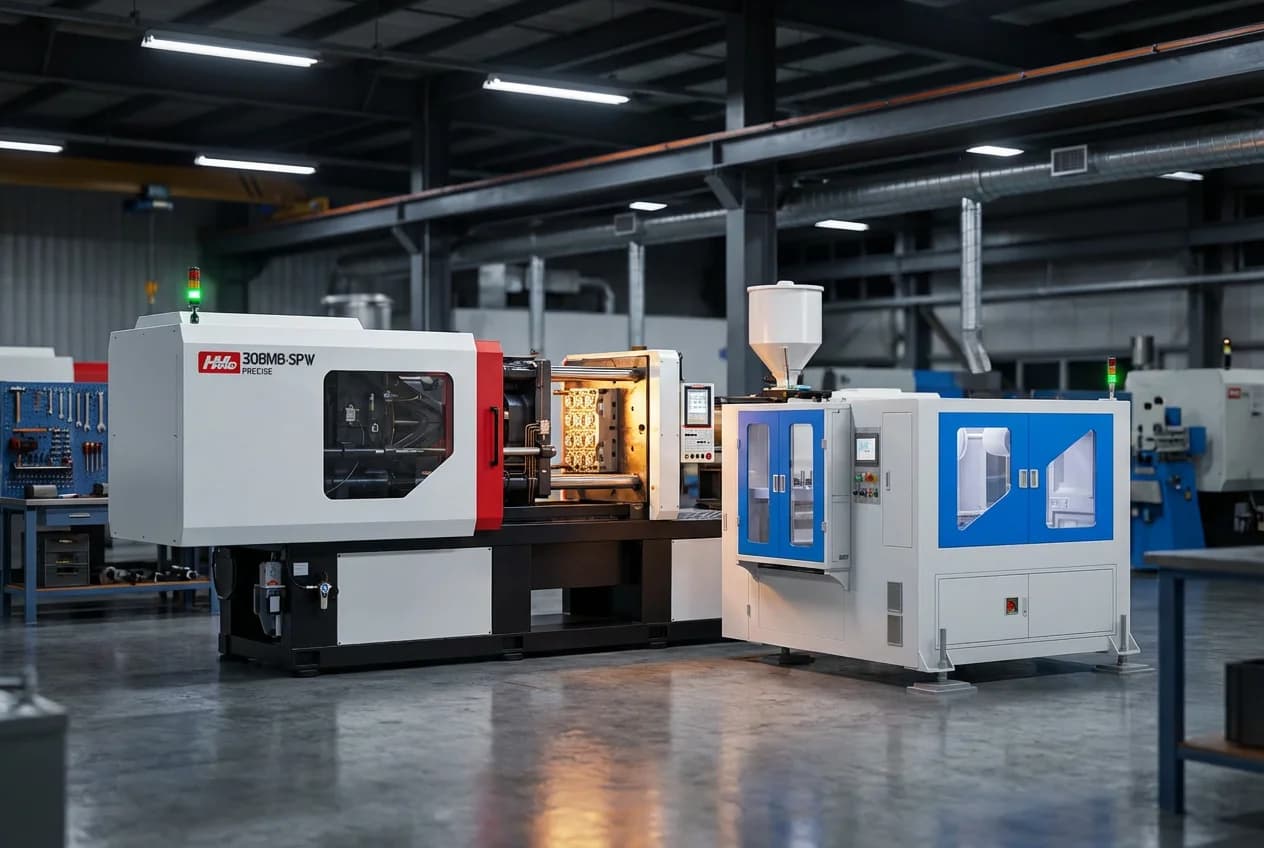
Yogurt cup production requires HWAMDA SPV5 machines in the 350-400 tonne range based on cavity count and cup size. For 4-cavity molds producing 150-200 ml cups, the HMD 350M8-SPV at 3,500 kN provides adequate clamping with injection speed of 418 mm/s and injection volume of 641-689 cm3. The 55 mm screw diameter with 25:1 L/D ratio delivers injection pressure up to 176 MPa, sufficient for the 0.30-0.40 mm wall sections. For 8-cavity molds, the HMD 400M8-SPV at 4,000 kN is the recommended choice, offering 60-65 mm screw options with injection speed of 374-442 mm/s and injection pressure of 164-165 MPa. The platen size of 1,080 x 1,060 mm accommodates 8-cavity molds weighing 1,500-2,500 kg, with tie bar distance of 720 x 700 mm providing ample space for the IML robot access. Maximum daylight of 1,390 mm allows full mold opening for SWITEK robot part removal. The dual 55+55 kW pump motor configuration enables charging-on-fly operation essential for achieving cycle times under 5 seconds. Both models feature 6 barrel heating zones with total heater power of 31.7-32 kW for consistent PP melt quality.
Mold Design for High-Speed Yogurt Cup Production
Yogurt cup molds for SPV5 machines use valve gate hot runner systems from YUDO or Synventive with gate diameters of 1.5-2.0 mm positioned at the base center of each cup cavity. The valve gate provides a clean, vestige-free gate mark essential for food packaging aesthetics and sealing surface integrity. Cavity steel is 1.2344 (H13) hardened to 50-52 HRC, with cavity surfaces polished to SPI A-2 finish for consistent part release and gloss. Cooling channel design is critical: conformal cooling circuits maintain cavity surface temperature at 15-22 degrees Celsius with water flow of 10-12 liters per minute per cavity circuit at 12-15 degrees Celsius supply temperature and 3-4 bar pressure drop across each circuit. The mold includes integrated IML label magazines and vacuum label placement systems that position labels in each cavity during the mold-open phase, synchronized with the SWITEK robot cycle. Stack mold designs with 4+4 cavity configurations are available for doubling output without increasing machine size, though they require longer daylight and are suited to the HMD 400M8-SPV with 1,390 mm maximum daylight. Total mold investment ranges from 60,000-120,000 USD for 4-cavity and 100,000-200,000 USD for 8-cavity configurations.
Key Specs
- •Yogurt cup molds for SPV5 machines use valve gate hot runner systems from YUDO or Synventive with gate diameters of 1.5-2.0 mm positioned at the base center of each cup cavity.
- •Cavity steel is 1.2344 (H13) hardened to 50-52 HRC, with cavity surfaces polished to SPI A-2 finish for consistent part release and gloss.
- •Cooling channel design is critical: conformal cooling circuits maintain cavity surface temperature at 15-22 degrees Celsius with water flow of 10-12 liters per minute per cavity circuit at 12-15 degrees Celsius supply temperature and 3-4 bar pressure drop across each circuit.
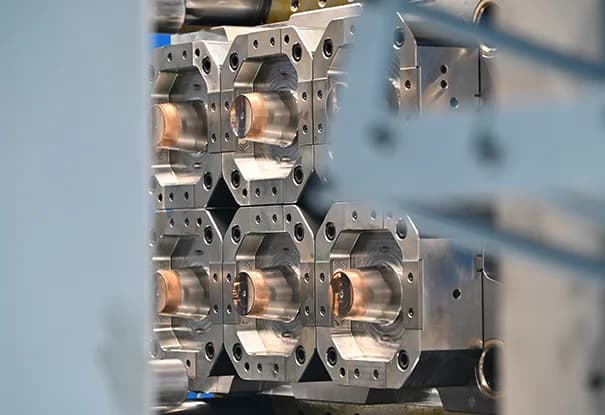
Multi-cavity yogurt cup mold with precision cooling channels
Need Expert Advice?
Talk to our engineers about your specific production requirements. Free consultation.
Process Parameters and Cycle Time Optimization
Achieving 3.5-5.0 second cycle times for yogurt cups on SPV5 machines requires precise parameter optimization across all phases. Injection phase: fill time of 0.15-0.30 seconds at injection speed of 400-442 mm/s, with velocity-to-pressure transfer at 95-98% fill volume. Injection pressure reaches 150-176 MPa to push PP melt at 230-245 degrees Celsius through the 0.30-0.40 mm wall cross-section. Hold pressure phase: 0.5-1.0 seconds at 40-60% of peak injection pressure to pack out the part and compensate for volumetric shrinkage of 1.5-2.0% for PP. Gate freeze time for a 1.5-2.0 mm valve gate is 0.3-0.5 seconds. Cooling phase: 1.0-2.0 seconds with mold temperature maintained at 15-22 degrees Celsius. The thin wall of 0.30-0.40 mm solidifies rapidly, but the thicker rim section of 1.2-1.5 mm determines minimum cooling time. Mold open phase: 0.3-0.5 seconds at high traverse speed. SWITEK robot entry and part removal: 0.5-0.8 seconds. Mold close phase: 0.3-0.5 seconds. With charging-on-fly overlapping plasticizing with mold movements, total cycle time of 3.8-4.5 seconds is achievable for 4-cavity and 4.5-5.0 seconds for 8-cavity with IML.
IML Integration for Branded Yogurt Cups
In-Mold Labeling is standard for yogurt cup production, delivering photographic-quality graphics permanently fused to the cup surface during molding. The IML system for SPV5 production cells consists of a label magazine holding 5,000-10,000 pre-cut PP or OPP labels per stack, a vacuum pick-and-place system that transfers labels to the mold cavities during the mold-open phase, and an electrostatic charging station that applies 20-30 kV to labels for temporary adhesion to the cavity wall. Label thickness is typically 40-70 micrometers for PP-based labels, with printed graphics on the outer surface and a heat-seal compatible layer on the inner surface that bonds with the injected PP melt at 230-245 degrees Celsius. Label placement accuracy must be within plus or minus 0.3 mm in both circumferential and axial directions, achieved through the precision of the SWITEK IML robot with repeatability of plus or minus 0.1 mm. The IML cycle adds 0.3-0.8 seconds to the base cycle time, bringing total cycle with IML to 4.5-5.5 seconds. Key quality parameters for IML include wrinkle-free label appearance, absence of air bubbles between label and cup wall, and consistent label position verified by vision system inspection at production speed.
Key Specs
- •Label placement accuracy must be within plus or minus 0.3 mm in both circumferential and axial directions, achieved through the precision of the SWITEK IML robot with repeatability of plus or minus 0.1 mm.
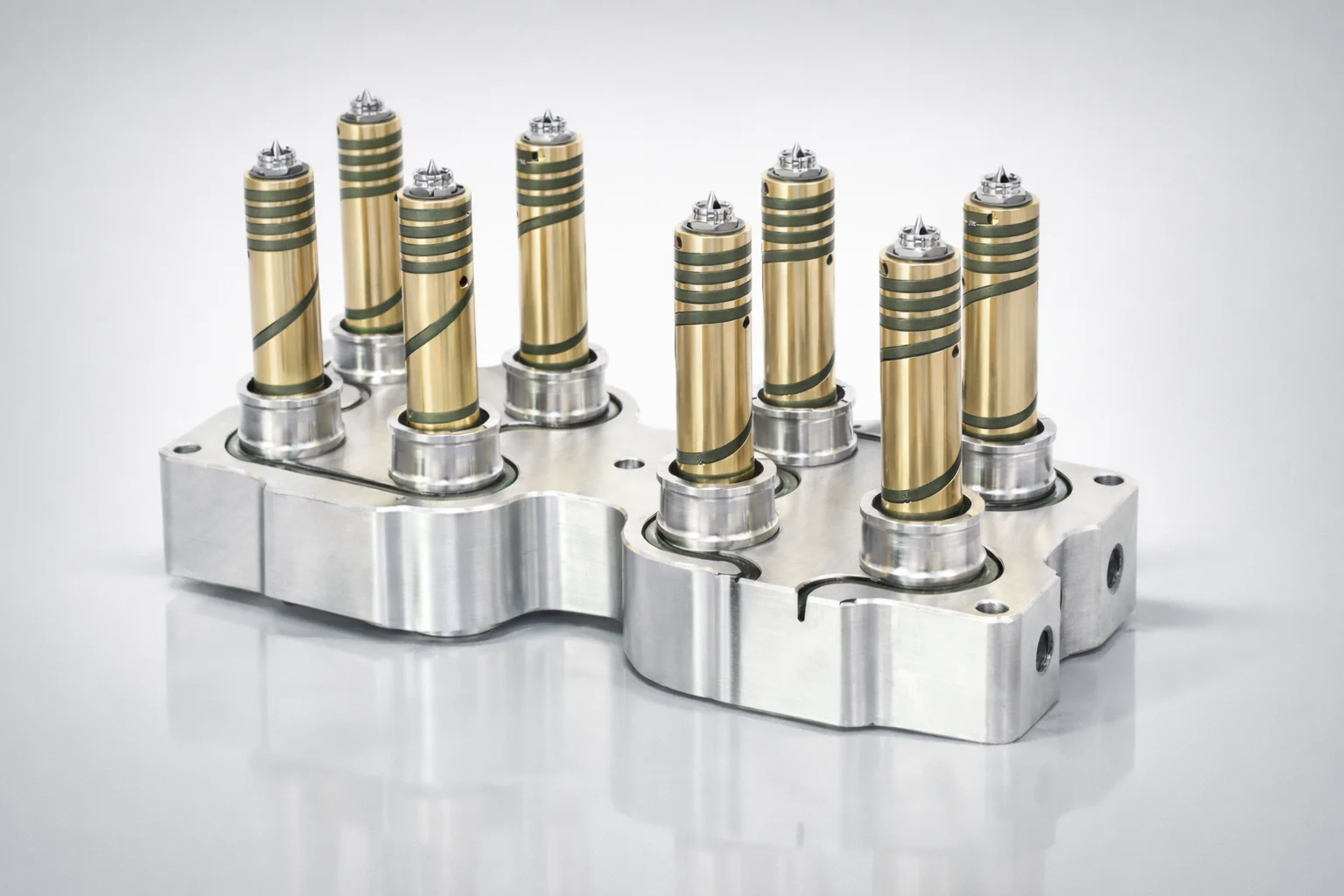
Hot runner system for balanced melt flow distribution
Production Economics and Output Calculations
A complete yogurt cup production cell with an HWAMDA HMD 400M8-SPV produces compelling economics. With an 8-cavity mold at 4.8-second cycle time including IML, hourly output is 6,000 cups. Running 24/7 at 85% OEE, monthly output reaches 3.67 million cups. Material cost for a 6.5g PP cup at PP price of 1.20 USD/kg is 0.0078 USD per cup. Energy consumption with the servo-hydraulic drive is approximately 1.0-1.2 kWh/kg of PP processed, translating to 0.008 kWh per cup or approximately 0.001 USD at industrial electricity rates of 0.10 USD/kWh. IML label cost averages 0.005-0.010 USD per label depending on print complexity and volume. Total variable cost per cup is approximately 0.014-0.019 USD. With selling prices of 0.03-0.05 USD per cup depending on the market, gross margins range from 40-65%. Machine payback period at this production rate is typically 18-30 months including mold investment. Energy savings compared to standard hydraulic machines amount to 25-35%, representing 15,000-25,000 USD per year in reduced electricity costs. The HWAMDA SPV5 servo-hydraulic system recovers braking energy during deceleration phases, further improving energy efficiency.
Frequently Asked Questions
On HWAMDA SPV5 machines, the fastest achievable cycle time for yogurt cups is 3.5-4.0 seconds for 4-cavity molds without IML, and 4.5-5.0 seconds for 8-cavity molds with IML. These times require injection speed of 418-442 mm/s, mold temperature of 15-18 degrees Celsius, charging-on-fly enabled, and optimized SWITEK robot speed. European benchmark machines achieve 2.7-3.0 seconds with ICM technology on 4-cavity molds, but SPV5 machines deliver competitive output through higher cavity counts.
Related Guides
Ready to Start Your Project?
Get a free consultation and quotation for your thin-wall packaging production line.
Join 500+ manufacturers in 60+ countries who trust HWAMDA.
Get Free Quote