

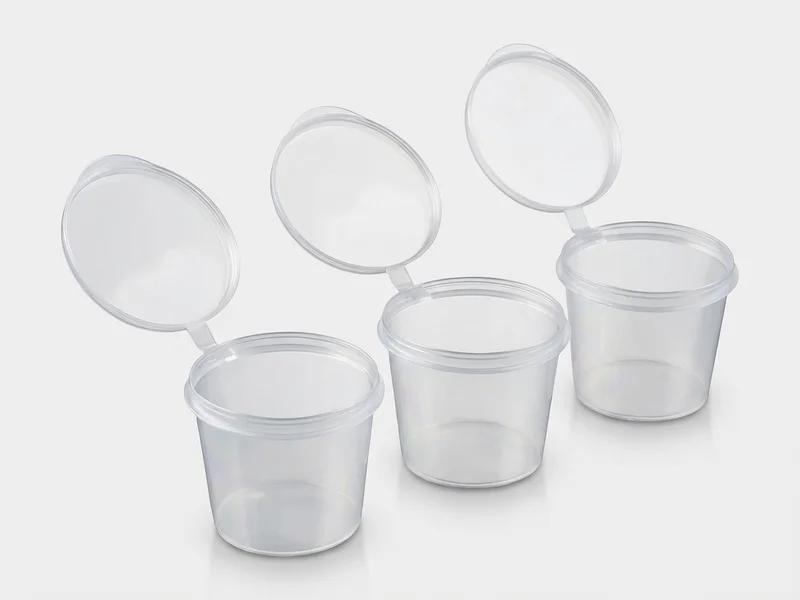
Sauce Cup Product Specifications
Sauce cups, also called portion cups or condiment cups, range from 30 ml (1 oz) to 120 ml (4 oz) capacity. A standard 30 ml cup measures approximately 45 mm diameter by 30 mm height with wall thickness of 0.35-0.40 mm and part weight of just 1.5-2.0 grams. A 60 ml (2 oz) cup measures 55 mm diameter by 45 mm height at 0.40-0.45 mm wall and 2.5-3.5 grams. The largest 120 ml (4 oz) cups reach 70 mm diameter by 60 mm height with 0.45-0.50 mm walls and 4.0-5.0 grams. Many sauce cup molds produce the cup and a hinged lid in the same shot using a living hinge design with 0.25-0.35 mm thickness at the hinge point, which requires PP homopolymer with excellent flex life. The material is almost universally PP homopolymer with MFI of 50-100 g/10min for the thinnest walls, chosen for its flexibility that allows the hinged lid to fold without cracking. IML decoration is not used for sauce cups due to their small size and disposable nature, keeping production focused on speed and material efficiency. Surface finish is typically SPI B-1 to B-2 level, providing a slight texture that facilitates part stacking.
Key Specs
- •A standard 30 ml cup measures approximately 45 mm diameter by 30 mm height with wall thickness of 0.35-0.40 mm and part weight of just 1.5-2.0 grams.
- •A 60 ml (2 oz) cup measures 55 mm diameter by 45 mm height at 0.40-0.45 mm wall and 2.5-3.5 grams.
- •The largest 120 ml (4 oz) cups reach 70 mm diameter by 60 mm height with 0.45-0.50 mm walls and 4.0-5.0 grams.
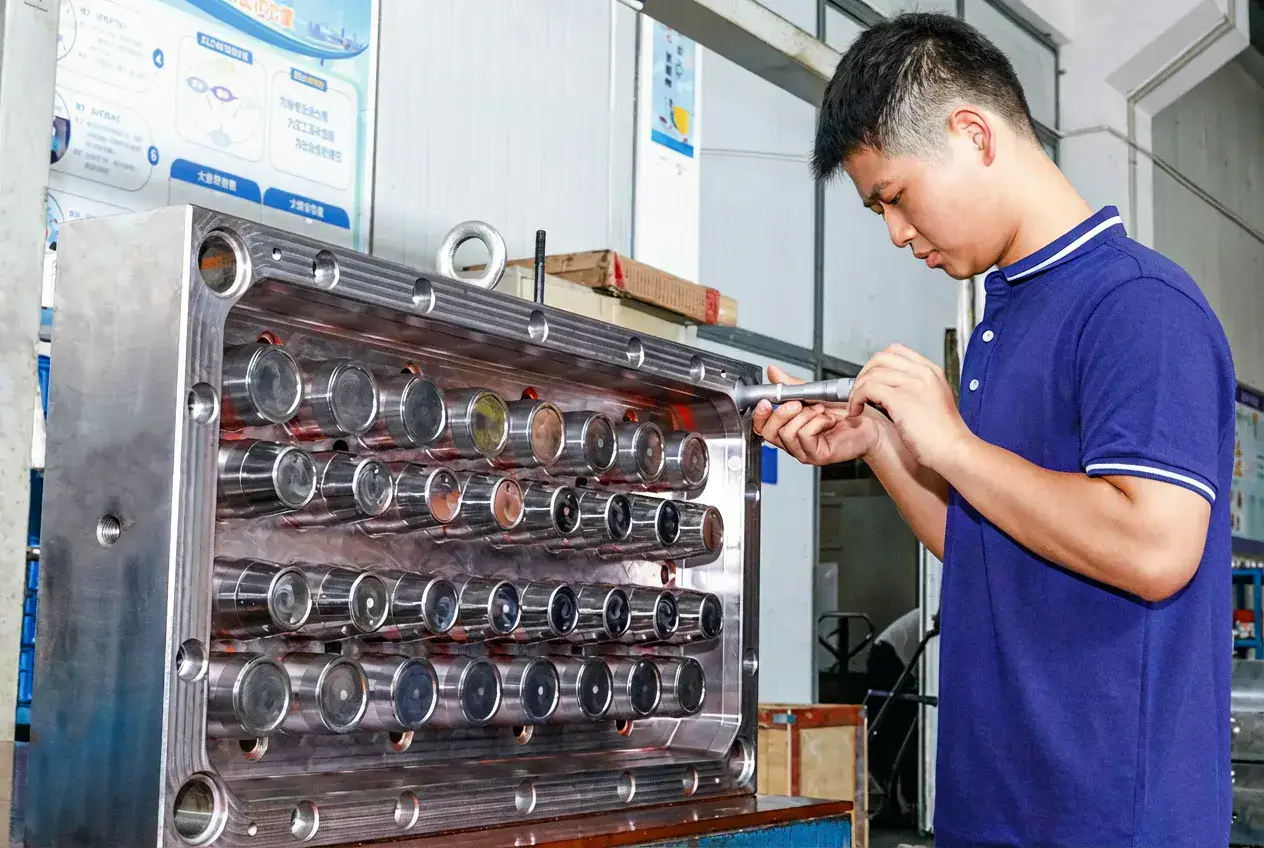
32-cavity high-speed sauce cup mold — 3 second cycle time
High-Cavity Mold Design for Sauce Cups
Sauce cup molds achieve the highest cavity counts in thin-wall packaging, ranging from 16 to 32 cavities depending on cup size and machine platen area. A 16-cavity 60 ml sauce cup mold fits on the HMD 368M8-SPV with platen size of 1,030 x 1,000 mm and tie bar distance of 670 x 640 mm. The mold layout uses a 4x4 grid with cavity pitch of 80-100 mm. For 32-cavity 30 ml cup molds, step up to the HMD 480M8-SPV with platen size of 1,190 x 1,140 mm and tie bar distance of 760 x 710 mm. The hot runner system uses 16-32 torpedo or valve gate nozzles from YUDO, with precise flow balancing to achieve less than 2% weight variation across all cavities. Runner system design is critical: a geometrically balanced manifold with equal flow path lengths from the sprue to each cavity ensures uniform fill. Mold weight ranges from 1,200-2,500 kg for 16-32 cavity configurations. Cooling uses baffled cooling circuits with 6-8 mm diameter channels spaced 12-15 mm apart, achieving cavity surface temperatures of 15-20 degrees Celsius. The mold includes air-assist ejection to release the lightweight parts reliably without deformation.
SPV5 Machine Configuration for 16-32 Cavity Production
Running 16-32 cavity sauce cup molds requires specific SPV5 configurations to ensure balanced fill and consistent part quality. The HMD 418M8-SPV at 4,180 kN is an ideal choice for 16-cavity 60 ml molds, delivering injection speed of 517 mm/s for rapid fill of the 0.40-0.45 mm wall sections. The 55 mm screw with L/D ratio of 25.3:1 provides excellent mixing for the high-MFI PP grades used in sauce cup production. Total shot weight for 16 cavities at 3g each plus runner is approximately 55-65g, well within the 432g injection weight capacity. For 24-32 cavity molds, the HMD 480M8-SPV at 4,800 kN provides the additional clamping force needed for the larger projected area. Despite having the same injection unit with 517 mm/s speed and 432g capacity, the 32-cavity mold total shot of 65-80g still represents only 15-18% of the injection capacity, ensuring precise metering at the small end of the shot range. The screw position control must be accurate to plus or minus 0.2 mm to maintain shot weight consistency within plus or minus 0.1g across 32 cavities, which the INOVA controller achieves through high-resolution encoder feedback.
Key Specs
- •Running 16-32 cavity sauce cup molds requires specific SPV5 configurations to ensure balanced fill and consistent part quality.
- •The HMD 418M8-SPV at 4,180 kN is an ideal choice for 16-cavity 60 ml molds, delivering injection speed of 517 mm/s for rapid fill of the 0.40-0.45 mm wall sections.
- •The 55 mm screw with L/D ratio of 25.3:1 provides excellent mixing for the high-MFI PP grades used in sauce cup production.
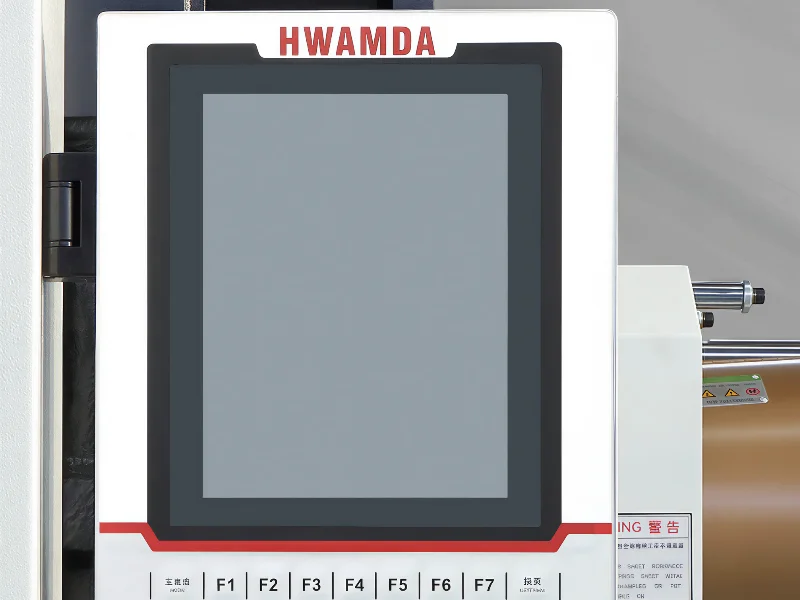
INOVA controller with precision process monitoring
Need Expert Advice?
Talk to our engineers about your specific production requirements. Free consultation.
Process Optimization for Ultra-Lightweight Parts
Producing parts weighing just 1.5-5.0 grams on machines with injection capacity of 432-465 grams requires careful process optimization. Injection phase: fill time of 0.10-0.20 seconds at 500-517 mm/s for the thin 0.35-0.50 mm walls, with injection pressure of 160-182 MPa. The key challenge is achieving uniform fill across 16-32 cavities within this narrow time window. Runner balancing must be validated by a short-shot study, progressively increasing shot size from 50% to 100% and confirming simultaneous fill completion across all cavities. Hold pressure: 0.3-0.6 seconds at 35-50% of injection pressure, shorter than larger parts because the thin walls freeze rapidly. Cooling: 2.0-3.5 seconds at mold temperature of 15-20 degrees Celsius. The small thermal mass of sauce cups means they cool faster than larger containers, but the high cavity count means total heat removal load is significant. Charging-on-fly is essential, with the screw completing the small 55-80g charge easily within the 2.0-second mold movement window. Total cycle time of 5.0-7.0 seconds delivers output per cavity of 514-720 parts per hour, multiplied by 16-32 cavities for total production rates of 8,200-23,000 cups per hour.
Cavity Balance and Quality Control for High-Cavity Molds
Maintaining uniform part quality across 16-32 cavities is the primary technical challenge in sauce cup production. Cavity imbalance manifests as weight variation between cavities, where an outer-row cavity may receive slightly more material than a center cavity due to shear-induced flow imbalance in the runner system. On HWAMDA SPV5 machines, implement the following cavity balance protocol. First, collect one shot of 16-32 parts and weigh each part individually on a 0.01g balance, recording results by cavity position. Calculate the weight spread as the difference between heaviest and lightest cavities, targeting less than plus or minus 2% from the mean weight. If spread exceeds this limit, adjust runner system gate sizes or manifold temperatures zone by zone using the hot runner controller. Second, monitor cavity pressure using in-mold pressure sensors installed in 2-4 reference cavities, comparing peak cavity pressure which should vary by less than 5% across monitored positions. The INOVA controller can receive analog signals from cavity pressure transducers and display real-time cavity pressure curves. Third, implement vision system inspection downstream of the SWITEK robot to detect short shots, flash, or surface defects on each of the 16-32 parts per cycle at production speed.
Key Specs
- •Maintaining uniform part quality across 16-32 cavities is the primary technical challenge in sauce cup production.
- •Calculate the weight spread as the difference between heaviest and lightest cavities, targeting less than plus or minus 2% from the mean weight.
- •Second, monitor cavity pressure using in-mold pressure sensors installed in 2-4 reference cavities, comparing peak cavity pressure which should vary by less than 5% across monitored positions.
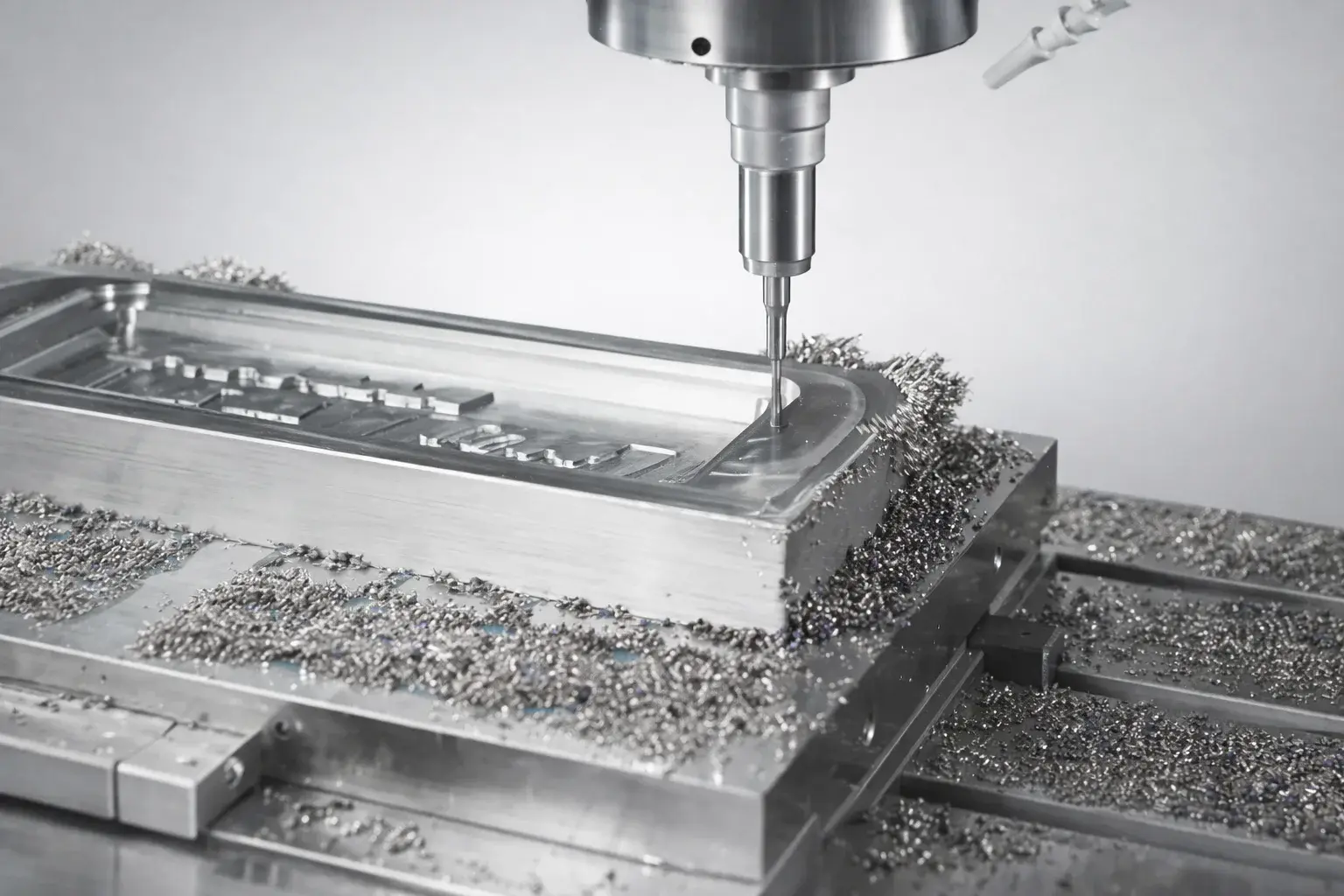
Optimized cooling channel design for rapid heat extraction
Production Volume and Market Economics
Sauce cup production generates the highest piece counts of any thin-wall application. A 16-cavity mold on the HMD 418M8-SPV at 5.5-second cycle produces 10,473 cups per hour. At 85% OEE running 24/7, monthly output reaches 6.39 million cups. A 24-cavity mold at 6.0-second cycle produces 14,400 cups per hour and 8.78 million monthly. A 32-cavity mold at 6.5-second cycle achieves 17,723 cups per hour and 10.81 million monthly. Material cost for a 3g PP sauce cup at 1.20 USD/kg is just 0.0036 USD per cup. Energy cost at 1.0 kWh/kg is 0.0004 USD per cup. With selling prices of 0.008-0.015 USD per cup in bulk markets, gross margins range from 45-65%. The key economic advantage of high-cavity molds is amortizing the machine hour cost across more parts: a 32-cavity mold spreads the approximately 15-20 USD per hour machine operating cost across 17,723 cups, adding just 0.0009-0.0011 USD per cup in machine cost. Mold investment of 80,000-150,000 USD for a 32-cavity mold typically pays back in 6-12 months at full production volume. The HWAMDA SPV5 servo-hydraulic drive further improves economics through 25-35% energy savings versus standard hydraulic machines.
Frequently Asked Questions
The maximum practical cavity count for sauce cups on HWAMDA SPV5 machines is 32 cavities for 30 ml (1 oz) cups on the HMD 480M8-SPV with platen size of 1,190 x 1,140 mm. For 60 ml (2 oz) cups, 16-24 cavities is the practical maximum. The limiting factor is platen area, as each cavity with its cooling and ejection components requires 80-100 mm pitch. Cavity counts above 32 require machines larger than the current SPV5 range.
Related Guides
Ready to Start Your Project?
Get a free consultation and quotation for your thin-wall packaging production line.
Join 500+ manufacturers in 60+ countries who trust HWAMDA.
Get Free Quote