

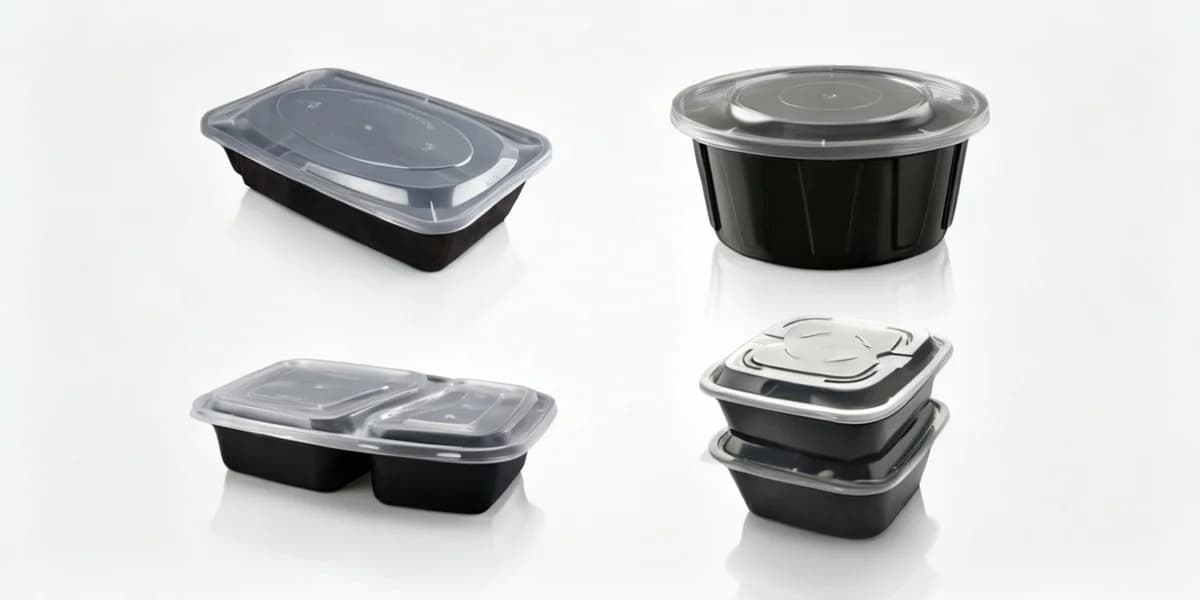
Food Container Dimensions and Material Requirements
Food containers span a wide range of sizes requiring different machine configurations. A 500 ml rectangular container measures approximately 120 x 170 x 40 mm with wall thickness of 0.35-0.50 mm and part weight of 15-20 grams. A 1,000 ml version measures approximately 150 x 200 x 55 mm at 0.45-0.60 mm wall and 25-35 grams. The largest 1,500 ml containers reach 170 x 230 x 60 mm with 0.50-0.70 mm walls and 35-45 grams. All food containers use PP homopolymer or impact copolymer with MFI of 35-60 g/10min, chosen for microwave compatibility up to 120 degrees Celsius, top-load stacking strength exceeding 30 N per container, and chemical resistance to fatty and acidic foods. The rectangular geometry introduces complexity not found in round yogurt cups: corner fill requires balanced runner design, and differential shrinkage between long and short sides can cause warpage exceeding 0.5 mm if cooling is not uniform. Container lids are typically produced on a separate machine or in a family mold, using the same PP grade with slightly thinner walls of 0.30-0.45 mm for snap-fit closure.
Key Specs
- •A 500 ml rectangular container measures approximately 120 x 170 x 40 mm with wall thickness of 0.35-0.50 mm and part weight of 15-20 grams.
- •A 1,000 ml version measures approximately 150 x 200 x 55 mm at 0.45-0.60 mm wall and 25-35 grams.
- •The largest 1,500 ml containers reach 170 x 230 x 60 mm with 0.50-0.70 mm walls and 35-45 grams.
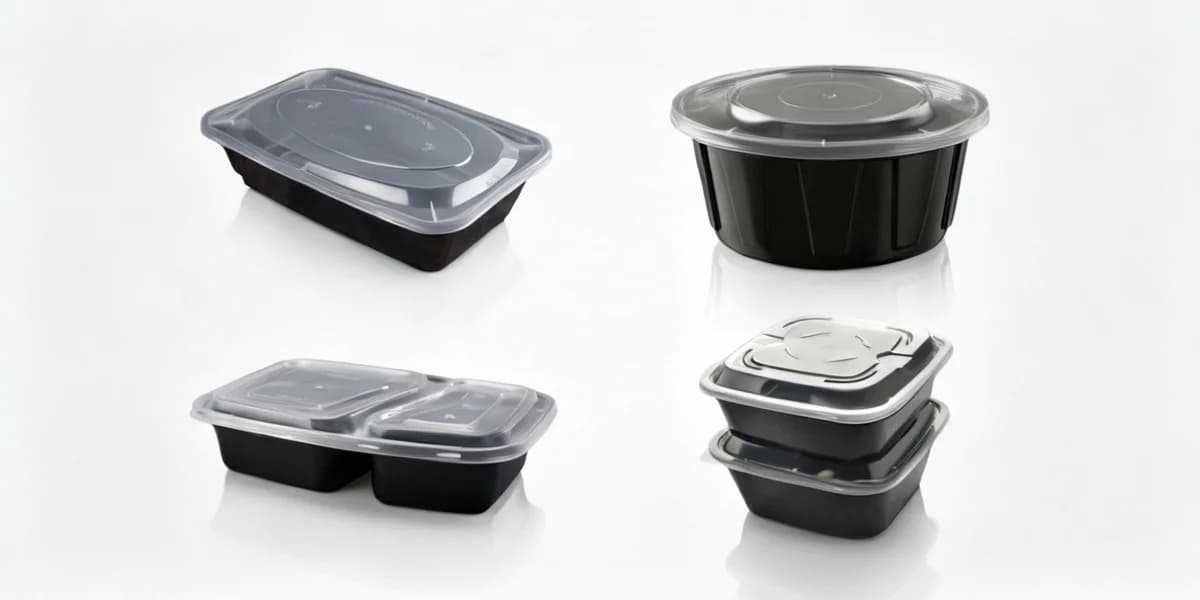
Thin-wall food containers — 500ml to 1500ml range
SPV5 Machine Selection by Container Size
Machine selection for food containers is driven by projected area, shot weight, and cavity count. For 4-cavity 500 ml containers with a total projected area of approximately 800 cm2, the HMD 400M8-SPV at 4,000 kN provides adequate clamping force at approximately 5 tonnes per cm2 of projected area. The injection unit with 60-65 mm screw delivers 835-981 grams injection weight capacity, sufficient for 4 containers totaling 60-80 grams plus runner. For 2-cavity 1,000 ml containers, the HMD 400M8-SPV remains suitable with the same injection unit handling the 50-70 gram total shot weight easily. For 1-2 cavity 1,500 ml containers with projected areas exceeding 400 cm2 per cavity, step up to the HMD 480M8-SPV at 4,800 kN or HMD 530M8-SPV at 5,300 kN. The larger platen sizes of 1,190 x 1,140 mm and 1,250 x 1,200 mm accommodate the wider molds required for rectangular geometries. Injection speed requirements for food containers are lower than yogurt cups, typically 300-400 mm/s, because the thicker walls of 0.45-0.70 mm provide more flow time before freeze-off.
Mold Design for Rectangular Food Containers
Rectangular food container molds present unique engineering challenges compared to round cup molds. The mold uses 2-4 valve gate hot runner nozzles per cavity positioned along the long axis of the container to ensure uniform fill. Gate positions must balance flow length, with the maximum flow distance from gate to far corner not exceeding 120 mm for 0.45 mm wall thickness at injection speeds of 350-400 mm/s. Cooling channel layout follows the container perimeter with circuits spaced 15-20 mm apart, maintaining cavity surface temperature at 18-25 degrees Celsius. Corner cooling requires special attention with directed cooling channels to prevent hot spots that cause warpage and extended cycle times. Mold steel is 1.2344 (H13) or 1.2738 (P20+Ni) depending on production volume requirements. For IML-decorated food containers, the mold incorporates label pockets on the bottom and optionally one or two side walls, with the IML system placing labels via the SWITEK robot during the mold-open phase. Container molds range from 1,500-3,000 kg for 4-cavity 500 ml to 2,500-5,000 kg for 1-2 cavity larger sizes. Ejection uses stripper plate or air-assist systems to prevent deformation of the thin walls during demolding.
Key Specs
- •Gate positions must balance flow length, with the maximum flow distance from gate to far corner not exceeding 120 mm for 0.45 mm wall thickness at injection speeds of 350-400 mm/s.
- •Cooling channel layout follows the container perimeter with circuits spaced 15-20 mm apart, maintaining cavity surface temperature at 18-25 degrees Celsius.
- •Container molds range from 1,500-3,000 kg for 4-cavity 500 ml to 2,500-5,000 kg for 1-2 cavity larger sizes.
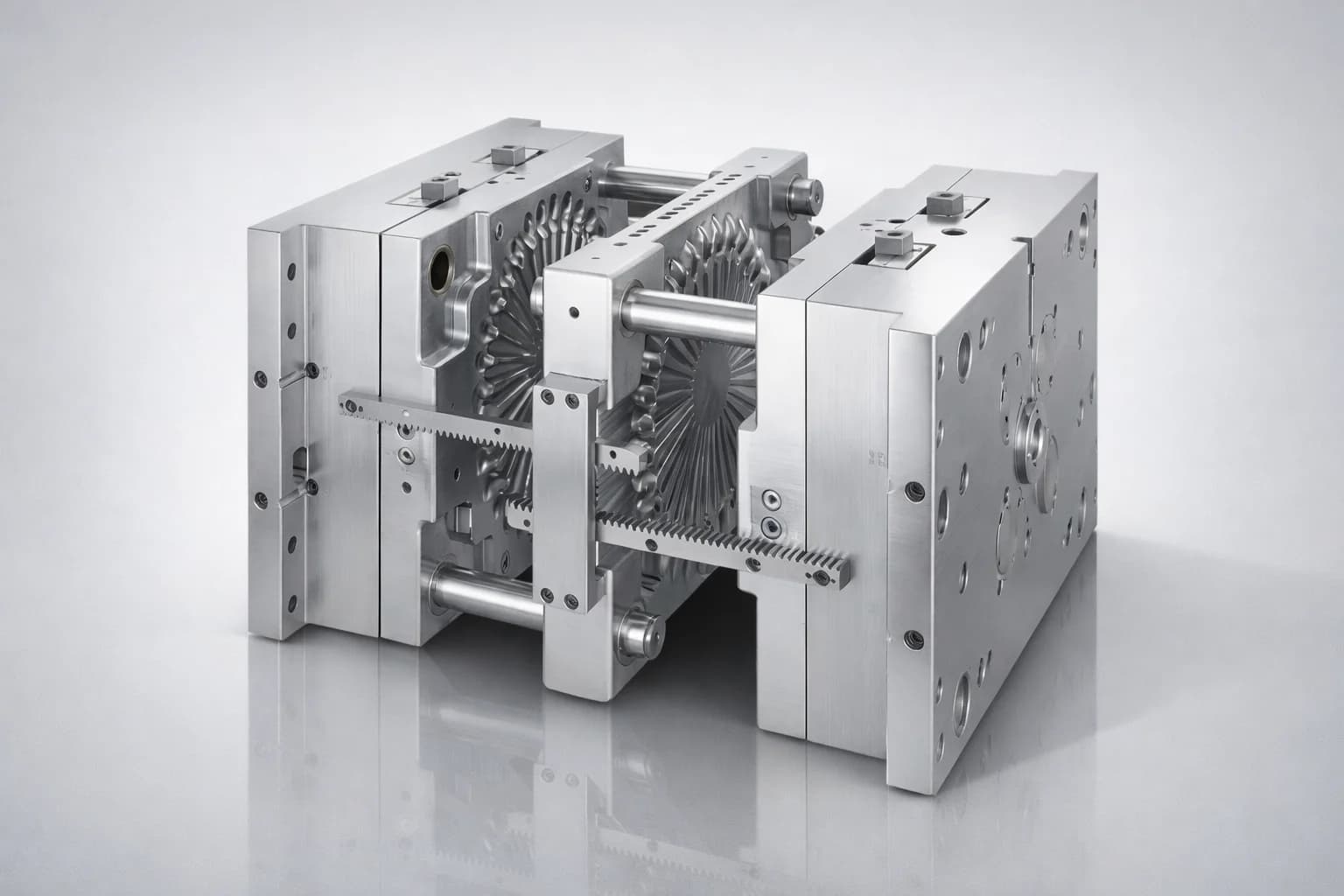
Stack mold technology doubles output per cycle
Need Expert Advice?
Talk to our engineers about your specific production requirements. Free consultation.
Process Parameters for Different Container Volumes
Process parameters vary significantly across the food container size range. For a 4-cavity 500 ml container on the HMD 400M8-SPV: injection speed of 380-420 mm/s, injection pressure of 140-160 MPa, melt temperature of 225-240 degrees Celsius, hold pressure at 50-65% of injection pressure for 1.0-1.5 seconds, cooling time of 2.0-3.5 seconds, and total cycle time of 5.0-7.5 seconds. For a 2-cavity 1,000 ml container: injection speed of 350-400 mm/s, injection pressure of 130-155 MPa due to thicker walls allowing easier flow, hold pressure for 1.5-2.5 seconds, cooling time of 3.0-5.0 seconds due to thicker wall sections at base and rim, and total cycle time of 7.0-10.0 seconds. For 1-cavity 1,500 ml containers: injection speed of 300-380 mm/s, injection pressure of 120-150 MPa, hold pressure for 2.0-3.0 seconds, cooling time of 4.0-6.0 seconds, and total cycle of 9.0-12.0 seconds. In all cases, the INOVA controller manages velocity-to-pressure transfer at 95-97% fill to prevent flash at the parting line while ensuring complete corner fill.
Warpage Control in Rectangular Containers
Warpage is the primary quality challenge in rectangular food container production, caused by differential cooling and non-uniform shrinkage across the part geometry. On HWAMDA SPV5 machines, warpage control involves several strategies. First, optimize cooling circuit design to achieve less than 2 degrees Celsius temperature differential across the cavity surface, using independent temperature control units for core and cavity sides. The SPV5 INOVA controller monitors mold temperature sensors in real-time to alert operators of cooling deviations. Second, implement a multi-stage hold pressure profile: high initial pressure at 60% of injection pressure for 0.5 seconds to pack the gate area, then reduced to 40% for 0.5-1.0 seconds for uniform packing across the container. Third, control melt temperature uniformity across the 6 barrel heating zones within plus or minus 2 degrees Celsius at 230-240 degrees Celsius, as temperature variation causes viscosity differences that create uneven flow and packing. Fourth, use mold temperature differential between core and cavity sides, typically maintaining the core 3-5 degrees Celsius warmer than the cavity to compensate for the natural tendency of rectangular parts to warp inward. Target final warpage below 0.5 mm across the container diagonal for food-grade applications.
Key Specs
- •Second, implement a multi-stage hold pressure profile: high initial pressure at 60% of injection pressure for 0.5 seconds to pack the gate area, then reduced to 40% for 0.5-1.0 seconds for uniform packing across the container.
- •Third, control melt temperature uniformity across the 6 barrel heating zones within plus or minus 2 degrees Celsius at 230-240 degrees Celsius, as temperature variation causes viscosity differences that create uneven flow and packing.
- •Target final warpage below 0.5 mm across the container diagonal for food-grade applications.
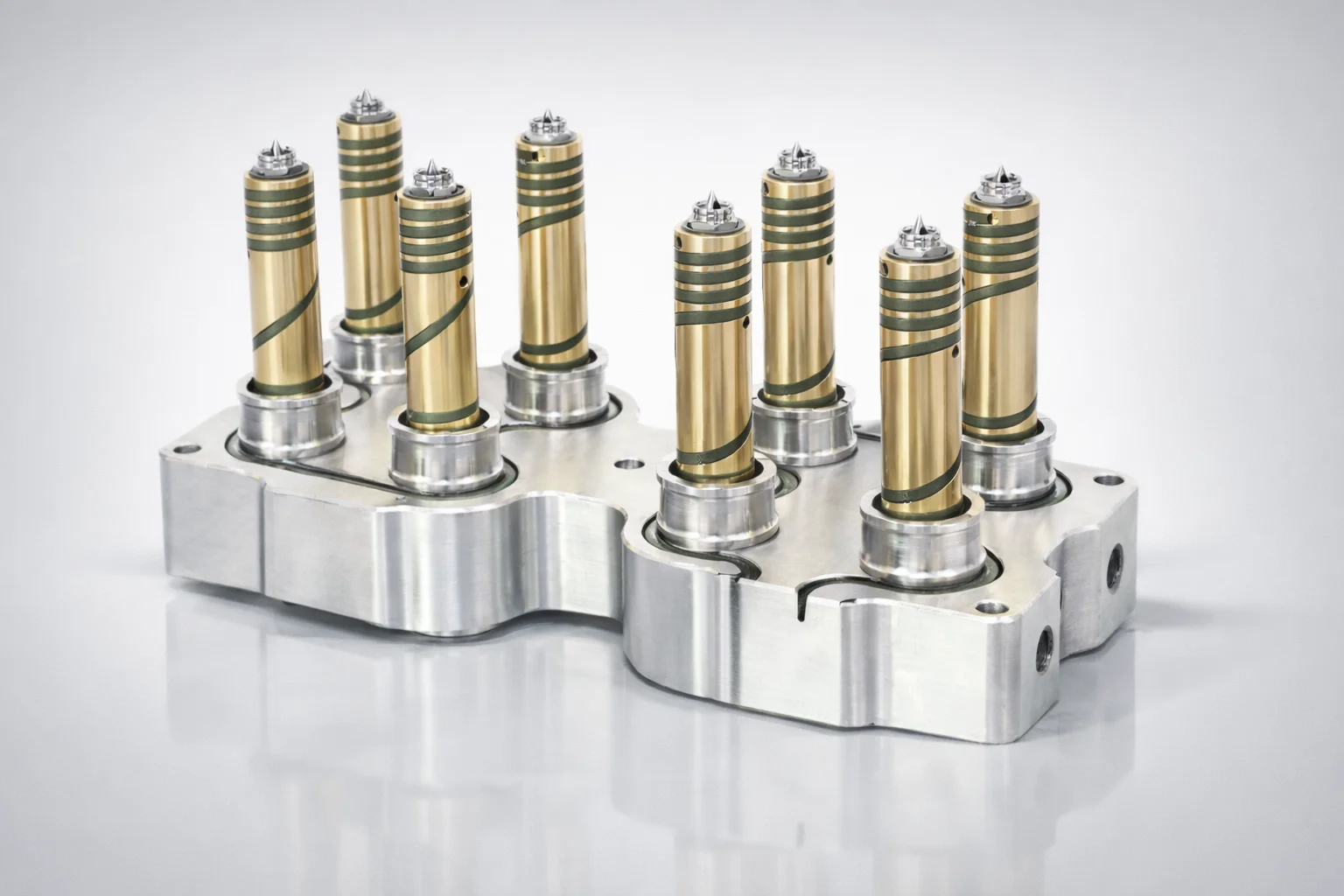
Valve gate system for gate vestige-free containers
Production Output and Cost Analysis
Food container production economics differ from yogurt cups due to larger part size and lower cavity counts. An HMD 400M8-SPV with a 4-cavity 500 ml container mold at 6.5-second cycle produces 2,215 containers per hour. At 85% OEE running 24/7, monthly output reaches 1.35 million containers. Material cost for a 20g PP container at 1.20 USD/kg PP is 0.024 USD per container. Energy consumption at 1.0-1.2 kWh/kg translates to 0.002-0.003 USD per container. IML label cost adds 0.008-0.015 USD for branded versions. Total variable cost per 500 ml container is approximately 0.035-0.042 USD. For a 2-cavity 1,000 ml container mold at 9.0-second cycle, hourly output is 800 containers and monthly output reaches 488,000 units. The 30g container has a material cost of 0.036 USD. Larger containers command higher selling prices of 0.06-0.12 USD, maintaining gross margins of 40-55%. Mold investment for food containers ranges from 50,000-80,000 USD for 4-cavity 500 ml to 80,000-150,000 USD for complex IML configurations, with payback periods of 12-24 months at full production capacity.
Frequently Asked Questions
Optimal cavity count depends on container size. For 500 ml containers, 4-cavity molds on the HMD 400M8-SPV deliver the best balance of output at 2,215 per hour and mold cost of 50,000-80,000 USD. For 1,000 ml containers, 2-cavity molds are standard. For 1,500 ml and larger, single-cavity molds are most practical due to projected area limitations. Going above these counts risks insufficient clamping force and quality issues from cavity imbalance.
Related Guides
Ready to Start Your Project?
Get a free consultation and quotation for your thin-wall packaging production line.
Join 500+ manufacturers in 60+ countries who trust HWAMDA.
Get Free Quote