

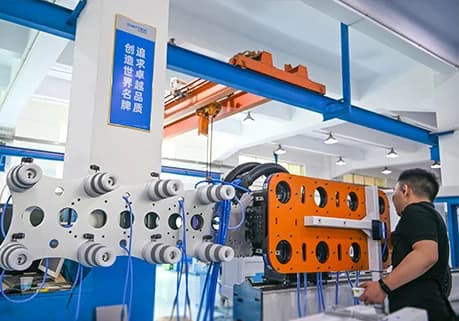
The Complete IML Process Step by Step
Step 1 - Label preparation: Pre-printed PP labels (40-70 micron thickness) are die-cut to match the exact cavity geometry and delivered in stacks of 1,000-5,000 to the production floor. Labels are loaded into the robot's magazine, a precision holder that separates and presents one label at a time using electrostatic separation and air assist. Step 2 - Robot label pick and placement: As the HWAMDA SPV5 mold opens at the end of the previous cycle, the side-entry robot (SWITEK or Star Automation) extends its arm into the mold space. The end-of-arm tooling (EOAT) uses vacuum suction cups (12-16 per label) and static charge generation to pick labels from the magazine and place them precisely against the cavity wall with +/-0.3-0.5mm accuracy. Step 3 - Label held in cavity: The label is held against the mold surface by static electricity and/or vacuum channels machined into the cavity surface. Step 4 - Injection: The mold closes and PP melt at 230-245°C is injected at 368-560 mm/s through the valve gate hot runner. The molten plastic bonds with the label's back surface, encapsulating it as a structural component of the container wall.
Key Specs
- •The end-of-arm tooling (EOAT) uses vacuum suction cups (12-16 per label) and static charge generation to pick labels from the magazine and place them precisely against the cavity wall with +/-0.3-0.5mm accuracy.
- •Step 4 - Injection: The mold closes and PP melt at 230-245°C is injected at 368-560 mm/s through the valve gate hot runner.
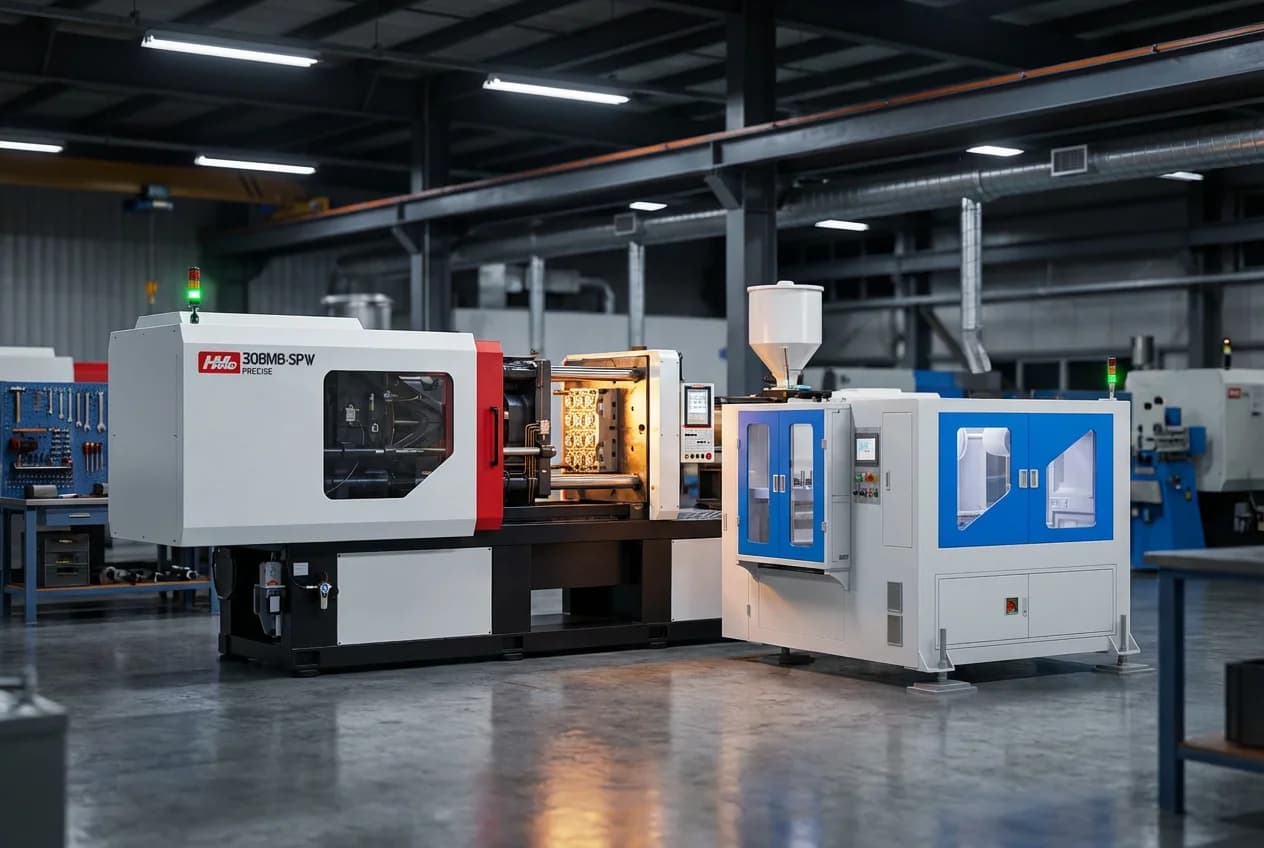
IML decorated containers with photographic quality labels
Why IML Outperforms Post-Mold Labeling Methods
IML offers decisive advantages over traditional pressure-sensitive labels (PSL), shrink sleeves, and direct printing. Label durability: IML labels are permanently fused to the container wall and cannot be peeled, scuffed, or washed off, surviving dishwasher temperatures of 60-70°C, freezer storage at -20 to -40°C, and microwave heating to 100°C+. Image quality: IML labels are printed using rotogravure or offset processes at 150-200 LPI resolution, delivering photographic quality with metallic, holographic, and matte finish options impossible with direct printing on PP containers. Wall thickness integration: the 40-70 micron label thickness integrates into the 0.35-0.50mm container wall, allowing thinner PP injection (saving 0.5-1.0g material per container) while maintaining structural integrity. Recyclability: mono-material PP containers with PP IML labels are fully recyclable in PP streams without label separation, unlike PSL (adhesive contamination) or shrink sleeves (PVC/PET contamination). At current PP prices of $1.2-1.5/kg, the 0.5-1.0g material savings per container offsets 30-50% of the IML label cost.
IML Equipment Requirements for HWAMDA SPV5 Lines
A complete IML production cell on an HWAMDA SPV5 machine requires three main components beyond the standard molding machine. The IML robot: SWITEK SW-IML side-entry robot ($25,000-40,000) or Star Automation Flex IML ($45,000-75,000), with EOAT custom-designed for each mold ($3,000-8,000 per set). The IML mold: differs from standard thin-wall molds by incorporating vacuum channels (0.3-0.5mm diameter, 15-20 per cavity) machined into the cavity surface to hold labels, slightly larger mold opening stroke to accommodate robot entry, and label alignment features (centering pins or air-assist positioning). IML molds cost 15-25% more than equivalent non-IML molds: an 8-cavity yogurt cup IML mold runs $40,000-60,000 versus $35,000-50,000 for non-IML. The label magazine and separator: precision magazine holding 2,000-6,000 labels per stack with electrostatic separation ($2,000-5,000). Total IML-specific investment above a standard SPV5 thin-wall cell: $35,000-90,000. At $0.01-0.02 higher margin per IML-decorated container versus plain containers, payback on the IML investment occurs within 3-6 months of production.
Key Specs
- •The IML mold: differs from standard thin-wall molds by incorporating vacuum channels (0.3-0.5mm diameter, 15-20 per cavity) machined into the cavity surface to hold labels, slightly larger mold opening stroke to accommodate robot entry, and label alignment features (centering pins or air-assist positioning).
- •IML molds cost 15-25% more than equivalent non-IML molds: an 8-cavity yogurt cup IML mold runs $40,000-60,000 versus $35,000-50,000 for non-IML.
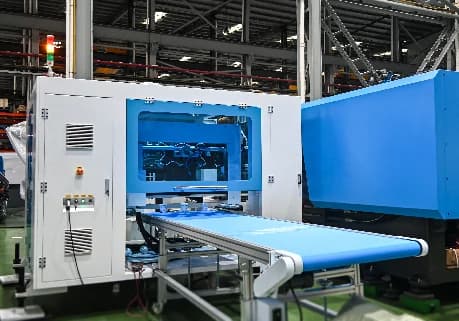
IML robot detail — pick-and-place label handling
Need Expert Advice?
Talk to our engineers about your specific production requirements. Free consultation.
IML Label Specifications and Material Selection
IML labels for injection molding are produced from biaxially oriented polypropylene (BOPP) or cast polypropylene (CPP) film. Thickness: 40-70 microns, with 50-60 microns being the standard for yogurt cups and food containers. Thinner labels (40 microns) save cost but are harder to handle; thicker labels (70 microns) provide better barrier properties and print registration. Print surface: corona-treated for ink adhesion, with UV-curable or solvent-based inks at 150-200 LPI resolution. The back surface is either unprinted or treated with a heat-activated bonding layer for enhanced adhesion to the injected PP melt. Label shapes for IML injection molding include: wraparound (270-360 degree coverage for cups and tubs), bottom labels (flat disc for container bottom branding), and combination wrap + bottom (premium full-coverage decoration). Label curl specification is critical: maximum 2mm curl height on a 100mm span, as excessive curl prevents accurate placement. Labels must be supplied with consistent static properties (surface resistivity 10^9-10^12 ohms/sq) for reliable electrostatic holding in the cavity. Major IML label suppliers: Verstraete (Belgium), Viappiani (Italy), Shantou Lianhe (China), and HC Packaging (Turkey).
Common IML Defects and Prevention
IML introduces unique defects not found in standard injection molding. Label wrinkling: caused by the melt front pushing or dragging the label during injection. Prevention: optimize injection speed profile (slower initial fill of 60-70% speed near the label edge, then full speed), ensure label static holding force exceeds 0.1 N/cm2, and verify mold vacuum channels are not blocked. Label shift: the label moves from its intended position during injection. Prevention: maintain label placement accuracy within +/-0.3mm, verify mold vacuum function (test each circuit at -0.06 MPa), and ensure consistent label dimensions with +/-0.2mm die-cutting tolerance. Wash-out: the print ink partially dissolves or migrates due to contact with hot PP melt at 230-245°C. Prevention: use heat-resistant inks rated for 260°C+, verify ink cure level with a tape pull test (must exceed 90% retention), and reduce melt temperature to the minimum that achieves complete fill. Air bubbles between label and container wall: trapped air creates visible blistering. Prevention: ensure sufficient venting behind the label through vacuum channels, reduce injection speed during initial label contact phase, and verify label flatness (no wrinkles in magazine).
Key Specs
- •Prevention: optimize injection speed profile (slower initial fill of 60-70% speed near the label edge, then full speed), ensure label static holding force exceeds 0.1 N/cm2, and verify mold vacuum channels are not blocked.
- •Prevention: maintain label placement accuracy within +/-0.3mm, verify mold vacuum function (test each circuit at -0.06 MPa), and ensure consistent label dimensions with +/-0.2mm die-cutting tolerance.
- •Wash-out: the print ink partially dissolves or migrates due to contact with hot PP melt at 230-245°C.
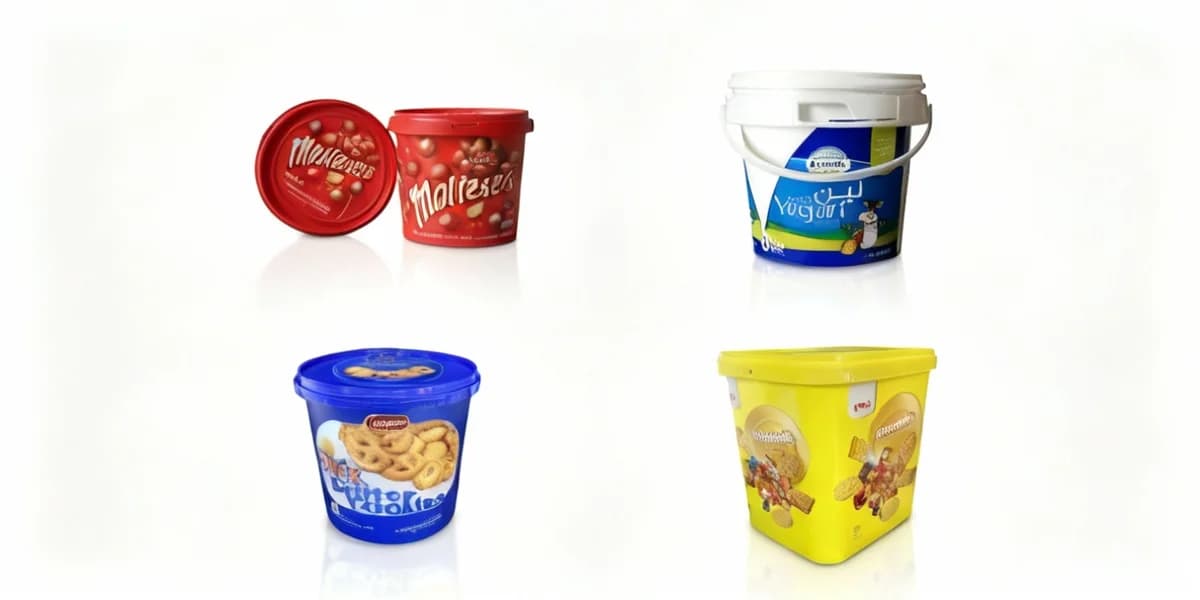
IML production output — consistent decoration quality
IML Production Economics and ROI Analysis
IML economics for a typical HWAMDA SPV5 production line producing 8-cavity yogurt cups at 4.5s cycle. Production rate: 6,400 cups/hour, 153,600 cups/day (24hr operation), 4.6 million cups/month. Label cost: $0.008-0.015 per label (quantity 5+ million/order from Chinese suppliers; $0.015-0.025 from European suppliers). Monthly label cost: $36,800-69,000 (Chinese labels) or $69,000-115,000 (European labels). Material savings from thinner wall enabled by label structural contribution: 0.5-0.8g per cup x 4.6 million cups/month x $1.3/kg PP = $2,990-4,784/month. Market value premium: IML-decorated cups command $0.005-0.015 more per unit than sleeve-labeled or plain cups, generating $23,000-69,000/month additional revenue on 4.6 million units. Net IML benefit (revenue premium + material savings - label cost): $-13,000 to +$65,800 per month depending on label sourcing and market pricing. The economics are most favorable when: using Chinese-sourced labels, serving premium dairy brands willing to pay for IML quality, and exploiting material savings through wall thickness optimization. HWAMDA's turnkey IML lines include label supplier introductions and process optimization to maximize IML economics.
Frequently Asked Questions
IML labels cost $0.008-0.025 per unit depending on quantity and supplier (Chinese labels at low end, European at high end). The IML process adds 0.3-0.5 seconds to cycle time, adding approximately $0.001-0.002 in machine time cost. Total IML cost addition: $0.009-0.027 per container. However, material savings of $0.001-0.002/cup (thinner wall enabled by label) and elimination of post-mold labeling ($0.003-0.008/cup) can offset 20-50% of this cost.
Related Guides
Ready to Start Your Project?
Get a free consultation and quotation for your thin-wall packaging production line.
Join 500+ manufacturers in 60+ countries who trust HWAMDA.
Get Free Quote