

Insufficient Injection Speed as the Primary Cause
In thin-wall molding, the polymer melt freezes rapidly as it contacts the cold mold surface, creating a frozen skin layer that narrows the available flow channel. If injection speed is too low, the frozen layer grows faster than the melt front advances, eventually closing off the flow path and leaving the part incomplete. For 0.40mm wall PP cups, the melt must reach the last-filled point within 0.2-0.4 seconds to prevent freeze-off. The HWAMDA SPV5 series delivers injection speeds of 368-560 mm/s depending on model, sufficient for all standard thin-wall food packaging. Common injection speed issues: operators setting speed too conservatively to avoid flash (solution: increase speed and add clamping force instead), worn check ring allowing melt backflow during injection reducing effective speed by 10-20% (solution: replace check ring assembly, cost $1,200-1,800 for SPV5), and insufficient accumulator pre-charge pressure reducing peak injection rate (solution: verify accumulator nitrogen pre-charge at 80-100 bar). On the HMD 400M8-SPV with 60mm screw, full injection speed of 442 mm/s delivers a flow front velocity exceeding 200 mm/s in a 0.40mm wall section.
Key Specs
- •For 0.40mm wall PP cups, the melt must reach the last-filled point within 0.2-0.4 seconds to prevent freeze-off.
- •The HWAMDA SPV5 series delivers injection speeds of 368-560 mm/s depending on model, sufficient for all standard thin-wall food packaging.
- •Common injection speed issues: operators setting speed too conservatively to avoid flash (solution: increase speed and add clamping force instead), worn check ring allowing melt backflow during injection reducing effective speed by 10-20% (solution: replace check ring assembly, cost $1,200-1,800 for SPV5), and insufficient accumulator pre-charge pressure reducing peak injection rate (solution: verify accumulator nitrogen pre-charge at 80-100 bar).
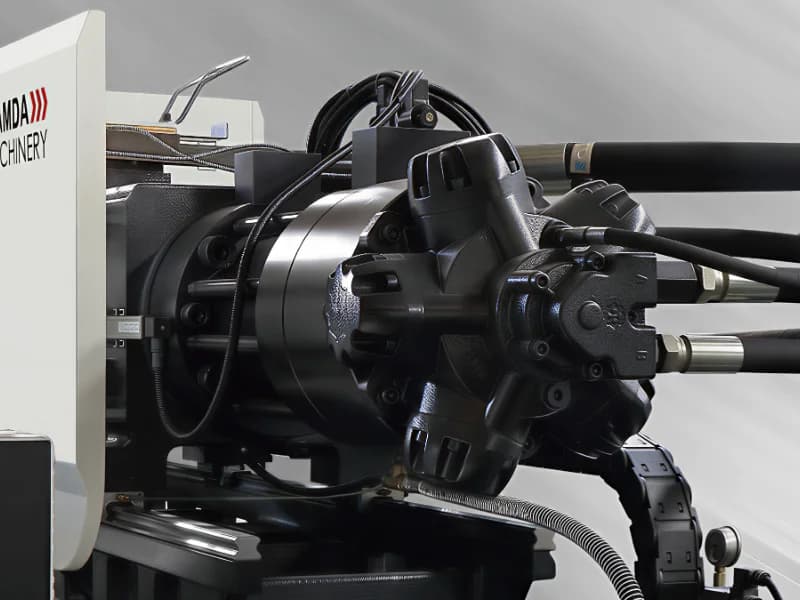
High-speed injection unit with linear guides
Low Melt Temperature and Premature Solidification
PP melt temperature below 220°C dramatically increases viscosity in thin sections, reducing flow length before freeze-off. Optimal melt temperature for thin-wall PP on HWAMDA SPV5 machines: homopolymer 230-245°C, random copolymer 220-235°C. Temperature-related short shot causes: barrel zone temperatures set too low (verify actual melt temperature with a pyrometer, not just controller setpoints), insufficient residence time in the barrel causing un-melted pellets (increase back pressure to 8-15 MPa and screw speed to 200-300 r/min), cold slug from the nozzle tip entering the mold first and blocking the gate or thin section (purge and verify nozzle heater band is functioning at 230-250°C, the Herzog nozzle on SPV5 machines should maintain +/-3°C stability), and excessive decompression after plasticizing creating air gaps that cool the melt (reduce decompression stroke to 2-5mm). Check actual versus set temperature by measuring barrel zones with an infrared thermometer. A 10°C drop in melt temperature can reduce flow length by 15-25% in 0.40mm wall sections.
Inadequate Venting Causing Air Entrapment
As molten PP fills the cavity at 200+ mm/s, the air inside must escape rapidly. Blocked or insufficient vents create back-pressure that resists the melt front, causing short shots or burn marks at the last-filled areas. Thin-wall mold venting specifications: vent depth 0.02-0.03mm for PP (deeper causes flash), vent width 5-8mm, vent land length 1.0-1.5mm, and vent channels behind the land at 0.5-1.0mm depth. For an 8-cavity yogurt cup mold, place vents at: the bottom center of each cavity (last fill point for center-gated cups), around the rim at 30-45 degree intervals, and at all weld line locations. Total vent area per cavity should be 30-50 mm2. Symptoms of venting issues: short shots consistently in the same cavity location, burn marks (diesel effect) at the end of fill, and short shots that worsen as production continues (progressive vent blockage from PP off-gas deposits). Solutions: clean vents every 50,000-100,000 cycles using ultrasonic cleaning ($200-400 per cleaning), add vacuum venting for deep-draw containers (vacuum to -0.06 to -0.08 MPa applied 0.1s before injection), and machine vents 0.005mm deeper if consistent short shots persist despite other optimization.
Key Specs
- •Thin-wall mold venting specifications: vent depth 0.02-0.03mm for PP (deeper causes flash), vent width 5-8mm, vent land length 1.0-1.5mm, and vent channels behind the land at 0.5-1.0mm depth.
- •Total vent area per cavity should be 30-50 mm2.
- •Solutions: clean vents every 50,000-100,000 cycles using ultrasonic cleaning ($200-400 per cleaning), add vacuum venting for deep-draw containers (vacuum to -0.06 to -0.08 MPa applied 0.1s before injection), and machine vents 0.005mm deeper if consistent short shots persist despite other optimization.
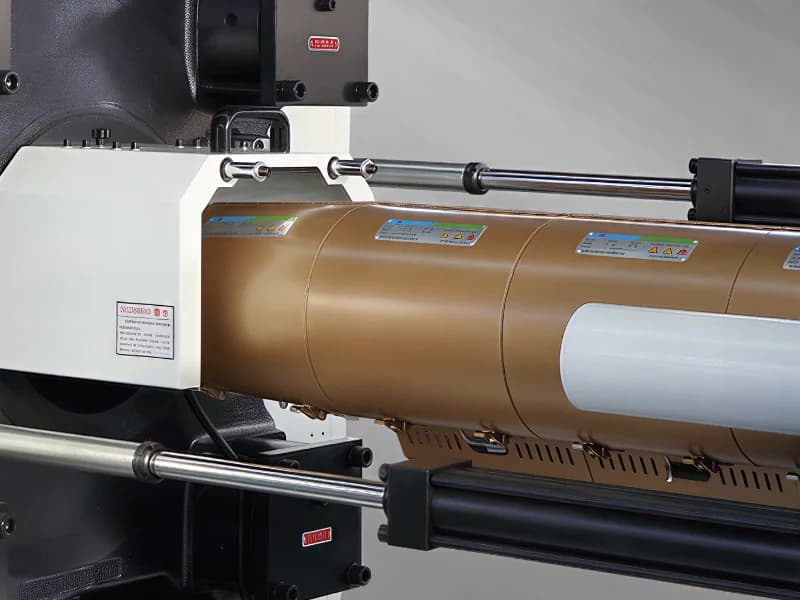
Servo-hydraulic drive system with energy recovery
Need Expert Advice?
Talk to our engineers about your specific production requirements. Free consultation.
Gate and Hot Runner Flow Restrictions
The gate and hot runner system are the bottleneck between the machine's injection unit and the cavity. For thin-wall production on HWAMDA SPV5 machines, flow restrictions in this path are a leading cause of short shots. Gate-related issues: gate diameter too small (minimum 1.2-1.5mm for valve gates on PP thin-wall), gate freeze-off occurring before cavity fill completion (increase melt temperature by 5-10°C or enlarge gate by 0.2-0.3mm), and unbalanced gate sizes in multi-cavity molds causing some cavities to fill before others (verify all gates are within +/-0.05mm of specified diameter). Hot runner issues: manifold temperature set too low causing increased melt viscosity (set 10-15°C above the melt temperature target, e.g., 245-260°C for PP homopolymer), nozzle tip temperature cold spots from worn heater bands (replace annually or per manufacturer schedule), and flow channel blockage from degraded PP (purge with commercial cleaning compound every 50,000-100,000 cycles). On 8-drop YUDO or Synventive systems running on SPV5 machines, verify temperature uniformity across all nozzle zones is within +/-2°C. A single cold nozzle produces short shots in only that cavity while others fill completely.
Material-Related Causes and Solutions
PP material properties directly affect flow length in thin sections. Material causes of short shots: MFI too low for the wall thickness (0.35-0.40mm walls require MFI 50-100 g/10min, using MFI 20-30 grades will consistently short-shot), regrind percentage too high increasing melt viscosity (limit regrind to 15-20% for non-food applications, 0% for food-contact parts), moisture on pellets causing splay that disrupts the melt front (dry PP at 80-90°C for 2-3 hours), and material degradation from excessive residence time in the barrel (residence time should be 2-5 minutes, not exceeding 8 minutes). When short shots occur after a material lot change, check the new lot's MFI against the specification. MFI variation of +/-10% between lots is normal for most PP suppliers. For thin-wall applications, specify tight MFI tolerance grades: SABIC FLOWPACT FPC70 (MFI 70 +/-5), Borealis BorPure RJ766MO (MFI 70 +/-3). If switching PP suppliers, run a trial of 500+ shots on the HWAMDA SPV5 to validate fill before committing to full production.
Key Specs
- •Material causes of short shots: MFI too low for the wall thickness (0.35-0.40mm walls require MFI 50-100 g/10min, using MFI 20-30 grades will consistently short-shot), regrind percentage too high increasing melt viscosity (limit regrind to 15-20% for non-food applications, 0% for food-contact parts), moisture on pellets causing splay that disrupts the melt front (dry PP at 80-90°C for 2-3 hours), and material degradation from excessive residence time in the barrel (residence time should be 2-5 minutes, not exceeding 8 minutes).
- •MFI variation of +/-10% between lots is normal for most PP suppliers.
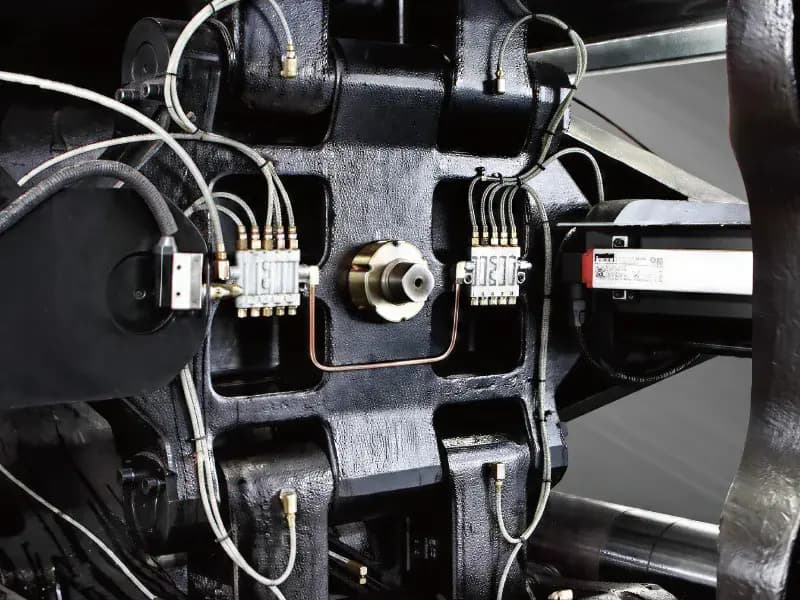
Toggle clamping unit — high rigidity for thin-wall molding
Systematic Troubleshooting Procedure on HWAMDA SPV5
When short shots occur on an HWAMDA SPV5 machine, follow this systematic procedure. Step 1: Check shot size. Verify the cushion position is 5-10mm (sufficient material reserve). If cushion is near zero, increase shot size by 5-10%. Step 2: Verify injection speed profile. Use the INOVA controller's injection speed monitoring to confirm actual speed reaches the programmed 368-560 mm/s. Actual speed dropping more than 10% below setpoint indicates hydraulic system issues or check ring wear. Step 3: Check melt temperature. Measure actual melt temperature via an air-shot into a temperature probe. Target 230-245°C for PP homopolymer. Step 4: Inspect vents. Remove the mold for cleaning if vents are blocked (production should pause every 50,000-100,000 cycles for vent maintenance). Step 5: Increase injection pressure. Raise the pressure limit by 5-10 MPa increments while monitoring for flash. The SPV5 provides up to 177 MPa. Step 6: Verify hot runner temperatures. Check all nozzle and manifold zones are within +/-2°C of setpoint using the INOVA controller display. Step 7: Check material. Verify MFI, drying status, and regrind content. Step 8: If all above are correct, the mold requires flow analysis and possible gate enlargement. Contact HWAMDA technical support at +86-159-5888-5672 for remote diagnostic assistance through the INOVA controller.
Frequently Asked Questions
For 0.35-0.45mm wall PP containers, minimum injection speed is 300 mm/s, with 400-500 mm/s recommended. The HWAMDA SPV5 series delivers 368 mm/s (HMD 270M8-SPV) to 560 mm/s (HMD 600M8-SPV). For ultra-thin 0.30-0.35mm walls like yogurt cup sidewalls, speeds above 450 mm/s are necessary. Verify actual speed using the INOVA controller's real-time injection speed graph, as hydraulic response can cause actual speed to lag setpoint by 5-15%.
Related Guides
Ready to Start Your Project?
Get a free consultation and quotation for your thin-wall packaging production line.
Join 500+ manufacturers in 60+ countries who trust HWAMDA.
Get Free Quote