

The Cavity Count Decision Framework
Three factors determine optimal cavity count. Factor 1 - Required output: calculate the annual production volume divided by available production hours. For 50 million yogurt cups annually with 7,200 operating hours (24/7 minus 10% downtime), required output is 6,944 cups/hour. An 8-cavity mold at 4.5s cycle produces 6,400 cups/hour (just under target), while a 4-cavity mold at 4.5s produces only 3,200 (requires two machines). Factor 2 - Machine clamping force: each additional cavity adds projected area requiring more clamping force. An HWAMDA HMD 400M8-SPV at 4,000 kN supports 8 cavities of 85mm-diameter yogurt cups but not 12 cavities (which would require 5,000+ kN). Factor 3 - Mold cost versus machine cost: an 8-cavity mold costs $35,000-55,000 versus $18,000-30,000 for 4-cavity, but one 8-cavity mold on one machine replaces two 4-cavity molds on two machines, saving $85,000-100,000 in machine investment. The general rule: maximize cavity count within the available machine tonnage and mold budget to minimize cost-per-part.
Key Specs
- •For 50 million yogurt cups annually with 7,200 operating hours (24/7 minus 10% downtime), required output is 6,944 cups/hour.
- •An 8-cavity mold at 4.5s cycle produces 6,400 cups/hour (just under target), while a 4-cavity mold at 4.5s produces only 3,200 (requires two machines).
- •An HWAMDA HMD 400M8-SPV at 4,000 kN supports 8 cavities of 85mm-diameter yogurt cups but not 12 cavities (which would require 5,000+ kN).
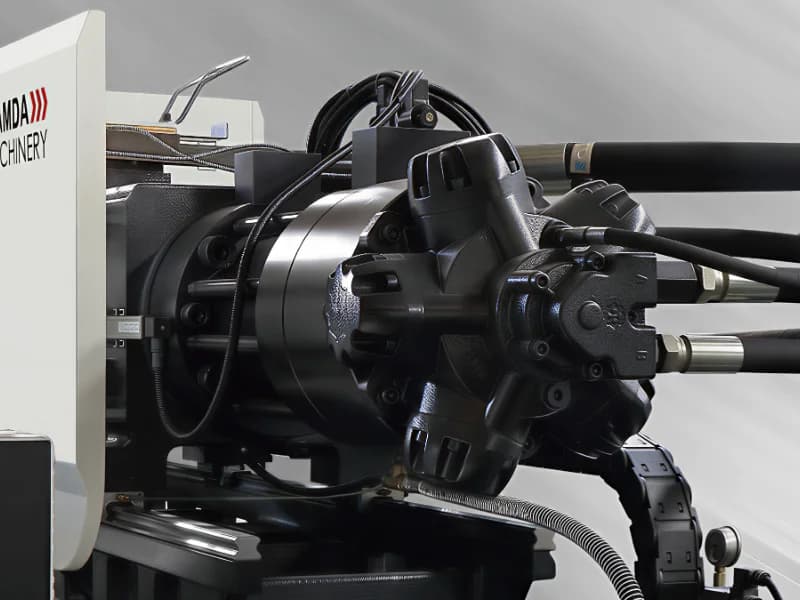
High-speed injection unit with linear guides
Cavity Count by Product Category
Based on HWAMDA SPV5 production data and mold maker specifications, recommended cavity counts by product. Yogurt cups (125-200ml, 85mm diameter, 4-8g): standard production uses 4 or 8 cavities. 4-cavity on HMD 308M8-SPV (3,080 kN) produces 3,200 cups/hr at 4.5s cycle. 8-cavity on HMD 400M8-SPV (4,000 kN) produces 6,400 cups/hr. 12-cavity on HMD 530M8-SPV (5,300 kN) produces 9,600 cups/hr. Sauce cups (30ml, 45mm diameter, 2-4g): 8-cavity on HMD 270M8-SPV, 16-cavity on HMD 350M8-SPV. Higher cavity counts are feasible due to small projected area. Food containers (500-1000ml, 170x120mm, 15-25g): 2-cavity on HMD 400M8-SPV, 4-cavity on HMD 530M8-SPV. Large projected area limits cavity count. Milk tea cups (500ml, 95mm diameter, 8-12g): 4-cavity on HMD 350M8-SPV, 6-cavity on HMD 418M8-SPV. Margarine IML tubs (250-500g, 120mm diameter, 20-30g): 2-cavity on HMD 400M8-SPV, 4-cavity on HMD 530M8-SPV. IML robot complexity increases with cavity count.
Cost Analysis: Mold Investment vs Production Economics
Mold cost scales non-linearly with cavity count. Using 150ml yogurt cup molds with YUDO valve gate hot runners as reference: 2-cavity mold $15,000-22,000 (mold cost per cavity: $7,500-11,000), 4-cavity mold $22,000-35,000 ($5,500-8,750 per cavity), 8-cavity mold $35,000-55,000 ($4,375-6,875 per cavity), 16-cavity mold $60,000-90,000 ($3,750-5,625 per cavity). Per-cavity cost decreases with higher cavity counts because the mold base, hot runner manifold, and machining setup are amortized across more cavities. However, the machine tonnage required increases proportionally. Total cell cost comparison for 6,400 cups/hour target: Option A (two 4-cavity molds on two HMD 308M8-SPV machines): 2 x $75,000 machines + 2 x $28,000 molds + 2 x $30,000 IML robots = $266,000. Option B (one 8-cavity mold on one HMD 400M8-SPV machine): $92,000 machine + $45,000 mold + $35,000 IML robot = $172,000. Option B saves $94,000 (35%) while achieving the same output, clearly demonstrating the economic advantage of higher cavity counts on larger machines.
Key Specs
- •Total cell cost comparison for 6,400 cups/hour target: Option A (two 4-cavity molds on two HMD 308M8-SPV machines): 2 x $75,000 machines + 2 x $28,000 molds + 2 x $30,000 IML robots = $266,000.
- •Option B saves $94,000 (35%) while achieving the same output, clearly demonstrating the economic advantage of higher cavity counts on larger machines.
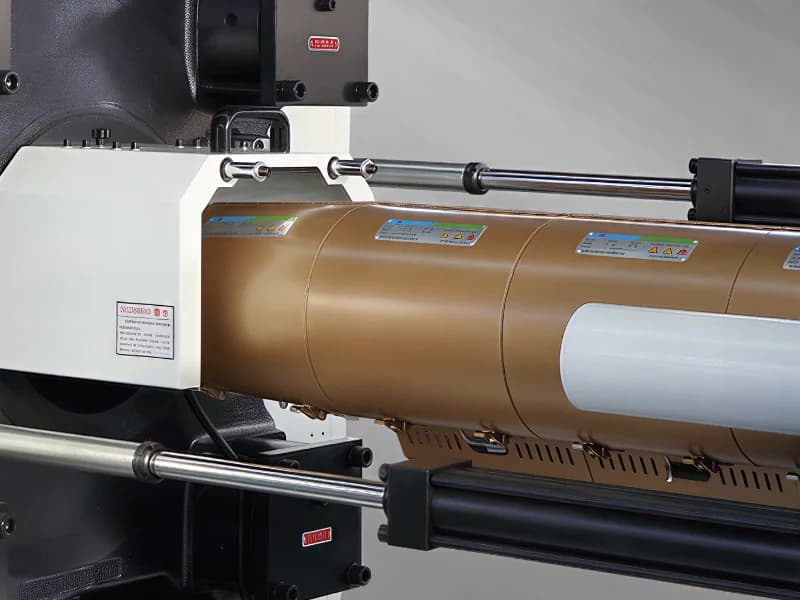
Servo-hydraulic drive system with energy recovery
Need Expert Advice?
Talk to our engineers about your specific production requirements. Free consultation.
Machine Tonnage and Platen Size Constraints
The HWAMDA SPV5 platen size and tie bar spacing physically limit the mold dimensions and therefore cavity count. HMD 270M8-SPV: platen 860x850mm, tie bar distance 580x570mm, max mold footprint approximately 550x540mm. Fits 8-cavity sauce cups or 4-cavity yogurt cups with tight spacing. HMD 350M8-SPV: platen 960x900mm, tie bar distance 640x590mm, max footprint 610x560mm. Comfortable for 8-cavity yogurt cups. HMD 400M8-SPV: platen 1,020x960mm, tie bar distance 680x630mm, max footprint 650x600mm. Standard for 8-cavity yogurt cups with IML. HMD 530M8-SPV: platen 1,180x1,050mm, tie bar distance 780x710mm, max footprint 750x680mm. Supports 12-cavity yogurt cups or 4-cavity large food containers. HMD 600M8-SPV: platen 1,350x1,150mm, tie bar distance 900x780mm, max footprint 870x750mm. 16-cavity yogurt cups or 4-cavity large IML containers. When planning cavity layout, maintain minimum 25mm clearance between outer cavity edges and tie bar faces to allow mold insertion and cooling line routing. IML molds need additional 50-80mm on the robot entry side.
Quality Considerations in High-Cavity Molds
Increasing cavity count introduces quality challenges that must be managed. Fill balance: in an 8 or 16-cavity mold, all cavities must fill simultaneously within +/-5% time difference. Naturally balanced H-bridge runner layouts achieve this when the hot runner manifold is symmetrical. However, manufacturing tolerances mean cavity-to-cavity weight variation increases with cavity count: typical +/-0.08g for 4-cavity, +/-0.15g for 8-cavity, +/-0.25g for 16-cavity. If your product specification requires +/-0.1g weight tolerance, 8 cavities may be the practical maximum. Cooling uniformity: higher cavity counts make uniform cooling more challenging as outer cavities cool differently than inner cavities. Temperature variation of 2-3°C between inner and outer cavities is typical in 8-cavity molds, increasing to 3-5°C in 16-cavity configurations. This causes dimensional variation of 0.02-0.05mm between cavity positions. Mold maintenance: more cavities mean more valve pins, more cooling circuits, and more potential failure points. An 8-cavity mold has 8 valve pins, 16 cooling circuits, and 8 sets of ejection components versus 4 of each for a 4-cavity mold. Maintenance time scales roughly linearly with cavity count.
Key Specs
- •Fill balance: in an 8 or 16-cavity mold, all cavities must fill simultaneously within +/-5% time difference.
- •If your product specification requires +/-0.1g weight tolerance, 8 cavities may be the practical maximum.
- •Temperature variation of 2-3°C between inner and outer cavities is typical in 8-cavity molds, increasing to 3-5°C in 16-cavity configurations.
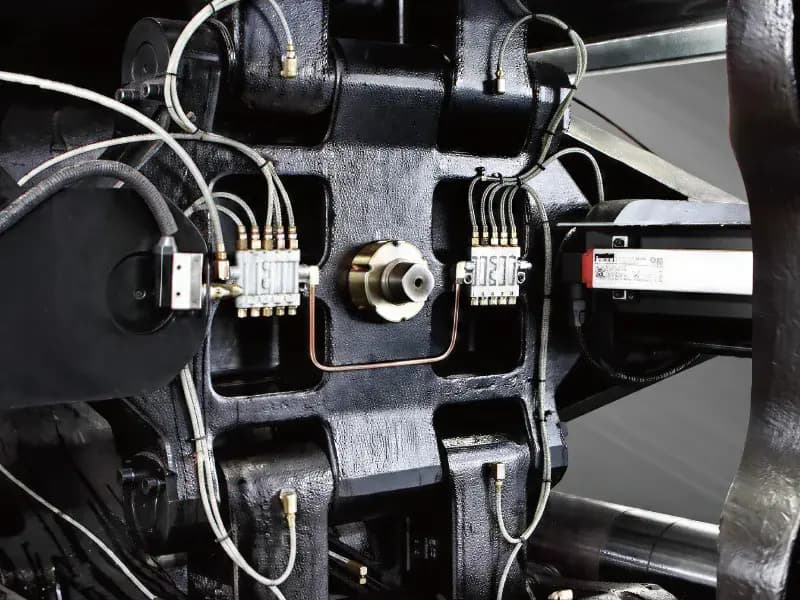
Toggle clamping unit — high rigidity for thin-wall molding
Step-by-Step Cavity Count Selection Process
Step 1: Define annual volume requirement (e.g., 50 million yogurt cups). Step 2: Calculate hourly production rate needed: 50,000,000 / 7,200 hours = 6,944/hr. Step 3: Determine cycle time for your product (yogurt cups: 4.0-5.0s on HWAMDA SPV5). Step 4: Calculate minimum cavities: 6,944 / (3,600/4.5) = 6,944 / 800 = 8.7 cavities. Round up to 8 (accept slight under-capacity) or consider 12 (with overcapacity for growth). Step 5: Calculate clamping force for selected cavity count: 8 cavities x 56.7 cm2/cavity x 50 MPa x 1.15 / 10 = 2,610 kN. Step 6: Select HWAMDA SPV5 model: HMD 350M8-SPV (3,500 kN) or HMD 400M8-SPV (4,000 kN). Step 7: Verify platen size accommodates the mold: 8-cavity layout in 2x4 arrangement requires approximately 400x500mm, well within HMD 400M8-SPV's 650x600mm usable area. Step 8: Calculate total investment and per-unit cost: $172,000 total cell / 46 million annual cups = $0.0037/cup amortization over 1 year. Step 9: Compare against alternatives (fewer cavities + multiple machines, or more cavities + larger machine). Contact HWAMDA at sales@hwamdaglobal.com for cavity count optimization specific to your product and volume requirements.
Frequently Asked Questions
The HMD 600M8-SPV (6,000 kN) supports up to 16-cavity yogurt cup molds (85mm diameter). However, 8 cavities on the HMD 400M8-SPV is the most common configuration, balancing output (6,400 cups/hr at 4.5s), mold cost ($35,000-55,000), and quality consistency (+/-0.15g weight variation). 12-cavity on the HMD 530M8-SPV offers the best volume-to-investment ratio for high-demand operations exceeding 70 million cups/year.
Related Guides
Ready to Start Your Project?
Get a free consultation and quotation for your thin-wall packaging production line.
Join 500+ manufacturers in 60+ countries who trust HWAMDA.
Get Free Quote