

Wall Thickness Ranges by Product Category
Commercially proven wall thickness ranges on HWAMDA SPV5 production lines. Sauce cups (30ml, 30-45mm diameter, 2-4g part weight): 0.30-0.40mm, achievable on HMD 270M8-SPV through HMD 350M8-SPV at injection speeds of 368-418 mm/s. The short flow length (30-40mm) enables ultra-thin walls. Yogurt cups (125-200ml, 75-95mm diameter, 4-8g): 0.35-0.45mm, standard on HMD 350M8-SPV through HMD 400M8-SPV. The 60-80mm flow length requires 400+ mm/s injection speed for reliable fill at 0.35mm. Milk tea cups (350-500ml, 85-100mm diameter, 8-12g): 0.40-0.55mm on HMD 350M8-SPV through HMD 480M8-SPV. Larger volume demands thicker walls for structural integrity during use. Food containers (500-1500ml, 120-180mm major dimension, 15-25g): 0.50-0.70mm on HMD 400M8-SPV through HMD 530M8-SPV. Rectangular shapes with long flow paths need thicker walls. Margarine IML tubs (250-500g, 100-130mm diameter, 20-30g): 0.50-0.65mm with IML on HMD 400M8-SPV through HMD 530M8-SPV. IML label adds structural stiffness allowing slightly thinner base PP. Yogurt pails (1-5L, 130-180mm diameter, 30-50g): 0.60-0.90mm on HMD 480M8-SPV through HMD 600M8-SPV.
Key Specs
- •Sauce cups (30ml, 30-45mm diameter, 2-4g part weight): 0.30-0.40mm, achievable on HMD 270M8-SPV through HMD 350M8-SPV at injection speeds of 368-418 mm/s.
- •The short flow length (30-40mm) enables ultra-thin walls.
- •Yogurt cups (125-200ml, 75-95mm diameter, 4-8g): 0.35-0.45mm, standard on HMD 350M8-SPV through HMD 400M8-SPV.
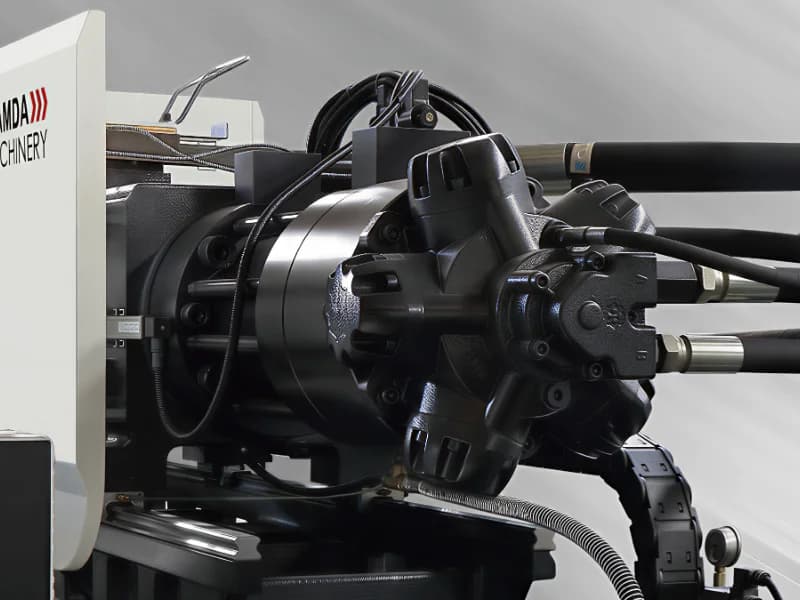
High-speed injection unit with linear guides
Factors Limiting Minimum Wall Thickness
Five factors determine the achievable minimum wall thickness. Factor 1 - Flow length to wall thickness ratio (L/t): the maximum practical L/t ratio for PP with MFI 50-80 is 250-350:1 at injection speeds above 400 mm/s. For a yogurt cup with 70mm flow length, minimum wall = 70/300 = 0.23mm theoretical, but practical minimum is 0.35mm due to other limitations. Factor 2 - Material MFI: higher MFI enables thinner walls. MFI 30 limits practical wall to 0.50mm+, MFI 50 achieves 0.40mm, MFI 70-100 enables 0.30-0.35mm. Factor 3 - Injection speed: the frozen layer forms at 0.01-0.03mm/s from each cavity surface. At 0.40mm wall, the available flow channel is only 0.34-0.38mm after frozen layer formation, closing in 3-5 seconds. Injection speed of 400+ mm/s fills the cavity within 0.3s before significant freeze-off occurs. Factor 4 - Part structural requirements: containers must support stacking loads (10-30N), resist user handling forces, and survive packaging/transport. These structural requirements often dictate wall thickness above the molding minimum. Factor 5 - Mold cooling uniformity: non-uniform cooling on 0.30mm walls causes 0.02-0.03mm thickness variation, representing 7-10% of wall thickness and potentially causing weak spots.
Machine Requirements for Ultra-Thin Walls
Producing walls below 0.40mm demands specific machine capabilities that the HWAMDA SPV5 series provides. Injection speed: minimum 350 mm/s for 0.40mm, 400+ mm/s for 0.35mm, 500+ mm/s for 0.30mm. SPV5 range: 368 mm/s (HMD 270M8-SPV) to 560 mm/s (HMD 600M8-SPV). The HMD 418M8-SPV at 517 mm/s is the preferred model for ultra-thin-wall applications. Injection pressure: 150-180 MPa needed to push melt through thin cross-sections against increasing viscous resistance. SPV5 range: 158-182 MPa depending on model and screw diameter. Injection response time: the hydraulic system must reach full speed within 0.05-0.10 seconds from the start signal. SPV5's high-speed accumulator system achieves 0.03-0.08 second response. Shot weight consistency: at 4g part weight with 0.35mm walls, +/-0.1g variation represents +/-2.5% of total weight and can cause appearance and structural inconsistency. SPV5 shot weight repeatability: +/-0.3-0.5% with the INOVA controller's pressure/position cascade control. Screw design: thin-wall applications benefit from barrier flight screws with L/D ratio of 23-24.5:1 (standard on SPV5) for uniform melt quality.
Key Specs
- •Producing walls below 0.40mm demands specific machine capabilities that the HWAMDA SPV5 series provides.
- •Injection speed: minimum 350 mm/s for 0.40mm, 400+ mm/s for 0.35mm, 500+ mm/s for 0.30mm.
- •SPV5 range: 368 mm/s (HMD 270M8-SPV) to 560 mm/s (HMD 600M8-SPV).
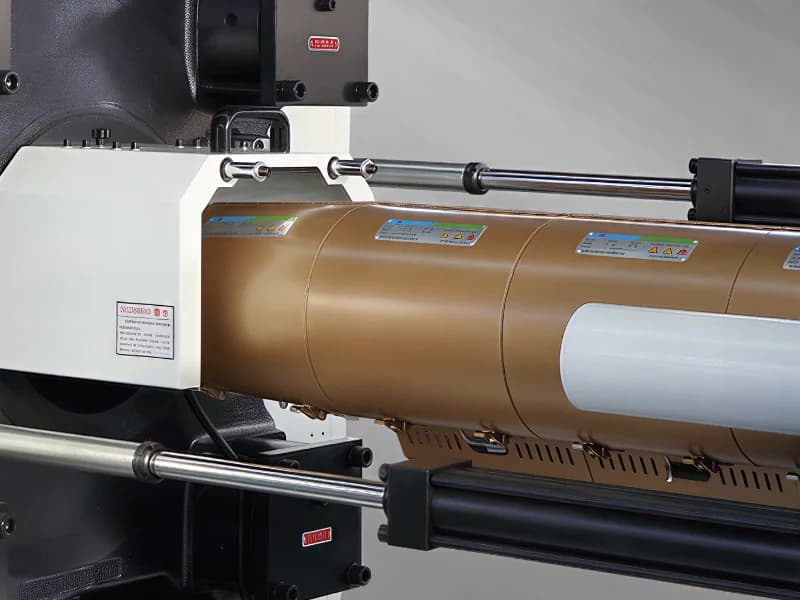
Servo-hydraulic drive system with energy recovery
Need Expert Advice?
Talk to our engineers about your specific production requirements. Free consultation.
Mold Design for Ultra-Thin-Wall Production
The mold determines whether machine capability translates into consistent thin-wall parts. Gate design: valve gates with 1.2-2.0mm diameter for thin-wall (smaller gates increase shear heating and risk gate freeze-off before fill completion). Center gating is preferred for round containers to equalize flow length. For rectangular containers, 2-point gating may be needed for walls below 0.50mm with flow lengths above 120mm. Core deflection: at injection pressures of 150-180 MPa, thin cores deflect under the asymmetric pressure load during fill, creating non-uniform wall thickness. Core deflection must be limited to 0.02mm maximum. Solutions: increase core diameter where possible, use core supports (interlock pins between core and cavity), and employ pressure-balanced gate locations. Steel selection: H13 at 48-52 HRC provides the hardness needed to maintain 0.30-0.40mm wall dimensions over 3-5 million cycles without wear-related dimensional growth. Cooling channels within 10-14mm of the cavity surface with conformal routing remove heat uniformly, preventing hot spots that cause localized thick spots or warpage.
Material Selection for Minimum Wall Thickness
PP grade selection is critical for pushing wall thickness boundaries. For 0.30-0.35mm walls, use ultra-high MFI grades: SABIC FLOWPACT FPC100 (MFI 100), Total/Borealis RF365MO (MFI 75), or HMC polymers grades with MFI 80-100. These grades sacrifice some impact strength (Izod 1.5-3.0 kJ/m2) versus standard PP (3-5 kJ/m2) but flow easily through thin sections. For 0.35-0.45mm walls (the most common thin-wall range), balanced grades work well: SABIC FLOWPACT FPC70 (MFI 70), Borealis BorPure RJ766MO (MFI 70 random copolymer for clarity), or LyondellBasell Moplen HP548R (MFI 35 for thicker-wall applications). Processing tip: when pushing minimum wall thickness, run the PP at the upper end of the recommended melt temperature range (240-250°C) to maximize fluidity, accepting slightly longer cooling time as the trade-off. On the HWAMDA HMD 418M8-SPV at 517 mm/s injection speed with MFI 70+ PP at 245°C, achieving 0.35mm walls on yogurt cups is routine production, not an extreme process condition.
Key Specs
- •For 0.30-0.35mm walls, use ultra-high MFI grades: SABIC FLOWPACT FPC100 (MFI 100), Total/Borealis RF365MO (MFI 75), or HMC polymers grades with MFI 80-100.
- •For 0.35-0.45mm walls (the most common thin-wall range), balanced grades work well: SABIC FLOWPACT FPC70 (MFI 70), Borealis BorPure RJ766MO (MFI 70 random copolymer for clarity), or LyondellBasell Moplen HP548R (MFI 35 for thicker-wall applications).
- •Processing tip: when pushing minimum wall thickness, run the PP at the upper end of the recommended melt temperature range (240-250°C) to maximize fluidity, accepting slightly longer cooling time as the trade-off.
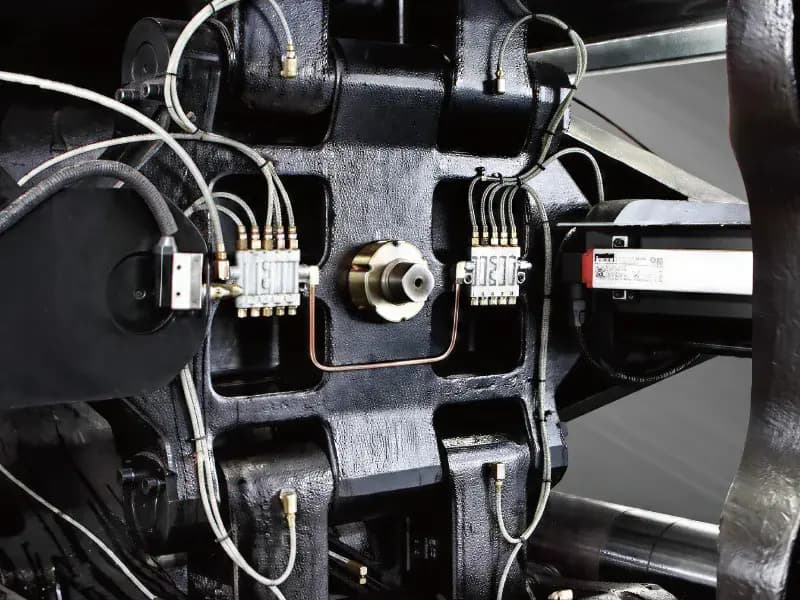
Toggle clamping unit — high rigidity for thin-wall molding
Practical Testing and Validation Approach
Before committing to minimum wall thickness in production, validate with a systematic approach. Step 1: Mold flow simulation (Moldflow or Moldex3D, $2,000-5,000 per project) to predict fill pattern, weld line locations, and required injection parameters at target wall thickness. Step 2: Trial molding at HWAMDA's Ningbo facility with your mold or a sample mold. Run 500+ consecutive shots at target wall thickness, measuring: part weight standard deviation (target below 1% of mean), wall thickness variation at 8 measurement points per part (target +/-0.03mm), and warpage measurement (target below 0.3mm for cups). Step 3: Structural testing of sample parts: top-load compression test (minimum 15-25N for stacking), drop test from 1.5m (no cracking), and lid snap-fit verification if applicable. Step 4: If 0.35mm fails structural tests, increase to 0.38 or 0.40mm. Each 0.05mm increase adds approximately 0.5-0.8g to a yogurt cup (8-13% weight increase) but dramatically improves structural margin. The optimal wall thickness is the minimum that passes all structural requirements with a 15-20% safety margin, not the absolute minimum the machine can produce.
Frequently Asked Questions
Yes, the HMD 418M8-SPV (517 mm/s injection speed) and HMD 600M8-SPV (560 mm/s) routinely produce 0.30mm wall containers for small-diameter applications like 30ml sauce cups (30-45mm diameter, 2-3g weight). For larger containers like 150ml yogurt cups (85mm diameter), 0.35mm is the practical minimum due to longer flow lengths. Ultra-thin 0.30mm production requires MFI 80-100 PP, conformal-cooled molds, and valve gate hot runners.
Related Guides
Ready to Start Your Project?
Get a free consultation and quotation for your thin-wall packaging production line.
Join 500+ manufacturers in 60+ countries who trust HWAMDA.
Get Free Quote