

Root Causes of Flash in Thin-Wall Multi-Cavity Molds
Flash occurs when the cavity pressure exceeds the clamping force per unit area at any point along the parting line, forcing molten PP through the gap. For PP with MFI 50-80 at 230-245°C, flash occurs through gaps as small as 0.015-0.025mm. Five primary causes in multi-cavity production: Cause 1 - Insufficient total clamping force: if the aggregate cavity pressure across all cavities exceeds machine tonnage, the mold opens microscopically. On an 8-cavity yogurt cup mold with 453 cm2 total projected area at 50 MPa cavity pressure, minimum force is 2,265 kN. Running on an HMD 270M8-SPV at 2,700 kN provides only 19% safety margin. Cause 2 - Uneven cavity fill creating localized pressure spikes: if some cavities fill before others, the first-filled cavities reach peak pressure while the mold is still opening against partially filled cavities. Cause 3 - Worn mold parting line surfaces. Cause 4 - Platen deflection causing center or edge gaps. Cause 5 - Mold venting clogged, trapping air and transferring pressure to parting line. Each cause requires a different solution, and most production flash results from a combination of 2-3 causes simultaneously.
Key Specs
- •For PP with MFI 50-80 at 230-245°C, flash occurs through gaps as small as 0.015-0.025mm.
- •On an 8-cavity yogurt cup mold with 453 cm2 total projected area at 50 MPa cavity pressure, minimum force is 2,265 kN.
- •Running on an HMD 270M8-SPV at 2,700 kN provides only 19% safety margin.

High-speed injection unit with linear guides
Clamping Force Optimization on HWAMDA SPV5
Correct clamping force settings prevent flash without over-clamping, which damages vents and increases energy consumption. Calculate required force: F = A_projected x P_cavity x 1.15 safety factor. For an 8-cavity 85mm-diameter yogurt cup mold on the HMD 400M8-SPV: F = 453.9 cm2 x 50 MPa x 1.15 / 10 = 2,610 kN. The machine provides 4,000 kN, giving 53% margin. Start production at 80% of maximum tonnage (3,200 kN) and reduce in 5% increments until flash appears, then increase by 10% for the working setpoint. This approach maintains vent effectiveness while preventing flash. The INOVA controller displays real-time clamping force via tie bar strain gauges with +/-1% accuracy. Monitor all four tie bar forces for balance: variation exceeding 5% between tie bars indicates mold misalignment or platen tilt requiring shimming. For troublesome flash in specific cavity locations, check local platen deflection. The SPV5's strengthened platen design limits center deflection to 0.05mm at full tonnage, but worn toggle bushings or uneven tie bar stretch can create localized gaps of 0.02-0.05mm that cause flash in particular cavities.
Mold-Side Flash Prevention Strategies
Mold condition is responsible for 60-70% of flash issues in multi-cavity production. Parting line surface condition: inspect under 10x magnification every 250,000-500,000 cycles. Surface damage, corrosion pitting, or plastic buildup exceeding 0.01mm creates flash channels. Polish parting surfaces to Ra 0.4 or better. Parting line flatness: check with a precision flat (granite surface plate) and Prussian blue dye. Maximum permissible out-of-flat: 0.01mm over 500mm span. Remachining parting surfaces costs $1,000-3,000 per mold. Guided alignment: leader pins and bushings must maintain +/-0.01mm registration between mold halves. Worn bushings (visible daylight between pin and bushing) must be replaced ($200-400 per set). Interlocking parting line design: for molds prone to flash, specify a 0.05-0.08mm interlocking step or tongue-and-groove feature at the parting line. This creates a mechanical labyrinth that prevents plastic from escaping even if the parting line gap reaches 0.03mm. Add $2,000-5,000 per mold for this feature. Hot runner balance: verify cavity-to-cavity weight variation is within +/-2% using a short-shot study at 85-90% fill. Rebalance flow by adjusting individual nozzle temperatures in +/-2°C increments.
Key Specs
- •Mold condition is responsible for 60-70% of flash issues in multi-cavity production.
- •Surface damage, corrosion pitting, or plastic buildup exceeding 0.01mm creates flash channels.
- •Maximum permissible out-of-flat: 0.01mm over 500mm span.
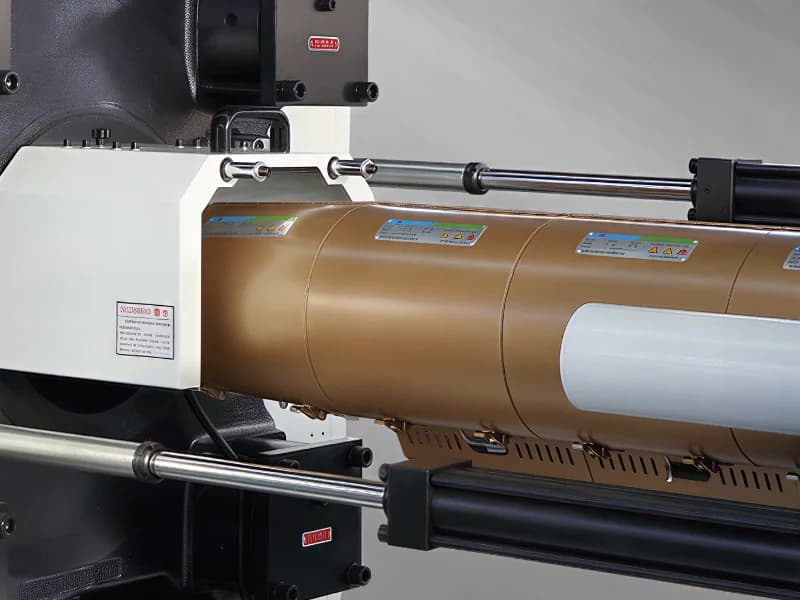
Servo-hydraulic drive system with energy recovery
Need Expert Advice?
Talk to our engineers about your specific production requirements. Free consultation.
Process Parameter Optimization to Eliminate Flash
Process adjustments can eliminate flash without mechanical mold changes. Strategy 1 - Velocity-to-pressure transfer (V/P switchover): set the switchover position so that 95-98% of cavity volume fills during the velocity-controlled phase, with only 2-5% filled during the pressure-controlled packing phase. Late switchover (overpacking) is the most common process cause of flash. On the INOVA controller, monitor the injection pressure curve: if pressure spikes sharply at switchover, reduce switchover position by 1-2mm. Strategy 2 - Packing pressure profiling: instead of constant packing pressure (which risks overpacking the first-filled cavities while underpacking the last), use a descending 2-3 step packing profile. Example: 60 MPa for 0.3s, 45 MPa for 0.3s, 30 MPa for 0.3s. This reduces peak cavity pressure at the end of fill while maintaining sufficient pressure for shrinkage compensation. Strategy 3 - Injection speed profiling: reduce injection speed during the final 10-15% of fill to 60-70% of maximum. This prevents the pressure spike that occurs as the melt compresses against the end of the cavity. On SPV5 machines, program a 3-stage velocity profile: 100% speed for first 70% of stroke, 80% for next 20%, and 60% for final 10%.
Preventive Maintenance Schedule for Flash-Free Production
A documented maintenance program prevents flash before it occurs. Every shift (8-12 hours): visual inspection of parts for flash at parting line, check mold temperature readings for drift (indicating cooling circuit issues), verify clamping force readings on INOVA controller display. Every 50,000-100,000 cycles (approximately weekly at 24/7 production): clean mold vents with ultrasonic cleaning or soft brass brush, inspect parting line for plastic buildup and clean with mold-safe solvents, check valve pin operation on all hot runner nozzles, and verify ejector pin heights are flush with cavity surface. Every 250,000-500,000 cycles (monthly): remove mold for bench inspection, polish parting surfaces to Ra 0.4, check leader pin/bushing wear with go/no-go gauges, measure parting line flatness with Prussian blue test, inspect and clean all cooling circuits with descaling agent, and verify cavity dimensions at 4 key measurement points per cavity. Every 1-3 million cycles (quarterly to semi-annually): replace worn valve pins ($50-150 each), replace leader pin bushings ($200-400 per set), re-chrome or re-coat worn cavity surfaces ($500-2,000 per cavity), and replace cooling circuit O-rings. Total annual preventive maintenance cost for an 8-cavity thin-wall mold: $3,000-6,000.
Key Specs
- •Every shift (8-12 hours): visual inspection of parts for flash at parting line, check mold temperature readings for drift (indicating cooling circuit issues), verify clamping force readings on INOVA controller display.
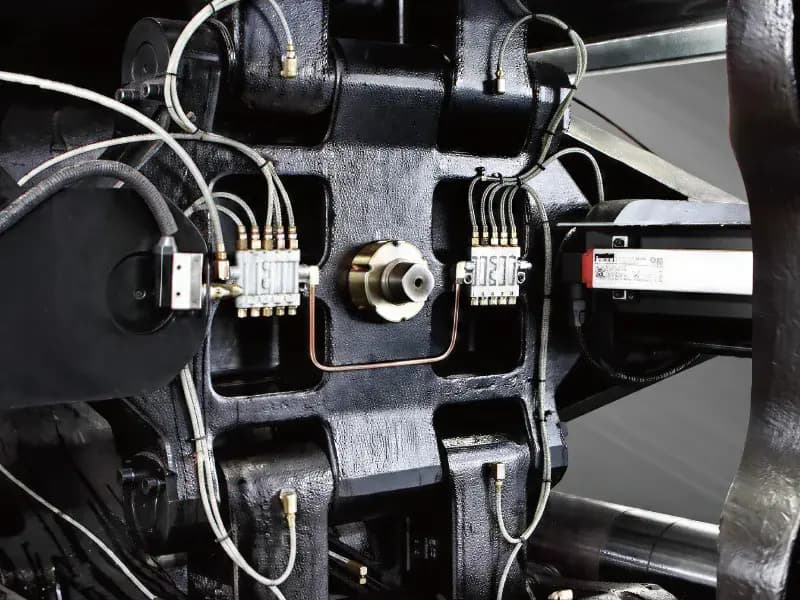
Toggle clamping unit — high rigidity for thin-wall molding
Diagnosing Flash by Location and Pattern
The flash pattern reveals the root cause. Flash on all cavities, uniform around the parting line: insufficient total clamping force. Solution: increase clamp tonnage by 10-15%. If already at maximum, the machine is undersized for the mold. Flash on all cavities, only at the end of fill: late V/P switchover or excessive packing pressure. Solution: advance switchover position by 1-2mm and reduce packing pressure by 5-10%. Flash on specific cavities only: unbalanced fill (those cavities receive more material/pressure). Solution: reduce nozzle temperature on affected cavities by 2-5°C or restrict gate diameter by 0.05-0.10mm. Flash on one side of the mold: platen tilt or mold misalignment. Solution: check tie bar forces for balance, shim mold mounting as needed. Flash that worsens over production run: progressive vent blockage forcing gas pressure through parting line. Solution: clean vents (cycle interval 50,000-100,000 shots). Flash appearing suddenly after previously good production: material lot change with lower MFI (lower viscosity), or mold damage from crashed core pins. Investigate material certificate and inspect mold. On HWAMDA SPV5 machines, the INOVA controller logs injection pressure, clamping force, and cushion position for every shot. Reviewing these trends when flash appears identifies whether the cause is process drift, material change, or mechanical degradation.
Frequently Asked Questions
For food packaging, any visible flash is typically a reject. Flash as thin as 0.02mm (20 microns) is visible to the naked eye and creates a sharp edge that fails consumer safety requirements. Automated vision inspection systems detect flash down to 0.05mm. For IML containers, flash is especially critical as it interferes with label edge alignment. Target zero flash in production by maintaining 15-30% clamping force margin above calculated requirements.
Related Guides
Ready to Start Your Project?
Get a free consultation and quotation for your thin-wall packaging production line.
Join 500+ manufacturers in 60+ countries who trust HWAMDA.
Get Free Quote