

Short Shot and Incomplete Filling
Short shots occur when the mold cavity does not fill completely, producing parts with missing sections, typically at the farthest points from the gate. In thin-wall molding with wall thicknesses of 0.4-0.7 mm, the melt freezes rapidly against the cold mold surface, and any delay or restriction in flow leads to premature solidification before the cavity fills. The primary causes include insufficient injection speed, allowing freeze-off before fill completion, and inadequate injection pressure to push melt through the narrowing flow channels. Troubleshooting should begin with verifying that injection speed is within the 300-500 mm/s range required for thin-wall PP. If speed is adequate, check melt temperature, which should be 220-260 degrees C for PP food packaging grades. Increasing melt temperature by 5-10 degrees C reduces viscosity and extends flow length. Examine mold venting next, as trapped air at flow ends creates back-pressure preventing complete filling. Vents should be 0.02-0.03 mm deep for PP. For multi-cavity molds on HWAMDA SPV5 machines, verify hot runner balance by collecting and weighing individual cavity shots.
Key Specs
- •In thin-wall molding with wall thicknesses of 0.4-0.7 mm, the melt freezes rapidly against the cold mold surface, and any delay or restriction in flow leads to premature solidification before the cavity fills.
- •Troubleshooting should begin with verifying that injection speed is within the 300-500 mm/s range required for thin-wall PP.
- •Vents should be 0.02-0.03 mm deep for PP.

High-speed injection unit with linear guides
Warpage and Dimensional Distortion
Warpage in thin-wall containers manifests as bowing, twisting, or out-of-round conditions that prevent proper stacking and lid fitment. The fundamental cause is differential shrinkage across the part, driven by non-uniform cooling, molecular orientation differences, or packing pressure variations. In thin-wall parts with 0.5 mm walls, even a 5 degree C temperature difference between core and cavity sides can produce measurable warpage because the thin walls lack structural rigidity to resist shrinkage-induced stresses. Cooling system balance is the first area to investigate. Measure water inlet and outlet temperatures on both core and cavity circuits. The temperature differential should not exceed 2-3 degrees C for thin-wall molds. If cooling is balanced but warpage persists, examine the packing pressure profile. Insufficient holding pressure allows the part to shrink unevenly, while excessive holding pressure creates locked-in stresses released as warpage after ejection. For yogurt cups on HWAMDA SPV5-380 machines, the holding pressure should taper from 60-70% of injection pressure down to 30-40% over 0.8-1.5 seconds.
Sink Marks and Surface Defects
While sink marks are less common in thin-wall parts than conventional molding due to uniformly thin sections, they can still appear at rib intersections, stacking ledges, and gate areas where local wall thickness increases. Sink marks form when the outer skin solidifies and the interior continues to shrink, pulling the surface inward. In thin-wall food containers, even shallow sink marks of 0.05-0.1 mm depth can be visible on high-gloss surfaces. The primary solution is optimizing packing pressure magnitude and duration to compensate for volumetric shrinkage during solidification. For ribbed sections in thin-wall containers, design guidelines recommend rib thickness at 50-60% of the nominal wall thickness rather than the conventional 60-80% rule used for thicker parts. Surface defects beyond sink marks include burn marks from trapped gas, peeling or delamination from contaminated material, and surface roughness from mold wear. HWAMDA's thin-wall molds use high-quality P20 or NAK80 steel with mirror-polished cavity surfaces to maintain consistent surface finish quality throughout the mold's production life.
Key Specs
- •In thin-wall food containers, even shallow sink marks of 0.05-0.1 mm depth can be visible on high-gloss surfaces.
- •For ribbed sections in thin-wall containers, design guidelines recommend rib thickness at 50-60% of the nominal wall thickness rather than the conventional 60-80% rule used for thicker parts.

Servo-hydraulic drive system with energy recovery
Need Expert Advice?
Talk to our engineers about your specific production requirements. Free consultation.
Flash and Parting Line Issues
Flash occurs when molten plastic escapes from the cavity through the parting line, creating thin projections of excess material on the finished part. In thin-wall molding, the high injection pressures of 180-280 MPa make flash particularly challenging to control. The mold's clamping force must exceed the total opening force generated by cavity pressure acting over the projected area. For a 16-cavity sauce cup mold running on an HWAMDA SPV5-270 machine, the required clamping force calculation considers 250 MPa cavity pressure across the total projected area. Parting line precision is critical. The mold steel surfaces at the parting line must maintain flatness within 0.01-0.02 mm across the entire mold face. Any damage, wear, or contamination on the parting line surfaces allows flash to form. Regular parting line maintenance, including inspection every 100,000 cycles and re-polishing as needed, prevents flash from becoming chronic. If flash appears on a previously clean-running mold, check for foreign material on the parting line, verify clamping force has not decreased, and confirm process parameters have not drifted from validated settings.
Gate Blush and Flow Marks
Gate blush appears as a matte or discolored region around the gate area, caused by excessive shear stress as the melt passes through the gate restriction. In thin-wall packaging with valve gate systems, blush is minimized by the controlled gate opening sequence, but it can still occur if the gate opening timing is not synchronized with the injection start. HWAMDA molds use hydraulically actuated valve gates with adjustable timing to optimize gate opening relative to the injection stroke. Flow marks, appearing as visible lines or patterns on the part surface, result from uneven melt flow fronts or temperature variations during filling. In thin-wall molding, the most common flow marks include record-groove lines from melt hesitation and jetting marks from excessive gate velocity. Addressing flow marks requires balancing gate size, injection speed profile, and melt temperature. For HWAMDA thin-wall molds, the gate diameter is calculated to achieve shear rates within the optimal window for PP: high enough for rapid filling but below the threshold causing surface defects. Typical gate diameters range from 1.2-2.0 mm for containers and 0.8-1.2 mm for sauce cups.
Key Specs
- •Typical gate diameters range from 1.2-2.0 mm for containers and 0.8-1.2 mm for sauce cups.
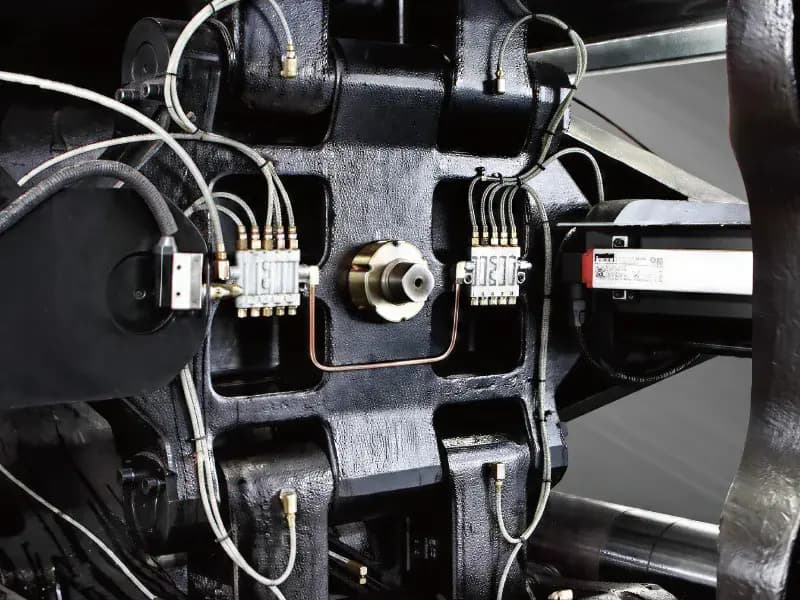
Toggle clamping unit — high rigidity for thin-wall molding
Systematic Defect Analysis Approach
Effective thin-wall troubleshooting requires a systematic approach rather than random parameter adjustments. Begin with defect identification and classification: photograph the defect, note its location on the part, and determine whether it appears on all cavities or specific ones. All-cavity defects point to machine or material issues, while single-cavity defects indicate mold-specific problems. Document the current process parameters as a baseline before making any changes. Follow a one-variable-at-a-time methodology. Change one parameter, run 10-20 shots to stabilize, then evaluate the result before adjusting anything else. For HWAMDA SPV5 machines, the controller's trend analysis function helps track how each parameter change affects quality metrics. Maintain a troubleshooting log that records each change, its effect, and the resulting part quality. When multiple defects appear simultaneously, address the most fundamental issue first. Short shots take priority because they indicate the process cannot fill the cavity. After achieving complete filling, address dimensional issues through packing optimization, then refine surface quality through temperature and speed adjustments.
Frequently Asked Questions
Short shots in thin-wall molding primarily result from premature melt freeze-off before the cavity fills completely. The main causes are insufficient injection speed below the required 300-500 mm/s range, inadequate injection pressure below 180-250 MPa, low melt temperature causing high viscosity, blocked or insufficient venting at flow ends, and imbalanced multi-cavity hot runner systems directing unequal flow to different cavities. HWAMDA recommends starting troubleshooting by verifying injection speed and melt temperature settings are within specification, then checking vent depth at 0.02-0.03 mm for PP, before adjusting other parameters.
Related Guides
Ready to Start Your Project?
Get a free consultation and quotation for your thin-wall packaging production line.
Join 500+ manufacturers in 60+ countries who trust HWAMDA.
Get Free Quote