

Importance of Cooling in Thin-Wall Molding
In thin-wall injection molding, the cooling phase dominates the cycle time equation despite the thin wall sections that cool quickly in absolute terms. For a 0.5 mm wall PP container, the theoretical cooling time is approximately 0.8-1.2 seconds, but the overall cooling phase including mold open/close time, ejection, and temperature stabilization extends to 1.5-3.0 seconds. Reducing cooling time by even 0.3 seconds translates to significant productivity gains at production volumes of millions of units. For a 12-cavity yogurt cup mold on an HWAMDA SPV5-380 running at 4.0 second cycles, saving 0.3 seconds reduces the cycle to 3.7 seconds, increasing daily output from approximately 259,200 to 280,000 cups, an 8% productivity improvement. Non-uniform cooling creates quality problems particularly severe in thin-wall parts. Temperature differences as small as 5 degrees C between core and cavity sides cause differential shrinkage that warps the thin walls. HWAMDA designs cooling circuits to maintain surface temperature uniformity within plus or minus 2 degrees C across the entire cavity surface.
Key Specs
- •For a 0.5 mm wall PP container, the theoretical cooling time is approximately 0.8-1.2 seconds, but the overall cooling phase including mold open/close time, ejection, and temperature stabilization extends to 1.5-3.0 seconds.
- •For a 12-cavity yogurt cup mold on an HWAMDA SPV5-380 running at 4.0 second cycles, saving 0.3 seconds reduces the cycle to 3.7 seconds, increasing daily output from approximately 259,200 to 280,000 cups, an 8% productivity improvement.
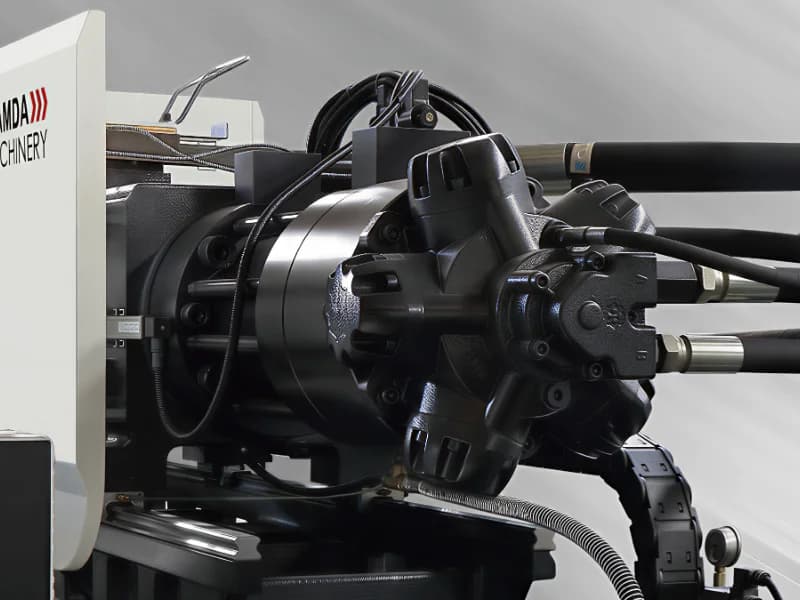
High-speed injection unit with linear guides
Conformal vs Conventional Cooling Channels
Conventional cooling channels are straight-drilled passages that follow linear paths through the mold steel, limited by the physical constraints of gun-drilling. These channels cannot closely follow complex contours of container geometries, resulting in hot spots where the distance from the cavity surface to the nearest cooling channel varies significantly. For simple cylindrical containers like sauce cups, conventional cooling with properly spaced parallel channels achieves adequate uniformity. Conformal cooling channels follow the contour of the cavity surface at a consistent distance, maintaining uniform heat extraction across complex geometries. These channels are produced through 3D metal printing or specialized machining techniques, and they offer 20-40% improvement in cooling uniformity compared to conventional drilling. For food containers with complex geometries, such as rectangular shapes with rounded corners or containers with embossed features, conformal cooling eliminates the hot spots that conventional channels cannot reach. HWAMDA employs conformal cooling selectively in mold regions where conventional channels cannot achieve adequate cooling, balancing performance against manufacturing cost.
Cooling Circuit Layout Strategies
Cooling circuit layout determines how effectively heat is extracted across the entire cavity surface. The fundamental principles include maintaining consistent channel-to-surface distance (typically 1.5-2.0 times the channel diameter), ensuring turbulent water flow for optimal heat transfer, and balancing flow rates across parallel circuits. For multi-cavity thin-wall molds, each cavity should have independent cooling circuits or series-connected circuits with minimal temperature buildup. HWAMDA designs cooling layouts using two primary strategies. For core cooling in deep-draw containers like yogurt cups, a baffled or bubbler approach directs water through the core interior with alternating flow directions to maximize surface coverage. For cavity cooling, spiral or parallel channel layouts follow the container's external geometry. The number of cooling circuits per cavity depends on container size: sauce cup molds typically use 2-3 circuits per cavity, while yogurt cup molds require 4-6 circuits per cavity to achieve uniform temperature distribution. Each circuit is designed for a pressure drop of 2-4 bar at the recommended flow rate.
Key Specs
- •Each circuit is designed for a pressure drop of 2-4 bar at the recommended flow rate.
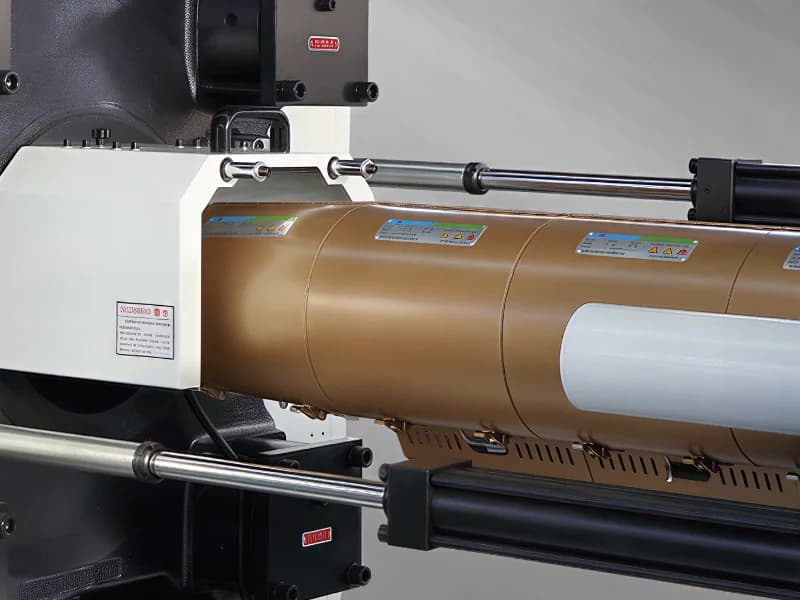
Servo-hydraulic drive system with energy recovery
Need Expert Advice?
Talk to our engineers about your specific production requirements. Free consultation.
Water Temperature and Flow Rate
Water temperature and flow rate are the primary operational parameters for cooling system optimization. For PP thin-wall food packaging, the recommended mold surface temperature is 15-25 degrees C, achieved with chilled water at 8-15 degrees C depending on ambient conditions and heat load. Lower water temperatures accelerate cooling but can cause condensation on mold surfaces in humid environments, potentially introducing moisture defects. The temperature differential between water inlet and outlet should not exceed 3-5 degrees C per circuit to maintain uniform mold surface temperatures. Flow rate directly determines the heat transfer coefficient between the water and the channel wall. Turbulent flow, achieved at Reynolds numbers above 10,000, provides 3-5 times better heat transfer than laminar flow. For typical cooling channels with 8-12 mm diameter, turbulent flow requires water velocity of 1.5-3.0 m/s, corresponding to flow rates of 4-12 liters per minute per circuit. HWAMDA specifies mold temperature controllers with sufficient pump capacity to maintain turbulent flow across all circuits simultaneously, typically requiring total flow rates of 60-120 liters per minute for a 12-cavity yogurt cup mold.
Beryllium Copper Inserts for Enhanced Cooling
Beryllium copper (BeCu) alloy, with thermal conductivity of 100-120 W/m-K compared to 30-40 W/m-K for P20 tool steel, provides 3-4 times faster heat extraction in critical mold regions. BeCu inserts are strategically placed in areas where steel cooling channels cannot achieve sufficient heat removal, particularly in deep cores, thin projections, and gate areas receiving the hottest melt. For thin-wall yogurt cup molds, BeCu core inserts reduce core-side surface temperature by 8-15 degrees C compared to all-steel construction, significantly improving cooling uniformity. The cost premium for BeCu inserts is substantial, approximately 5-8 times the cost of equivalent steel components, so their use must be justified by measurable cycle time or quality improvements. HWAMDA evaluates each mold design through thermal simulation to identify regions where BeCu delivers the greatest benefit. In typical thin-wall applications, BeCu inserts in the core tip and bottom center areas reduce cycle time by 0.5-1.0 seconds, which over millions of cycles generates significant production value.
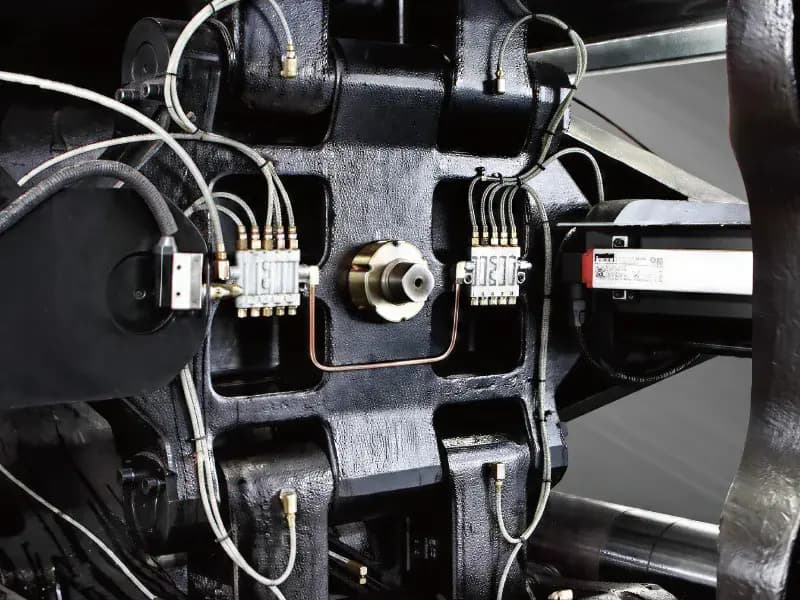
Toggle clamping unit — high rigidity for thin-wall molding
Cooling Time Calculation Methods
Cooling time calculation provides the theoretical minimum time required for the part to solidify sufficiently for ejection without deformation. The fundamental equation relates cooling time to wall thickness squared, thermal diffusivity of the polymer, and the temperature differential between melt and mold surface. For PP with thermal diffusivity of approximately 0.096 mm2/s, a 0.5 mm wall thickness yields a theoretical cooling time of approximately 0.65 seconds. However, practical cooling time must account for additional factors. These include the time for the hottest point in the part to reach the ejection temperature of 60-80 degrees C for PP, non-uniform mold temperature adding 15-30% to the theoretical minimum, and dynamic effects during injection and packing phases that pre-heat the mold surface. HWAMDA uses mold flow simulation software to calculate realistic cooling times accounting for all these factors, providing accurate cycle time predictions during the mold design phase. For a 12-cavity yogurt cup mold, the simulation-predicted cooling phase of 1.8-2.2 seconds aligns closely with actual production data of 1.9-2.3 seconds.
Frequently Asked Questions
Cooling accounts for 60-70% of the total cycle time in thin-wall molding, making it the dominant factor in production efficiency. Although thin walls cool faster in absolute terms than thick sections, the overall cooling phase of 1.5-3.0 seconds still dominates total cycles of 3-7 seconds. Even small cooling improvements yield significant productivity gains at high production volumes. Reducing cooling by just 0.3 seconds on a 12-cavity yogurt cup mold running on an HWAMDA SPV5-380 increases daily output by approximately 20,000 cups. HWAMDA optimizes cooling through conformal channels, BeCu inserts, and precision circuit design.
Related Guides
Ready to Start Your Project?
Get a free consultation and quotation for your thin-wall packaging production line.
Join 500+ manufacturers in 60+ countries who trust HWAMDA.
Get Free Quote