

Minimum Wall Thickness by Material and Application
The practical minimum wall thickness depends on the material, container geometry, and intended use. For PP yogurt cups, the current industry minimum is 0.30 mm achieved with Injection Compression Molding (ICM) technology, while standard injection molding reliably produces 0.40 to 0.55 mm walls. PP milk tea cups with IML typically run at 0.40 to 0.70 mm. PP food containers (rectangular) range from 0.40 to 0.80 mm, with thicker walls on larger containers. Sauce cups achieve 0.30 to 0.50 mm. Margarine containers run at 0.50 to 0.90 mm, wider mouth geometries requiring thicker walls for stacking strength. Disposable tableware spans 0.50 to 1.50 mm, with flat plates at the thin end and bowls requiring thicker walls for rigidity. PS (polystyrene) containers typically run 10 to 20 percent thinner than PP equivalents due to PS's lower shrinkage of 0.4 to 0.7 percent versus PP's 1.0 to 2.5 percent, providing better dimensional accuracy at thinner walls.
Key Specs
- •For PP yogurt cups, the current industry minimum is 0.30 mm achieved with Injection Compression Molding (ICM) technology, while standard injection molding reliably produces 0.40 to 0.55 mm walls.
- •PP milk tea cups with IML typically run at 0.40 to 0.70 mm.
- •PP food containers (rectangular) range from 0.40 to 0.80 mm, with thicker walls on larger containers.
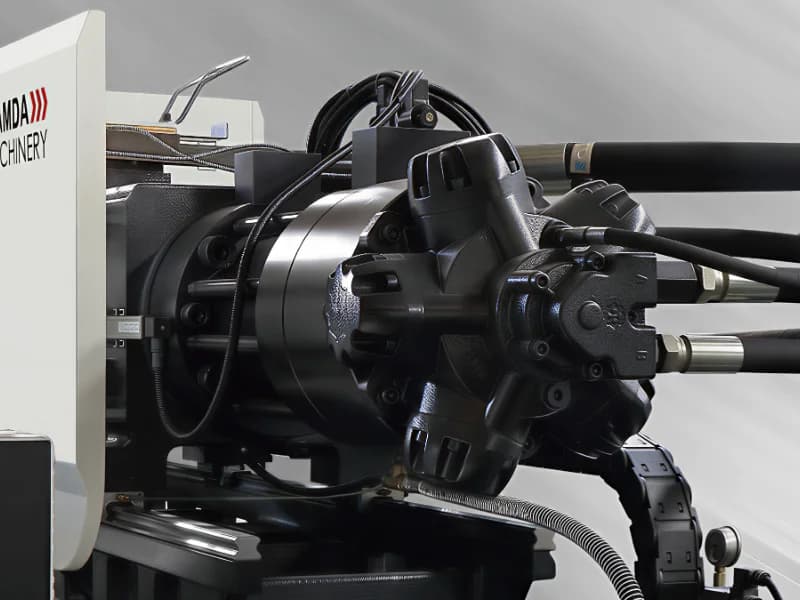
High-speed injection unit with linear guides
Wall Thickness vs Flow Length Ratio
The flow-length-to-wall-thickness (L/t) ratio is the primary design constraint in thin-wall molding. This ratio determines whether the melt can travel from the gate to the farthest point in the cavity before freezing. Typical L/t ratios for thin-wall food packaging range from 100:1 to over 400:1. A 200 mL yogurt cup with 80 mm flow length and 0.40 mm wall has an L/t of 200:1, requiring injection speeds above 400 mm/s. A rectangular food container with 120 mm flow length and 0.60 mm wall has L/t of 200:1. As L/t increases, required injection pressure and speed increase proportionally. The maximum achievable L/t depends on the machine's injection speed capability and the hot runner system's pressure delivery. HWAMDA SPV5 machines with injection speeds of 368 to 517 mm/s reliably handle L/t ratios up to 250:1 with food-grade PP at MFI 35 to 60. For L/t above 300:1, European high-speed machines with injection speeds above 800 mm/s may be required.
Impact on Cycle Time and Cooling
Cooling time is proportional to the square of the wall thickness, making it the most powerful lever for cycle time reduction. The theoretical cooling time formula shows that halving wall thickness from 0.80 to 0.40 mm reduces cooling time by 75 percent. In practice, a 0.80 mm food container cools in approximately 3 to 5 seconds, while a 0.40 mm yogurt cup cools in approximately 1.0 to 1.5 seconds. The total cycle time impact is somewhat less dramatic because injection time, packing time, and mold open/close times remain relatively constant regardless of wall thickness. For a container going from 0.60 mm to 0.45 mm wall, the expected cycle time reduction is approximately 15 to 25 percent. At 3 million cups per month, a 20 percent cycle time reduction from 4.5 to 3.6 seconds increases monthly capacity to 3.75 million cups, generating approximately 22,500 additional units per day worth roughly 675 dollars in daily revenue.
Key Specs
- •The theoretical cooling time formula shows that halving wall thickness from 0.80 to 0.40 mm reduces cooling time by 75 percent.
- •In practice, a 0.80 mm food container cools in approximately 3 to 5 seconds, while a 0.40 mm yogurt cup cools in approximately 1.0 to 1.5 seconds.
- •For a container going from 0.60 mm to 0.45 mm wall, the expected cycle time reduction is approximately 15 to 25 percent.
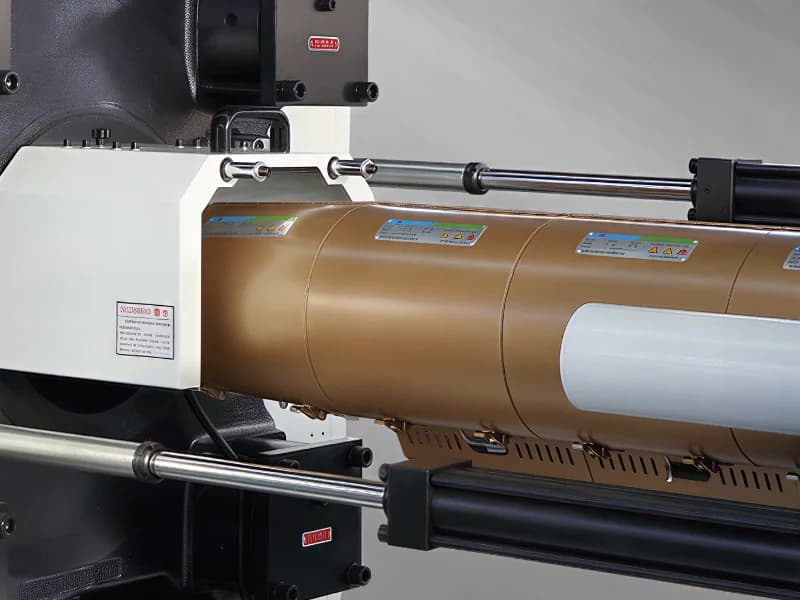
Servo-hydraulic drive system with energy recovery
Need Expert Advice?
Talk to our engineers about your specific production requirements. Free consultation.
Structural Integrity Considerations
Reducing wall thickness increases material efficiency but must not compromise the container's ability to withstand stacking loads during storage and transport, lid-fit force during sealing, and handling forces during filling operations. Stacking strength is the most common structural limitation. A column of 20 filled 200 mL yogurt cups stacked in a refrigerated display exerts approximately 2 to 4 kg of compressive load on the bottom cup. The container rim, sidewall, and base must support this load without buckling or excessive deformation. Design features that maintain structural performance at reduced wall thickness include rolled rims that increase rim stiffness by 50 to 100 percent versus flat rims, radial ribs on the sidewall that resist buckling, domed or corrugated base designs that support compressive loads, and tapered wall profiles that place material where stress is highest. Finite element analysis (FEA) during mold design validates structural performance at the target wall thickness. These design features allow manufacturers to reduce material consumption while maintaining the functional performance that end users expect.
Common Wall Thickness Ranges by Product Type
Based on verified industry data from multiple manufacturers, standard wall thickness ranges are well established. Yogurt cups at 0.30 to 0.55 mm represent the thinnest commercial thin-wall category. Sauce cups at 0.30 to 0.50 mm are similarly thin due to their small size and disposable nature. Milk tea cups at 0.40 to 0.70 mm are slightly thicker to accommodate the taller cup profile and IML label placement. Food containers (rectangular) at 0.40 to 0.80 mm vary by size, with 650 mL containers at 0.45 to 0.60 mm and 1,000 mL at 0.55 to 0.80 mm. Margarine containers at 0.50 to 0.90 mm require thicker walls for the wide-mouth geometry and lid-sealing force resistance. Yogurt pails at 0.40 to 0.80 mm need thicker walls for the larger volume and carry-handle attachment. Disposable tableware at 0.50 to 1.50 mm has the widest range, from thin flat plates to rigid bowls. HWAMDA molds are designed for the specific wall thickness each application requires.
Key Specs
- •Yogurt cups at 0.30 to 0.55 mm represent the thinnest commercial thin-wall category.
- •Sauce cups at 0.30 to 0.50 mm are similarly thin due to their small size and disposable nature.
- •Milk tea cups at 0.40 to 0.70 mm are slightly thicker to accommodate the taller cup profile and IML label placement.
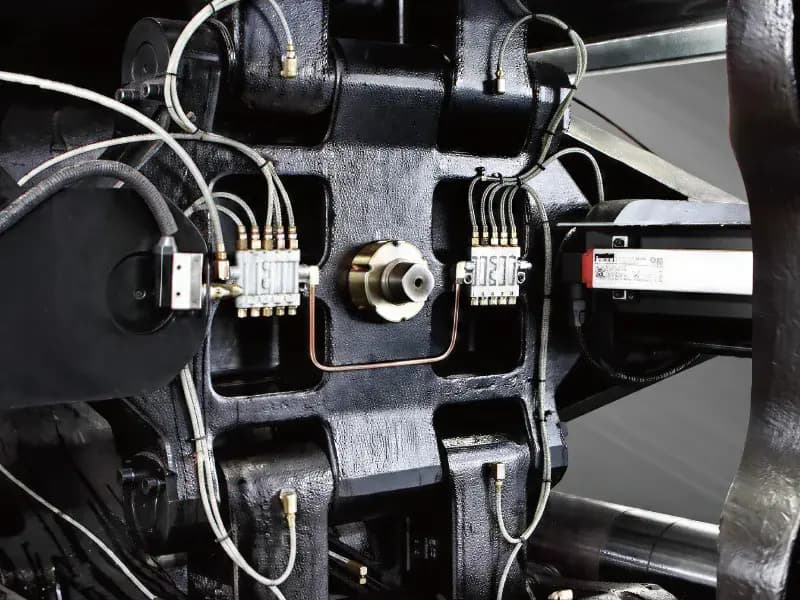
Toggle clamping unit — high rigidity for thin-wall molding
Design Tips for Uniform Wall Thickness
Uniform wall thickness is the single most important design principle for thin-wall injection molding. Variations in wall thickness create differential cooling, causing warpage, sink marks, and stress concentrations. The ideal container design maintains wall thickness within plus or minus 10 percent throughout the part. Transition zones where wall thickness changes, such as at the base-to-wall junction or rim area, should use gradual tapers with a maximum taper ratio of 3:1 (the thick section should not exceed 3 times the thin section thickness). Gate location at the thinnest section of the part is avoided because it creates the highest pressure loss at the most difficult-to-fill area. Instead, the gate should be placed at the thickest section, allowing the melt to flow from thick to thin. Corner radii should be at least 0.5 times the wall thickness to prevent flow hesitation and stress concentration. HWAMDA's mold design team reviews every container design for uniform wall thickness and recommends modifications to improve moldability and reduce cycle time.
Frequently Asked Questions
The thinnest commercially verified PP wall thickness for food containers is 0.37 mm, achieved using Injection Compression Molding (ICM) technology on premium all-electric machines. With standard injection molding on HWAMDA SPV5 machines, the practical minimum is approximately 0.40 mm for small cups like yogurt cups and 0.45 mm for larger containers. These thicknesses require PP grades with MFI of 45 to 60, injection speeds above 400 mm/s, and valve gate hot runner systems. Going below 0.40 mm with standard injection molding significantly narrows the process window.
Related Guides
Ready to Start Your Project?
Get a free consultation and quotation for your thin-wall packaging production line.
Join 500+ manufacturers in 60+ countries who trust HWAMDA.
Get Free Quote