

Cavity Count vs Production Volume Requirements
The starting point for cavity count selection is the required monthly output. For volumes below 500,000 units per month, a 4-cavity mold provides adequate output with the lowest tooling investment. For 500,000 to 2 million units per month, 8-cavity molds offer the best balance of tooling cost and output. For 2 to 5 million units monthly, 16-cavity molds become cost-effective. Above 5 million units, 32-cavity or stack mold configurations deliver the lowest cost per unit. These thresholds assume 24-hour, 3-shift operation at 85 percent overall equipment effectiveness. Product type also influences the decision: small items like sauce cups use higher cavity counts of 32 to 64 because their compact footprint allows more cavities per mold, while large containers like yogurt pails are limited to 2 to 4 cavities by the available platen area. HWAMDA provides production calculators that determine the optimal cavity count based on the customer's target volume, machine budget, and facility constraints.
Key Specs
- •For volumes below 500,000 units per month, a 4-cavity mold provides adequate output with the lowest tooling investment.
- •Product type also influences the decision: small items like sauce cups use higher cavity counts of 32 to 64 because their compact footprint allows more cavities per mold, while large containers like yogurt pails are limited to 2 to 4 cavities by the available platen area.
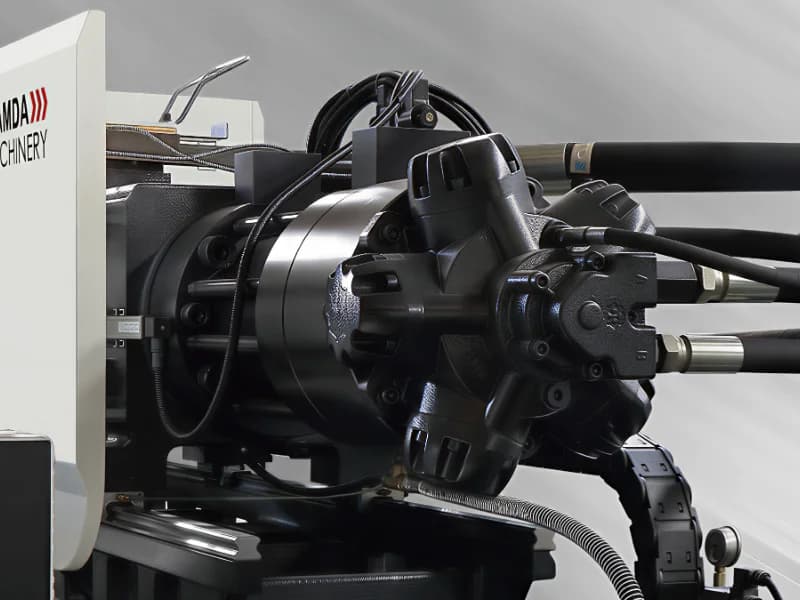
High-speed injection unit with linear guides
Machine Tonnage and Platen Size Constraints
Each additional cavity increases the projected area and therefore the required clamping force. The rule of thumb for thin-wall packaging is 3 to 5 tons per square centimeter of projected area. An 8-cavity yogurt cup mold with approximately 800 square centimeters total projected area requires 320 to 400 tons of clamping force. A 16-cavity version doubles the projected area, requiring 450 to 530 tons. Platen size must physically accommodate the mold footprint. HWAMDA SPV5 platen dimensions range from 860 by 850 mm (270T) to 1,120 by 1,060 mm (480T). The tie-bar spacing determines the maximum mold width: 580 by 570 mm on the 270T to 720 by 700 mm on the 400T. For food containers with larger cavity footprints, the platen and tie-bar constraints often limit cavity count before the clamping force does. A 4-cavity 1,000 mL round container mold may require the same machine tonnage as an 8-cavity 200 mL yogurt cup mold.
Cost Per Unit at Different Cavity Counts
Mold cost increases with cavity count, but cost per unit decreases because the higher output amortizes the investment faster. A 4-cavity yogurt cup mold at 15,000 to 25,000 dollars producing 3 million cups before replacement yields a mold amortization of approximately 0.007 dollars per cup. An 8-cavity mold at 30,000 to 60,000 dollars producing 6 million cups yields approximately 0.007 dollars per cup. A 16-cavity mold at 80,000 to 150,000 dollars producing 10 million cups yields approximately 0.010 dollars per cup. However, the 16-cavity mold requires only one machine operator versus two operators for two 8-cavity machines to achieve the same output, saving labor cost of 600 to 800 dollars per month per operator in China. When all factors are included, the 8-cavity and 16-cavity configurations typically deliver the lowest total cost per unit for most volume ranges. The 4-cavity option remains competitive for new market entrants with limited initial capital.
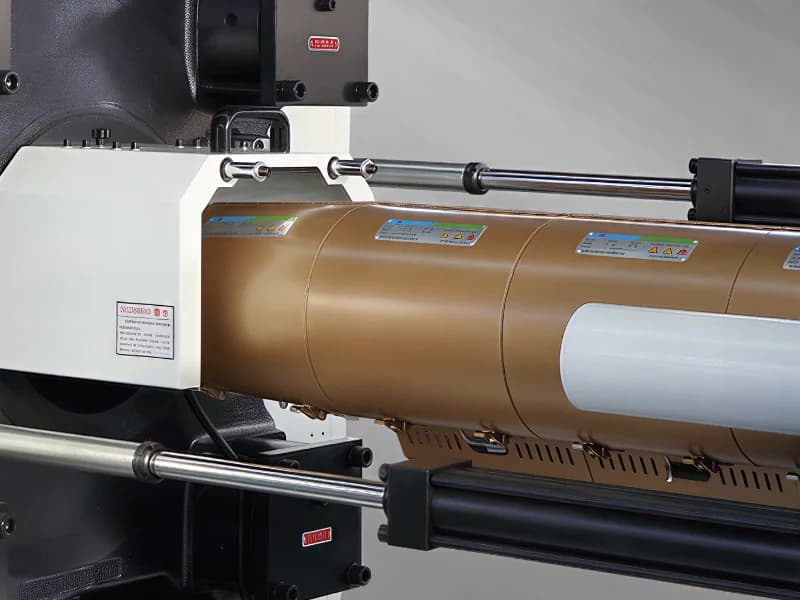
Servo-hydraulic drive system with energy recovery
Need Expert Advice?
Talk to our engineers about your specific production requirements. Free consultation.
Mold Complexity and Maintenance Trade-offs
Higher cavity counts increase mold complexity in several dimensions. The hot runner system grows proportionally, with each additional drop adding a valve pin, nozzle, heater, and thermocouple that require maintenance. Cooling circuit complexity increases as more cavities compete for coolant flow within the available mold volume. Cavity-to-cavity balance becomes harder to maintain as the runner system extends further from the injection point. Maintenance frequency scales with cavity count: a 16-cavity mold requires approximately twice the maintenance hours of an 8-cavity mold due to the additional hot runner components. Downtime risk also increases because any single cavity defect affects the entire mold's output until repaired. Some operators prefer to run two 8-cavity molds on separate machines rather than one 16-cavity mold, accepting higher capital cost for operational resilience. HWAMDA recommends this dual-mold strategy for customers where production continuity is more critical than minimizing total equipment investment. HWAMDA provides maintenance hour estimates and spare parts cost projections for each cavity count option to help customers make fully informed decisions.
Common Cavity Configurations by Product
Based on HWAMDA's experience and verified industry data, common cavity configurations are as follows. Yogurt cups (200-300 mL): 4, 6, 8, 12, or 16 cavities with PP material, valve gate hot runner, and robot automatic demolding. Tea and milk tea cups (500-700 mL): 4, 6, 8, or 12 cavities, often with IML compatibility. Food containers (rectangular, 650-1,000 mL): 2, 4, 6, or 8 cavities. Sauce cups with lids (30-120 mL): 6, 8, 12, 16, 24, or 32 cavities, the highest counts due to compact product size. Cup lids: 4, 6, 8, 12, or 16 cavities. Yogurt pails (2-5 L): 1, 2, or 4 cavities. Margarine containers with IML: 1, 2, 4, or 6 cavities. Disposable tableware: 2, 4, 8, or 32 cavities depending on item size. HWAMDA manufactures molds across all these configurations using DIN 2344 steel with 5 million-plus shot life. Each configuration uses valve gate hot runner systems and DIN 2344 steel for consistent production quality across all cavity counts.
Key Specs
- •Yogurt cups (200-300 mL): 4, 6, 8, 12, or 16 cavities with PP material, valve gate hot runner, and robot automatic demolding.
- •Tea and milk tea cups (500-700 mL): 4, 6, 8, or 12 cavities, often with IML compatibility.
- •Food containers (rectangular, 650-1,000 mL): 2, 4, 6, or 8 cavities.
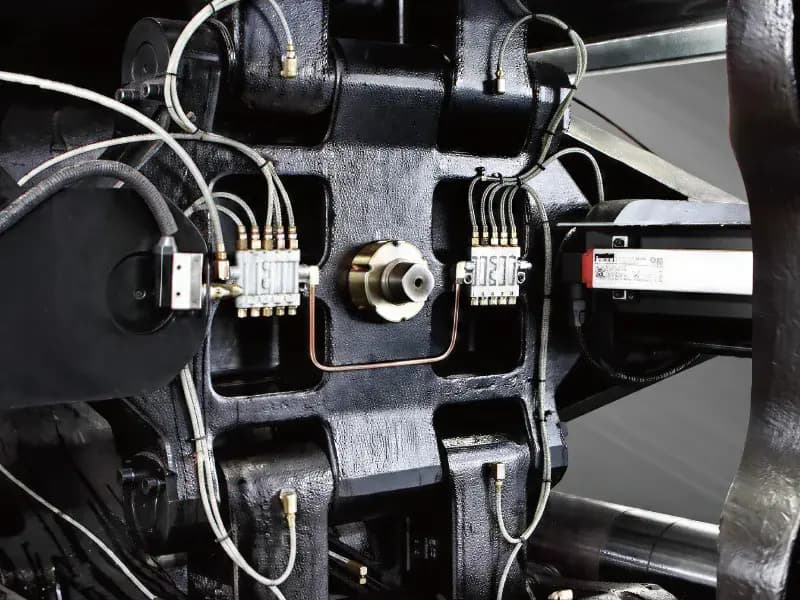
Toggle clamping unit — high rigidity for thin-wall molding
Scaling Strategy: Start Small, Expand Later
HWAMDA recommends a phased scaling strategy for new market entrants. Phase 1 starts with a 4-cavity mold on a mid-size machine to validate the market, establish customer relationships, and optimize the production process with minimal capital risk. The investment is approximately 80,000 to 120,000 dollars for the complete line. Phase 2 upgrades to an 8-cavity mold on the same machine or adds a second 4-cavity line, doubling output for an incremental investment of 30,000 to 60,000 dollars for the mold or 80,000 to 120,000 dollars for a second line. Phase 3 invests in a 16-cavity or stack mold on a larger machine for maximum output efficiency, justified by proven market demand. This approach reduces financial risk because the Phase 1 machine continues operating during the Phase 2 and 3 expansions, maintaining production continuity. The same HWAMDA machine platform supports all cavity counts within its tonnage range, protecting the initial equipment investment across all expansion phases.
Frequently Asked Questions
Start with your target monthly output and work backwards. Divide the monthly target by the number of operating hours (typically 600 to 720 hours for 3-shift, 85 percent OEE), then divide by 3,600 to convert to shots per second, then divide by the target cycle time to get required cavities per shot. For example, 2 million yogurt cups per month divided by 648 operating hours divided by 3,600 seconds per hour equals 0.86 cups per second. At a 4.5-second cycle time, you need 3.9 cavities per shot, meaning a 4-cavity mold is the minimum. HWAMDA provides detailed calculators for this analysis.
Related Guides
Ready to Start Your Project?
Get a free consultation and quotation for your thin-wall packaging production line.
Join 500+ manufacturers in 60+ countries who trust HWAMDA.
Get Free Quote