

Output and Cycle Time Comparison
A 4-cavity food container mold on an HWAMDA SPV5 480T machine produces 4 containers per cycle at 5-7 second cycle times, delivering approximately 49,000-69,000 containers per day running 24 hours. An 8-cavity mold on an HWAMDA SPV5 530T machine produces 8 containers per cycle at slightly longer 6-8 second cycle times due to increased fill volume, delivering approximately 86,000-115,000 containers per day. The output advantage of 8-cavity molds is approximately 65-80% greater than 4-cavity molds, not a full doubling because cycle times increase by 10-20%. This is due to the larger shot volume requiring more fill time, more cooling circuits creating minor thermal management challenges, and longer ejection sequences. For yogurt cups on HWAMDA SPV5 380-400T machines, 8-cavity molds achieve 3.5-4.5 second cycles compared to 3.0-3.5 seconds for 4-cavity configurations. The flexibility of 4-cavity molds also benefits manufacturers running multiple products, with shorter mold change times and simpler restart procedures allowing more frequent product switches.
Key Specs
- •A 4-cavity food container mold on an HWAMDA SPV5 480T machine produces 4 containers per cycle at 5-7 second cycle times, delivering approximately 49,000-69,000 containers per day running 24 hours.
- •An 8-cavity mold on an HWAMDA SPV5 530T machine produces 8 containers per cycle at slightly longer 6-8 second cycle times due to increased fill volume, delivering approximately 86,000-115,000 containers per day.
- •The output advantage of 8-cavity molds is approximately 65-80% greater than 4-cavity molds, not a full doubling because cycle times increase by 10-20%.
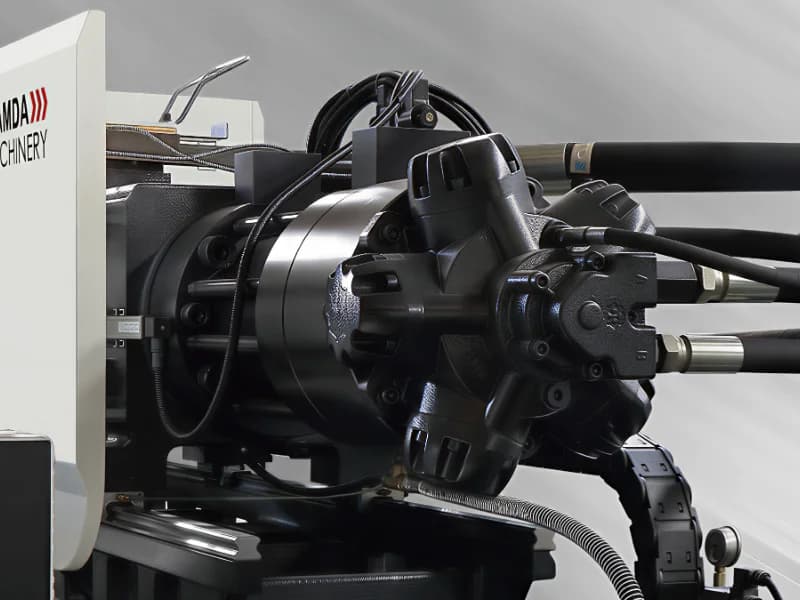
High-speed injection unit with linear guides
Machine Size Requirements
Clamping force requirements scale roughly linearly with cavity count. A 4-cavity food container mold requires approximately 480-530 tons of clamping force, while an 8-cavity version needs 480-530 tons or slightly more depending on container size and wall thickness. The tonnage calculation depends on projected area per cavity multiplied by cavity count, plus runner system projected area, and a safety factor of 10-15%. Beyond clamping force, 8-cavity molds require larger shot volume capacity—typically 1.8-2.0 times the 4-cavity shot weight. The HWAMDA SPV5 series offers barrel sizes matched to cavity counts for each product type. Platen dimensions must accommodate the larger mold base; 8-cavity molds are typically 30-50% larger in footprint than 4-cavity versions. For yogurt cup production, 8-cavity molds fit comfortably on the HWAMDA SPV5 380-400T platen, while 16-cavity molds may require moving to the 400T frame size. HWAMDA engineering provides detailed machine-mold compatibility verification for every order, ensuring platen size, tie bar spacing, and shot capacity all match the specific mold requirements.
Mold Cost and Lead Time
A 4-cavity thin-wall food container mold from a quality Chinese manufacturer like HWAMDA typically costs $30,000-45,000 including valve gate hot runner system. An equivalent 8-cavity mold costs $50,000-75,000. The per-cavity cost decreases from approximately $7,500-11,000 for 4-cavity to $6,200-9,400 for 8-cavity, representing a 15-20% savings per cavity. Lead times also differ. A 4-cavity mold can be completed in 8-12 weeks from design approval, while an 8-cavity mold typically requires 10-14 weeks. The additional time accounts for machining more cavity sets, more complex cooling system design and manufacturing, and longer mold trial and balancing procedures. Hot runner system delivery adds 2-4 weeks for either configuration. HWAMDA provides complete DFM review within 5 business days of receiving product drawings. For budget-conscious startups, the lower upfront cost of 4-cavity molds means faster breakeven and earlier positive cash flow during the critical customer development period. HWAMDA provides complete mold cost quotations with itemized breakdowns so customers can compare the per-cavity economics transparently between different cavity count options.
Key Specs
- •The per-cavity cost decreases from approximately $7,500-11,000 for 4-cavity to $6,200-9,400 for 8-cavity, representing a 15-20% savings per cavity.
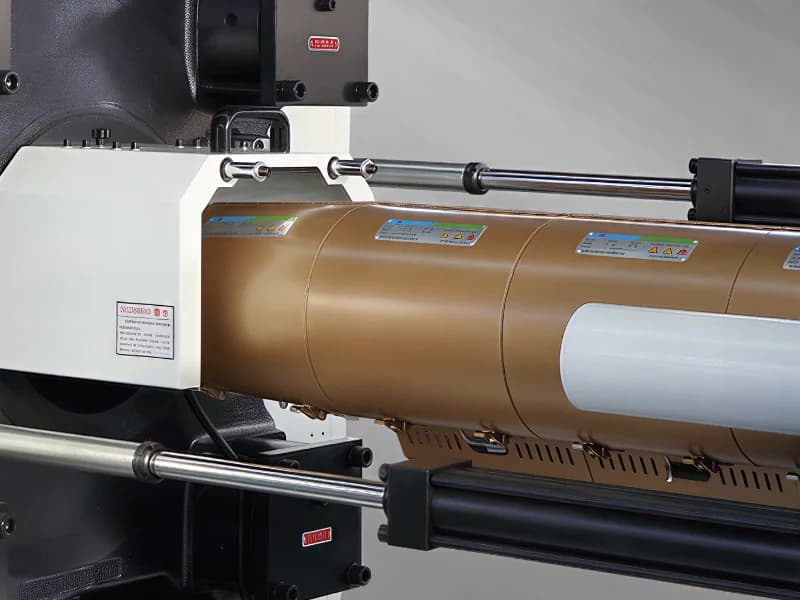
Servo-hydraulic drive system with energy recovery
Need Expert Advice?
Talk to our engineers about your specific production requirements. Free consultation.
Quality and Consistency
4-cavity molds inherently offer better cavity-to-cavity consistency. With fewer cavities to balance, the hot runner system delivers more uniform melt temperature and pressure to each cavity. Weight variation between cavities is typically within 0.5-1.0% for well-built 4-cavity molds. This makes 4-cavity configurations ideal for premium products where tight weight and dimensional tolerances are critical. 8-cavity molds require more sophisticated balancing during mold trials. Hot runner manifold design must ensure equal flow path length and pressure drop to all 8 cavities—a challenge that increases with cavity count. Cavity-to-cavity weight variation for 8-cavity molds typically runs 1.0-2.5%. Cooling uniformity is more difficult to achieve across 8 cavities, potentially causing differential shrinkage and dimensional variation. However, experienced mold builders like HWAMDA use flow simulation software and iterative mold trials (T0, T1, T2) to achieve production-ready balance. For food containers where wall thickness consistency is critical for lid sealing performance, the easier balance of a 4-cavity mold provides quality advantages justifying the higher per-unit cost.
Total Cost Per Unit Analysis
Material cost per unit is identical regardless of cavity count—approximately $0.010-0.015 for a 150ml yogurt cup and $0.015-0.025 for a 500ml food container. The cost advantage of higher cavity counts comes from fixed cost allocation: machine depreciation, operator labor, energy, and overhead are spread across more units per cycle. For a yogurt cup production example: Machine cost (depreciation + energy) per cycle is approximately $0.025 on an HWAMDA SPV5 400T. With a 4-cavity mold at 3.5s cycle, machine cost per cup is $0.00625. With an 8-cavity mold at 4.0s cycle, machine cost per cup is $0.003125. Including mold depreciation (over 5 million cycles), the 8-cavity mold adds $0.010 per cup versus $0.007 for the 4-cavity. Total cost per cup: 4-cavity approximately $0.032, 8-cavity approximately $0.028—a 12-15% savings that compounds to significant annual savings at high volumes. Also include secondary costs such as packaging materials, pallets, and warehousing that scale with output volume, as these become significant at higher production levels.
Key Specs
- •Total cost per cup: 4-cavity approximately $0.032, 8-cavity approximately $0.028—a 12-15% savings that compounds to significant annual savings at high volumes.
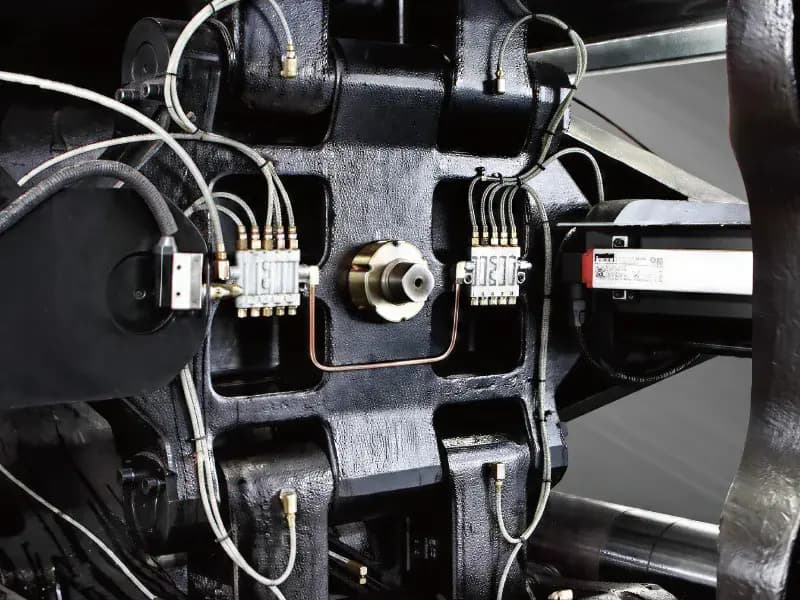
Toggle clamping unit — high rigidity for thin-wall molding
Scaling Path Recommendation
HWAMDA recommends a phased scaling approach for new thin-wall packaging manufacturers. Start with a 4-cavity mold to validate your product design, establish production parameters, train operators, and enter the market with manageable capital investment of $80,000-120,000 for machine and mold combined. Once sales volume consistently exceeds 3-5 million units per month and production is running stably, invest in an 8-cavity mold for the same machine or order a second machine with 8-cavity tooling. This progression from 4 to 8 cavities can increase output by 80% while adding only 40-50% more tooling cost. For very high volumes exceeding 15 million units per month, consider 12 or 16-cavity configurations on HWAMDA SPV5 400T machines. The 16-cavity yogurt cup mold running at 4.5 second cycles delivers the lowest cost per unit and highest machine utilization. This natural progression builds production knowledge and customer relationships incrementally, reducing risk at each expansion stage of the manufacturing operation.
Frequently Asked Questions
In many cases, yes. The HWAMDA SPV5 series is designed with platen dimensions, shot capacity, and clamping force that accommodate both 4-cavity and 8-cavity molds for the same product. For yogurt cups, both 4-cavity and 8-cavity molds run on the SPV5 380-400T. For food containers, a 4-cavity mold on the SPV5 480T can later be paired with an 8-cavity mold on the same or slightly larger SPV5 530T machine. Verify shot weight capacity and platen size with HWAMDA engineering before ordering. Verify shot weight capacity and platen size with HWAMDA engineering before ordering the mold to ensure complete compatibility.
Related Guides
Ready to Start Your Project?
Get a free consultation and quotation for your thin-wall packaging production line.
Join 500+ manufacturers in 60+ countries who trust HWAMDA.
Get Free Quote