

Clamping Speed and Force Control
Toggle clamping systems achieve the fastest clamp close and open speeds, typically 300-500 mm/s for the high-speed approach phase. The mechanical advantage of the toggle linkage provides rapid acceleration and deceleration with precise mold protection at low speed near the closed position. The HWAMDA SPV5 toggle mechanism delivers dry cycle times of 1.5-2.0 seconds, which is critical when total cycle times target 3.5-5 seconds for thin-wall products. Servo-hydraulic direct clamping systems use hydraulic cylinders controlled by servo valves to generate clamping force. While modern servo-hydraulic systems can achieve clamp speeds of 200-400 mm/s, they typically cannot match toggle speed at the extremes of travel. However, servo-hydraulic systems offer continuously variable force control throughout the entire stroke—valuable for insert molding and applications requiring precise force profiling during mold close. The toggle's ability to maintain maximum force with zero hydraulic energy during the locked phase is particularly valuable for thin-wall molding where cooling phases dominate cycle time.
Key Specs
- •Toggle clamping systems achieve the fastest clamp close and open speeds, typically 300-500 mm/s for the high-speed approach phase.
- •The HWAMDA SPV5 toggle mechanism delivers dry cycle times of 1.5-2.0 seconds, which is critical when total cycle times target 3.5-5 seconds for thin-wall products.
- •While modern servo-hydraulic systems can achieve clamp speeds of 200-400 mm/s, they typically cannot match toggle speed at the extremes of travel.
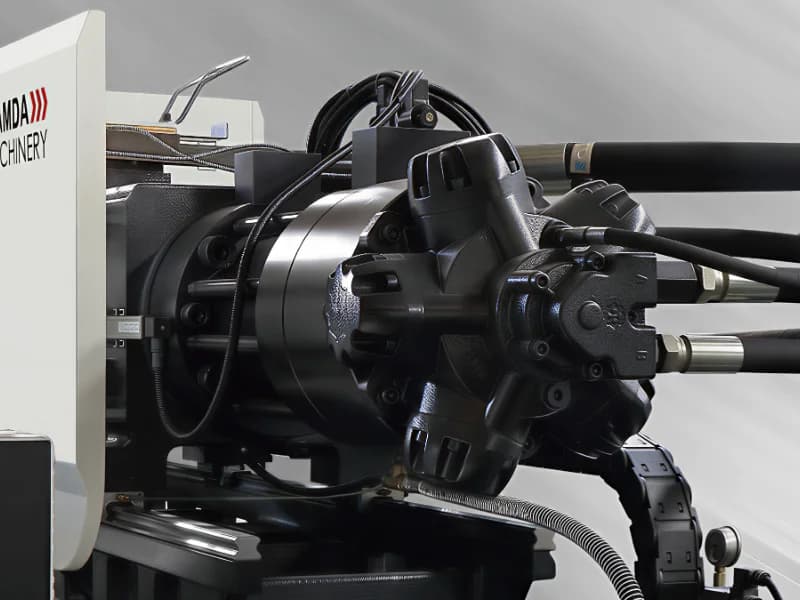
High-speed injection unit with linear guides
Energy Efficiency Comparison
Servo-hydraulic machines with variable-speed pump drives are highly energy efficient. The servo motor only consumes power proportional to the current demand, idling at near-zero energy consumption during cooling phases. Energy savings of 40-60% compared to fixed-pump hydraulic machines are common. Typical energy consumption for a 400T servo-hydraulic machine running thin-wall packaging is 15-25 kWh per hour. Toggle clamping machines with servo-hydraulic power units achieve comparable energy efficiency. The HWAMDA SPV5 series combines a toggle clamp mechanism with a servo-driven hydraulic pump, capturing the benefits of both systems. During the cooling phase—which constitutes 40-60% of the cycle in thin-wall molding—the servo pump reduces to minimal speed, cutting energy waste. SPV5 energy consumption runs 12-22 kWh per hour for the 270T-600T range. The toggle mechanism itself requires no energy to maintain clamping force once locked, unlike direct hydraulic systems that must maintain pressure. These energy savings compound across 8,000+ annual operating hours, delivering $3,000-8,000 in electricity cost reduction per machine per year compared to older fixed-pump hydraulic systems.
Precision and Repeatability
Toggle clamping systems provide excellent mechanical repeatability. Once the toggle is locked over-center, the clamp position is determined by the mechanical geometry, delivering consistent platen parallelism shot after shot. Platen parallelism on the HWAMDA SPV5 is maintained within ±0.03mm across the full clamping force range. This mechanical consistency is essential for uniform wall thickness in thin-wall containers where even 0.02mm variation causes quality issues. Servo-hydraulic direct clamp systems offer programmable force profiles and position control via closed-loop servo valves. This provides flexibility for different mold types and enables adaptive control during production. However, hydraulic systems are inherently subject to fluid temperature variations and seal wear that can affect long-term repeatability. Modern systems with position encoders mitigate these effects, but toggle mechanisms maintain their geometric precision independent of hydraulic conditions. Mechanical precision is especially important for multi-cavity thin-wall molds where platen deflection must remain below 0.03mm to ensure uniform quality across all cavities.
Key Specs
- •Platen parallelism on the HWAMDA SPV5 is maintained within ±0.03mm across the full clamping force range.
- •This mechanical consistency is essential for uniform wall thickness in thin-wall containers where even 0.02mm variation causes quality issues.
- •Mechanical precision is especially important for multi-cavity thin-wall molds where platen deflection must remain below 0.03mm to ensure uniform quality across all cavities.
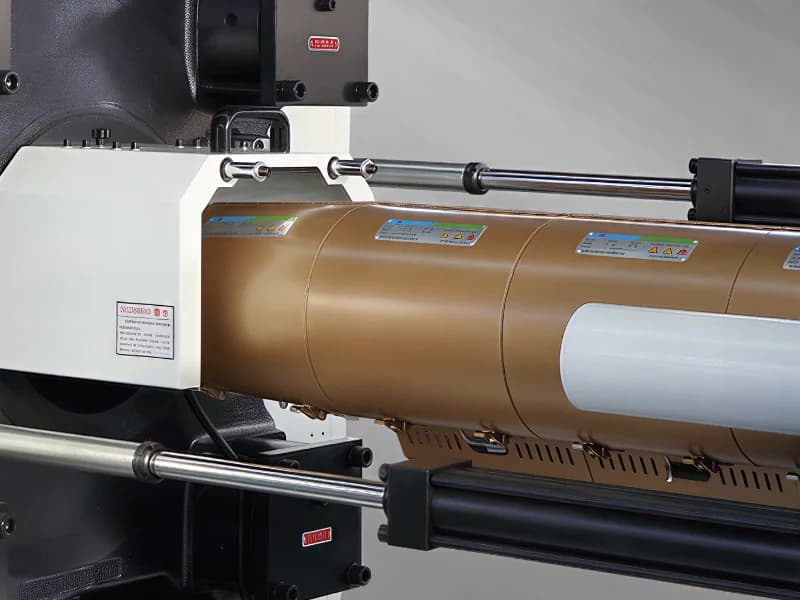
Servo-hydraulic drive system with energy recovery
Need Expert Advice?
Talk to our engineers about your specific production requirements. Free consultation.
Machine Cost and Availability
Toggle clamping machines are the dominant architecture for thin-wall packaging worldwide, representing over 80% of machines in this application. This market prevalence means competitive pricing, readily available spare parts, and a large pool of trained operators and maintenance technicians. An HWAMDA SPV5 400T toggle machine is priced competitively against equivalent servo-hydraulic alternatives, typically 5-15% lower. Servo-hydraulic direct clamp machines are less common in the thin-wall packaging segment but are gaining traction for their flexibility. Two-platen servo-hydraulic machines offer larger mold mounting areas relative to their tonnage, which can be advantageous for large molds. However, fewer manufacturers offer high-speed servo-hydraulic machines optimized for thin-wall packaging, limiting competition and keeping prices higher. Parts availability and local service can also be more limited for less common machine architectures. For manufacturers standardizing on a single platform, toggle architecture's dominance means operators, technicians, and spare parts are interchangeable across machines in the facility. The market prevalence of toggle machines also means a larger selection of compatible molds, automation equipment, and production accessories designed for toggle machine platen configurations.
Maintenance Requirements
Toggle clamping systems require regular lubrication of toggle pins and bushings, typically every 500-1,000 hours of operation. Toggle linkage pins and bushings are wear items that need replacement every 15,000-25,000 hours depending on lubrication quality and maintenance discipline. Platen parallelism should be checked annually. Toggle maintenance is straightforward and well-documented, with most technicians able to perform routine service without specialized training. Servo-hydraulic direct clamp systems have fewer moving mechanical parts in the clamping unit, reducing mechanical wear. However, they rely on precision hydraulic components (servo valves, seals, accumulators) that require specialized maintenance and are more expensive to replace. Hydraulic fluid cleanliness is critical—contamination causes servo valve failures that can be costly. The HWAMDA SPV5 toggle system includes centralized automatic lubrication that extends toggle component life and reduces maintenance labor. The SPV5's centralized automatic lubrication system addresses the primary toggle maintenance concern, ensuring consistent lubrication of all pivot points without manual intervention.
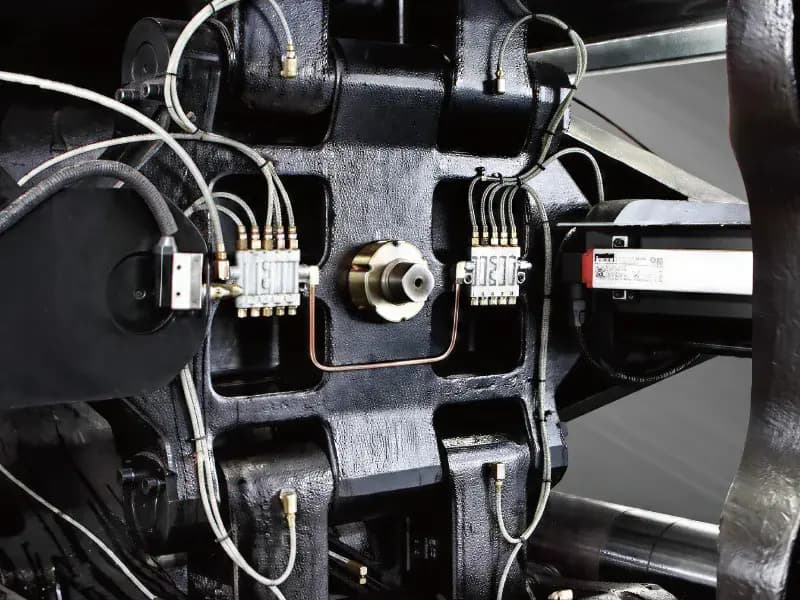
Toggle clamping unit — high rigidity for thin-wall molding
Best Choice for Thin-Wall Packaging
For high-speed thin-wall food packaging production, toggle clamping with servo-hydraulic power is the industry standard and HWAMDA's proven choice for the SPV5 series. The combination delivers the fastest dry cycle times, excellent repeatability, energy efficiency through servo pump control, and straightforward maintenance. Leading thin-wall packaging machine builders globally—including Husky, Netstal, and Engel for packaging—all use toggle clamping for their high-speed lines. The HWAMDA SPV5 toggle design is optimized for thin-wall cycle times with rapid clamp close (high-speed approach at 400+ mm/s), precise low-speed mold protection, and fast clamp open with synchronized ejection. The toggle geometry is specifically calculated for thin-wall mold heights and force requirements. For yogurt cups at 3.5-4.5 seconds, food containers at 5-7 seconds, and sauce cups at 3-4 seconds, the SPV5 toggle system delivers consistent, reliable performance throughout multi-million cycle production campaigns. The toggle geometry is specifically calculated for mold heights and force profiles typical of thin-wall food packaging, ensuring optimal clamping force distribution across the entire mold face.
Frequently Asked Questions
HWAMDA selected toggle clamping for the SPV5 series because it delivers the fastest dry cycle times, best mechanical repeatability, and lowest maintenance cost for thin-wall packaging production. The toggle mechanism locks mechanically without consuming hydraulic energy during the cooling phase, maximizing energy efficiency. Combined with a servo-driven hydraulic pump, the SPV5 toggle system achieves the optimal balance of speed, precision, and efficiency that thin-wall packaging demands. Additionally, toggle mechanisms are simpler to maintain and have a proven reliability record in 24/7 packaging production environments worldwide.
Related Guides
Ready to Start Your Project?
Get a free consultation and quotation for your thin-wall packaging production line.
Join 500+ manufacturers in 60+ countries who trust HWAMDA.
Get Free Quote