

Foundation Design and Factory Preparation
Prepare the machine foundation before the SPV5 machine arrives. The foundation must support the static machine weight (15-28 tons depending on model) plus dynamic forces generated during the 3.5-6 second high-speed injection cycles. Pour a reinforced concrete foundation pad with minimum 300mm thickness, 35 MPa compressive strength, and steel reinforcement mesh. The foundation dimensions should exceed the machine footprint by 200mm on each side: for the HMD 380M8-SPV (7.5x1.9m machine), the foundation should be 7.9x2.3m. Level the foundation surface to within 0.3mm per meter using a precision leveling compound. Install M24 or M30 anchor bolts at the factory-specified positions before concrete pouring—HWAMDA provides a foundation drawing with exact bolt locations for each model. Allow the concrete to cure for minimum 21 days before machine placement. Verify floor loading capacity: the point load under each machine foot is 3-7 tons, requiring a floor rated for minimum 5 tons per square meter. Prepare utility connections within 3 meters of the machine: 3-phase electrical supply (380V/50Hz or 400V/50Hz, 200-350A depending on model), cooling water supply and return (DN32-DN50, 3-5 bar), compressed air (DN15, 6-8 bar), and floor drain for cooling water overflow.
Key Specs
- •The foundation must support the static machine weight (15-28 tons depending on model) plus dynamic forces generated during the 3.5-6 second high-speed injection cycles.
- •Pour a reinforced concrete foundation pad with minimum 300mm thickness, 35 MPa compressive strength, and steel reinforcement mesh.
- •The foundation dimensions should exceed the machine footprint by 200mm on each side: for the HMD 380M8-SPV (7.5x1.9m machine), the foundation should be 7.9x2.3m.
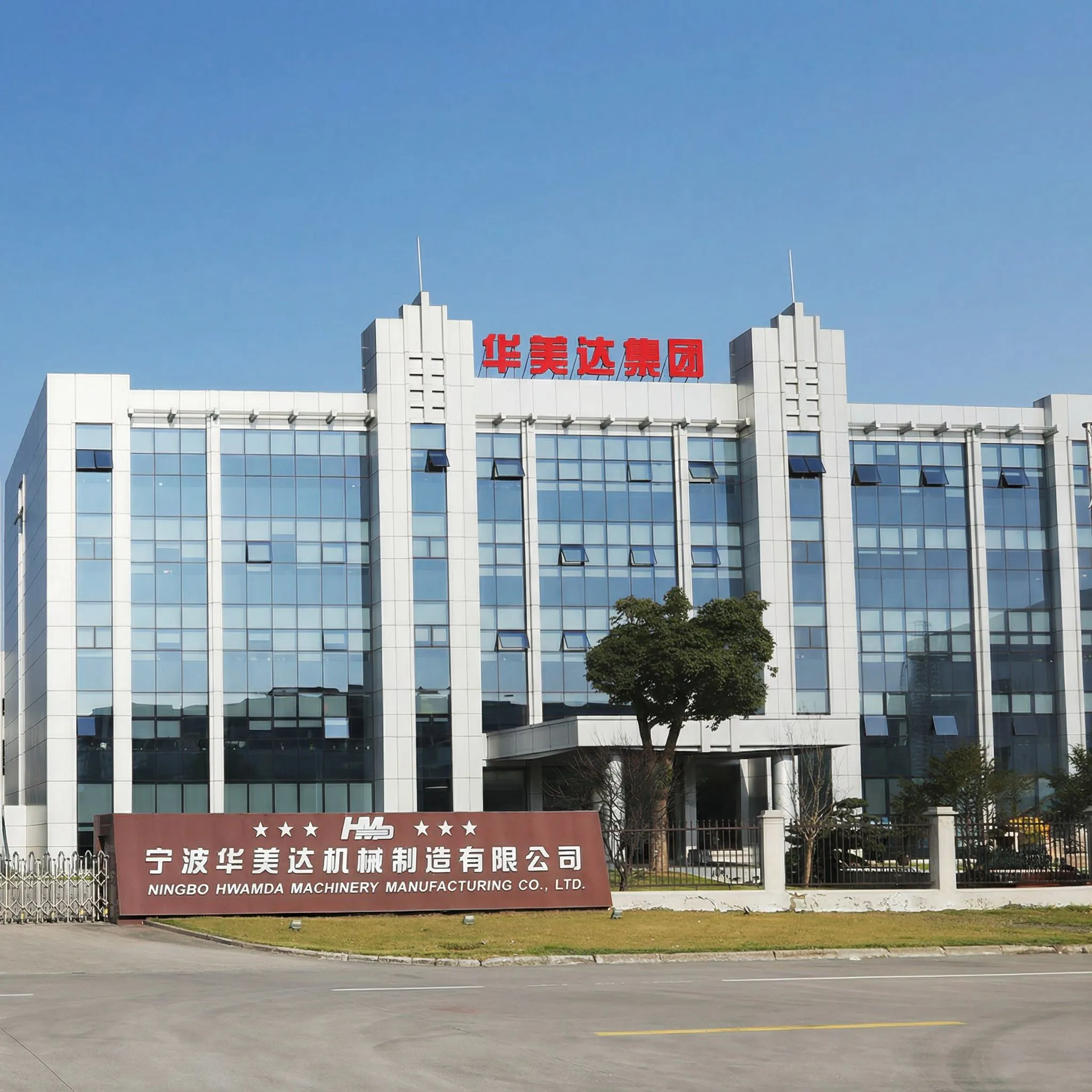
HWAMDA factory — quality manufacturing since 2003
Machine Unloading and Positioning
Unload the SPV5 machine using an overhead crane (minimum rated capacity 1.5x machine weight) or a heavy-duty forklift rated for the machine weight. For the HMD 270M8-SPV at 15-17 tons, use a minimum 25-ton overhead crane with a 4-point lifting sling attached to the four factory-installed lifting eyes on the machine frame. Never lift the machine by the tie bars, barrel, or any non-designated points. Position the machine on the foundation with the operator side facing the production floor and the non-operator side accessible for IML robot installation if planned. Lower the machine onto adjustable anti-vibration mounts (included with the machine delivery) positioned at each anchor bolt location—typically 6-8 mounts per machine. Level the machine using a precision spirit level (sensitivity 0.02mm per meter) placed on the machine bed in both longitudinal and transverse directions. Adjust the anti-vibration mounts until the machine is level within 0.1mm per meter in all directions. Tighten the anchor bolts to the specified torque (350-500 Nm for M24 bolts) after leveling is confirmed. Recheck leveling after bolt tightening, as uneven bolt tension can distort the machine bed. Allow the machine to settle for 24 hours, then recheck and adjust leveling if necessary.
Electrical Connection and Power-Up Sequence
Electrical installation must be performed by a licensed electrician familiar with industrial machinery. Connect the 3-phase power supply to the machine's main disconnect switch using cable sized for the machine's rated current: HMD 270M8-SPV requires 200A (95mm2 cable), HMD 380M8-SPV requires 250A (120mm2 cable), and HMD 600M8-SPV requires 350A (185mm2 cable). Verify the supply voltage at the main disconnect: 380V plus or minus 10% between each phase pair, with phase-to-phase balance within 2%. Connect the protective earth conductor to the machine frame ground stud using a green/yellow cable of equal cross-section to the phase conductors. Measure earth ground resistance: must be below 4 ohms per IEC 60204-1. Before first power-up, verify that all electrical cabinet connections are tight by performing a torque check on all terminal blocks. Confirm the phase rotation is correct (R-S-T sequence) using a phase rotation meter—incorrect rotation will cause the hydraulic pump to run backward, which can damage the pump within seconds. Power up the main disconnect and verify the INOVA controller boots to the home screen. Check that all heater zones display the correct resistance on the INOVA diagnostics screen. Perform an insulation resistance test on the pump motors (minimum 1 megaohm at 500V DC). Activate the hydraulic pump for 2 seconds only to confirm rotation direction by observing the pressure gauge response.
Key Specs
- •Connect the 3-phase power supply to the machine's main disconnect switch using cable sized for the machine's rated current: HMD 270M8-SPV requires 200A (95mm2 cable), HMD 380M8-SPV requires 250A (120mm2 cable), and HMD 600M8-SPV requires 350A (185mm2 cable).
- •Verify the supply voltage at the main disconnect: 380V plus or minus 10% between each phase pair, with phase-to-phase balance within 2%.
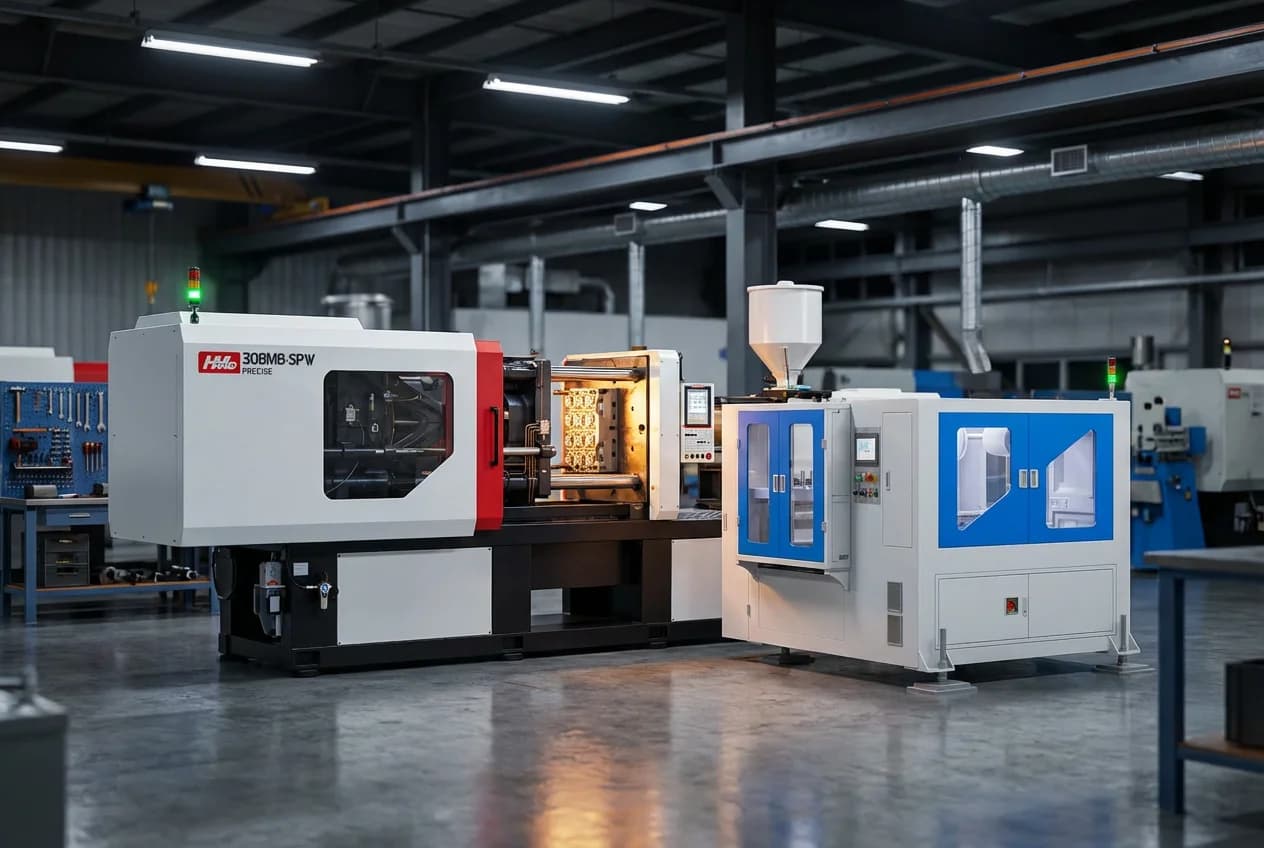
SPV5 machines on the production floor
Need Expert Advice?
Talk to our engineers about your specific production requirements. Free consultation.
Hydraulic System Filling and Commissioning
Fill the hydraulic tank with ISO VG 46 anti-wear hydraulic oil through the tank-top fill port using a filter cart equipped with a 3-micron filter element. For the HMD 380M8-SPV with a 480-liter tank, filling takes approximately 45 minutes at a typical filter cart flow rate of 15 liters per minute. Fill to the upper sight glass mark with all cylinders retracted. Charge the accumulator bladders with dry nitrogen to the specified pre-charge pressure (typically 60-70% of system pressure, or 10.5-12.25 MPa for the 17.5 MPa system). Never use compressed air or oxygen for accumulator charging. Run the hydraulic pump at idle (low pressure, approximately 3-5 MPa) for 30 minutes to circulate oil through all circuits and purge air from the system. During this period, manually cycle all machine movements at slow speed: mold open/close, injection forward/back, screw rotation, ejector forward/back. Air trapped in cylinders causes jerky motion and audible popping. Bleed air from the highest points in the hydraulic circuit using the bleed screws on the injection cylinder and clamping cylinder. After 30 minutes of circulation, check the return line filter differential pressure indicator—replace the filter if the indicator has tripped. Check the oil level again (it will have dropped as oil fills cylinders and manifolds) and top up to the mark.
INOVA Controller Configuration and Mold Setup
Configure the INOVA controller with machine-specific parameters provided in HWAMDA's commissioning data sheet. Set the machine identification (model, serial number), maximum clamping force, maximum injection pressure, screw diameter, and screw stroke. Configure the input/output assignments for any auxiliary equipment: IML robot interface (Euromap 67), core pull valves, air blast timers, and conveyor start/stop signals. Load the first mold recipe or create a new recipe from the default template. For a 16-cavity yogurt cup mold on the HMD 380M8-SPV, initial parameter settings include: mold opening stroke 300mm, mold closing speed fast/slow transition at 50mm from closed, mold protection force 5kN over the last 20mm of closing, clamping force 3,080kN (start at 80% of maximum and adjust based on flash observation), injection speed 350 mm/s (start at 85% of maximum 368 mm/s), injection pressure limit 150 MPa, holding pressure 50-80 MPa for 0.5-1.5 seconds, cooling time 2.0-3.5 seconds, barrel temperatures zone 1 (feed) 200°C through zone 6 (nozzle) 240°C in progressive increments. Allow 45-60 minutes for the barrel to reach temperature setpoint. Soak at temperature for 15 minutes before starting plasticizing.
Key Specs
- •For a 16-cavity yogurt cup mold on the HMD 380M8-SPV, initial parameter settings include: mold opening stroke 300mm, mold closing speed fast/slow transition at 50mm from closed, mold protection force 5kN over the last 20mm of closing, clamping force 3,080kN (start at 80% of maximum and adjust based on flash observation), injection speed 350 mm/s (start at 85% of maximum 368 mm/s), injection pressure limit 150 MPa, holding pressure 50-80 MPa for 0.5-1.5 seconds, cooling time 2.0-3.5 seconds, barrel temperatures zone 1 (feed) 200°C through zone 6 (nozzle) 240°C in progressive increments.
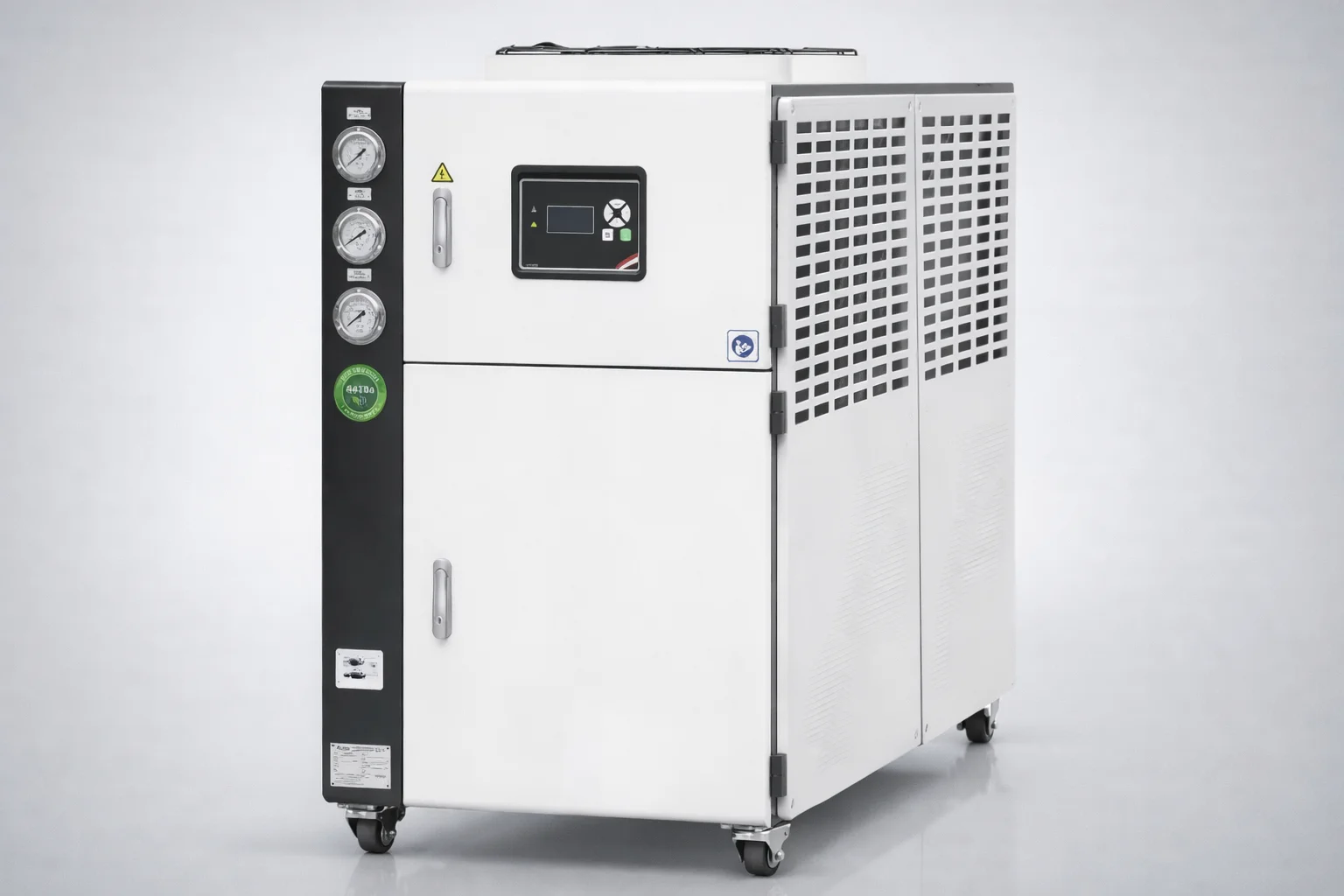
Industrial cooling system for injection molding
Process Optimization and Production Handover
Begin process optimization by molding 50-100 setup shots at conservative parameters (80% of target injection speed, 110% of target cooling time). Gradually increase injection speed in 5% increments while inspecting parts for flash, short shots, and weld line strength. Use the INOVA controller's cavity pressure monitoring (if equipped) or visual part inspection to identify the optimal switchover point from velocity control to pressure control—this occurs when the cavity is 95-98% filled. Fine-tune holding pressure in 2 MPa increments to achieve target part weight within plus or minus 2%. Optimize cooling time by reducing in 0.2-second increments until the ejected part shows acceptable temperature (below 60°C surface temperature measured with IR thermometer) and no deformation. Document the final optimized parameters as the production recipe in the INOVA controller. Run a 2-hour trial production at full speed to verify process stability—monitor part weight, dimensions, and visual quality every 15 minutes. Calculate the process capability index (Cpk) for part weight: target Cpk above 1.33 for production release. After successful trial production, provide operator training covering startup procedure, parameter adjustment within approved ranges, quality inspection methods, and basic troubleshooting. The complete commissioning takes 7-14 days depending on mold complexity and operator experience level. HWAMDA engineers provide on-site commissioning support for $350-500 per day.
Frequently Asked Questions
Complete installation and commissioning of an HWAMDA SPV5 machine takes 7-14 days from arrival at your factory: day 1-2 for unloading and positioning, day 2-3 for electrical connection and power-up, day 3-4 for hydraulic filling and system commissioning, day 4-5 for INOVA controller configuration and mold mounting, and days 5-14 for process optimization and operator training depending on the number of mold configurations. Factories with experienced maintenance teams can complete in 7 days; first-time installations typically require the full 14 days.
Related Guides
Ready to Start Your Project?
Get a free consultation and quotation for your thin-wall packaging production line.
Join 500+ manufacturers in 60+ countries who trust HWAMDA.
Get Free Quote