

Hydraulic System Overhaul Procedures
Drain the complete hydraulic oil tank (380-650 liters depending on SPV5 model) and flush the system with a light flushing oil at 40°C for 4 hours minimum. Inspect the dual servo pump assembly (37+37kW on HMD 270M8-SPV through 55+55kW on HMD 600M8-SPV) for internal wear by measuring volumetric efficiency—replacement is needed when efficiency drops below 85% of original specification. Replace all hydraulic oil filters including the 10-micron return line filter, 3-micron pressure line filter, and the servo valve pilot filter. Inspect accumulator bladders by releasing nitrogen pressure and checking for rubber deterioration or permeation marks. Replace bladders every 2-3 years or at each annual overhaul if degradation is visible. Rebuild all cylinder seals on the injection cylinder, clamping cylinder, and ejector cylinder using genuine HWAMDA seal kits. Check all proportional and servo valves for spool scoring by measuring hysteresis—values exceeding 3% indicate replacement is required. Refill with ISO VG 46 anti-wear hydraulic oil meeting DIN 51524 Part 2 specifications. Total hydraulic overhaul component cost ranges $2,500-6,000 depending on machine model.
Key Specs
- •Drain the complete hydraulic oil tank (380-650 liters depending on SPV5 model) and flush the system with a light flushing oil at 40°C for 4 hours minimum.
- •Inspect the dual servo pump assembly (37+37kW on HMD 270M8-SPV through 55+55kW on HMD 600M8-SPV) for internal wear by measuring volumetric efficiency—replacement is needed when efficiency drops below 85% of original specification.
- •Check all proportional and servo valves for spool scoring by measuring hysteresis—values exceeding 3% indicate replacement is required.
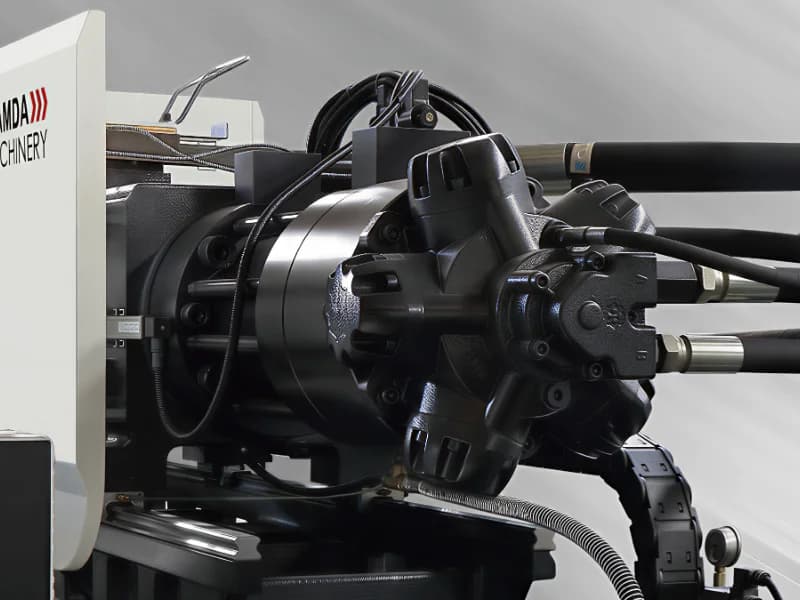
High-speed injection unit with linear guides
Toggle Mechanism and Clamping Unit Rebuild
The toggle mechanism on SPV5 machines endures over 5 million cycles annually at typical thin-wall production rates. Remove the toggle side covers and inspect all link pins (typically 8-12 pins per toggle set) for diameter wear using an outside micrometer—replace pins showing wear exceeding 0.05mm from nominal diameter. Measure all toggle bushings for internal diameter growth; bushings with bore enlargement exceeding 0.08mm require replacement. The bushing-to-pin clearance should not exceed 0.05mm on reassembly. Inspect the crosshead guide rails for scoring and measure the crosshead bearing clearance. Replace the centralized lubrication distribution block seals and verify all 16-24 lubrication points receive grease flow. Check tie bar surface condition with a surface roughness tester—Ra values exceeding 0.8 micrometers indicate the need for tie bar polishing or replacement. Measure platen parallelism at full clamp using four dial indicators positioned at the tie bar locations; parallelism must be within 0.10mm across the full platen face. Re-torque all toggle mounting bolts to the factory specification of 280-450 Nm depending on bolt size. Toggle overhaul parts typically cost $4,000-12,000 for the full SPV5 range.
Injection Unit Complete Service
Remove the screw from the barrel for inspection every annual overhaul. On SPV5 machines with 50-80mm diameter screws and 20-25:1 L/D ratios, measure the screw flight outside diameter at the feed, compression, and metering zones. Screw replacement is required when flight diameter wear exceeds 0.10mm from nominal, which typically occurs after 3-5 million shots with standard PP processing. Inspect the barrel bore using a telescoping bore gauge at 100mm intervals along the full 1,000-2,000mm barrel length. Barrel-to-screw clearance should not exceed 0.15mm for the metering section; values above this cause plasticizing efficiency to drop and increase melt temperature variation. Replace the check ring assembly (ball check or sliding ring type) if the backflow volume exceeds 5% of shot volume. Inspect the screw tip for erosion, particularly on the sealing face. Check the barrel alignment to the nozzle centerline using a precision straight edge—misalignment exceeding 0.05mm accelerates tip and nozzle wear. Replace all barrel heater bands that show resistance deviation exceeding 10% from the nameplate value. Verify thermocouple accuracy across all 6-8 zones by comparison against a calibrated reference probe.
Key Specs
- •On SPV5 machines with 50-80mm diameter screws and 20-25:1 L/D ratios, measure the screw flight outside diameter at the feed, compression, and metering zones.
- •Screw replacement is required when flight diameter wear exceeds 0.10mm from nominal, which typically occurs after 3-5 million shots with standard PP processing.
- •Inspect the barrel bore using a telescoping bore gauge at 100mm intervals along the full 1,000-2,000mm barrel length.
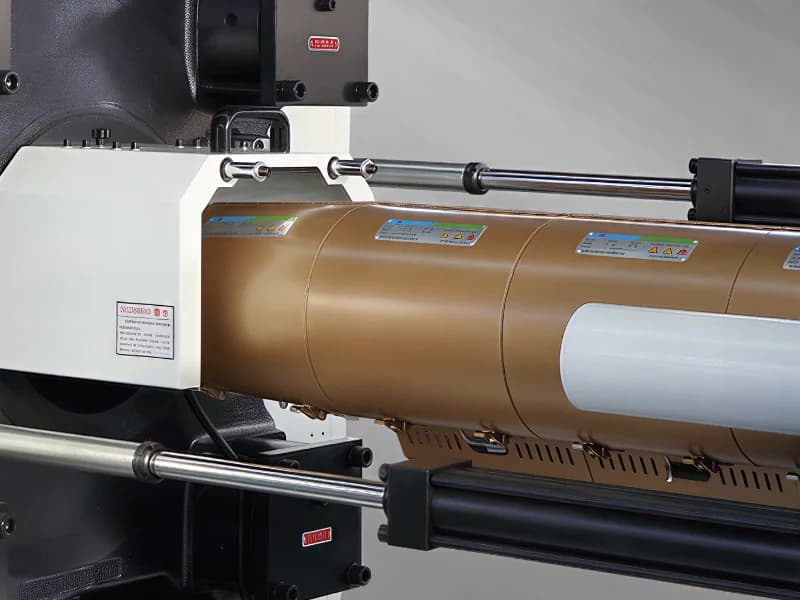
Servo-hydraulic drive system with energy recovery
Need Expert Advice?
Talk to our engineers about your specific production requirements. Free consultation.
Electrical System and Controller Calibration
Perform thermal imaging of the main electrical cabinet under load to identify hot spots at terminal connections, contactors, and bus bars. Retorque all power terminals to the manufacturer's specified values—loose connections are the leading cause of electrical fires in injection molding plants. Test all servo drive parameters and recalibrate the encoder feedback using the INOVA controller's built-in calibration routines. Verify the 10-inch LED touchscreen calibration and check for dead pixels or areas of reduced touch sensitivity. Update the INOVA controller firmware to the latest release if available, backing up all machine parameters and mold recipes before updating. Test all analog and digital I/O channels by running the built-in diagnostics—typical SPV5 machines have 32 digital inputs, 16 digital outputs, 8 analog inputs, and 4 analog outputs. Calibrate the pressure transducers on the injection and clamping hydraulic circuits against a certified reference gauge accurate to 0.25% full scale. Verify the linear position transducers on the screw stroke, clamp stroke, and ejector stroke by comparing against physical measurements at three positions across the full travel range. Replace any sensors showing deviation exceeding 0.5% of full scale.
Safety Systems and Compliance Verification
Annual overhaul must include complete safety system verification to maintain CE marking compliance and insurance requirements. Test all mechanical safety gates by measuring the closing force—it must not exceed 150N per EN 201 requirements. Verify safety gate interlock switch redundancy by testing each switch independently. Check the hydraulic safety valve function by deliberately overriding the gate signal and confirming the machine does not generate clamping force. Test the emergency stop circuit response time—the clamping motion must cease within 0.3 seconds of pressing any emergency stop button. Inspect the mechanical safety bar (if equipped) for proper engagement when the guard is open. Verify the mold height safety limit switches are properly positioned and functioning. Test the purge guard interlock to confirm that screw rotation stops when the guard is opened. Check all warning labels and safety decals for legibility and replace any that are damaged or faded. Calibrate the low-pressure mold protection function by setting a test mold protection force of 5-10kN and verifying the clamp stops when the setpoint is reached. Document all safety test results in the annual certification record. Many insurance providers require this documentation for policy renewal.
Key Specs
- •Calibrate the low-pressure mold protection function by setting a test mold protection force of 5-10kN and verifying the clamp stops when the setpoint is reached.
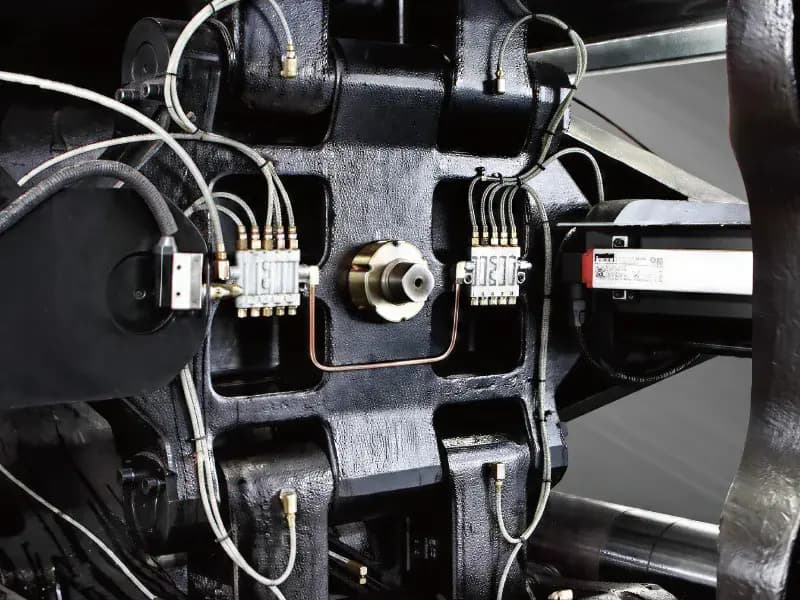
Toggle clamping unit — high rigidity for thin-wall molding
Overhaul Documentation and Restart Procedures
Compile a comprehensive overhaul report documenting all measurements, replaced components, and test results. Record the serial numbers of all replaced components including pumps, valves, seals, bearings, and sensors for warranty tracking and spare parts planning. Photograph any unusual wear patterns for engineering analysis—asymmetric toggle bushing wear, for example, may indicate platen alignment issues requiring correction. Update the machine maintenance history in the INOVA controller's data log. After reassembly, perform a systematic restart sequence: fill and bleed the hydraulic system, then run the pump at low pressure (5 MPa) for 30 minutes to circulate oil through all circuits. Gradually increase to full system pressure of 17.5 MPa. Run 50 dry cycles at reduced speed to verify all mechanical movements. Perform 20 clamping cycles at full force to verify toggle and platen performance. Heat the barrel to production temperature over 45-60 minutes and run 30 purge cycles. Install the production mold and run 100 setup shots before beginning quality verification. Compare the first production run data against pre-overhaul baseline measurements to confirm restoration of original machine performance.
Frequently Asked Questions
Total annual overhaul costs for HWAMDA SPV5 machines range from $8,000-25,000 depending on the model size and wear condition. The HMD 270M8-SPV typically costs $8,000-12,000, while the HMD 600M8-SPV runs $18,000-25,000. This includes $2,500-6,000 for hydraulic components, $4,000-12,000 for toggle parts, $1,500-4,000 for injection unit wear items, and $500-3,000 for electrical components. Labor adds 40-56 hours at local technician rates.
Related Guides
Ready to Start Your Project?
Get a free consultation and quotation for your thin-wall packaging production line.
Join 500+ manufacturers in 60+ countries who trust HWAMDA.
Get Free Quote