

Italy's Plastic Tableware Market and Industry Landscape
Italy's 58.9 million population and EUR 28 billion foodservice sector generate substantial demand for disposable and reusable tableware. The Italian food packaging market is valued at approximately USD 9.5 billion in 2025, ranking third in Europe behind Germany and France. Italy's plastics processing industry cluster in Lombardy, Emilia-Romagna, and Veneto regions includes approximately 250 injection molding companies producing food packaging. Major domestic players include Flo S.p.A (one of Europe's largest disposable tableware producers), Isap Packaging, Dopla, and ITP Packaging. Italy consumes roughly 400,000 tonnes of rigid plastic food packaging annually. The country's D.Lgs. 196/2021 transposing the EU SUP Directive has shifted production toward reusable PP tableware and compostable alternatives. Import duty for injection molding machines from China is 0% under EU MFN tariff schedule for HS 8477.10. Key industry events include PLAST Milan (triennial, next edition 2026) and IPACK-IMA Milan, both premier platforms for packaging machinery sourcing.
Key Specs
- •Italy consumes roughly 400,000 tonnes of rigid plastic food packaging annually.
- •Import duty for injection molding machines from China is 0% under EU MFN tariff schedule for HS 8477.10.
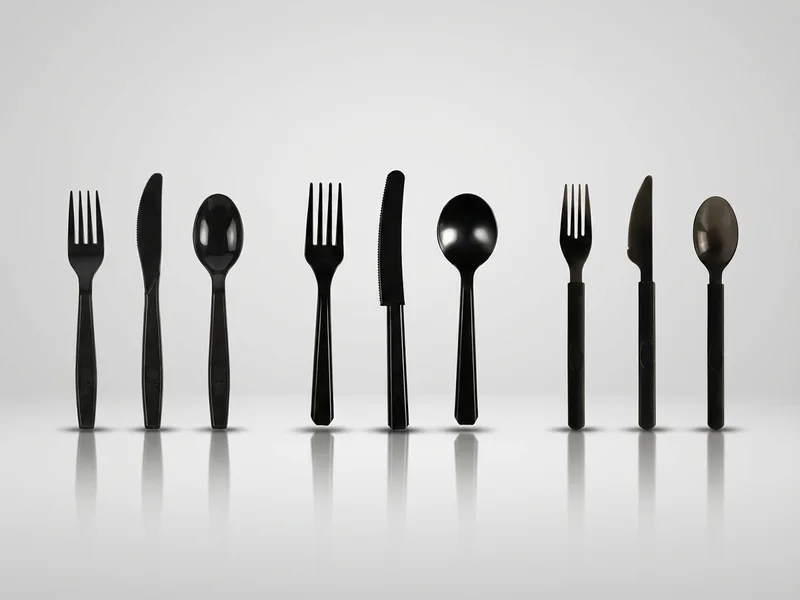
Disposable tableware production line — forks, spoons, knives
HWAMDA SPV5 Technical Specifications for Italian Tableware Applications
Italian tableware production demands European-grade precision with competitive cost structures. The HMD 270M8-SPV delivers 2700kN clamping with injection speed of 368mm/s and maximum injection pressure of 220 MPa, suitable for cutlery weighing 3-4g in 32-48 cavity configurations. The HMD 320M8-SPV at 3200kN provides additional force for deeper-draw items like bowls and plates at 5-8g in 8-16 cavities. The INOVA controller features multi-language HMI with Italian interface, offering 1ms control resolution for velocity-to-pressure switchover critical at 0.4mm wall thickness where the filling window is 0.15-0.25 seconds. Screw diameter options of 50-65mm provide plasticizing rates of 28-42 g/s for PP, enabling shot recovery within the 1.2-1.5 second cooling phase. Toggle clamping ensures platen parallelism within 0.03mm across the full 730x730mm platen face on the 270T model, preventing flash on multi-cavity molds where clamp force distribution must be uniform. Energy consumption of 1.0-1.2 kWh/kg via servo-hydraulic drive represents 30-35% savings compared to older hydraulic machines prevalent in smaller Italian factories.
High-Cavitation Tooling and Automation Integration
Italian tableware producers competing against Turkish and Asian imports require maximum cavitation to minimize per-piece cost. For disposable forks and knives, 48-cavity molds with YUDO valve-gate hot runners running 3-3.5 second cycles achieve output of 49,300-55,500 pieces per hour on the SPV5-270. Spoon molds at 32 cavities run 3.5-4 second cycles due to deeper draw depths, producing 28,800-32,900 pieces hourly. For plates (180-230mm diameter), 8-cavity molds on the SPV5-320 deliver 4-4.5 second cycles at 6,400-7,200 pieces per hour. All configurations use Herzog needle-valve nozzles ensuring gate vestige below 0.1mm for smooth tableware surfaces. SWITEK 3-axis robots with 0.5-0.6 second extraction time integrate via Euromap 67 protocol with the INOVA controller. Italian producers often specify downstream stacking systems with automatic counting (accuracy +/-1 piece per 100), sleeve insertion, and carton erection. Complete turnkey lines from HWAMDA include chiller (sized at 1.2x theoretical cooling capacity), hopper dryer with 4-hour residence time, and centralized material conveying for multi-machine installations common in Italian packaging plants.
Key Specs
- •For disposable forks and knives, 48-cavity molds with YUDO valve-gate hot runners running 3-3.5 second cycles achieve output of 49,300-55,500 pieces per hour on the SPV5-270.
- •Spoon molds at 32 cavities run 3.5-4 second cycles due to deeper draw depths, producing 28,800-32,900 pieces hourly.
- •For plates (180-230mm diameter), 8-cavity molds on the SPV5-320 deliver 4-4.5 second cycles at 6,400-7,200 pieces per hour.
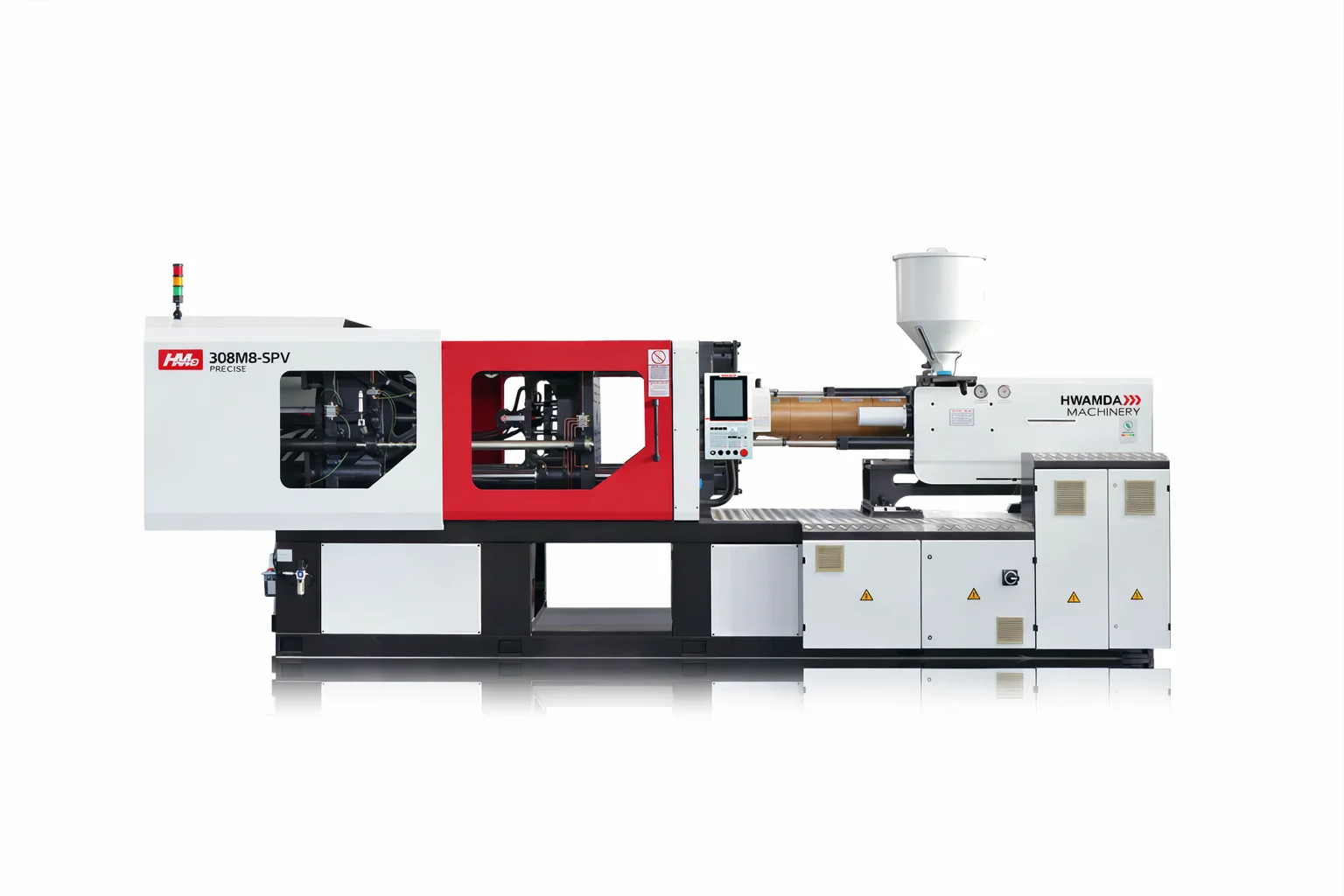
SPV5 series machine for high-cavity tableware molds
Need Expert Advice?
Talk to our engineers about your specific production requirements. Free consultation.
EU Regulatory Compliance and Food Safety Standards
Operating in Italy requires strict adherence to EU food-contact and machinery safety regulations. EU Regulation 10/2011 mandates overall migration testing with food simulants (simulant A for aqueous foods, simulant D2 for fatty foods) with limits of 10 mg/dm2. Specific migration limits apply to antioxidants, slip agents, and nucleating agents common in tableware-grade PP. Italian national authority MOCA (Materiali e Oggetti a Contatto con Alimenti) enforces additional requirements beyond the EU framework, including positive list compliance for colorants and printing inks used in decorated tableware. PP homopolymer with MFI 40-60 g/10min meeting EU 10/2011 is sourced from LyondellBasell (Moplen HP548R), Borealis (BH348MO), or SABIC (PHC26) at European pricing of approximately EUR 1,510/MT. CE marking for the SPV5 machine covers the Machinery Directive 2006/42/EC, Low Voltage Directive 2014/35/EU, and EMC Directive 2014/30/EU. HWAMDA provides the complete technical file including risk assessment, hydraulic circuit schematics, and electrical wiring diagrams in Italian language as required by Italian workplace safety legislation (D.Lgs. 81/2008).
Cost Structure and Competitive Positioning in Italy
Italian tableware producers face competition from Turkish manufacturers operating with lower energy and labor costs. A HWAMDA SPV5-270 turnkey line priced at USD 180,000-240,000 offers 40-50% capital cost savings compared to equivalent European machines from ENGEL, Arburg, or Netstal while delivering comparable cycle time performance. Running a 48-cavity cutlery mold at 3.5 second cycles on 24/7 operation at 85% OEE produces approximately 35.6 million pieces monthly. At PP consumption of 3.5g per piece, monthly material cost is EUR 188,000 at EUR 1,510/MT. Italian industrial electricity at EUR 0.18-0.22/kWh (among the highest in Europe) makes the SPV5's 1.0-1.2 kWh/kg efficiency critical, with monthly energy cost of approximately EUR 5,800-7,200 per line. Labor costs for 3-shift automated operation require 2 operators per shift at average EUR 14-16/hour, totaling EUR 9,000-11,000 monthly. Selling prices for disposable cutlery average EUR 0.008-0.015 per piece wholesale, generating monthly revenue of EUR 285,000-534,000. Net margins of 20-30% are achievable with HWAMDA equipment, delivering payback within 10-16 months.
Key Specs
- •A HWAMDA SPV5-270 turnkey line priced at USD 180,000-240,000 offers 40-50% capital cost savings compared to equivalent European machines from ENGEL, Arburg, or Netstal while delivering comparable cycle time performance.
- •Running a 48-cavity cutlery mold at 3.5 second cycles on 24/7 operation at 85% OEE produces approximately 35.6 million pieces monthly.
- •Net margins of 20-30% are achievable with HWAMDA equipment, delivering payback within 10-16 months.
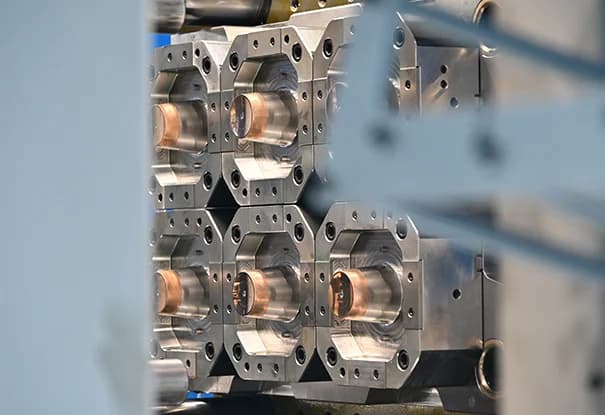
High-cavity mold detail — precision machined cavities
Delivery, Installation, and Technical Support for Italy
HWAMDA ships to Italian ports of Genova, La Spezia, and Napoli with 30-35 day transit from Shanghai. Customs clearance under EU procedures requires CE Declaration of Conformity, commercial invoice, packing list, and bill of lading. The 0% import duty on HS 8477.10 applies, with Italian VAT at 22% recoverable for IVA-registered companies. Machine installation requires foundation preparation with 150mm reinforced concrete pad, 3-phase 400V/50Hz power supply (standard Italian industrial specification), and cooling water at 12-15C from process chiller. HWAMDA installation engineers complete mechanical setup, electrical connection, and commissioning in 5-7 working days, followed by 2 weeks of operator training covering INOVA HMI navigation, process parameter optimization, and preventive maintenance schedules. Remote support via the INOVA controller's industrial Ethernet connection enables real-time parameter monitoring and diagnostic troubleshooting. HWAMDA's European service partnership provides on-site technical response within 48 hours for Italian customers. Spare parts for all SPV5 models ship via air freight within 5-7 days. Italian trade fair presence at PLAST Milan and IPACK-IMA enables direct customer engagement and live machine demonstrations.
Frequently Asked Questions
The HMD 270M8-SPV (2700kN) handles cutlery at 3-4g with 32-48 cavity molds achieving 3-3.5 second cycles and up to 55,500 pieces/hour. The HMD 320M8-SPV (3200kN) suits plates and bowls at 5-8g with 8-16 cavity molds at 4-5 second cycles. Both feature INOVA controller with Italian HMI, servo-hydraulic drive at 1.0-1.2 kWh/kg, and CE certification meeting EU Machinery Directive 2006/42/EC.
Related Guides
Ready to Start Your Project?
Get a free consultation and quotation for your thin-wall packaging production line.
Join 500+ manufacturers in 60+ countries who trust HWAMDA.
Get Free Quote