

Carbon Footprint Calculation for Injection Molding Operations
Calculate your facility's carbon footprint using the GHG Protocol framework across three scopes. Scope 1 (direct emissions) in injection molding includes natural gas combustion for factory heating and diesel for forklifts. Scope 2 (electricity) is typically the largest contributor, covering machine operation, cooling, compressed air, and lighting. Scope 3 (supply chain) includes raw material production, transportation, and end-of-life processing. For a typical HWAMDA SPV5 production cell running PP yogurt cups at 14,400 parts per hour: machine energy consumption of 30-35 kWh/hour at a grid emission factor of 0.5 kg CO2/kWh (global average) generates 15-17.5 kg CO2 per hour. Auxiliary equipment (chiller, compressor, conveyor, robot) adds 10-15 kWh/hour, contributing 5-7.5 kg CO2 per hour. Total Scope 2 emissions per 1,000 yogurt cups equal approximately 1.5-1.7 kg CO2. Raw material (Scope 3) dominates the total: PP resin at 1.8-2.0 kg CO2/kg multiplied by 10g per cup equals 18-20 kg CO2 per 1,000 cups—over 10 times the manufacturing emissions. This analysis shows that lightweighting and material substitution deliver the greatest absolute carbon reduction, but energy efficiency remains the most actionable improvement under direct manufacturing control.
Key Specs
- •Raw material (Scope 3) dominates the total: PP resin at 1.8-2.0 kg CO2/kg multiplied by 10g per cup equals 18-20 kg CO2 per 1,000 cups—over 10 times the manufacturing emissions.
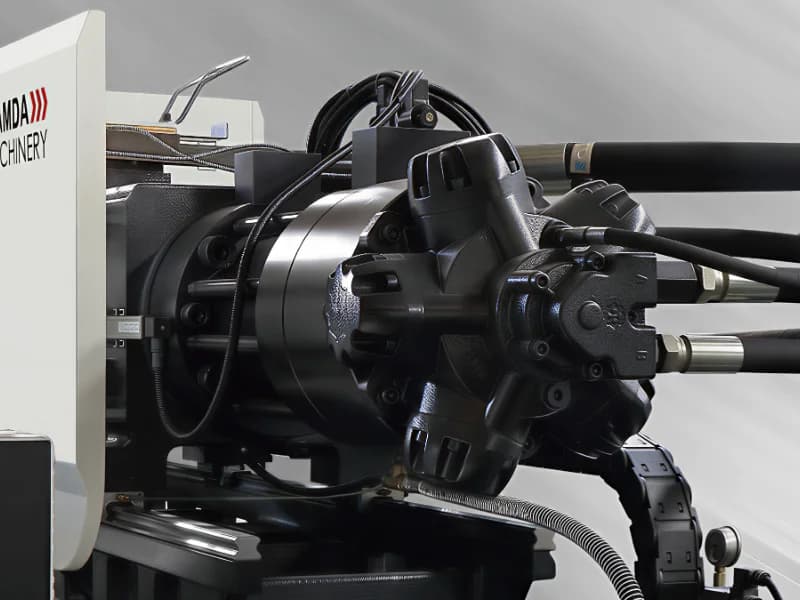
High-speed injection unit with linear guides
Machine Energy Efficiency as Primary Lever
Replacing standard hydraulic machines (1.4-1.6 kWh/kg) with HWAMDA SPV5 servo-hydraulic machines (1.0-1.2 kWh/kg) reduces machine-related carbon emissions by 25-40% immediately. For a 6-machine facility processing 200 tons of PP per month, the energy reduction of 0.4 kWh/kg saves 80,000 kWh annually. At a grid emission factor of 0.5 kg CO2/kWh, this eliminates 40 tons of CO2 per year from Scope 2 emissions. Further optimization through barrel insulation (saves 5-10% of heater energy), optimized process parameters (saves 3-8% of total machine energy), and reduced cycle times (less energy per part at faster cycles) can push total machine energy to 0.85-1.0 kWh/kg, approaching the performance of all-electric machines at a lower capital cost. Install the INOVA controller's energy monitoring module to track kWh per kg produced for each product and machine combination. Set quarterly reduction targets of 2-3% and assign responsibility for achievement. Many customers report that systematic energy monitoring alone—without any equipment changes—identifies wasteful practices and achieves 5-10% reduction in the first year through behavioral changes such as turning off barrel heaters during breaks and optimizing startup sequences.
Renewable Energy and Power Purchase Agreements
Transitioning to renewable electricity is the single largest lever for Scope 2 carbon reduction in injection molding. On-site solar PV installations on factory rooftops provide direct emission elimination at costs of $0.04-0.07/kWh in most regions, well below grid electricity prices. A 500kW rooftop solar array generates approximately 600-800 MWh annually (depending on location), offsetting 300-400 tons of CO2 and covering 30-50% of a 6-machine SPV5 facility's electrical demand. Installation cost of $350,000-500,000 achieves payback in 4-7 years with a 20-25 year system lifespan. For facilities unable to install on-site solar, renewable energy certificates (RECs) or power purchase agreements (PPAs) with wind or solar farms provide Scope 2 emission reduction at premium costs of $0.01-0.03/kWh above grid rates. Some countries offer green electricity tariffs directly from the utility at minimal premiums. Brands like Unilever and Nestle increasingly require their packaging suppliers to demonstrate renewable energy procurement, making this investment a commercial necessity for maintaining key customer relationships. Combine solar PV with battery storage (lithium-ion at $150-250/kWh capacity) to achieve 70-90% renewable electricity share and protect against grid power interruptions.
Key Specs
- •A 500kW rooftop solar array generates approximately 600-800 MWh annually (depending on location), offsetting 300-400 tons of CO2 and covering 30-50% of a 6-machine SPV5 facility's electrical demand.
- •Combine solar PV with battery storage (lithium-ion at $150-250/kWh capacity) to achieve 70-90% renewable electricity share and protect against grid power interruptions.
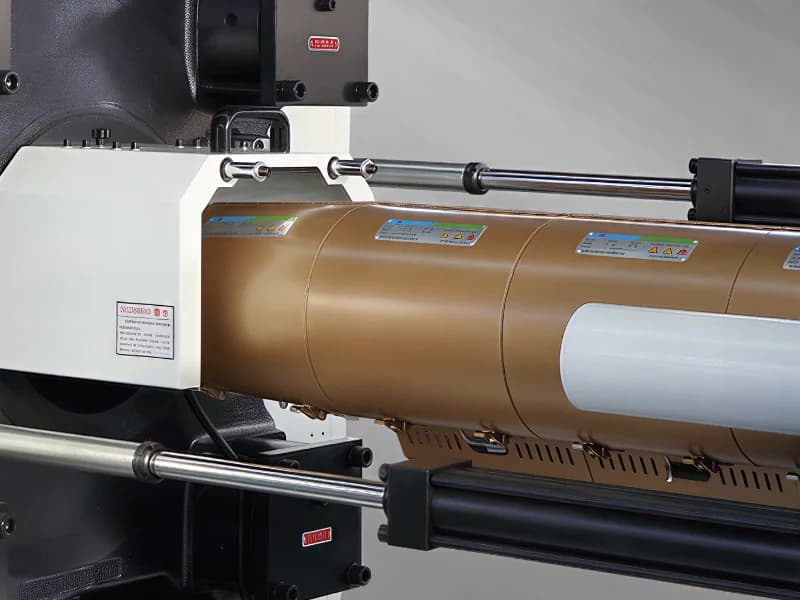
Servo-hydraulic drive system with energy recovery
Need Expert Advice?
Talk to our engineers about your specific production requirements. Free consultation.
Material Lightweighting and Waste Reduction
Lightweighting thin-wall containers reduces material consumption and the associated Scope 3 emissions from PP production. Each 1-gram reduction in a yogurt cup weighing 6 grams eliminates 0.16-0.20 kg CO2 per 100 cups from raw material production alone. HWAMDA SPV5 machines with their precise injection control (plus or minus 0.3% shot weight repeatability) and high injection speeds of 368-422 mm/s enable wall thicknesses as low as 0.35-0.40mm, approaching the limit for PP thin-wall containers while maintaining structural integrity for stacking and transportation. Optimize wall thickness distribution using mold flow simulation to identify areas where material can be removed without compromising performance. Reduce runner weight by using valve-gate hot runner systems (YUDO or Synventive) that eliminate cold runner waste entirely. For cold-runner systems, achieve 100% regrind recycling by installing an inline granulator at the SPV5 machine discharge. Minimize startup and shutdown scrap by programming the INOVA controller with optimized purge sequences that reduce material waste from 50-100 shots to 15-25 shots per transition. Target total material waste (startup, shutdown, rejects, and purge) below 3% of total resin consumed.
Supply Chain and Logistics Carbon Reduction
Scope 3 emissions from resin transportation, mold logistics, and finished goods distribution represent significant carbon reduction opportunities. Source PP resin from regional suppliers within 500km to reduce transportation emissions—PP transported 1,000km by truck generates 0.03-0.05 kg CO2 per kg versus 0.005-0.01 kg CO2 per kg for 500km rail transport. For HWAMDA SPV5 machines shipped from Ningbo, China, ocean freight generates approximately 500-800 kg CO2 per machine (15-25 tons shipping weight) versus 3,000-5,000 kg CO2 for air freight—always choose ocean shipping unless the production timeline is critically urgent. Optimize finished goods packaging density: thin-wall PP yogurt cups nested and sleeved at 50-100 per sleeve achieve 85-90% packaging volume utilization. Lightweight PP containers offer a transportation advantage over PS (density 0.90 vs 1.05 g/cm3) and PET (density 0.90 vs 1.38 g/cm3), fitting more containers per pallet and reducing freight trips. For facilities with multiple SPV5 machines, consolidate resin deliveries into bulk tanker shipments (25 tons per load) rather than individual 1-ton bulk bags, reducing packaging waste and handling emissions. Track Scope 3 emissions using the GHG Protocol's Scope 3 calculation tools.
Key Specs
- •For HWAMDA SPV5 machines shipped from Ningbo, China, ocean freight generates approximately 500-800 kg CO2 per machine (15-25 tons shipping weight) versus 3,000-5,000 kg CO2 for air freight—always choose ocean shipping unless the production timeline is critically urgent.
- •Optimize finished goods packaging density: thin-wall PP yogurt cups nested and sleeved at 50-100 per sleeve achieve 85-90% packaging volume utilization.
- •For facilities with multiple SPV5 machines, consolidate resin deliveries into bulk tanker shipments (25 tons per load) rather than individual 1-ton bulk bags, reducing packaging waste and handling emissions.
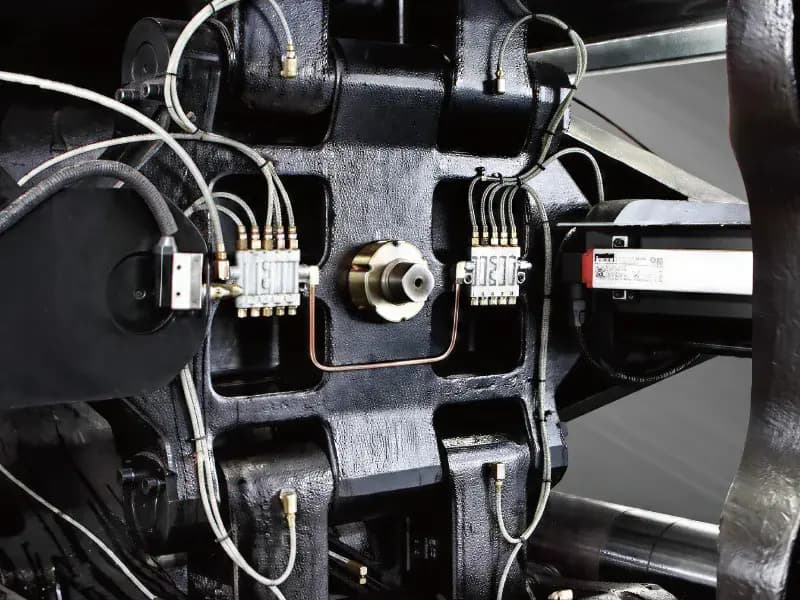
Toggle clamping unit — high rigidity for thin-wall molding
Carbon Reporting and Certification Pathways
Formalize your carbon reduction efforts through recognized certification and reporting frameworks. ISO 14064-1 provides the standard methodology for quantifying and reporting organizational greenhouse gas emissions—certification costs $10,000-25,000 and demonstrates credible carbon accounting to brand-owner customers. Science Based Targets initiative (SBTi) offers a pathway for setting emission reduction targets aligned with Paris Agreement goals—packaging manufacturers typically commit to 25-42% Scope 1+2 reduction by 2030. EcoVadis sustainability ratings (used by 100,000+ companies for supplier assessment) evaluate environmental management practices and assign bronze, silver, gold, or platinum ratings—achieving gold or platinum status opens procurement opportunities with major multinational brands. Carbon footprint labeling on finished packaging is an emerging trend: calculate the per-container carbon footprint using ISO 14067 (carbon footprint of products) methodology and display it on packaging or product data sheets. For a typical PP yogurt cup produced on HWAMDA SPV5 machines with grid electricity, the per-cup carbon footprint is approximately 5-8 grams CO2e. With renewable energy and lightweighting optimization, this can be reduced to 3-5 grams CO2e per cup.
Frequently Asked Questions
For a typical 6-gram PP yogurt cup produced on an HWAMDA SPV5 machine, the total carbon footprint is approximately 5-8 grams CO2e per cup. Raw material (PP resin production) contributes 60-70% at 3.5-4.5g CO2e. Manufacturing energy contributes 15-25% at 1.0-1.5g CO2e. Transportation and packaging add 10-15%. With renewable electricity and optimized processes, the manufacturing contribution can be reduced to 0.3-0.5g CO2e per cup, bringing the total to 4-5.5g CO2e.
Related Guides
Ready to Start Your Project?
Get a free consultation and quotation for your thin-wall packaging production line.
Join 500+ manufacturers in 60+ countries who trust HWAMDA.
Get Free Quote