

Types of Recycled PP and Quality Grades
Recycled PP available for thin-wall packaging falls into three categories with distinct quality and compliance profiles. Post-industrial recyclate (PIR-PP) comes from manufacturing scrap including runners, rejected parts, and edge trim from the same or similar production processes. PIR-PP has known and controlled composition, minimal contamination, and MFI values close to the virgin material. When generated from food-grade production on HWAMDA SPV5 machines, PIR-PP maintains food-contact compliance under FDA and EU regulations if it has not been commingled with non-food materials. Post-consumer recyclate (PCR-PP) comes from curbside collection and sorting of used PP containers. PCR-PP quality varies significantly by source: European and Japanese collection streams typically yield cleaner feedstock than developing market sources. PCR-PP MFI typically ranges from 5-25 g/10min (230°C/2.16kg), lower than the 30-70 g/10min required for thin-wall molding, requiring blending with high-MFI virgin PP. Chemically recycled PP undergoes pyrolysis or depolymerization to produce virgin-quality monomers that are repolymerized to food-grade PP. Chemical recycling produces PP indistinguishable from virgin material but at 2-3x the cost.
Key Specs
- •PCR-PP MFI typically ranges from 5-25 g/10min (230°C/2.16kg), lower than the 30-70 g/10min required for thin-wall molding, requiring blending with high-MFI virgin PP.
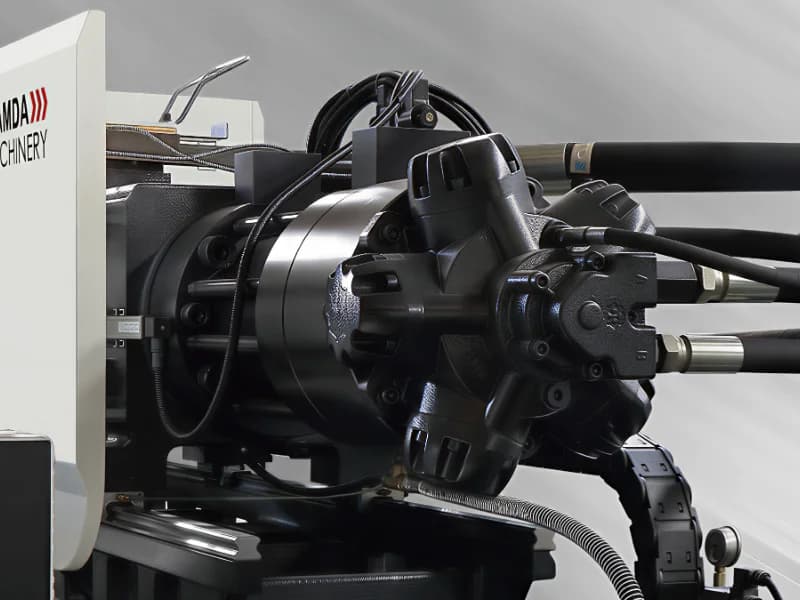
High-speed injection unit with linear guides
Processing Challenges on High-Speed Machines
Thin-wall injection molding at speeds of 368-422 mm/s on SPV5 machines demands consistent melt behavior that recycled PP can compromise if not properly managed. The primary challenge is MFI variation: virgin thin-wall PP grades have MFI of 30-70 g/10min with batch-to-batch variation below 5%, while PCR-PP batches may vary by 20-40%. This MFI inconsistency causes shot-to-shot weight variation exceeding the plus or minus 2% tolerance required for thin-wall containers weighing 4-25 grams. Contamination in PCR-PP including paper fibers, PE cross-contamination, pigment residues, and degraded polymer chains can cause specks, weak spots, and odor issues. Process the recycled PP through a 120-mesh screen pack at the extruder to filter particles above 125 micrometers. Increase back pressure by 1-2 MPa above the virgin PP setting to improve melt homogeneity. Reduce injection speed by 5-10% when running blends exceeding 15% recycled content to accommodate the slightly different rheological behavior. Monitor part weight variation on the INOVA controller's SPC screen and adjust holding pressure in 0.5 MPa increments to maintain tolerance. Run a DOE (design of experiments) when introducing a new recycled PP source to establish the optimal process window.
Blend Ratios and Recipe Development
Develop blend recipes that balance recycled content targets with thin-wall part quality requirements. For PIR-PP (production regrind) from the same product line on SPV5 machines, incorporation rates of 10-25% are typical without measurable quality impact. The regrind has identical base resin, has been through only one additional heat history, and maintains food-grade status. Use a gravimetric blender (plus or minus 0.1% accuracy) mounted on the SPV5 feed throat to maintain precise ratios. For PCR-PP blends, start at 5-10% recycled content with high-MFI virgin PP (60-70 g/10min) to compensate for the lower MFI of the recyclate. Test mechanical properties at each 5% increment increase: flexural modulus should remain above 1,200 MPa and Izod impact strength above 3.0 kJ/m2 for thin-wall container viability. Maximum PCR-PP content for thin-wall applications is typically 20-30%, limited by increasing brittleness and odor concerns. For IML containers, PCR-PP content above 15% may affect label adhesion due to surface energy changes—test label peel strength at each blend ratio. Document all blend recipes with complete traceability (virgin PP lot number, recycled PP source, batch date, blend ratio) for quality audit requirements.
Key Specs
- •For PIR-PP (production regrind) from the same product line on SPV5 machines, incorporation rates of 10-25% are typical without measurable quality impact.
- •Use a gravimetric blender (plus or minus 0.1% accuracy) mounted on the SPV5 feed throat to maintain precise ratios.
- •For PCR-PP blends, start at 5-10% recycled content with high-MFI virgin PP (60-70 g/10min) to compensate for the lower MFI of the recyclate.
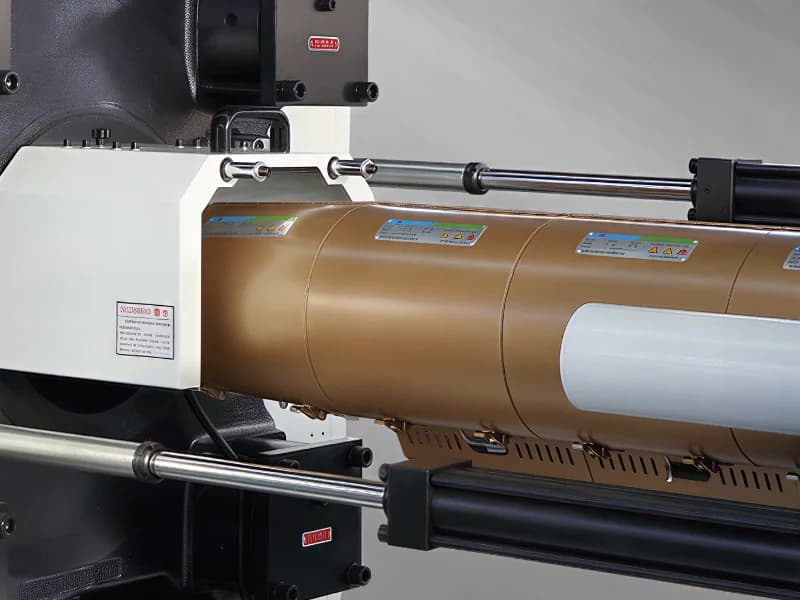
Servo-hydraulic drive system with energy recovery
Need Expert Advice?
Talk to our engineers about your specific production requirements. Free consultation.
Food Contact Compliance for Recycled PP
Food-contact use of recycled PP is governed by strict regulations that vary by jurisdiction. In the EU, Regulation (EU) 2022/1616 on recycled plastic materials for food contact requires that recycling processes be authorized by EFSA (European Food Safety Authority). Currently, mechanical recycling of PP for food contact is not yet broadly authorized under this regulation, limiting recycled PP in food-contact applications to closed-loop PIR systems or chemically recycled PP with EFSA-approved decontamination processes. In the USA, FDA requires a Letter of No Objection (LNO) for recycled plastics in food contact, based on challenge testing of the recycling process to demonstrate adequate removal of potential contaminants. Several mechanical PP recycling processes have obtained FDA LNOs for food-contact use. For non-food applications (industrial packaging, plant pots, automotive), recycled PP can be used without food-contact restrictions. Many brand owners are specifying 10-30% recycled content for non-food packaging to meet sustainability targets. When using recycled PP on HWAMDA SPV5 machines, maintain complete batch traceability through the INOVA controller's production logging system and the gravimetric blender's recipe database.
Quality Control Testing for Recycled PP Blends
Implement additional quality control tests when processing recycled PP blends on SPV5 machines. Test incoming recycled PP resin for MFI (target within 15% of specification), moisture content (below 0.05%), ash content (below 0.5% indicating low filler contamination), and DSC melting point (160-168°C for PP homopolymer). During production, increase the part weight check frequency from every 30 minutes to every 15 minutes when running recycled blends. Measure part wall thickness at 4 points per container using an ultrasonic thickness gauge—variation should not exceed plus or minus 0.05mm from the nominal 0.4-0.8mm specification. Conduct drop impact testing (1.2 meter drop onto concrete at 4°C) every production shift to verify that recycled content has not reduced impact strength below the failure threshold. For food packaging applications, perform organoleptic testing (taste and odor transfer assessment per EN 1230) on production samples from each new recycled PP batch. Test label adhesion strength on IML containers by the cross-cut tape test method (ASTM D3359)—adhesion must achieve Class 4B or better. Maintain retain samples from each production batch for 3 years for traceability and complaint investigation purposes.
Key Specs
- •Test incoming recycled PP resin for MFI (target within 15% of specification), moisture content (below 0.05%), ash content (below 0.5% indicating low filler contamination), and DSC melting point (160-168°C for PP homopolymer).
- •Measure part wall thickness at 4 points per container using an ultrasonic thickness gauge—variation should not exceed plus or minus 0.05mm from the nominal 0.4-0.8mm specification.
- •Conduct drop impact testing (1.2 meter drop onto concrete at 4°C) every production shift to verify that recycled content has not reduced impact strength below the failure threshold.
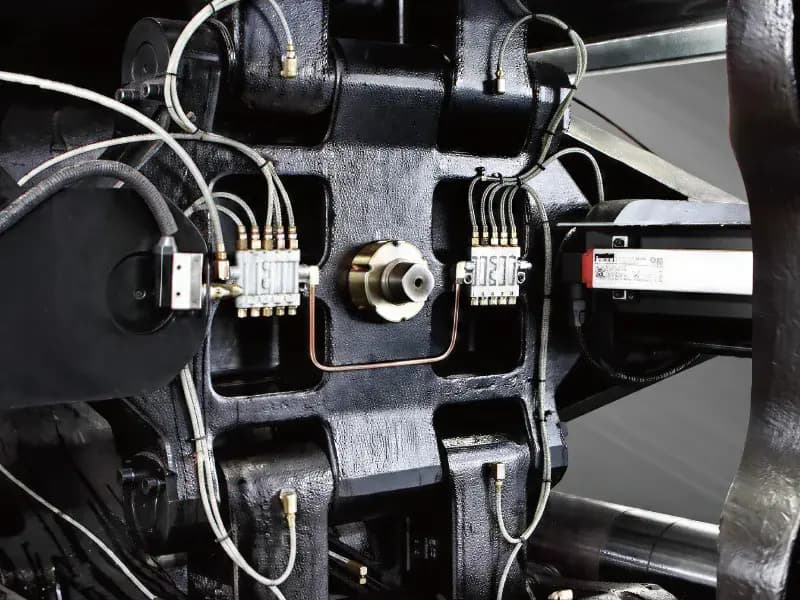
Toggle clamping unit — high rigidity for thin-wall molding
Cost Analysis and Market Positioning
Recycled PP pricing varies significantly by type and quality. PIR-PP (production regrind) has essentially zero material cost since it replaces virgin PP that would otherwise be waste. At virgin PP prices of $1,100-1,400 per ton and a 15% regrind rate, the material cost saving is $165-210 per ton of product, or $0.001-0.002 per thin-wall container. PCR-PP prices range from $800-1,200 per ton depending on quality and supply region, offering modest savings of 10-25% versus virgin PP. However, PCR-PP requires additional processing (drying, filtration, blend control) that adds $50-100 per ton in processing costs. The primary driver for recycled PP is not cost savings but market access: major brand owners including Nestle, Unilever, and Danone have committed to 25-50% recycled content by 2025-2030. Packaging manufacturers unable to demonstrate recycled content capability lose procurement eligibility for these high-volume contracts. HWAMDA SPV5 machines with their gravimetric blenders, INOVA process monitoring, and SPC capability provide the process control infrastructure needed to reliably produce thin-wall containers with documented recycled content. Position your facility to capture the recycled content premium of $50-150 per ton that major brands are willing to pay for certified sustainable packaging.
Frequently Asked Questions
For PIR-PP (production regrind) from the same product line, 15-25% incorporation is standard with no measurable quality impact on HWAMDA SPV5 machines. For PCR-PP (post-consumer), 10-20% is achievable in thin-wall applications with wall thickness above 0.5mm, but requires careful MFI matching and blend control. Above 25% total recycled content, impact strength and surface quality typically degrade below acceptable levels for packaging applications. IML containers may be limited to 15% PCR-PP due to label adhesion sensitivity.
Related Guides
Ready to Start Your Project?
Get a free consultation and quotation for your thin-wall packaging production line.
Join 500+ manufacturers in 60+ countries who trust HWAMDA.
Get Free Quote