

Servo-Hydraulic Drive Architecture in HWAMDA SPV5 Machines
The HWAMDA SPV5 servo-hydraulic system pairs a permanent magnet synchronous servo motor with a fixed-displacement axial piston pump. Unlike conventional hydraulic systems where a constant-speed motor drives a variable-displacement pump (which still consumes 30-40 percent of rated power at zero flow), the SPV5 servo motor speed varies from 0 to 1800 RPM proportional to the actual flow demand. During injection at 368-422 mm/s, the motor runs at peak speed delivering maximum flow and pressure. During the cooling phase (which occupies 60-70 percent of a 4.0s cycle), the motor idles at near-zero RPM, consuming less than 0.5 kW. The accumulator system in the SPV5 stores hydraulic energy during low-demand phases and releases it during peak-demand injection, enabling injection speeds that would otherwise require a motor 40-60 percent larger. This architecture delivers peak injection power of 75-180 kW (depending on tonnage) while the installed motor is sized at only 30-75 kW. The power factor exceeds 0.95 across the operating range, compared to 0.7-0.85 for conventional induction motor systems, further reducing apparent power demand and utility costs.
Key Specs
- •During injection at 368-422 mm/s, the motor runs at peak speed delivering maximum flow and pressure.
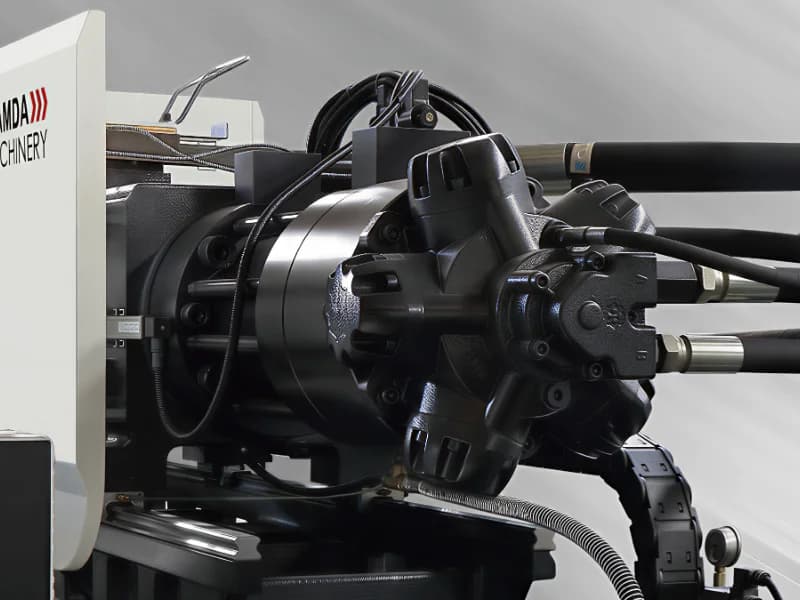
High-speed injection unit with linear guides
Energy Consumption Comparison Across Drive Technologies
Comparing HWAMDA SPV5 servo-hydraulic machines against conventional hydraulic, all-electric, and hybrid competitors provides a clear economic picture. For an HMD 380M8-SPV producing 8-cavity yogurt cups (6g each, 4.0s cycle, 48g shot weight): servo-hydraulic SPV5 consumes 1.05-1.15 kWh/kg, processing 43 kg/hr of PP, yielding 45-50 kWh total machine power. A conventional hydraulic machine of equivalent tonnage consumes 1.4-1.6 kWh/kg = 60-69 kWh -- an additional 15-19 kWh per hour. At industrial electricity rates of USD 0.08-0.12 per kWh, the SPV5 saves USD 1.20-2.28 per hour, or USD 10,500-20,000 per year on a 3-shift operation. All-electric machines achieve 0.9-1.1 kWh/kg but cost 40-60 percent more than servo-hydraulic for equivalent tonnage and speed, with ROI payback on the price premium exceeding 5 years in most thin-wall applications. Hybrid high-speed machines (electric clamp, hydraulic injection) achieve 0.8-1.0 kWh/kg but are typically 30-50 percent more expensive than servo-hydraulic. The SPV5 servo-hydraulic platform represents the optimal cost-performance balance for thin-wall food packaging production.
Energy Monitoring and Optimization via INOVA Controller
The HWAMDA SPV5 INOVA controller provides real-time energy monitoring that enables ongoing optimization beyond the baseline servo-hydraulic savings. The controller displays instantaneous power draw (kW), cumulative energy per cycle (kJ), and specific energy consumption (kWh/kg) on the main dashboard. These metrics update every cycle, allowing operators to see the immediate impact of parameter changes on energy consumption. Reducing pack pressure from 90 to 75 MPa (where quality allows) typically saves 3-5 percent energy. Shortening cooling time by 0.2s saves energy both directly (less hydraulic holding power) and indirectly (higher throughput per kWh of fixed overhead power). The INOVA controller logs energy data per hour, shift, and day, enabling management reporting on energy KPIs. Integration with factory MES (Manufacturing Execution System) via OPC-UA allows centralized energy monitoring across multiple SPV5 machines. Monthly energy trend analysis identifies degradation: a progressive increase of 5-10 percent in specific energy consumption over 3-6 months typically indicates hydraulic system issues (pump wear, valve leakage, or oil degradation) requiring maintenance.
Key Specs
- •Reducing pack pressure from 90 to 75 MPa (where quality allows) typically saves 3-5 percent energy.
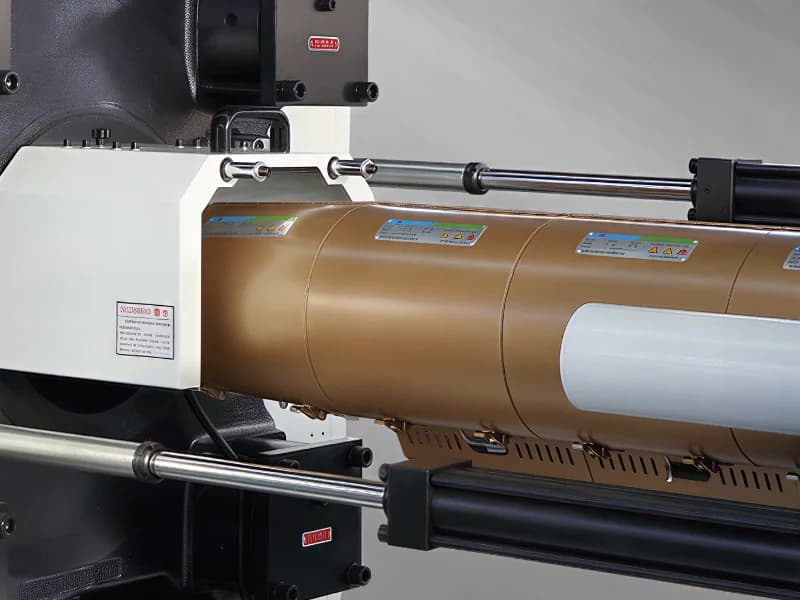
Servo-hydraulic drive system with energy recovery
Need Expert Advice?
Talk to our engineers about your specific production requirements. Free consultation.
ROI Calculation Framework for Servo-Hydraulic Upgrade
Quantifying the return on investment for upgrading from a conventional hydraulic machine to an HWAMDA SPV5 servo-hydraulic requires accounting for energy savings, productivity gains, and maintenance cost reduction. Energy savings: for a 380-ton machine running 24/7, the annual energy saving versus conventional hydraulic is USD 10,500-20,000 depending on local electricity rates. Productivity gain: the SPV5 parallel movement capability (charging on fly during mold opening) reduces cycle time by 0.3-0.5s versus sequential-operation machines, increasing annual output by 8-12 percent. On an 8-cavity yogurt cup line producing 7,200 cups/hour, a 10 percent increase adds 6.3 million cups per year at a conversion margin of USD 0.003-0.005 per cup = USD 19,000-31,500 additional margin. Maintenance cost: servo-hydraulic systems require oil changes every 4,000-6,000 hours (versus 2,000-3,000 for conventional), and the sealed system reduces oil consumption by 60-70 percent. Annual maintenance savings: USD 2,000-4,000. Total annual benefit: USD 31,500-55,500. Against a machine investment of USD 85,000-120,000 for the HMD 380M8-SPV, simple payback is 1.5-3.8 years.
Hydraulic Oil Management for Maximum Efficiency
Hydraulic oil condition directly affects servo-hydraulic system efficiency, with degraded oil increasing energy consumption by 5-15 percent through higher viscosity, internal leakage past worn seals, and reduced lubrication of pump components. HWAMDA SPV5 machines specify ISO VG 46 hydraulic oil (kinematic viscosity 41.4-50.6 cSt at 40 degrees C) for optimal servo pump efficiency. Oil temperature should be maintained at 40-50 degrees C -- below 35 degrees C the oil is too viscous (consuming excess pump energy), while above 55 degrees C the oil degrades rapidly and seal life decreases. The SPV5 oil cooler maintains temperature within this range at ambient temperatures up to 40 degrees C. Oil analysis should be performed every 1,000 operating hours, testing for: viscosity (replace if deviating more than plus or minus 10 percent from new oil specification), water content (maximum 0.1 percent / 1000 ppm), particle count (ISO 4406 target 18/16/13 for servo systems), and total acid number (TAN, replace when increase exceeds 0.5 mg KOH/g above new oil baseline). Oil change interval on SPV5 machines is 4,000-6,000 operating hours, with oil volume of 180-350 liters depending on machine tonnage. Use of high-performance synthetic hydraulic oil extends change intervals to 8,000-10,000 hours at approximately 2 times the cost per liter.
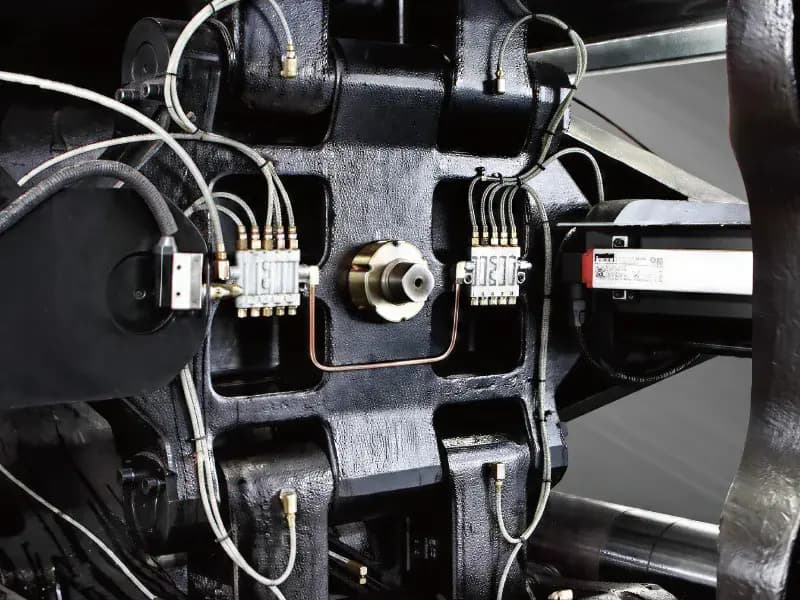
Toggle clamping unit — high rigidity for thin-wall molding
Utility Infrastructure Requirements for SPV5 Installations
Proper electrical infrastructure maximizes the energy efficiency benefits of HWAMDA SPV5 servo-hydraulic machines. The servo motor's variable frequency operation generates harmonic currents (5th and 7th harmonics primarily) that can affect power quality if multiple machines share an electrical supply without filtering. For installations of 4 or more SPV5 machines, install an active harmonic filter or ensure the supply transformer is de-rated to 80 percent of nameplate capacity. Power supply specifications for SPV5 machines: 380V/415V 3-phase, 50/60 Hz, with voltage regulation within plus or minus 5 percent. The HMD 380M8-SPV draws a peak current of approximately 120A during injection, dropping to 15-25A during cooling. The average power factor of 0.95 means minimal reactive power compensation is needed. Install a power meter (Carlo Gavazzi EM340 or equivalent) at each machine disconnect to enable individual machine energy tracking. Compressed air requirements for valve gate actuation and air-assist ejection total 200-400 NL/min at 6 bar per machine. Cooling water supply at 15-25 degrees C and 3-5 bar pressure, flow rate 60-100 L/min per machine. Proper utility sizing prevents voltage sags during injection that can affect servo motor response and injection speed consistency.
Frequently Asked Questions
The SPV5 servo-hydraulic system consumes 1.0-1.2 kWh/kg versus 1.4-1.6 kWh/kg for conventional hydraulic, a 25-35 percent reduction. For a 380-ton machine running 24/7 producing yogurt cups, this saves USD 10,500-20,000 annually at electricity rates of USD 0.08-0.12/kWh. The servo motor idles at near-zero power during the cooling phase (60-70 percent of cycle time), eliminating the constant 5-15 kW idle loss of conventional systems.
Related Guides
Ready to Start Your Project?
Get a free consultation and quotation for your thin-wall packaging production line.
Join 500+ manufacturers in 60+ countries who trust HWAMDA.
Get Free Quote