Ejection Methods for Thin-Wall Food Packaging
Three ejection methods serve thin-wall container production on HWAMDA SPV5 machines: stripper plate ejection, air-assist ejection, and ejector pin ejection. Stripper plate ejection is the dominant method for cups and containers, applying ejection force uniformly around the full container rim perimeter. The stripper plate contacts the rim (1.0-2.0mm wide contact area) and pushes the container off the core with distributed force, preventing the localized stress concentrations that cause wall deformation. For 0.5mm-wall yogurt cups, stripper plate ejection force is typically 200-500N total distributed across 8 cavities (25-60N per cavity), with ejection stroke of 80-120mm matching the container depth. Air-assist ejection uses compressed air (4-6 bar) introduced through a poppet valve at the core tip to break the vacuum between the part and the core surface. This method is essential for deep-draw containers where the vacuum hold-down force can exceed 100N per cavity. Combined stripper plate plus air assist is the standard configuration on HWAMDA SPV5 thin-wall molds, with air release timed to precede stripper plate motion by 0.05-0.1 seconds via the INOVA controller.
Key Specs
- •The stripper plate contacts the rim (1.0-2.0mm wide contact area) and pushes the container off the core with distributed force, preventing the localized stress concentrations that cause wall deformation.
- •For 0.5mm-wall yogurt cups, stripper plate ejection force is typically 200-500N total distributed across 8 cavities (25-60N per cavity), with ejection stroke of 80-120mm matching the container depth.
- •Air-assist ejection uses compressed air (4-6 bar) introduced through a poppet valve at the core tip to break the vacuum between the part and the core surface.
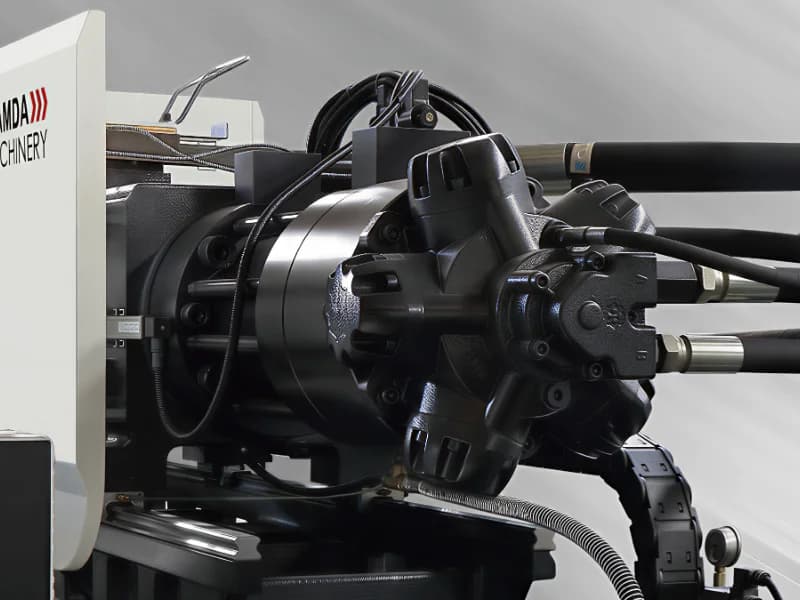
High-speed injection unit with linear guides
Ejection Force Calculation and Speed Profiling
Ejection force requirements depend on part shrinkage onto the core, draft angle, surface friction, and vacuum. For a PP yogurt cup (70mm diameter, 100mm depth, 0.5mm wall, 1.0 degree draft) on HWAMDA SPV5 molds, the shrinkage force calculation: PP shrinks 1.5-2.0 percent onto the core, creating a compressive contact pressure of approximately 0.3-0.5 MPa over the 220 cm2 core surface area. With a steel-to-PP friction coefficient of 0.3-0.4, the force to slide the part off is 20-40N per cavity. Adding vacuum break force of 30-50N per cavity and core surface adhesion, total ejection force reaches 60-100N per cavity. The HWAMDA SPV5 ejection system provides hydraulic ejection force of 50-80 kN (depending on machine tonnage), far exceeding the requirement but controlled via the INOVA controller's ejection speed profile to prevent part deformation. Ejection speed is profiled in 3 stages: initial break-away at 50-80 mm/s (slow start to overcome static friction and vacuum), acceleration to 200-300 mm/s through the main stroke, and deceleration to 100-150 mm/s at the end to prevent parts from bouncing or flying off the ejector.
Core Surface Treatments for Reliable Part Release
Core surface finish and coatings significantly affect ejection reliability on thin-wall molds. Polished cores (SPI B-1 to A-2, Ra 0.025-0.1 micrometers) create a smooth surface that minimizes friction but can increase vacuum adhesion due to the seal effect. A light texture (VDI 12-15, Ra 0.4-0.8 micrometers) on the core surface breaks the vacuum seal and reduces ejection force by 15-25 percent compared to a polished core. For HWAMDA SPV5 yogurt cup molds, the recommended core surface is SPI B-1 (Ra 0.05-0.1 micrometers) on the sidewall with a micro-texture band (VDI 15, Ra 0.56 micrometers) at the base-to-wall radius where vacuum adhesion is strongest. Physical vapor deposition (PVD) coatings reduce friction and extend mold life: TiN (titanium nitride, gold color) reduces the friction coefficient from 0.35-0.40 for uncoated H13 to 0.15-0.20, cutting ejection force by approximately 40 percent. DLC (diamond-like carbon) coating provides even lower friction at 0.08-0.12 and hardness of 2000-3000 HV, but at higher cost (USD 500-800 per core versus USD 200-400 for TiN). Recoating interval is 2-5 million shots depending on the PP filler content.
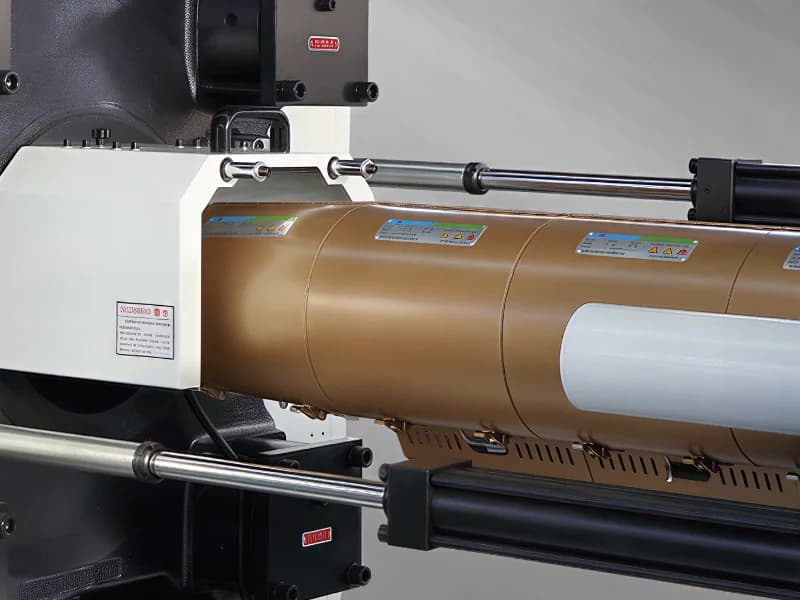
Servo-hydraulic drive system with energy recovery
Need Expert Advice?
Talk to our engineers about your specific production requirements. Free consultation.
Ejection Timing Integration with Robot Take-Out
On HWAMDA SPV5 production lines equipped with SWITEK robots for part removal, the ejection system timing must synchronize precisely with the robot entry and pick-up sequence. The mold opening, ejection, and robot operation constitute a complex choreography completed in 0.8-1.5s of the total 3.5-5.0s cycle time. Sequence on the HMD 380M8-SPV: mold opens (0.3-0.5s stroke time at 1200 mm/s maximum opening speed), ejection begins at the mold-open position (0.1-0.2s ejection stroke), SWITEK robot enters the mold area (0.2-0.3s swing time), robot grippers engage parts (0.1-0.2s), ejection retracts (0.1s), robot exits with parts (0.2-0.3s), and mold closes (0.3-0.5s). The INOVA controller provides digital output signals for robot interface: mold-open confirmation, ejection-forward confirmation, and ejection-retract confirmation. The robot controller (SWITEK SWC series) responds with robot-clear signal to authorize mold closing. Interlock response time between controllers is under 20 milliseconds. Any delay in this sequence directly extends cycle time -- optimizing the overlap between mold opening and robot entry saves 0.1-0.2s per cycle.
Troubleshooting Ejection Problems on Thin-Wall Molds
Ejection problems are among the most common production disruptions on thin-wall lines. Part sticking on core: if parts remain on the core after full ejection stroke, verify air assist is functioning (check air pressure at 4-6 bar, confirm poppet valve actuation timing), inspect core surface for scratches or burrs that create mechanical locking (hand-polish with 1000-grit diamond paste), and verify draft angle meets the 0.5-1.5 degree minimum. Ejection marks on parts: whitening or indentation at the ejector contact area indicates excessive localized force -- switch from ejector pins to a stripper plate design, or increase the ejector contact area by 50-100 percent. Double ejection (parts falling between the mold halves instead of being caught by the robot): adjust ejection speed to match the robot pick-up timing, or add part-present sensors to verify successful robot grip before mold closing. Parts deforming during ejection: reduce ejection speed by 20-30 percent, increase cooling time by 0.2-0.3s to improve part rigidity at ejection, and verify that the stripper plate is parallel to the mold parting line within 0.03mm. On HWAMDA SPV5 machines, the INOVA controller logs ejection position and pressure data for each cycle, enabling trend analysis to detect progressive sticking before it causes a production stop.
Key Specs
- •Part sticking on core: if parts remain on the core after full ejection stroke, verify air assist is functioning (check air pressure at 4-6 bar, confirm poppet valve actuation timing), inspect core surface for scratches or burrs that create mechanical locking (hand-polish with 1000-grit diamond paste), and verify draft angle meets the 0.5-1.5 degree minimum.
- •Parts deforming during ejection: reduce ejection speed by 20-30 percent, increase cooling time by 0.2-0.3s to improve part rigidity at ejection, and verify that the stripper plate is parallel to the mold parting line within 0.03mm.
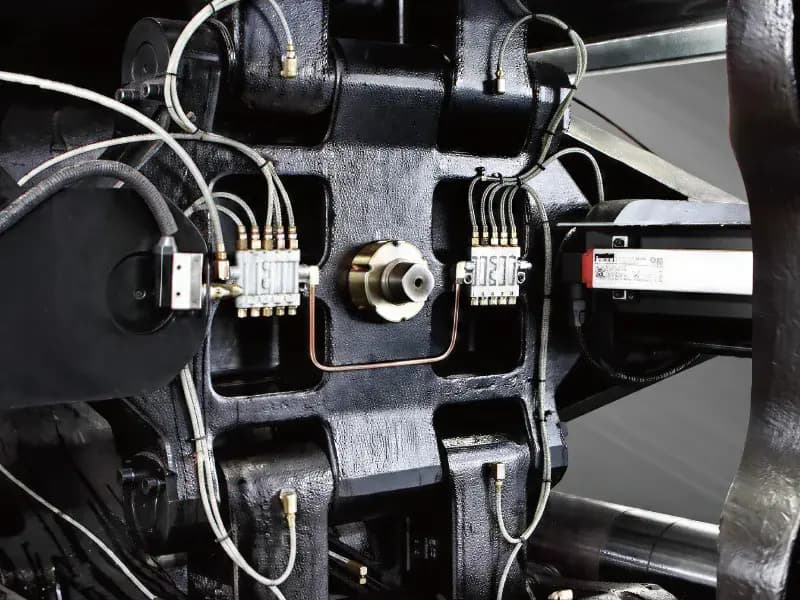
Toggle clamping unit — high rigidity for thin-wall molding
Stack Mold Ejection Considerations
Stack molds on HWAMDA SPV5 machines double cavity count (e.g., 8+8 = 16 cavities) by utilizing two parting lines, but add complexity to the ejection system. Each parting level requires an independent ejection system actuated from the machine's single ejection stroke through a mechanical linkage or separate hydraulic circuit. The center section of a stack mold houses the hot runner manifold and the ejection mechanism for the moving-side cavities, while the fixed-side cavities eject conventionally. Synchronization between the two ejection levels is critical: if one level ejects 0.1s before the other, the SWITEK robot cannot pick up all parts in a single entry. HWAMDA SPV5 machines support dual-ejection control through the INOVA controller, providing independent speed, position, and force profiles for each ejection stroke. The ejection force budget for stack molds doubles (120-200N per cycle for 16 yogurt cup cavities), well within the 50-80 kN capacity of SPV5 machines. Maintenance of stack mold ejection systems requires attention to the center section guide system -- bushing clearance should not exceed 0.05mm to maintain parting line alignment and ensure simultaneous contact of the stripper plates with all container rims.
Frequently Asked Questions
Stripper plate ejection combined with air assist is the standard for thin-wall yogurt cups on HWAMDA SPV5 molds. The stripper plate distributes ejection force uniformly around the rim perimeter (25-60N per cavity), preventing wall deformation. Air assist at 4-6 bar breaks the core vacuum 0.05-0.1s before the stripper plate moves. This combination achieves reliable ejection at 200-300 mm/s stroke speed within the 0.1-0.2s ejection window.
Related Guides
Ready to Start Your Project?
Get a free consultation and quotation for your thin-wall packaging production line.
Join 500+ manufacturers in 60+ countries who trust HWAMDA.
Get Free Quote