

Understanding Shrinkage Mechanisms in PP Thin-Wall Parts
Polypropylene is a semi-crystalline polymer with shrinkage behavior governed by crystallization kinetics, molecular orientation, and cooling rate. In thin-wall parts molded on HWAMDA SPV5 machines at injection speeds of 368-422 mm/s, the melt experiences extreme shear rates of 50,000-150,000 s-1 during filling, aligning polymer chains in the flow direction. This orientation creates anisotropic shrinkage: 1.5-2.5 percent in the flow direction versus 1.0-1.8 percent transverse to flow for homo-PP. The frozen skin layer (formed within 0.01-0.05s of melt contacting the 25-35 degrees C mold surface) has high molecular orientation and lower crystallinity, while the core solidifies more slowly with higher crystallinity and less orientation. This through-thickness asymmetry generates bending moments that cause warpage. For a 0.5mm-wall yogurt cup, the skin-core transition zone is approximately 0.05-0.10mm from the surface. Wall thickness variation of just 0.05mm changes local shrinkage by 0.2-0.3 percent, which on a 100mm diameter container produces 0.15-0.20mm warpage at the rim.
Key Specs
- •In thin-wall parts molded on HWAMDA SPV5 machines at injection speeds of 368-422 mm/s, the melt experiences extreme shear rates of 50,000-150,000 s-1 during filling, aligning polymer chains in the flow direction.
- •For a 0.5mm-wall yogurt cup, the skin-core transition zone is approximately 0.05-0.10mm from the surface.
- •Wall thickness variation of just 0.05mm changes local shrinkage by 0.2-0.3 percent, which on a 100mm diameter container produces 0.15-0.20mm warpage at the rim.
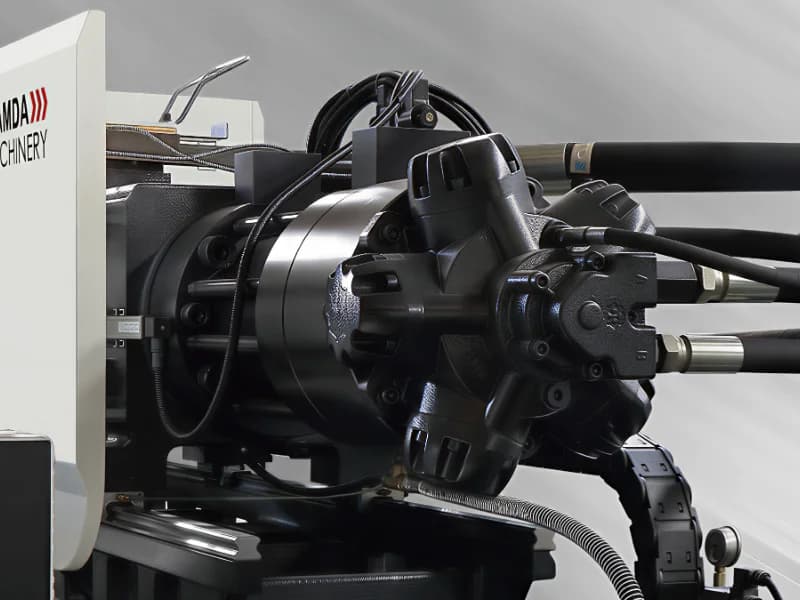
High-speed injection unit with linear guides
Mold Design Strategies for Warpage Minimization
Mold design directly controls the three primary warpage drivers: cooling uniformity, gate location, and part geometry. Uniform cooling within plus or minus 2 degrees C across the cavity surface is the most critical factor -- temperature differentials above 5 degrees C between the core and cavity sides produce through-thickness cooling asymmetry that creates 0.3-0.5mm warpage on thin-wall cups. On HWAMDA SPV5 molds, achieving uniform cooling requires: separate cooling circuits for core and cavity with independent temperature control, conformal cooling in heat-accumulation zones (base corners, rib intersections), and BeCu inserts at core tips where conventional cooling cannot reach. Gate location affects warpage through molecular orientation patterns: center-bottom gating on round containers creates radial symmetry that minimizes differential shrinkage. Off-center or side-gated round containers develop asymmetric orientation causing bowl-shaped warpage of 0.5-1.0mm. Part geometry modifications that reduce warpage include: adding a rim stiffening bead (0.3-0.5mm height, 1.0-1.5mm width) at the container lip, incorporating small draft angles (1.0-1.5 degrees versus the minimum 0.5 degrees) for easier ejection with less deformation, and avoiding abrupt wall thickness transitions.
Process Parameter Optimization for Shrinkage Control
Process parameters on HWAMDA SPV5 machines provide fine-tuning control over shrinkage within the range established by mold design. Pack pressure is the primary shrinkage control parameter: increasing pack pressure from 60 to 90 MPa typically reduces PP shrinkage by 0.3-0.5 percent. However, excessive pack pressure above 100 MPa causes residual stress that relaxes post-ejection, producing delayed warpage that manifests 2-24 hours after molding. The INOVA controller's 10-stage pressure profile enables differential packing: higher initial pack pressure (80-90 MPa) for 0.3s to densify the gate area and thick sections, stepping down to 60-70 MPa for the remaining hold time to prevent overpacking thin sections. Melt temperature affects crystallization: higher melt temperatures (240-260 degrees C) produce slower crystallization and lower overall shrinkage (1.2-1.5 percent) but longer cycle times. Lower melt temperatures (220-230 degrees C) increase crystallization speed and shrinkage (1.8-2.2 percent) but enable faster cycles. Cooling time directly affects part temperature at ejection: ejecting too early (above 45 degrees C surface temperature) allows post-mold shrinkage that causes warpage, while over-cooling wastes cycle time.
Key Specs
- •Pack pressure is the primary shrinkage control parameter: increasing pack pressure from 60 to 90 MPa typically reduces PP shrinkage by 0.3-0.5 percent.
- •However, excessive pack pressure above 100 MPa causes residual stress that relaxes post-ejection, producing delayed warpage that manifests 2-24 hours after molding.
- •The INOVA controller's 10-stage pressure profile enables differential packing: higher initial pack pressure (80-90 MPa) for 0.3s to densify the gate area and thick sections, stepping down to 60-70 MPa for the remaining hold time to prevent overpacking thin sections.
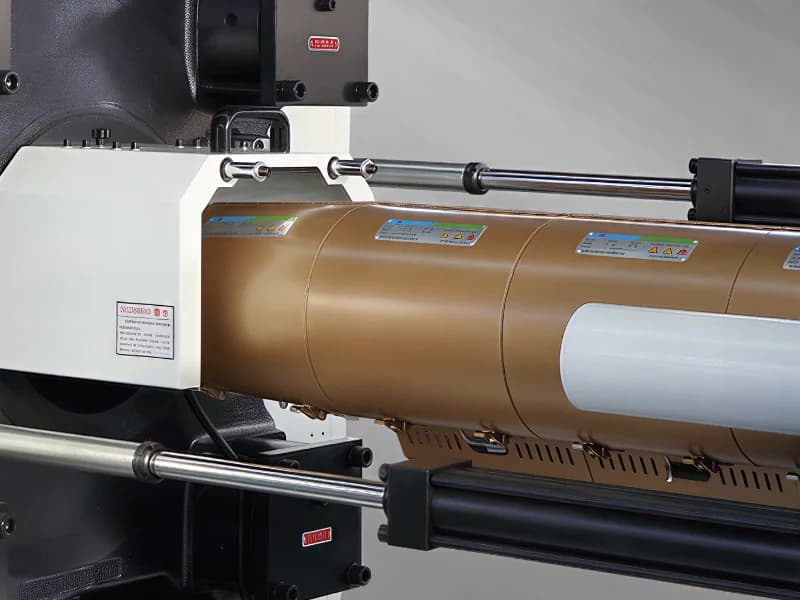
Servo-hydraulic drive system with energy recovery
Need Expert Advice?
Talk to our engineers about your specific production requirements. Free consultation.
Differential Shrinkage and Warpage Prediction Using Simulation
Mold flow simulation (Moldflow, Moldex3D) predicts shrinkage and warpage before mold steel is cut, potentially saving USD 10,000-30,000 in mold modifications. For thin-wall parts running on HWAMDA SPV5 machines, simulation accuracy requires inputting actual machine parameters: injection speed profile (368-422 mm/s peak), pack pressure profile, and cooling conditions. The simulation predicts warpage by calculating differential shrinkage across the part surface, identifying areas where flow orientation, cooling rate, or packing pressure variations create bending moments. For a 0.5mm-wall yogurt cup with center-bottom gate, simulation typically shows maximum warpage at the rim of 0.10-0.25mm for a well-designed mold. Simulation identifies the dominant warpage mechanism -- orientation-driven (from shear alignment during filling), cooling-driven (from temperature differentials), or pressure-driven (from packing non-uniformity) -- which guides the corrective strategy. For HWAMDA SPV5 mold orders, requesting simulation results from the mold maker before final approval is recommended for all multi-cavity molds. The simulation cost of USD 2,000-5,000 per part is minor compared to the cost of trial-and-error mold modifications at USD 5,000-15,000 per iteration.
Post-Mold Shrinkage and Dimensional Stability Over Time
Thin-wall PP parts continue to shrink for 24-72 hours after ejection as crystallization completes and residual stresses relax. This post-mold shrinkage amounts to an additional 0.1-0.3 percent beyond the immediate mold shrinkage, and is often overlooked during quality inspection performed immediately after molding. For HWAMDA SPV5 production lines, dimensional inspection should be performed at three time points: immediately after ejection (for process monitoring), at 24 hours (for shipping inspection), and at 72 hours (for final qualification). Rim diameter on a 70mm yogurt cup may shrink an additional 0.07-0.21mm over 72 hours. Storage temperature affects post-mold shrinkage: parts stored at 40 degrees C (e.g., in a warehouse without climate control) complete shrinkage faster and reach a higher final shrinkage than parts stored at 20 degrees C. For IML containers where precise dimensions are critical for automated filling line compatibility (rim diameter tolerance of plus or minus 0.15mm), mold dimensions must be oversized to compensate for the total shrinkage including the post-mold component. Work with the mold maker to specify the shrinkage compensation factor based on the specific PP grade: homo-PP at 1.6-2.0 percent total, RCP at 1.4-1.8 percent total.
Key Specs
- •Thin-wall PP parts continue to shrink for 24-72 hours after ejection as crystallization completes and residual stresses relax.
- •Rim diameter on a 70mm yogurt cup may shrink an additional 0.07-0.21mm over 72 hours.
- •For IML containers where precise dimensions are critical for automated filling line compatibility (rim diameter tolerance of plus or minus 0.15mm), mold dimensions must be oversized to compensate for the total shrinkage including the post-mold component.
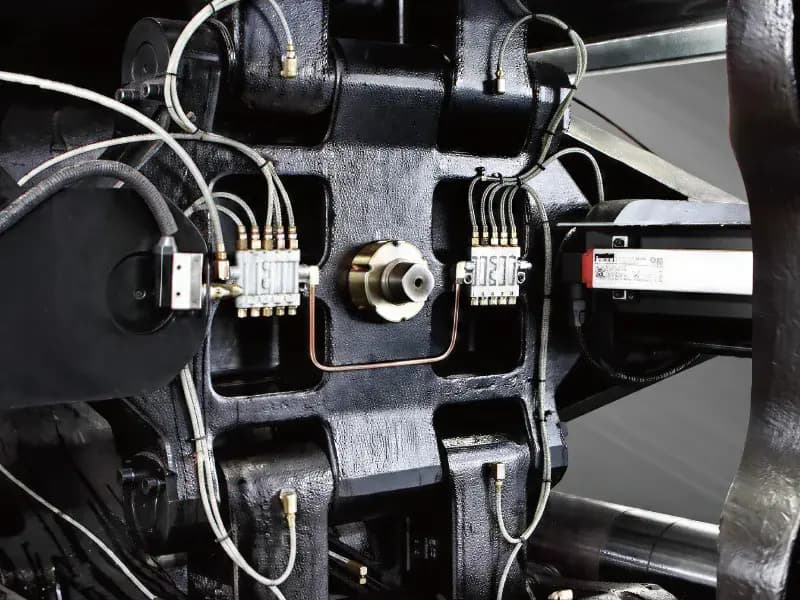
Toggle clamping unit — high rigidity for thin-wall molding
Corrective Actions for Warpage on Existing Production Molds
When warpage exceeds specification on an existing mold running on HWAMDA SPV5 machines, a systematic corrective approach saves time versus random parameter adjustment. Step 1: Measure the warpage pattern using a coordinate measuring machine (CMM) or flatness gauge -- determine whether warpage is bowl-shaped (concave or convex), saddle-shaped, or twisted, as each pattern points to a different root cause. Bowl-shaped warpage indicates core-to-cavity cooling imbalance -- measure coolant inlet and outlet temperatures on both mold halves and equalize to within 2 degrees C. Saddle-shaped warpage indicates differential shrinkage between flow and cross-flow directions -- adjust pack pressure profile to reduce orientation: lower injection speed by 10-15 percent and increase pack pressure by 5-10 MPa to compensate. Twisted warpage indicates gate position or runner balance issues on multi-cavity molds -- verify individual cavity weights and correct imbalances. Step 2: If process adjustments are insufficient, consider mold modifications: adding cooling channels (USD 2,000-5,000 per channel), modifying gate size (USD 1,000-3,000), or adding mold surface texture to the concave side (micro-texture increases friction, counteracting warpage tendency during cooling). Document all changes in the mold maintenance log.
Frequently Asked Questions
For a 70mm diameter yogurt cup with 0.5mm wall, acceptable rim flatness variation is plus or minus 0.15mm for automated filling line compatibility. Measure with a flatness gauge at 8 points around the rim, 24 hours after molding to account for post-mold shrinkage. HWAMDA SPV5 machines with uniform mold cooling and optimized pack pressure typically achieve plus or minus 0.10mm. Warpage exceeding 0.20mm causes filling line rejection.
Related Guides
Ready to Start Your Project?
Get a free consultation and quotation for your thin-wall packaging production line.
Join 500+ manufacturers in 60+ countries who trust HWAMDA.
Get Free Quote